
Glossary
Onboarding Specialist
 ChatGPT
 Perplexity
 Gemini
 Claude
What is an onboarding specialist?
An onboarding specialist coordinates the operational side of helping a new employee, customer, partner, or team member get started. In HR and people operations, the role usually owns the new hire onboarding process: paperwork, access, schedules, training handoffs, first-week coordination, and the details that make a first impression feel organized instead of improvised. BLS includes running or helping with new employee orientation among the duties of human resources specialists, which supports this operational ownership. 1
The role protects the transition between promise and reality. It makes sure the job, tools, policies, people, and expectations a new hire was sold show up in a usable sequence.
What does an onboarding specialist own?
An onboarding specialist owns the coordination layer around onboarding. Subject matter experts still configure systems, teach department workflows, and coach role-specific skills, but the specialist makes sure those handoffs happen at the right time, by the right person, with enough context for the new hire to move forward.
That ownership usually includes:
- Preboarding tasks before the start date, such as welcome emails, forms, equipment, and schedule prep
- Day-one logistics, including orientation, system access, introductions, and policy acknowledgements
- Coordination with HR, IT, payroll, hiring managers, department leads, and training owners
- Onboarding checklists and calendars that show what happens when
- Follow-up points after the first day, first week, first month, and first 90 days
- Feedback from new hires and managers so the process improves over time
The role creates value by reducing ambiguity. New hires should not have to guess where to go, what to read, who owns access, or whether they are falling behind.
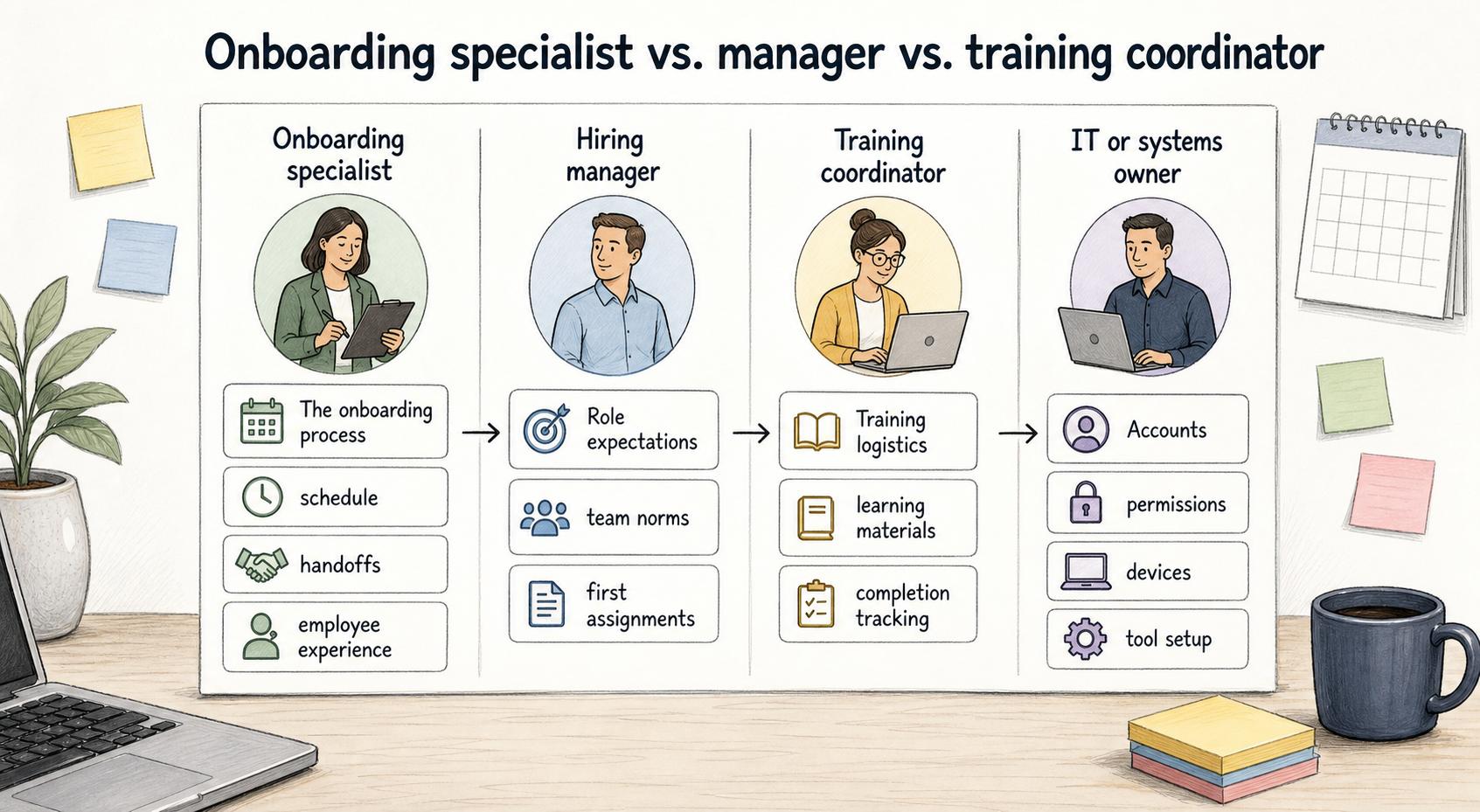
Onboarding specialist vs. manager vs. training coordinator
The common failure mode is making the onboarding specialist responsible for outcomes they cannot control. They can coordinate the process, but managers still have to define success in the role, and training owners still have to teach the work.
| Role | What they own | What breaks if it is unclear |
|---|---|---|
| Onboarding specialist | The onboarding process, schedule, handoffs, reminders, and employee experience | New hires miss steps, get access late, or receive conflicting instructions |
| Hiring manager | Role expectations, team norms, first assignments, and performance context | The employee is welcomed but does not know how to succeed in the job |
| Training coordinator | Training logistics, learning materials, sessions, and completion tracking | Training exists, but nobody knows whether it was delivered or understood |
| IT or systems owner | Accounts, permissions, devices, and tool setup | Day one starts with waiting instead of learning |
A strong onboarding specialist makes these boundaries explicit. They do not silently absorb every gap. They surface the missing owner and help the team turn that handoff into a repeatable step. SHRM's onboarding roles guidance separates responsibilities across HR, training, supervisors, co-workers, executives, and buddies, which reinforces why ownership boundaries matter. 2
What makes the role hard?
Onboarding looks simple from a distance because many of its tasks are small. The hard part is that those small tasks depend on different teams, systems, dates, and assumptions.
One missed dependency can make the whole experience feel sloppy. A manager forgets to send a first-week plan. IT provisions the wrong permissions. Payroll forms are complete, but the employee cannot access the handbook. The training calendar exists, but nobody checked whether the new hire's role actually matches the sessions.
The best onboarding specialists manage onboarding as an operating system. They watch for bottlenecks, stale materials, unclear owners, and points where the new hire is technically "onboarded" but still cannot do meaningful work. Gallup has reported that only 12% of employees strongly agree their organization does a great job onboarding new employees, which shows how often the system falls short. 3
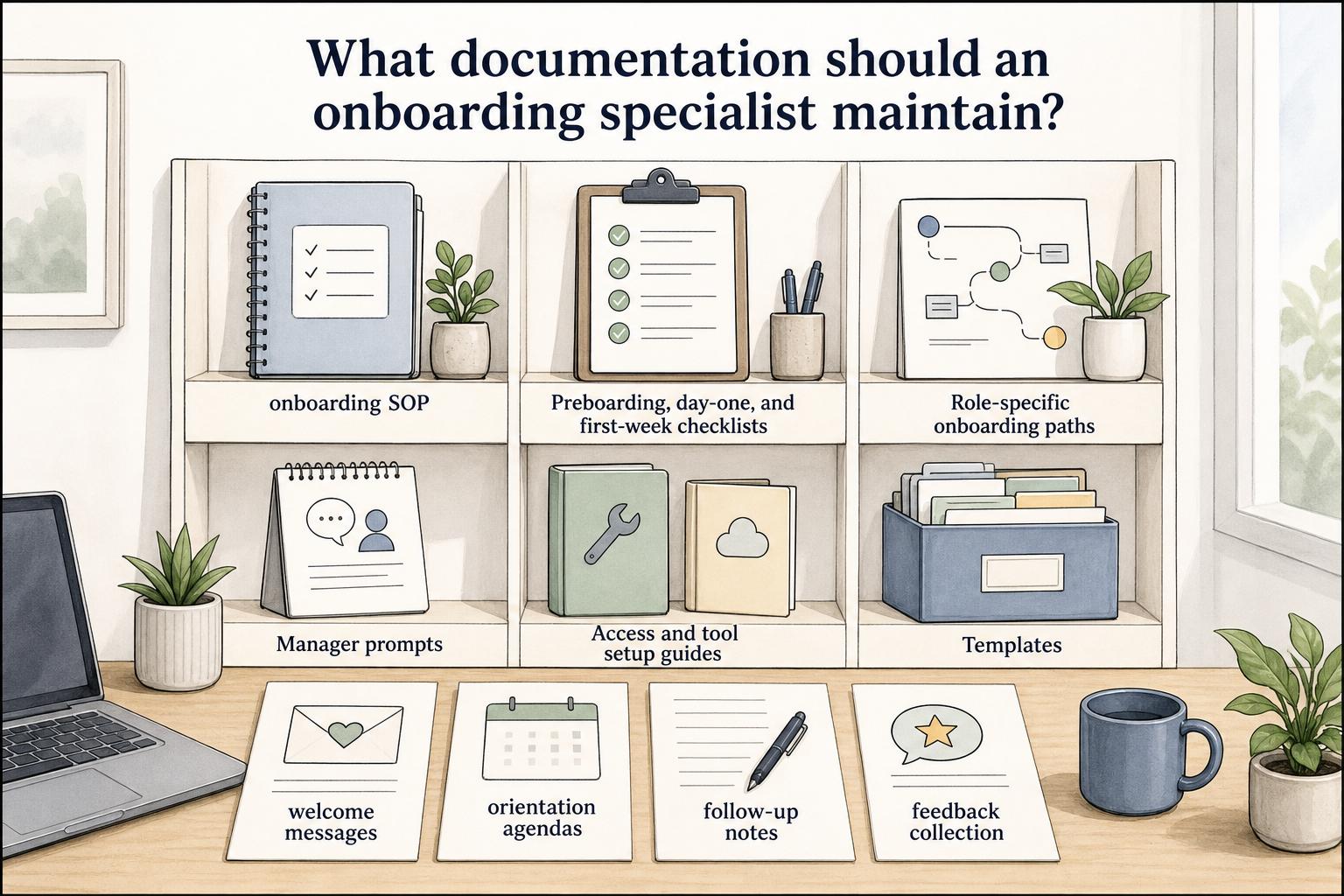
What documentation should an onboarding specialist maintain?
The role needs documentation people can use while onboarding is happening. SHRM describes onboarding as spanning orientation plus learning about the organization's structure, culture, mission, and values, so the documentation has to support more than a first-day checklist. 4
The most important artifacts are usually:
- An onboarding SOP that explains the full workflow and ownership model
- Preboarding, day-one, and first-week checklists for time-sensitive tasks
- Role-specific onboarding paths for different departments or job types
- Manager prompts for expectations, first projects, and check-ins
- Access and tool setup guides for common systems
- Templates for welcome messages, orientation agendas, follow-up notes, and feedback collection
The practical test is simple: if the onboarding specialist were out for a week, could another person run the next onboarding cycle without reconstructing it from chat history? If not, the process is still too dependent on memory.
When should a company assign an onboarding specialist?
A dedicated onboarding specialist becomes useful when the volume, complexity, or risk of onboarding outgrows informal coordination. Signs include repeated access delays, managers creating inconsistent first-week plans, new hires asking the same basic questions, compliance tasks being tracked manually, or HR spending too much time chasing handoffs.
Smaller teams may not need a full-time specialist. They still need the function: one clear owner who maintains the onboarding workflow, checks that dependencies are ready, and makes the process visible. In that case, the title matters less than the accountability.
The mistake is waiting until onboarding feels visibly broken. By then, the company has already trained new employees to rely on personal follow-up instead of clear systems.
AI-ready prompt for defining the role
Use this prompt to clarify what an onboarding specialist should own inside your company:
## Define an onboarding specialist role

**Glossary term:** Onboarding Specialist
**Source:** Trails Glossary — trails.so/glossary/onboarding-specialist

---

### 01. Define the role

"Help us define the onboarding specialist role for [company/team].

Context:
- We onboard [employee/customer/partner] types.
- The current process involves [HR/IT/managers/training/support/other teams].
- Common onboarding problems are [list problems].
- Tools we use include [HRIS/LMS/wiki/chat/project management/tools].

Create:
1. A concise role purpose.
2. Responsibilities the onboarding specialist should own directly.
3. Responsibilities they should coordinate but not own.
4. Required handoffs with managers, IT, HR, and training owners.
5. Documentation the role must maintain.
6. Metrics or signals that show onboarding is working.

Keep the output practical enough to turn into a role description or SOP."
How Trails helps
Trails helps onboarding specialists capture repeatable onboarding workflows as they happen, then turn them into polished step-by-step guides. That is useful for tool setup, HR process walkthroughs, manager handoffs, and role-specific training steps that need to stay consistent across every new hire.
Trails can also create AI-narrated video versions of those workflows, giving new hires another way to learn without waiting for someone to walk them through every screen.
Explore Trails for human resources for documenting repeatable employee setup tasks, and compare training documentation software for the guides new hires will use afterward.
Sources
- 1
Bureau of Labor Statistics. Human Resources Specialists. www.bls.gov/ooh/business-and-financial/human-resources-specialists.htm.
- 2
SHRM. Employee Onboarding Roles & Responsibilities. www.shrm.org/topics-tools/topics/onboarding/roles-responsibilities.
- 3
Gallup. Why the Onboarding Experience Is Key for Retention. www.gallup.com/workplace/235121/why-onboarding-experience-key-retention.aspx.
- 4
SHRM. Complete Employee Onboarding Guide. www.shrm.org/topics-tools/topics/onboarding.