
Glossary
New Hire Onboarding
 ChatGPT
 Perplexity
 Gemini
 Claude
What is new hire onboarding?
New hire onboarding is the coordinated process that moves a new employee from accepted offer to useful, connected work.1 It includes the administrative, technical, social, cultural, and role-specific steps that help someone understand where they work, who they work with, and how to begin contributing.
Good onboarding starts before day one and continues after orientation.2 It isn't paperwork, a welcome meeting, or a link list. It's a handoff-heavy workflow across HR, IT, the hiring manager, the new hire, and the team receiving them.
What new hire onboarding includes
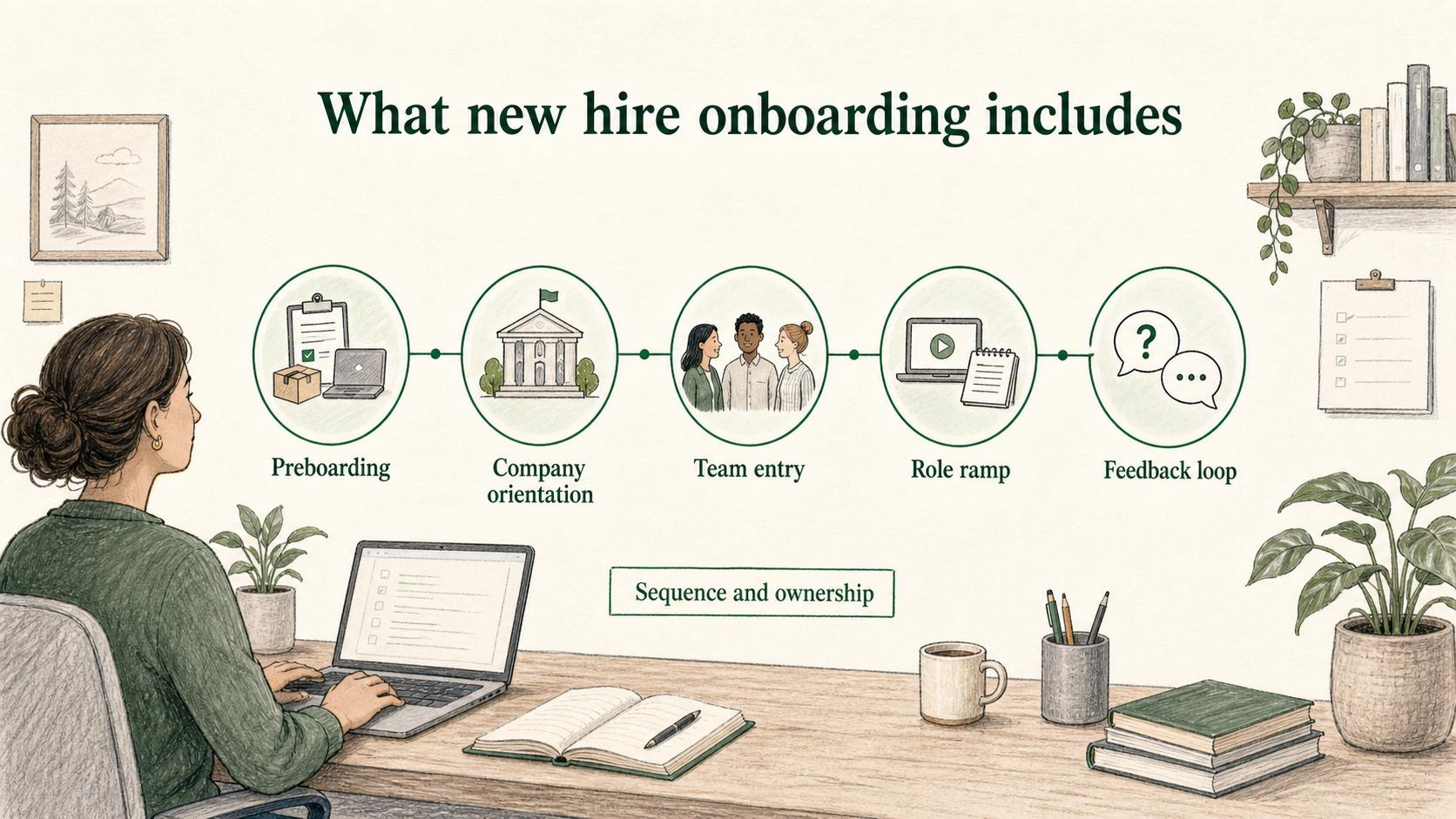
A complete onboarding process combines several kinds of work, but the value is in the sequence and ownership, not the length of the checklist.
Most onboarding plans need:
- Preboarding: Start-date communication, paperwork, equipment, access, and first-day expectations before the employee arrives.
- Company orientation: Policies, benefits, communication norms, culture, and where to get help.
- Team entry: Introductions, manager check-ins, team rituals, and a named person who can answer everyday questions.
- Role ramp: Role-specific training, SOPs, practice tasks, job aids, and early priorities.
- Feedback loop: A way to capture repeated questions, blocked steps, and gaps in the onboarding process while the experience is still fresh.
The mix changes by role. A remote employee may need sharper async setup instructions. A frontline employee may need safety training and shift-specific practice. A manager may need people operations workflows, reporting expectations, and decision rights.
Onboarding is a handoff process
New hire onboarding often fails because each team finishes its own checklist without seeing the whole employee journey. HR may complete paperwork. IT may ship equipment. The manager may schedule team meetings. But if those handoffs don't line up, the new hire experiences the process as gaps.
| Onboarding area | Usual owner | What breaks when it is unclear |
|---|---|---|
| Employment setup | HR or People Ops | Paperwork, payroll, policy, or benefits confusion |
| Tool access | IT or Operations | The employee cannot complete training or first tasks |
| Role expectations | Hiring manager | The new hire does not know what matters first |
| Team connection | Manager and team | The employee has meetings but no real support network |
| Process training | Manager, trainer, or enablement | The employee hears advice but cannot repeat the workflow |
A strong onboarding process makes each handoff visible: owner, timing, resource, blocker, and completion signal. Connection needs the same ownership. Microsoft research on onboarding buddies supports the value of visible team support during onboarding.3
Onboarding vs training vs orientation
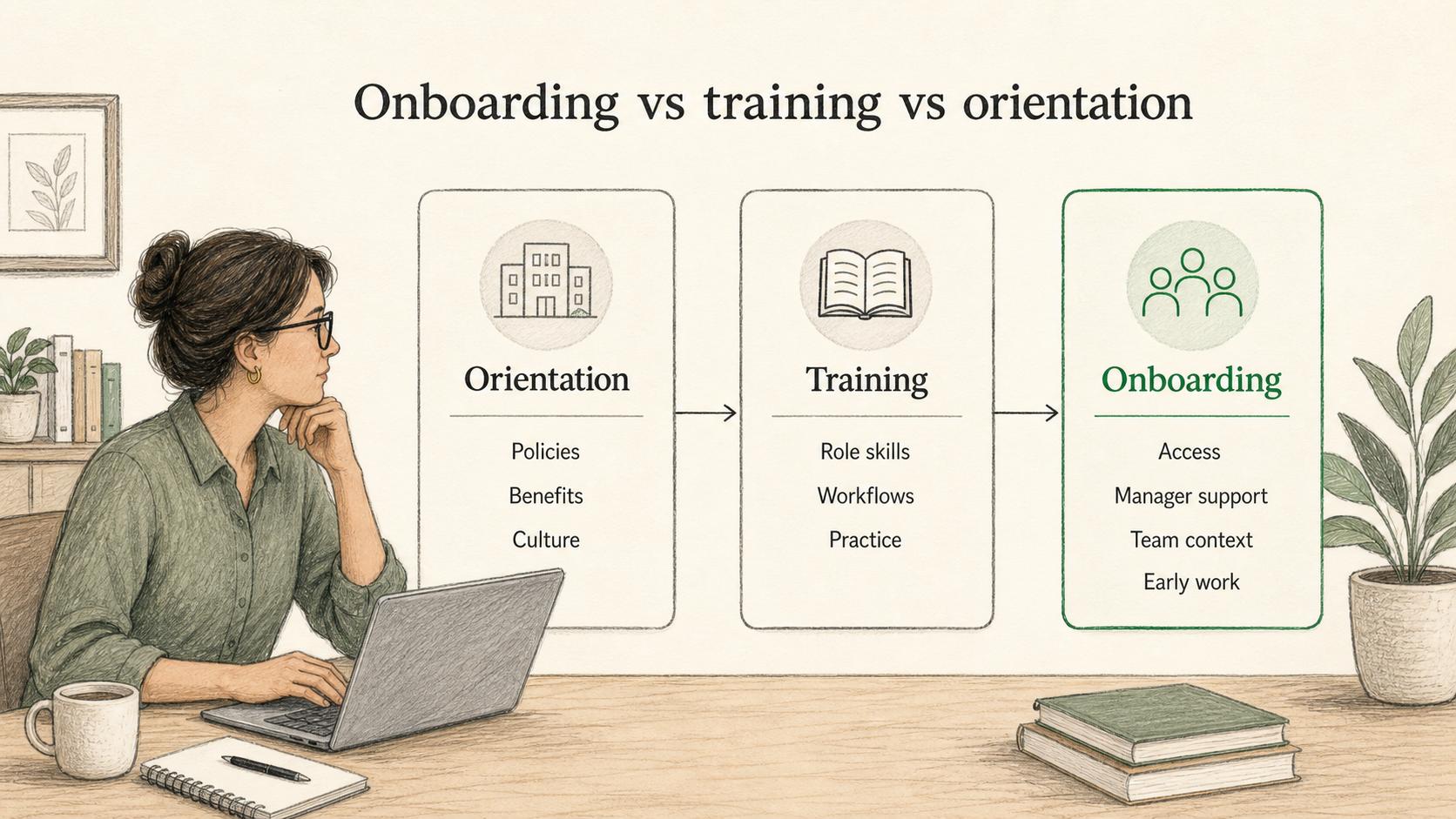
Onboarding, training, and orientation are related, but they don't solve the same problem.
Orientation introduces company-wide basics: policies, benefits, culture, communication norms, and where to find help. Training teaches the new hire how to perform the role. Onboarding connects both to systems access, manager support, team context, and early work.
This distinction matters because a company can have a polished orientation and still poor onboarding. A new hire may attend a friendly day-one session, then spend the next week blocked by missing permissions, unclear priorities, or outdated role documentation.
A practical onboarding timeline
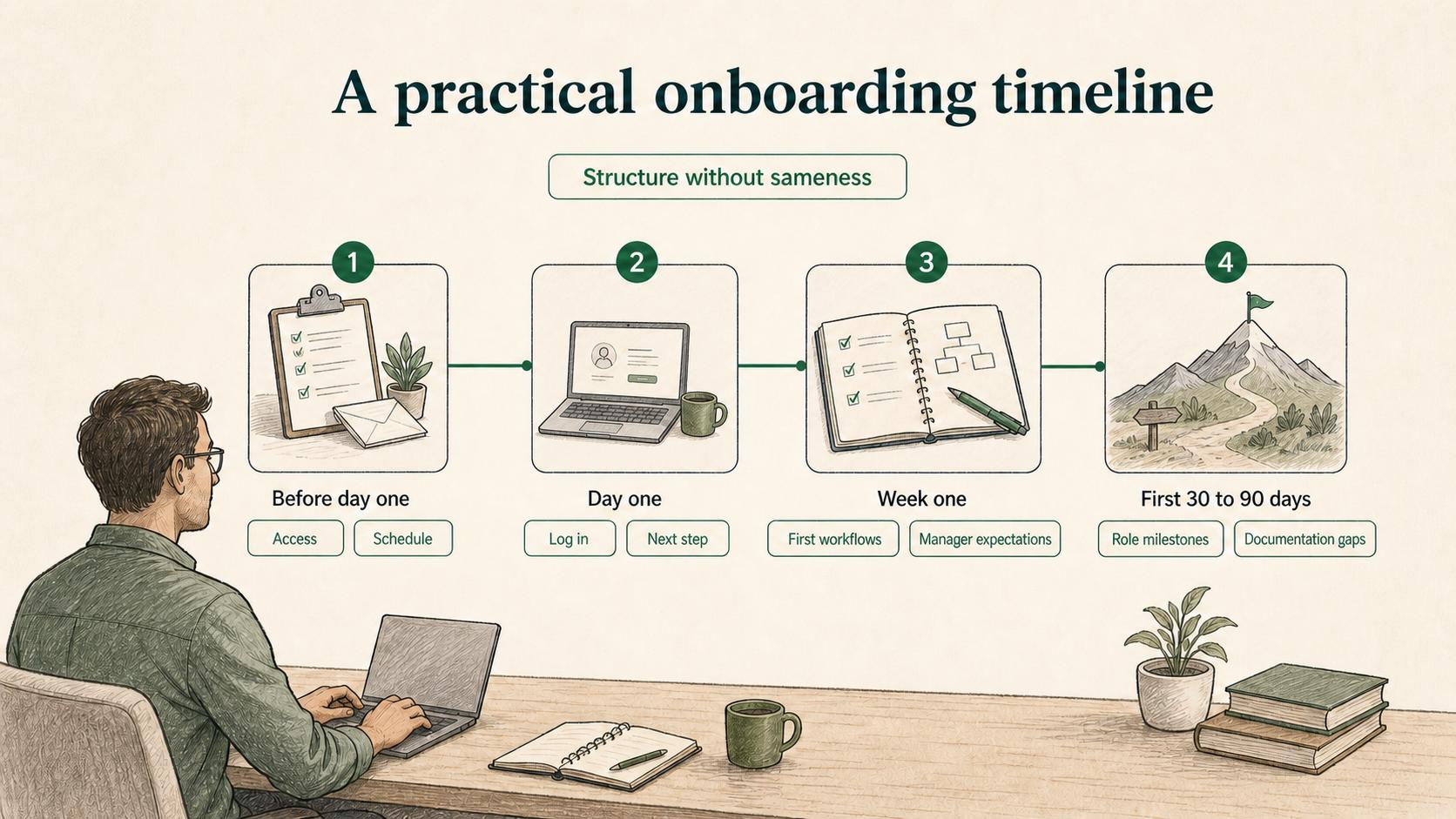
A useful onboarding timeline gives structure without pretending every role is identical.
Before day one: Confirm start date, manager, location or remote setup, equipment, system access, paperwork, and first-day schedule. Give the manager a readiness checklist, not just a calendar invite.
Day one: Make sure the employee can log in, knows where to ask questions, meets key people, understands the day, and leaves with a clear next step. Day one should orient the person, not bury them under every policy the company has ever written.
Week one: Connect company context to role context. Review the onboarding portal, required training, first workflows, team rituals, and manager expectations. Assign low-risk first tasks so learning has somewhere to land.
First 30 to 90 days: Move from guided learning to independent contribution.4 Add deeper role training, review progress against milestones, capture repeated questions, and update documentation where the onboarding process exposed gaps.
Common onboarding mistakes
The quiet failure mode in onboarding is mistaking activity for clarity. A calendar full of meetings can still leave a new employee unsure what matters first.
Watch for these patterns:
- HR, IT, and manager checklists that never reconcile into one employee-facing journey
- Access or equipment gaps discovered on day one
- Long link lists without priority, sequence, or owner
- Role-specific workflows left in a trainer's memory
- Orientation treated as the whole onboarding process
- Feedback collected too late to fix the process for the next hire
The fix isn't necessarily a bigger onboarding program. It's a clearer operating system for the first few weeks.
AI-ready onboarding process prompt
Use this prompt to draft a repeatable onboarding workflow:
## New Hire Onboarding Process Prompt

**Glossary term:** New Hire Onboarding
**Source:** Trails Glossary — trails.so/glossary/new-hire-onboarding

---

### 01. Draft a repeatable onboarding workflow

"Create a new hire onboarding process for [role] at [company/team]. Include preboarding, day one, week one, and first 30 days. For each phase, list the task, owner, timing, required resource or SOP, completion signal, and likely blocker. Separate company-wide orientation from role-specific training."
How Trails helps
Trails helps teams document the practical parts of onboarding: account setup, internal workflows, SOPs, screenshots, process walkthroughs, and role-specific instructions. A team can capture a workflow as someone performs it, turn it into a step-by-step guide, and create an AI-narrated video version for training or sharing.
That makes onboarding less dependent on memory and more repeatable across managers, cohorts, and locations.
Sources
- 1
Society for Human Resource Management. Complete Employee Onboarding Guide. www.shrm.org/topics-tools/topics/onboarding. Accessed July 24, 2026.
- 2
Gallup. Employee Experience and Workplace Culture. www.gallup.com/workplace/323573/employee-experience-and-workplace-culture.aspx. Accessed July 24, 2026.
- 3
Microsoft. Every New Employee Needs an Onboarding Buddy. techcommunity.microsoft.com/blog/viva_insights_blog/every-new-employee-needs-an-onboarding-buddy/3862435. Accessed July 24, 2026.
- 4
Society for Human Resource Management. Measuring Onboarding Success. www.shrm.org/topics-tools/topics/onboarding/measuring-success. Accessed July 24, 2026.