
Glossary
Training Coordinator
 ChatGPT
 Perplexity
 Gemini
 Claude
What is a training coordinator?
A training coordinator keeps a training program operational. They organize schedules, records, communications, materials, enrollments, and logistics so employees know what to take, when to show up, and what happens afterward.1
The role may not own the full training strategy, but it often decides whether that strategy feels clear or chaotic to learners.
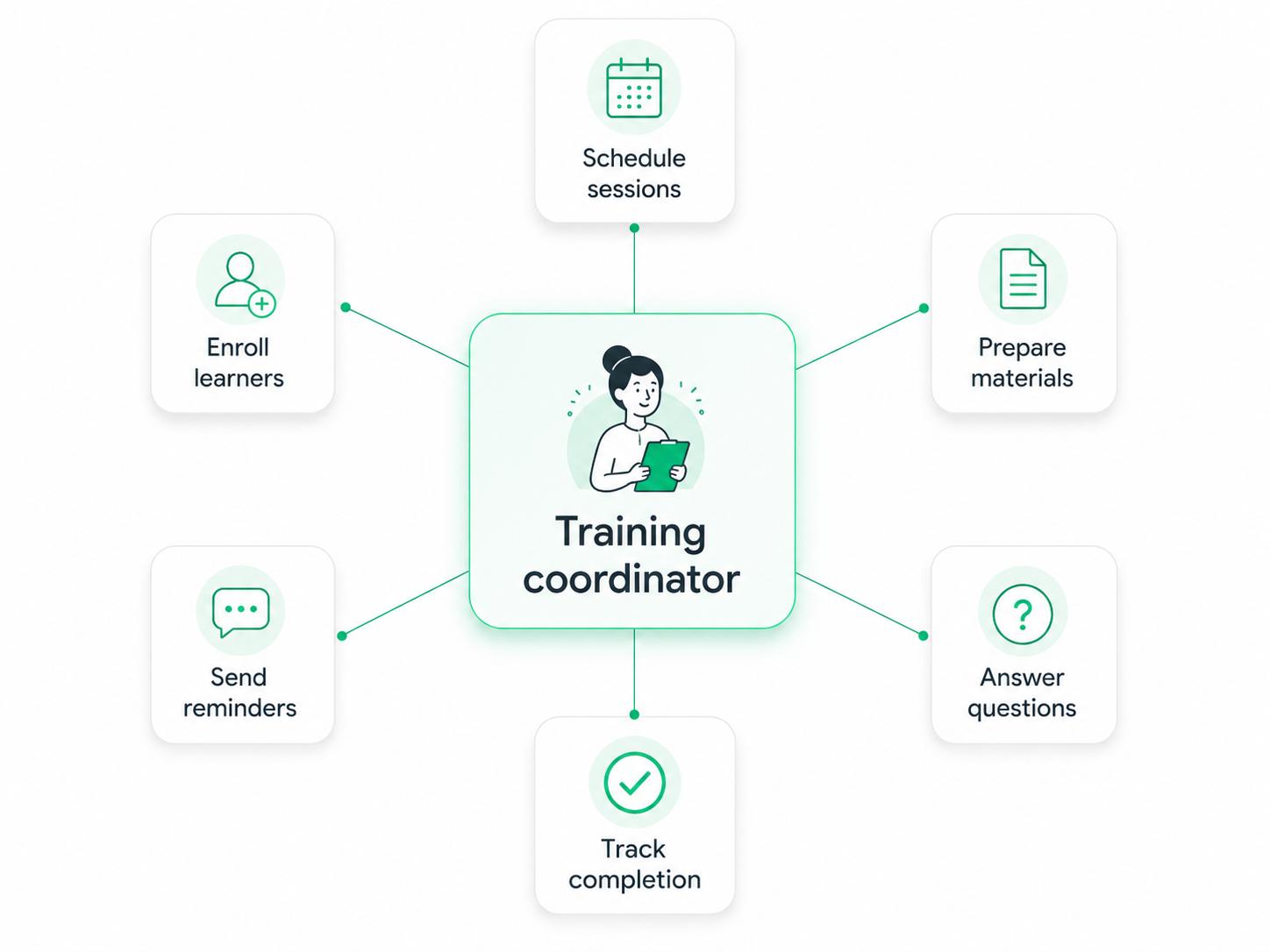
What a training coordinator does
Training coordinators handle the execution layer of training. They schedule sessions, enroll employees, prepare materials, send reminders, track attendance, update completion records, coordinate instructors, and answer learner questions.2
The work matters most when training crosses teams or repeats often: onboarding cohorts, compliance refreshers, platform rollouts, customer support training, enablement programs, or instructor-led sessions with multiple calendars. A strong coordinator turns those moving parts into a predictable learner experience.
In a smaller company, the coordinator may also create materials or maintain process documentation. In a larger organization, they usually work with a training manager, HR team, learning and development group, operations leader, or enablement function.
Training coordinator responsibilities
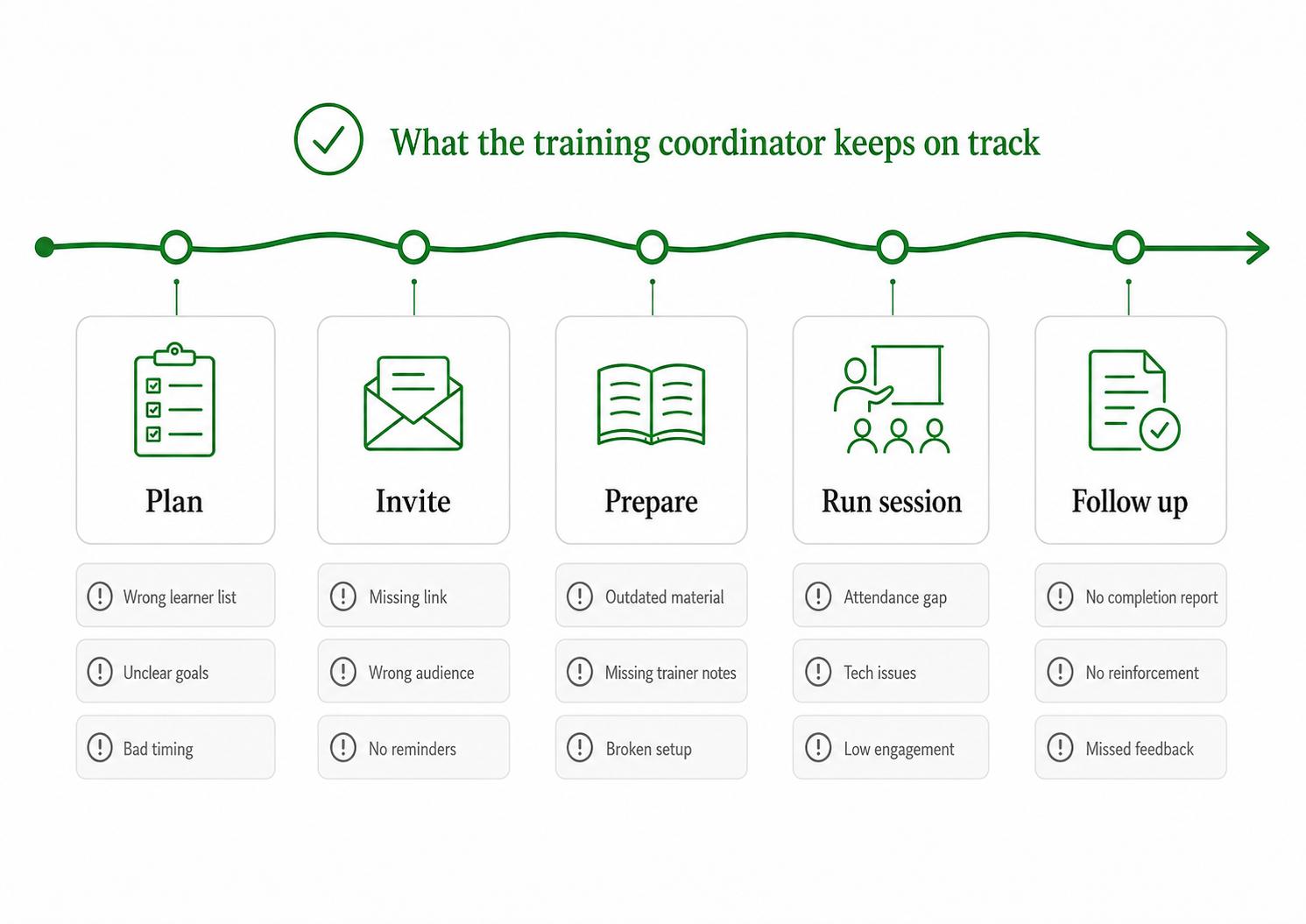
The responsibilities are detail-heavy because training breaks in small places: a missing link, an outdated checklist, a late reminder, a manager who does not know what to follow up on.
Useful responsibilities to define clearly include:
- Session logistics: Confirm dates, links, rooms, instructors, prerequisites, and learner availability before the launch rush.
- Learner communication: Send clear reminders and follow-ups, and keep naming consistent across invites, platforms, guides, and assessments.
- Records and reporting: Track attendance, completion, assessment results, exceptions, and missing work in a system people trust.
- Materials readiness: Prepare manuals, guides, checklists, exercises, platform links, and access instructions before learners need them.
- Issue capture: Notice where learners get stuck and turn repeated questions into better instructions for the next cohort.
The value of the role is consistency. Learners should not have to guess where to go, what to complete, which link to use, or who owns the next step.
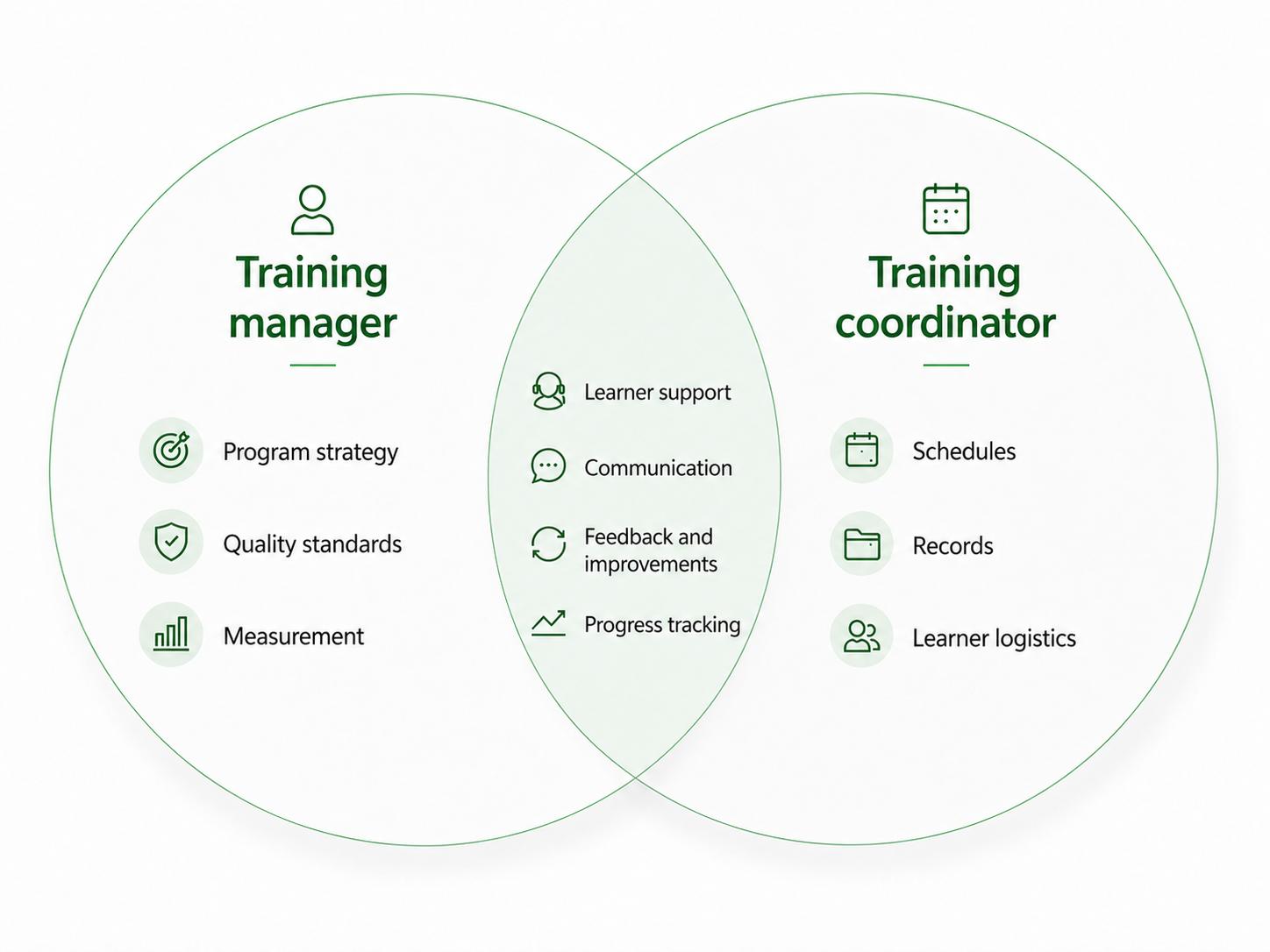
Training coordinator vs. training manager
A training manager usually owns strategy: program design, stakeholder alignment, quality standards, and measurement. A training coordinator usually owns execution: the schedule, records, communications, materials, and logistics that make the program real.
The roles can overlap. A coordinator may notice that learners keep asking the same question and recommend a documentation update. A manager may step into logistics for a high-priority launch. The distinction still matters because training fails when strategy and operations are both assumed and neither is clearly owned.
Skills training coordinators need
Training coordinators need organization, communication, follow-through, and enough program context to route questions without becoming a bottleneck.
The most useful skills are practical rather than flashy:
- Calendar and scheduling discipline.
- Training platform administration.
- Learner communication.
- Recordkeeping and completion tracking.
- Reporting and basic data cleanup.
- Materials preparation.
- Stakeholder coordination.
- Process documentation.
- Problem solving under time pressure.
The underrated skill is pattern recognition. If ten learners ask the same question, the coordinator may be the first person to see that the invite, guide, platform setup, or training path needs to change.
Common mistakes
The first mistake is treating the coordinator as purely administrative. Logistics matter, but coordinators often see friction before program owners do. Their feedback can reveal unclear instructions, outdated materials, broken access, or unrealistic timing.
The second mistake is relying on manual tracking for too long. A spreadsheet can work at first, but recurring training needs durable records, reminders, ownership, and reporting. Otherwise the coordinator becomes the system.
The third mistake is giving learners too many disconnected instructions. If the calendar invite, training platform, manual, checklist, and assessment all use different names or live in different places, the coordinator becomes a human search engine.
Training coordinator launch checklist
Before a training launch, use the checklist to look for failure points rather than to prove every box is filled:
- The learner list, enrollment path, and audience rules are final.
- Dates, times, links, locations, instructors, and backup plans are confirmed.
- Prerequisites, access requirements, and materials are current and easy to find.
- Reminders, follow-ups, completion tracking, and manager reports are ready.
- Missed sessions, late completions, learner questions, and improvement notes have an owner.3
That last point turns coordination into improvement. If every launch problem disappears into private messages, the program repeats the same friction.
Documentation takeaway
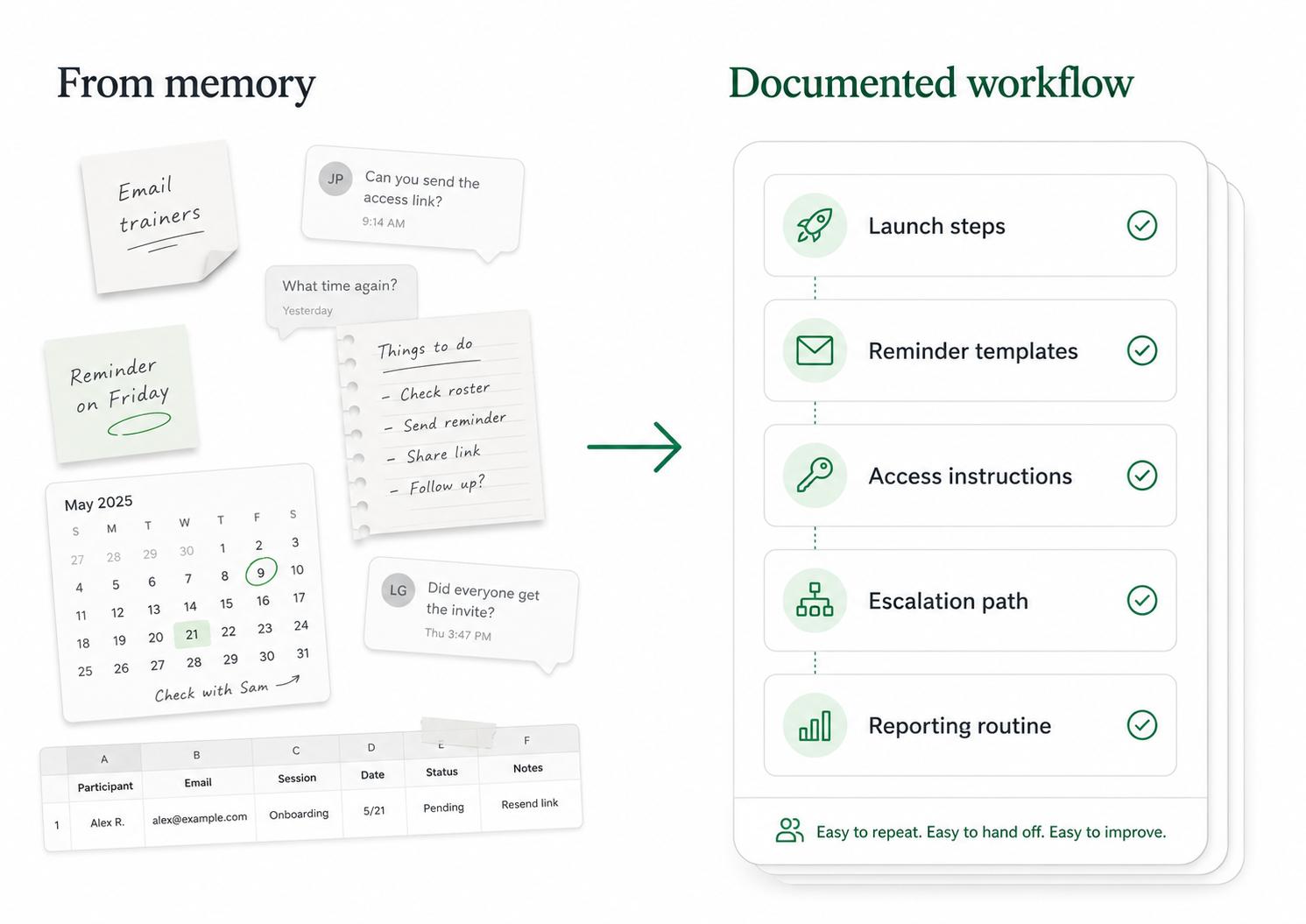
Training coordination gets easier when the coordination workflow is documented. Coordinators should not have to rebuild launch steps, reminder templates, access instructions, escalation paths, and reporting routines from memory each time.4
A documented workflow makes recurring programs more consistent and makes the role easier to hand off when someone is out, promoted, or replaced.
How Trails helps
Trails helps teams document recurring training operations. A coordinator or trainer can capture a workflow as they perform it, turn that capture into a polished step-by-step guide, and create an AI-narrated video version for training or sharing. That is useful for repeatable work like setting up a new hire cohort, assigning courses, sending reminders, preparing materials, or updating completion reports.
- Training manager
- New hire training
- Skills training
- Training materials
- Training platform
- Training manual
- Onboarding specialist
- Training SOP
Sources
- 1
O*NET. Training and Development Specialists. O*NET OnLine. www.onetonline.org/link/summary/13-1151.00. Accessed July 1, 2026.
- 2
Bureau of Labor Statistics. Training and Development Specialists. Occupational Outlook Handbook. www.bls.gov/ooh/business-and-financial/training-and-development-specialists.htm. Accessed July 1, 2026.
- 3
Centers for Disease Control and Prevention. Building a Training Evaluation Plan. CDC. www.cdc.gov/training-development/php/about/evaluate-training-building-an-evaluation-plan.html. Accessed July 1, 2026.
- 4
Centers for Disease Control and Prevention. Quality Training Standards. CDC. www.cdc.gov/training-development/php/qts/index.html. Accessed July 1, 2026.