
Glossary
Onboarding SOP
 ChatGPT
 Perplexity
 Gemini
 Claude
What is an onboarding SOP?
An onboarding SOP is a standard operating procedure for running onboarding the same way every time. For employee onboarding, it defines the steps, owners, timing, tools, handoffs, and exceptions that move a new hire from accepted offer to productive team member. SHRM describes onboarding as the process of integrating new employees into an organization, including orientation and learning about structure, culture, mission, and values. 1
Its job is to remove preventable confusion. A useful onboarding SOP gives HR, IT, managers, payroll, and training owners a shared operating plan so the new hire does not have to absorb the company's coordination gaps.
What belongs in an onboarding SOP?
An onboarding SOP should document the repeatable process behind onboarding, not every piece of content a new hire will read. Treat it as the backstage instructions for the team running the process.
Include the parts that determine whether onboarding actually happens on time:
- Scope: employee types, departments, locations, and time period covered
- Process owner and backup owner
- Required handoffs between recruiting, HR, IT, payroll, the hiring manager, and training owners
- Preboarding, day-one, first-week, and first-30-day milestones
- Required forms, policies, training, access setup, and role-specific materials
- Exceptions for remote roles, regulated work, internal transfers, or unusual start dates
- Escalation paths for late equipment, missing forms, unavailable managers, or blocked access
- Review cadence and update triggers
The strongest SOPs name the moment where responsibility moves from one person to another. Most onboarding failures happen in the handoff, not inside the task itself. SHRM's onboarding roles guidance separates responsibilities across HR, training, supervisors, co-workers, executives, and orientation buddies, which is why an SOP should make handoffs explicit. 2
Onboarding SOP vs. onboarding checklist vs. onboarding portal
These terms are often used together, but they solve different problems.
| Artifact | Primary job | What it should answer |
|---|---|---|
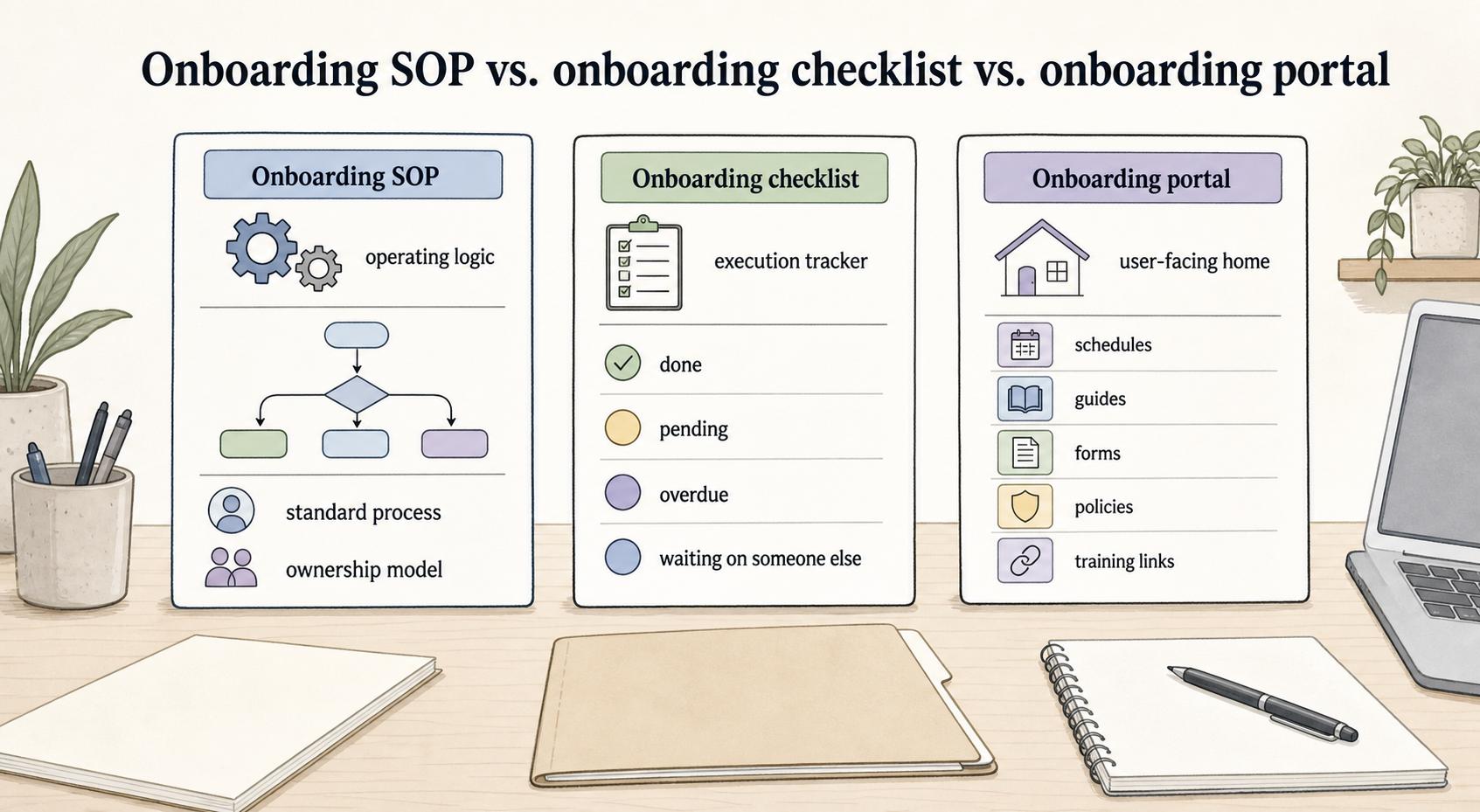
| Onboarding SOP | Explain the standard process and ownership model | How should onboarding run, who owns each step, and what happens when something is blocked? |
| Onboarding checklist | Track completion for a specific new hire | What tasks are done, pending, overdue, or waiting on someone else? |
| Onboarding portal | Give new hires and managers one place to find onboarding materials | Where do I go for schedules, guides, forms, policies, and training links? |
The SOP is the operating logic. The checklist is the execution tracker. The portal is the user-facing home. When teams confuse these, a checklist gets overloaded with explanations or a portal becomes a pile of links with no process behind it.
A practical onboarding SOP structure
A lean onboarding SOP should be specific enough to run from, but short enough that the owner will keep it current.
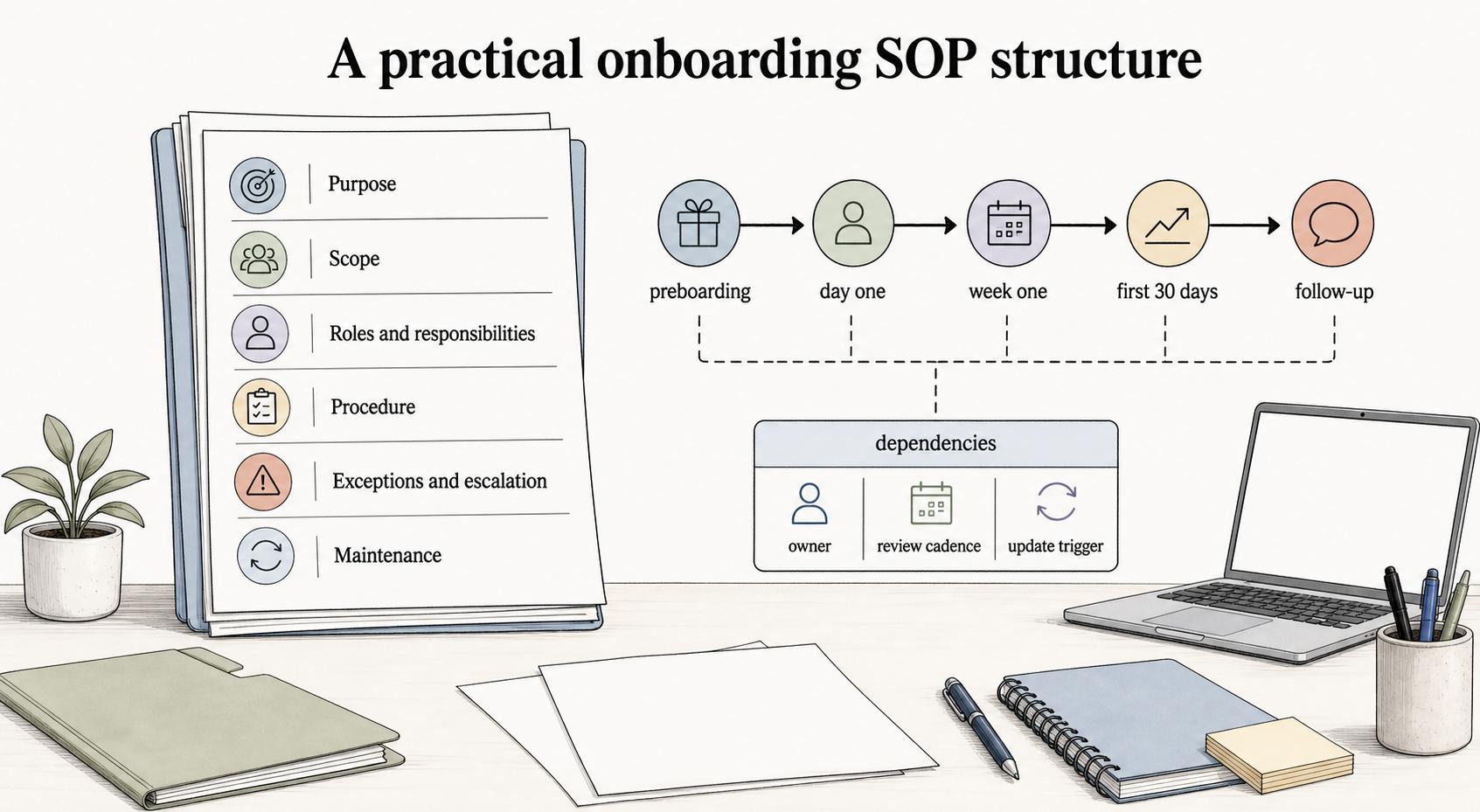
1. Purpose
State the outcome in operational terms. Instead of "create a great experience," use something concrete: "Ensure every new hire has required access, context, training, and manager alignment before their first independent work milestone."
2. Scope
Clarify what the SOP covers and what it does not. For example, it may cover full-time employee onboarding from signed offer through the first 30 days, while contractors or executives follow a modified process.
3. Roles and responsibilities
Name each owner. HR might coordinate the process. IT might own accounts and equipment. The hiring manager might own role expectations and first assignments. Payroll might own tax and payment setup.
4. Procedure
Break the process into timed phases: preboarding, day one, week one, first 30 days, and follow-up. Include dependencies, not just tasks. If IT cannot create an account without a manager-submitted form, that belongs in the SOP. SHRM identifies preboarding, orientation, foundation-building, and mentoring or buddy systems as integral onboarding process components. 3
5. Exceptions and escalation
Document what happens when equipment is late, a start date changes, a required form is missing, or a manager is unavailable. This is where an SOP becomes useful instead of decorative. Gallup reports that employees are 3.4 times as likely to feel their onboarding was successful when managers take an active role, so manager-dependent steps should be explicit. 4
6. Maintenance
Assign an owner, review cadence, and update trigger. Tool changes, policy changes, repeated questions, and missed handoffs should all trigger an SOP review.
Common mistakes
The most common onboarding SOP mistake is writing a policy when the team needs a workflow. A policy might say that new hires must complete security training. The SOP should explain who assigns it, when it is due, where completion is tracked, and what happens if it is not done.
Watch for these failure modes:
- No backup owner when the onboarding specialist is out
- Steps tied to one tool without explaining the underlying responsibility
- Manager tasks hidden inside HR-owned checklists
- No distinction between required onboarding and role-specific onboarding
- No exception path for remote hires, internal transfers, or delayed start dates
- Review dates that are not tied to feedback, missed handoffs, or repeated questions
A competent team can guess that onboarding should include forms, training, and introductions. The SOP earns its place by explaining sequence, ownership, and consequences.
AI-ready onboarding SOP template
Use this prompt to create a first draft of an onboarding SOP you can refine with the actual team owners:
## Onboarding SOP template

**Glossary term:** Onboarding SOP
**Source:** Trails Glossary — trails.so/glossary/onboarding-sop

---

### 01. Create an onboarding SOP

"Create an onboarding SOP for [team/company] covering [employee type: full-time, contractor, remote, role-specific group].

Context:
- Process owner: [owner]
- Teams involved: [HR, IT, payroll, manager, training, compliance, other]
- Tools used: [HRIS, LMS, wiki, checklist tool, chat, email, project management]
- Timeline covered: [signed offer to day 30/day 60/day 90]
- Known onboarding problems: [late access, unclear manager tasks, missing forms, inconsistent training, etc.]

Include:
1. Purpose and scope.
2. Role and responsibility table.
3. Step-by-step procedure by phase: preboarding, day one, week one, first 30 days.
4. Handoffs and dependencies between teams.
5. Exception paths for delays or missing information.
6. Required documentation and templates.
7. Review cadence and owner.

Write it as an operational SOP, not a welcome guide for the new hire."
How Trails helps
Trails helps teams capture onboarding workflows while someone performs them, then turn those workflows into polished step-by-step guides. That is especially useful for SOP steps that happen inside software: creating accounts, setting permissions, preparing a workspace, assigning training, or updating an HR system.
For onboarding SOPs, Trails helps teams compare the process they think they run with the process people actually follow. The result is a more practical, visual SOP that is easier to update as tools and roles change.
Compare SOP software for maintaining the onboarding procedures, or explore Trails for human resources for the account setup, employee records, and handoff workflows behind them.
Sources
- 1
SHRM. Complete Employee Onboarding Guide. www.shrm.org/topics-tools/topics/onboarding.
- 2
SHRM. Employee Onboarding Roles & Responsibilities. www.shrm.org/topics-tools/topics/onboarding/roles-responsibilities.
- 3
SHRM. Onboarding Process. www.shrm.org/topics-tools/topics/onboarding/process.
- 4
Gallup. Essential Ingredients for an Effective Onboarding Program. www.gallup.com/workplace/246242/essential-ingredients-effective-onboarding-program.aspx.