
Glossary
Employee Onboarding
 ChatGPT
 Perplexity
 Gemini
 Claude
What is employee onboarding?
Employee onboarding is the structured process that helps a new hire become prepared, connected, and productive in their role. It includes practical setup, role training, relationship building, cultural context, and early feedback, turning a signed offer into a person who can do the job with confidence.
Orientation introduces the company. Employee onboarding carries the person from acceptance through their first weeks or months of real work.
Why employee onboarding matters
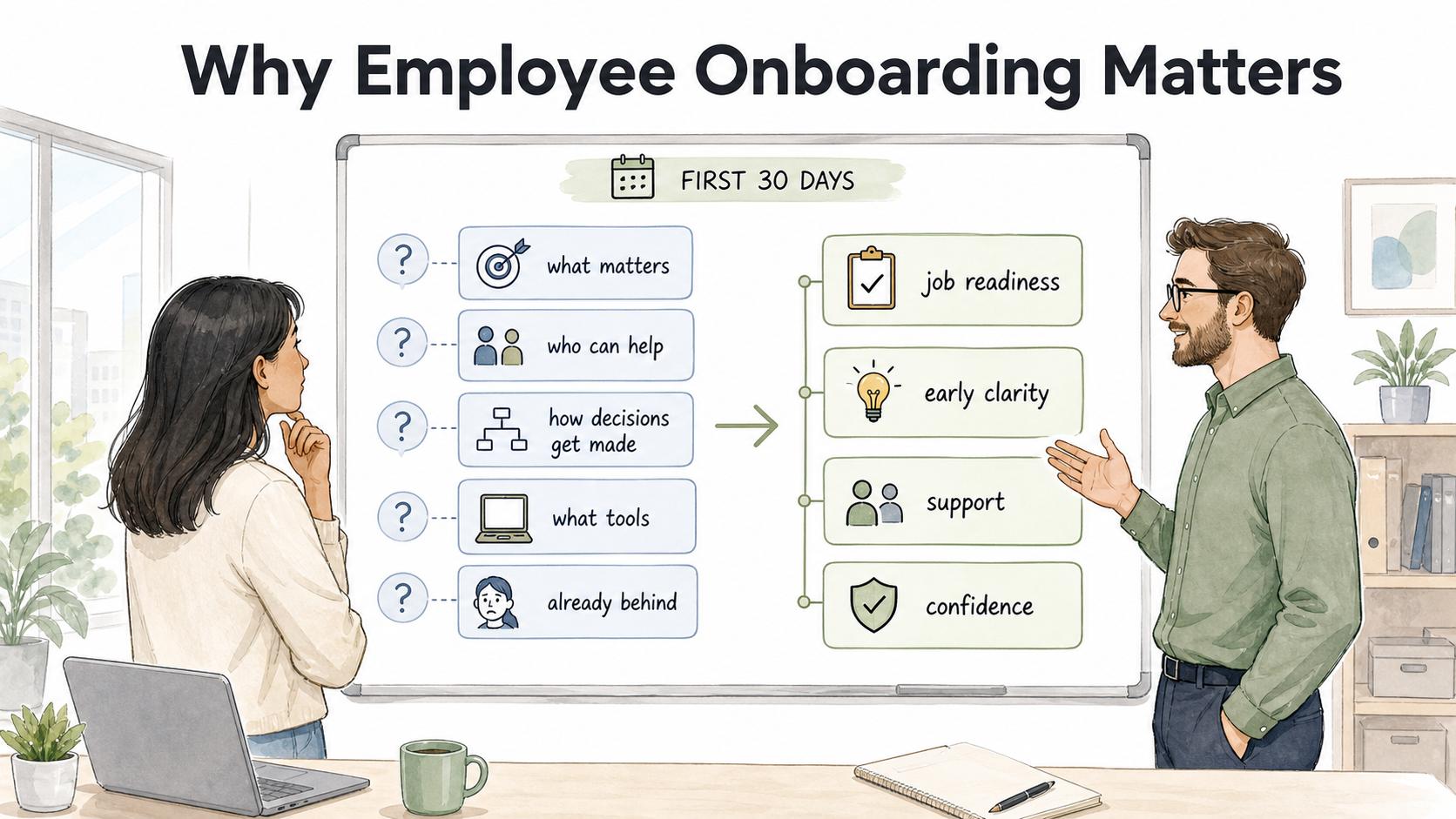
A new hire is making dozens of small judgments in their first days: what matters here, who can help me, how decisions get made, what tools I should use, and whether I am already behind. Gallup has found that only 12% of employees strongly agree their organization does a great job onboarding new employees, which shows how often those early questions go unanswered. 1 Good onboarding answers them before uncertainty turns into bad habits.
The common mistake is treating onboarding as an HR checklist. Tax forms, equipment, policy acknowledgements, and system access are necessary, but they don't teach someone how to succeed in a specific role. SHRM's onboarding guidance reports that only 29% of new hires felt prepared and supported to excel in their new role, which is the gap role-specific onboarding should close. 2 A strong onboarding process connects administration with job readiness: the person knows what to do, why it matters, how quality is measured, and where to find help.
For managers, onboarding is also a risk-control system. If the first 30 days are vague, the team pays for it later through repeated questions, uneven performance, rework, and avoidable turnover. SHRM's onboarding research summary emphasizes that new hires get roughly 90 days to prove themselves in a role, which makes early clarity a management responsibility. 3 The best onboarding programs make the invisible parts of the job explicit early.
What employee onboarding includes
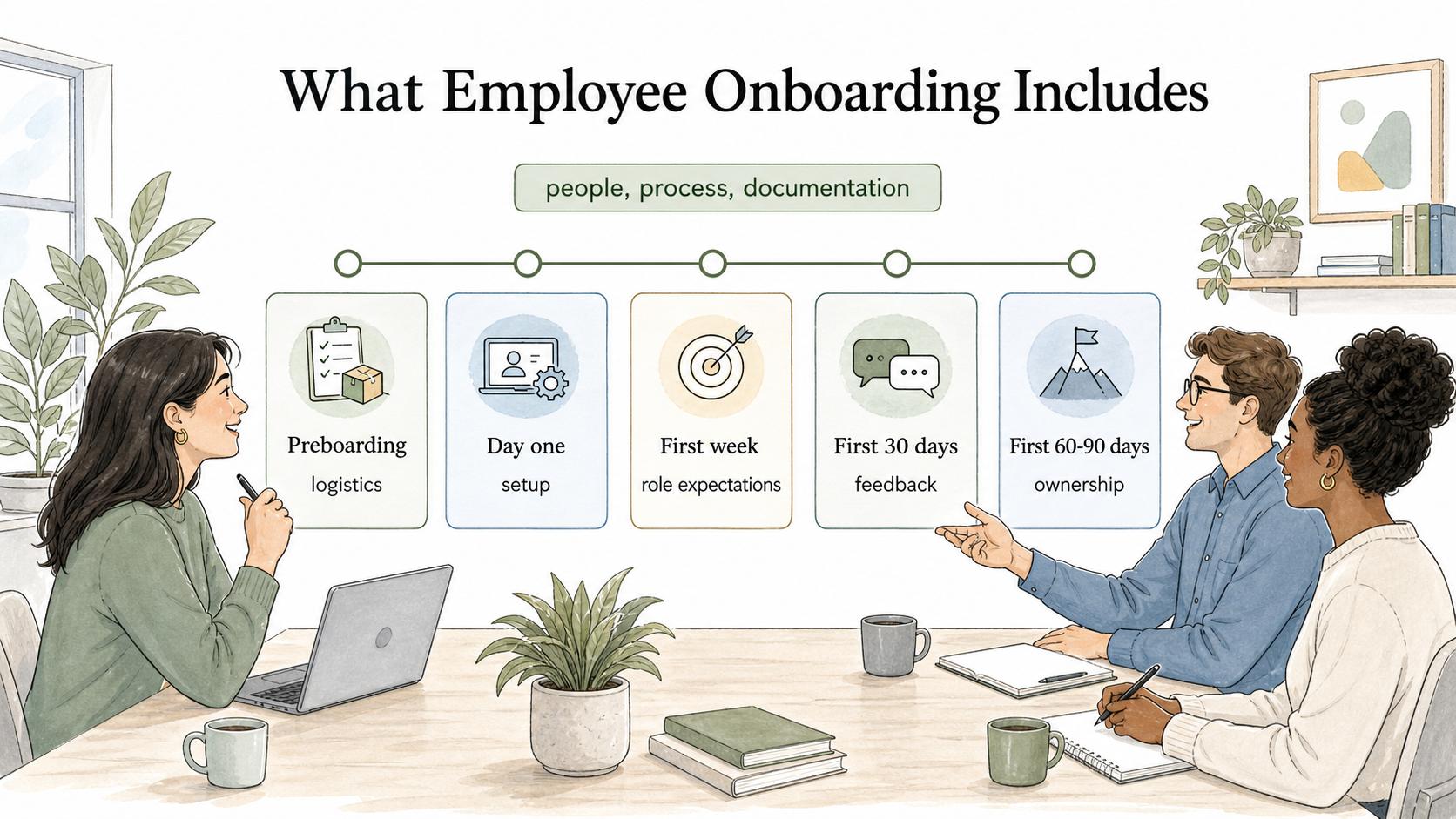
Employee onboarding usually combines people, process, and documentation:
| Stage | What the new hire needs | What tends to go wrong |
|---|---|---|
| Preboarding | Logistics, schedule, access plan, welcome context | The person starts with missing tools or no idea what day one looks like |
| Day one | Orientation, introductions, setup, first useful win | The day is packed with information but no clear next action |
| First week | Role expectations, core workflows, manager rhythm | The new hire shadows passively without practicing the work |
| First 30 days | Training path, feedback, early performance signals | The manager waits too long to correct misunderstandings |
| First 60-90 days | Increasing ownership, deeper context, development goals | Onboarding quietly ends before the person is fully independent |
The stages can be lightweight. What matters is intent: a clear checklist, a few role-specific guides, and a manager who knows what success should look like by week one, month one, and quarter one.
Employee onboarding vs employee orientation
Employee orientation is usually a short introduction to the company, policies, benefits, values, and administrative basics. Employee onboarding is the broader ramp into the role and team.
The distinction matters because orientation can be completed in a day, but onboarding cannot. A new support rep, operations coordinator, or account manager may understand the company after orientation and still be unable to handle the actual workflow without guidance.
A useful rule: orientation answers "Where am I and what do I need to know about the company?" Onboarding answers "How do I become effective in this role?"
What strong onboarding gets right
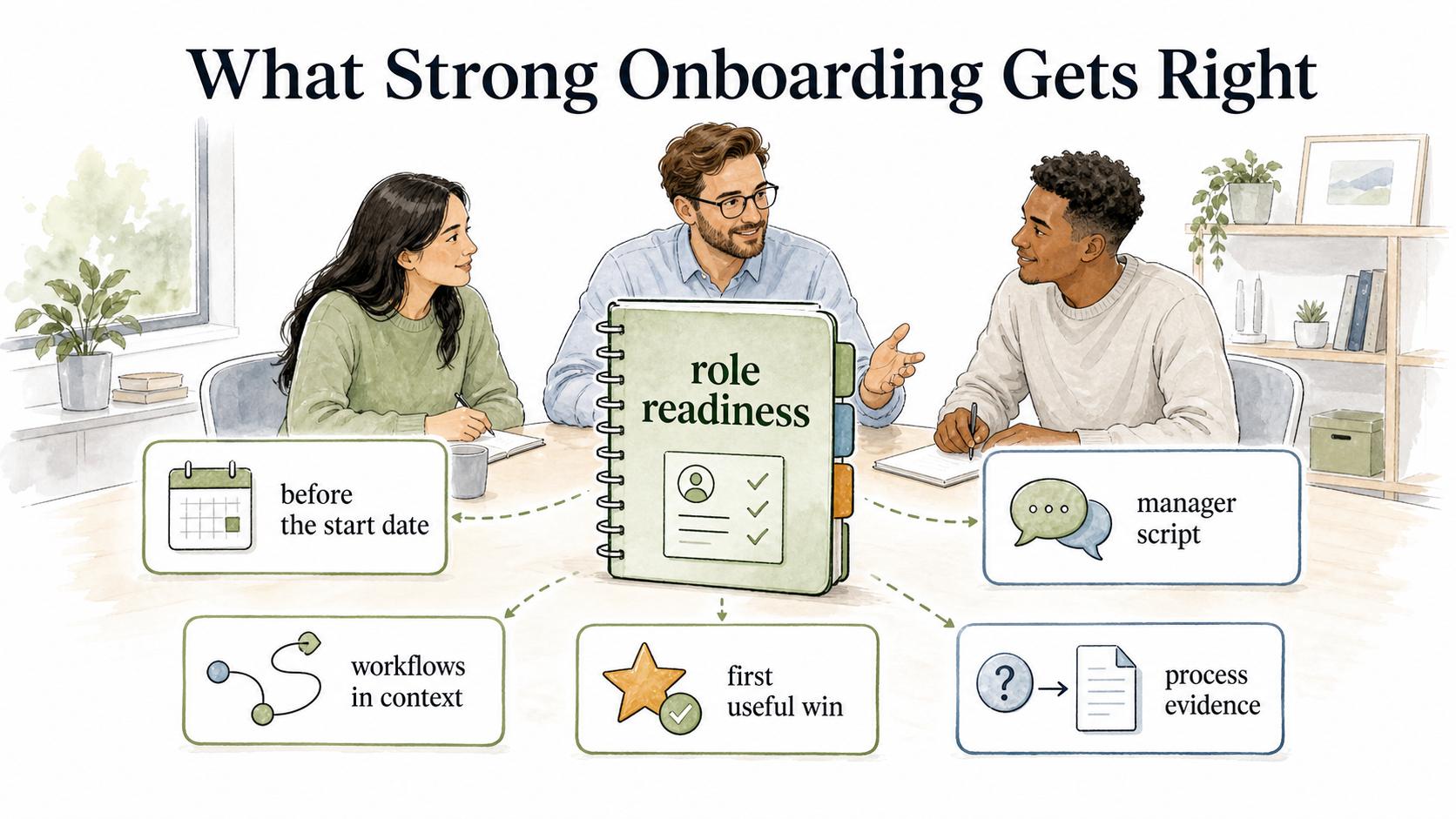
Start before the start date. The quiet period between offer acceptance and day one is often wasted. A simple preboarding note with schedule, equipment expectations, access needs, and first-week shape reduces anxiety and prevents the day-one scramble.
Give the manager a role-readiness script. HR can own the program, but the manager owns role readiness. Managers need prompts for first-week conversations, shadowing plans, practice tasks, and feedback moments.
Teach workflows in context. New hires don't need every policy at once. They need the process they will use first, the standard for doing it well, and the exception path when reality doesn't match the happy path.
Include early work that matters. A first useful win is better than a week of passive reading. The task should be small enough to complete safely and real enough to show how the team works.
Treat repeated questions as process evidence. If three people ask where a template lives or when to escalate a case, the onboarding documentation is missing a decision point.
A practical onboarding design rule
Build onboarding around milestones. A checklist can say that someone watched a training video. A milestone says they can complete a customer handoff, submit a report, run a weekly workflow, or explain when to escalate an issue. Microsoft's new employee onboarding guidance uses first 30-, 60-, and 90-day expectations as a practical way to structure those milestones. 4
For each role, define three to five milestones for the first month. Then attach the training, documentation, shadowing, and practice tasks that help the person reach those milestones. This keeps onboarding focused on capability instead of calendar-filling.
Documentation takeaway
Employee onboarding depends on documentation that is easy to use while someone is still unfamiliar with the company. The strongest materials are role-specific: first-week checklist, tool setup guide, core workflow guides, glossary of internal language, escalation map, and manager check-in prompts.
The hidden failure mode is assuming a helpful teammate can fill every gap. Helpful teammates are valuable, but they also create inconsistent onboarding when each person explains the job differently. Documentation gives new hires a stable baseline, while managers and peers add context around it.
How Trails helps
Trails helps teams turn repeatable onboarding workflows into clear step-by-step guides. A manager, trainer, or experienced teammate can capture a process as they perform it, then turn it into polished documentation or an AI-narrated video for new hires. That makes role-specific onboarding easier to create, share, and maintain as tools or procedures change.
See how Trails supports HR process documentation for repeatable onboarding tasks. For the role-specific learning materials, compare training documentation software.
Sources
- 1
Gallup. Why the Onboarding Experience Is Key for Retention. www.gallup.com/workplace/235121/why-onboarding-experience-key-retention.aspx.
- 2
SHRM. Complete Employee Onboarding Guide. www.shrm.org/topics-tools/topics/onboarding.
- 3
SHRM. Don't Underestimate the Importance of Good Onboarding. www.shrm.org/topics-tools/news/talent-acquisition/dont-underestimate-importance-good-onboarding.
- 4
Microsoft. New Employee Onboarding sites. learn.microsoft.com/en-us/sharepoint/provision-neo-hub.