
Glossary
On-the-Job Training
 ChatGPT
 Perplexity
 Gemini
 Claude
What is on-the-job training?
On-the-job training is training that happens while a person learns real work in the actual work environment. The U.S. Department of Labor describes apprenticeships as combining paid on-the-job training with classroom instruction to prepare workers for skilled careers.1 Instead of separating learning from the job, the employee observes, practices, receives feedback, and gradually takes ownership of the task under real conditions.
That realism is the advantage and the risk. If on-the-job training only means "watch someone experienced and copy them," quality depends on who is available, what they remember to explain, and whether the learner happens to see the right situations.
How on-the-job training works
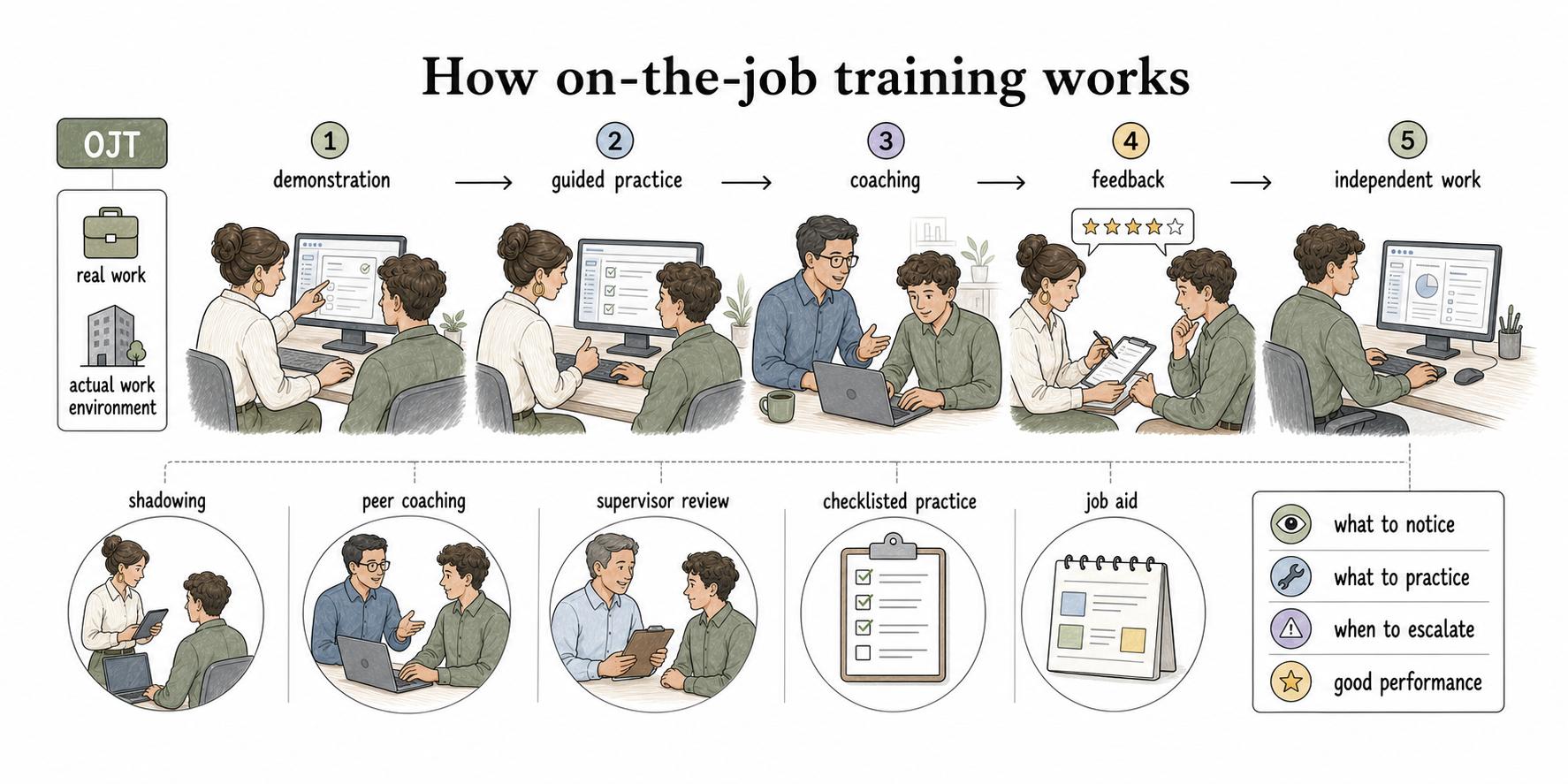
On-the-job training, often shortened to OJT, usually combines demonstration, guided practice, coaching, and independent work. Workplace-learning research describes mentoring practices such as modeling, demonstrating, observation, practice, and feedback.2
A new support rep might shadow an experienced teammate, handle a simple ticket with supervision, review feedback, then use a job aid the next time the same issue appears. A warehouse employee might observe a safety-critical process, practice it under supervision, and get cleared only after showing they can perform the task correctly.
Common OJT methods include shadowing, guided practice, peer coaching, job rotation, apprenticeship-style learning, supervisor review, and checklisted practice. The method matters less than the standard behind it. Good OJT tells the learner what to notice, what to practice, which mistakes matter, when to escalate, and how good performance will be judged.
When on-the-job training works best
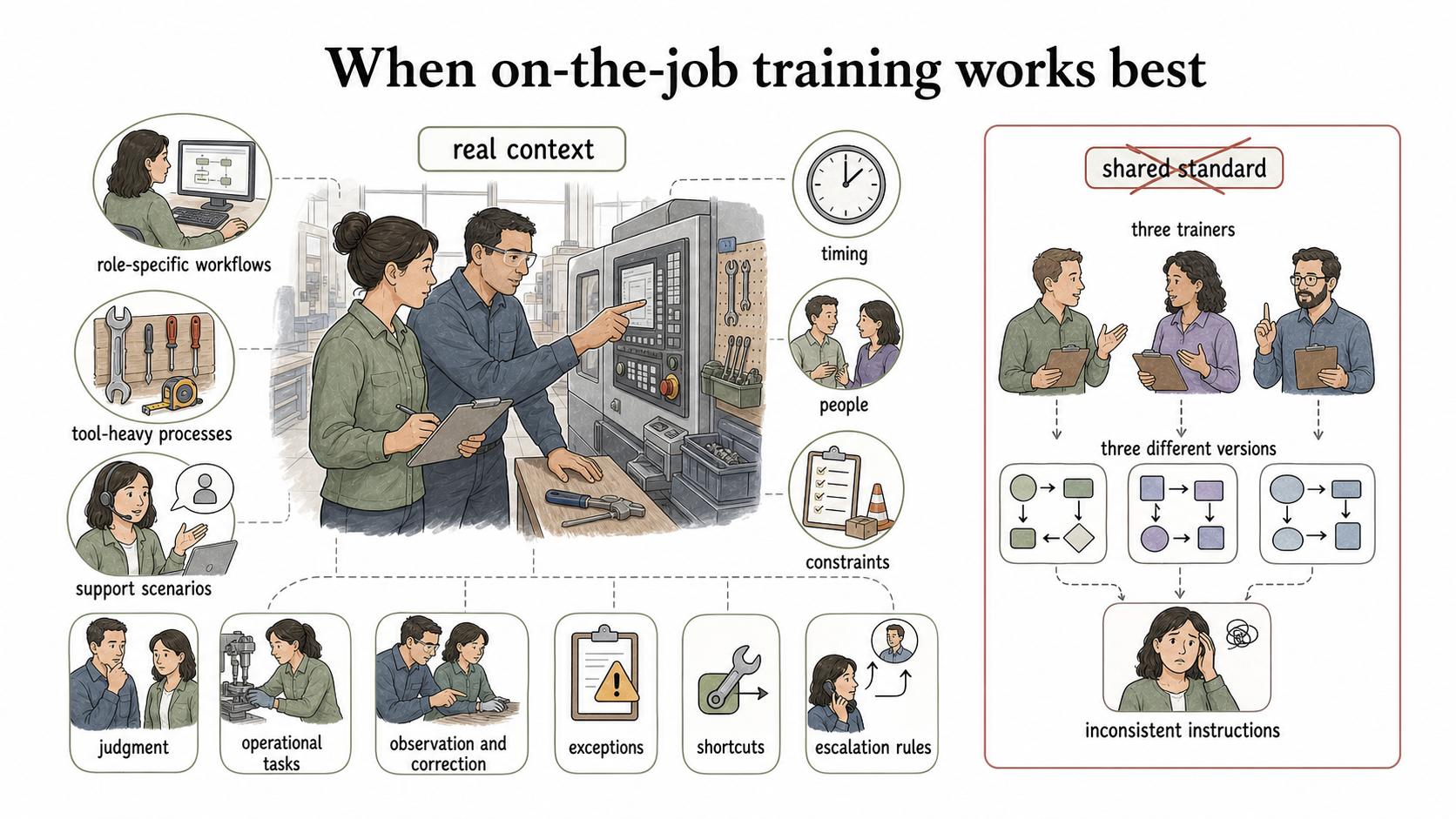
OJT works well when the task depends on real context. Some skills are hard to teach in isolation because the learner needs to see the tools, timing, people, constraints, and edge cases that exist in the actual job.
It is especially useful for:
- Role-specific workflows that vary by company or team
- Tool-heavy processes where screenshots or videos help but practice matters
- Customer or internal support scenarios that require judgment
- Physical, operational, or service tasks that need observation and correction
- Jobs where employees must learn exceptions, shortcuts, and escalation rules
OJT is weaker when the organization has no shared standard. If three trainers teach three different versions of the process, the learner is receiving inconsistent instructions, even if each trainer is trying to be helpful.
On-the-job training vs. other training formats
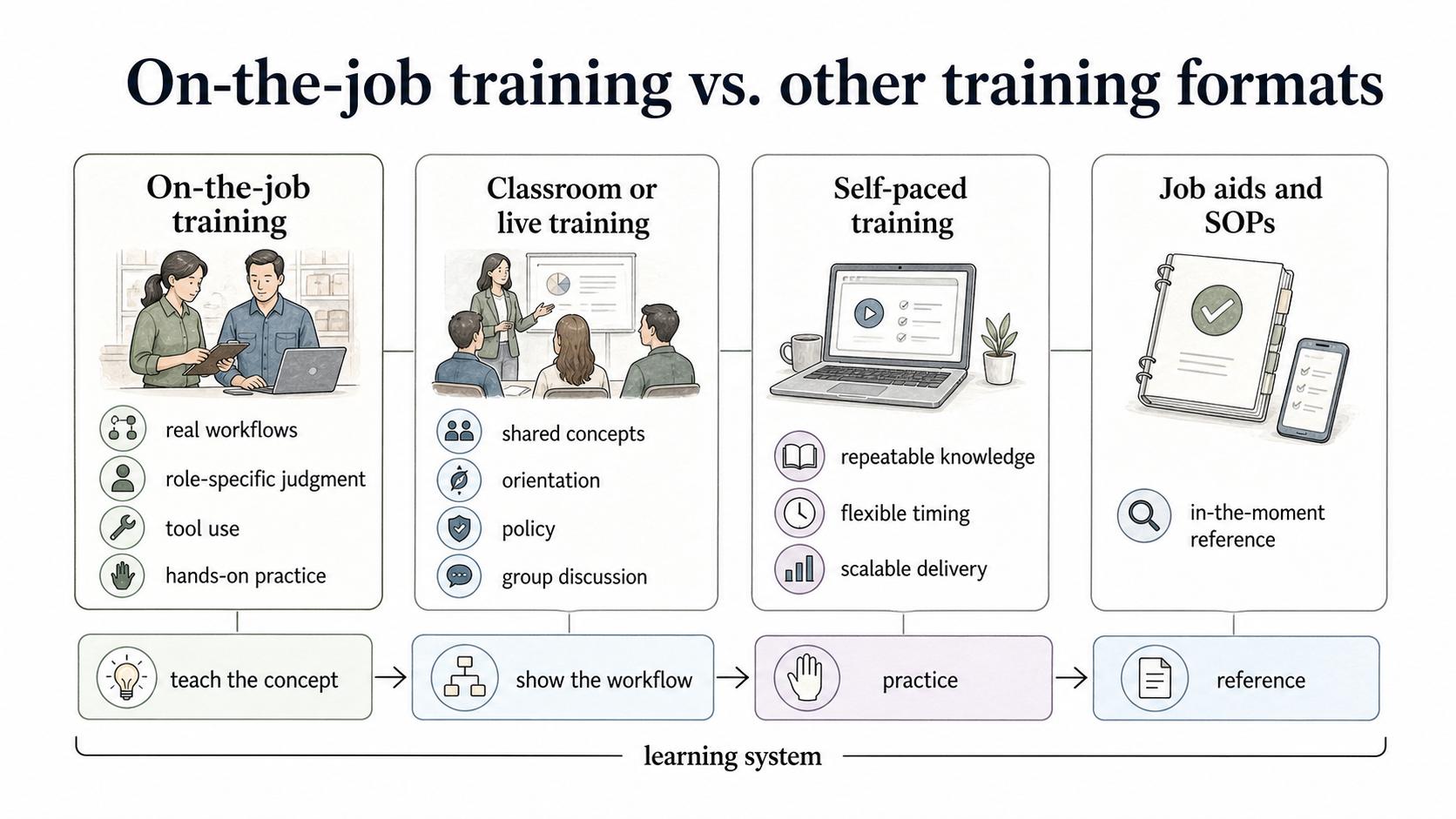
On-the-job training is one part of a practical learning system. It works best when paired with the formats that give learners context before, during, and after the work.
| Training format | Best for | Main risk |
|---|---|---|
| On-the-job training | Real workflows, role-specific judgment, tool use, and hands-on practice | Inconsistent training if there is no shared standard |
| Classroom or live training | Shared concepts, orientation, policy, and group discussion | Learners may understand the concept but not know how to apply it |
| Self-paced training | Repeatable knowledge, flexible timing, and scalable delivery | Learners may complete modules without building confidence or skill |
| Job aids and SOPs | In-the-moment reference while doing the work | Documentation can become stale or replace needed coaching |
A strong training program often combines these. Teach the concept, show the workflow, let the employee practice, then give them a reference they can return to when they are working independently. Registered apprenticeship guidance uses the same blended logic: on-the-job learning, related instruction, and mentorship work together.3
What good OJT includes
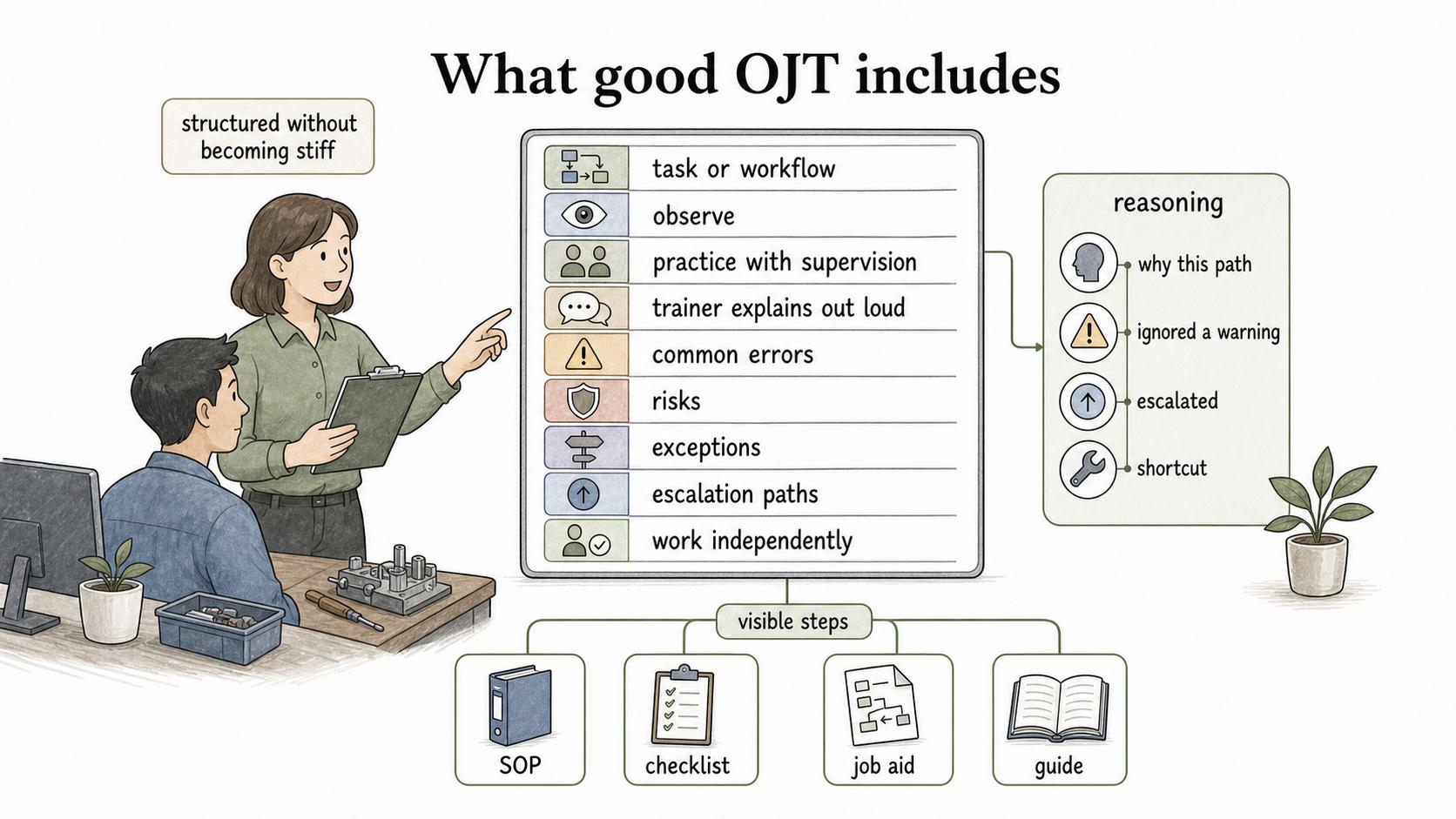
Good on-the-job training is structured without becoming stiff. Before putting a learner beside an experienced employee, the team should define:
- The task or workflow being trained
- What the learner should observe before trying the task
- What the learner should practice with supervision
- What the trainer should explain out loud
- Common errors, risks, exceptions, and escalation paths
- The point where the learner is allowed to work independently
- The SOP, checklist, job aid, or guide the learner should use afterward
The highest-value step is deciding what the trainer should explain out loud. Experts often skip the judgment calls that make them effective: why they chose one path, ignored a warning, escalated, or used a shortcut only in a narrow case. OJT should expose that reasoning, not just the visible steps.
Common mistakes
The most common mistake is confusing proximity with training. Watching a skilled person work can help, but observation alone does not prove that the learner can perform the work.
Other common mistakes include:
- Assigning a trainer without giving them a training plan
- Letting each trainer teach a different version of the same process
- Giving the learner practice only after the stakes are already high
- Providing feedback too late for the learner to adjust
- Failing to define what competence looks like
- Teaching the happy path but not the common exceptions
- Forgetting to update training materials after the process changes
The practical fix is a shared reference point for trainers and learners. A workplace-coaching meta-analysis found coaching is associated with positive organizational outcomes, which supports making feedback and guided practice part of OJT rather than treating training as observation alone.4
AI-ready OJT planning prompt
Use this prompt to turn a real task into a practical on-the-job training plan:
## On-the-Job Training Planning Prompt

**Glossary term:** On-the-Job Training
**Source:** Trails Glossary — trails.so/glossary/on-the-job-training

---

### 01. Create an on-the-job training plan

"Create an on-the-job training plan for [task/workflow] performed by [role].

Context:
- Work environment: [team/location/tool/system]
- Trainer: [role or person]
- Learner: [new hire/employee/team]
- Current problems: [inconsistent training, slow ramp, errors, unclear standard, etc.]

Include:
1. What the learner should know before training starts.
2. What the trainer should demonstrate.
3. What the learner should practice with supervision.
4. Common mistakes, risks, or exceptions to call out.
5. What the trainer should check before the learner works independently.
6. The SOP, checklist, job aid, or guide the learner should use afterward.
7. A short feedback loop for improving the training after the session.

Keep it practical enough for a trainer to use during the work, not just as a lesson outline."
Documentation takeaway
Documentation gives on-the-job training a memory. A short SOP, checklist, job aid, screen recording, or step-by-step guide helps trainers stay consistent and gives learners something to use after the coaching session ends.
The documentation should capture the standard process, key decisions, known risks, and proof that the learner is ready. Human coaching can still handle context and judgment, while the core workflow stops living only in one person's head.
How Trails helps
Trails helps teams capture real workflows as people perform them, then turn those workflows into polished step-by-step guides. For OJT, that means trainers can show the work once, preserve the process, and give learners a guide they can return to later.
Trails can also create an AI-narrated video version for training or sharing. The learner still gets coaching from a person, but the core process becomes easier to repeat across trainers, teams, and locations.
Sources
- 1
U.S. Department of Labor. Apprenticeship. U.S. Department of Labor. www.dol.gov/general/topic/training/apprenticeship. Accessed July 24, 2026.
- 2
European Centre for Modern Languages. Successful Workplace Learning: How learning happens at work. Council of Europe. languageforwork.ecml.at/Portals/48/ICT_REV_LFW/Successful_workplace_learning.pdf. Accessed July 24, 2026.
- 3
Pennsylvania Department of Labor and Industry. Apprenticeship and Training. Commonwealth of Pennsylvania. www.pa.gov/agencies/dli/programs-services/workforce-development-home/home----------. Accessed July 24, 2026.
- 4
Janis A. Cannon-Bowers et al.. Workplace coaching: a meta-analysis and recommendations for advancing the science of coaching. Frontiers in Psychology, 2023. pmc.ncbi.nlm.nih.gov/articles/PMC10597717/. Accessed July 24, 2026.