
Glossary
SOP Training
 ChatGPT
 Perplexity
 Gemini
 Claude
What is SOP training?
SOP training is the process of teaching people how to use a standard operating procedure in real work. It is not the same as asking someone to read the SOP. Useful training shows when the procedure applies, what good execution looks like, where judgment is allowed, and what to do when the clean version of the process breaks.
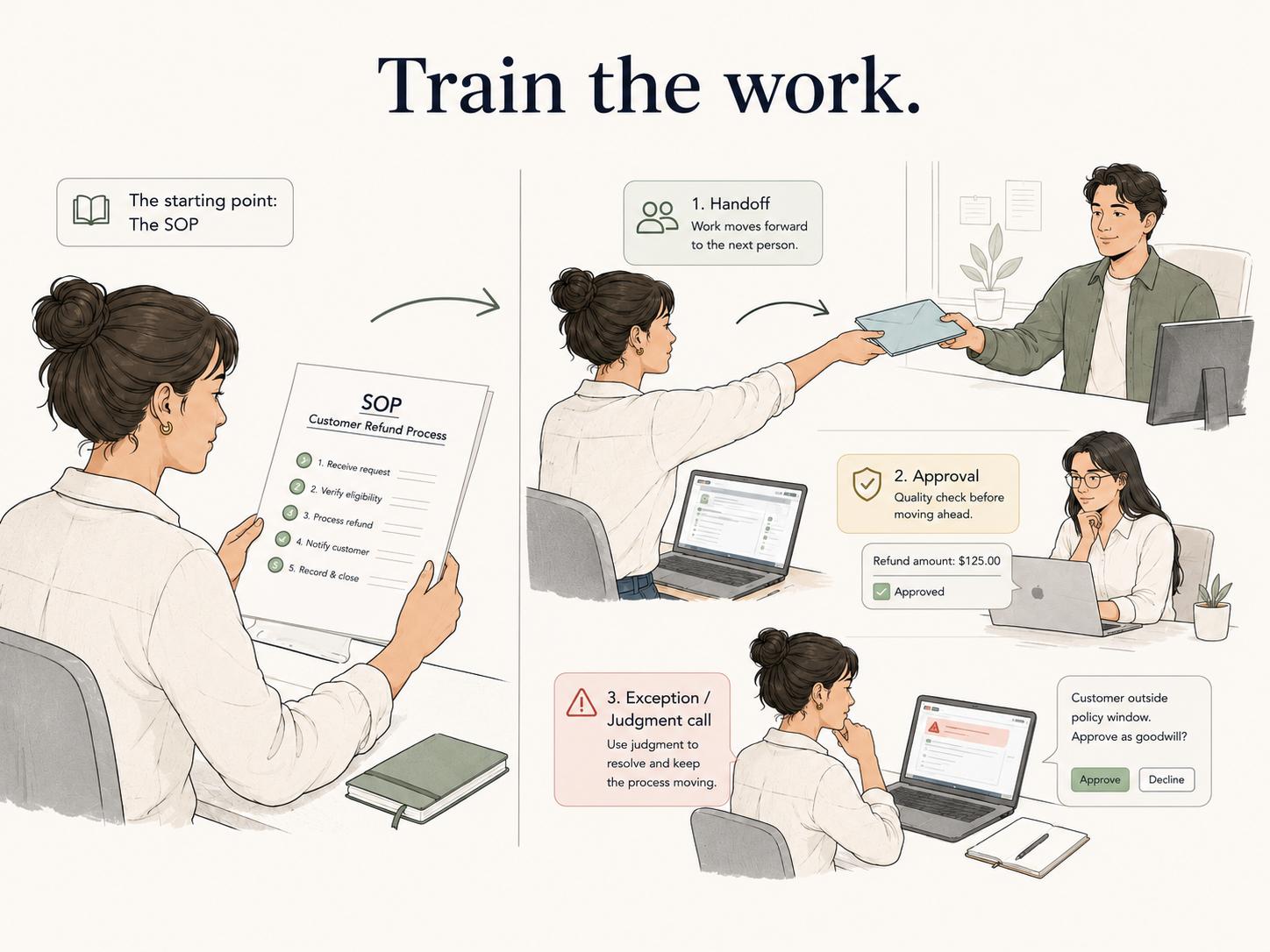
The usual failure mode is training on the document instead of the work. A tidy SOP can still miss the handoff, exception, approval threshold, or system behavior that decides whether someone can actually perform the task.
What SOP training should accomplish
SOP training should build reliable performance, not memorization. CDC training guidance evaluates effectiveness through learning, workplace transfer, and improved competence, capacity, and performance.1
A strong session gives the learner four things: context, demonstration, practice, and a completion standard. Context explains why the procedure exists. Demonstration shows the work in the relevant tool, queue, form, or environment. Practice exposes the judgment calls. The completion standard tells the learner and manager when the person is ready to work independently.
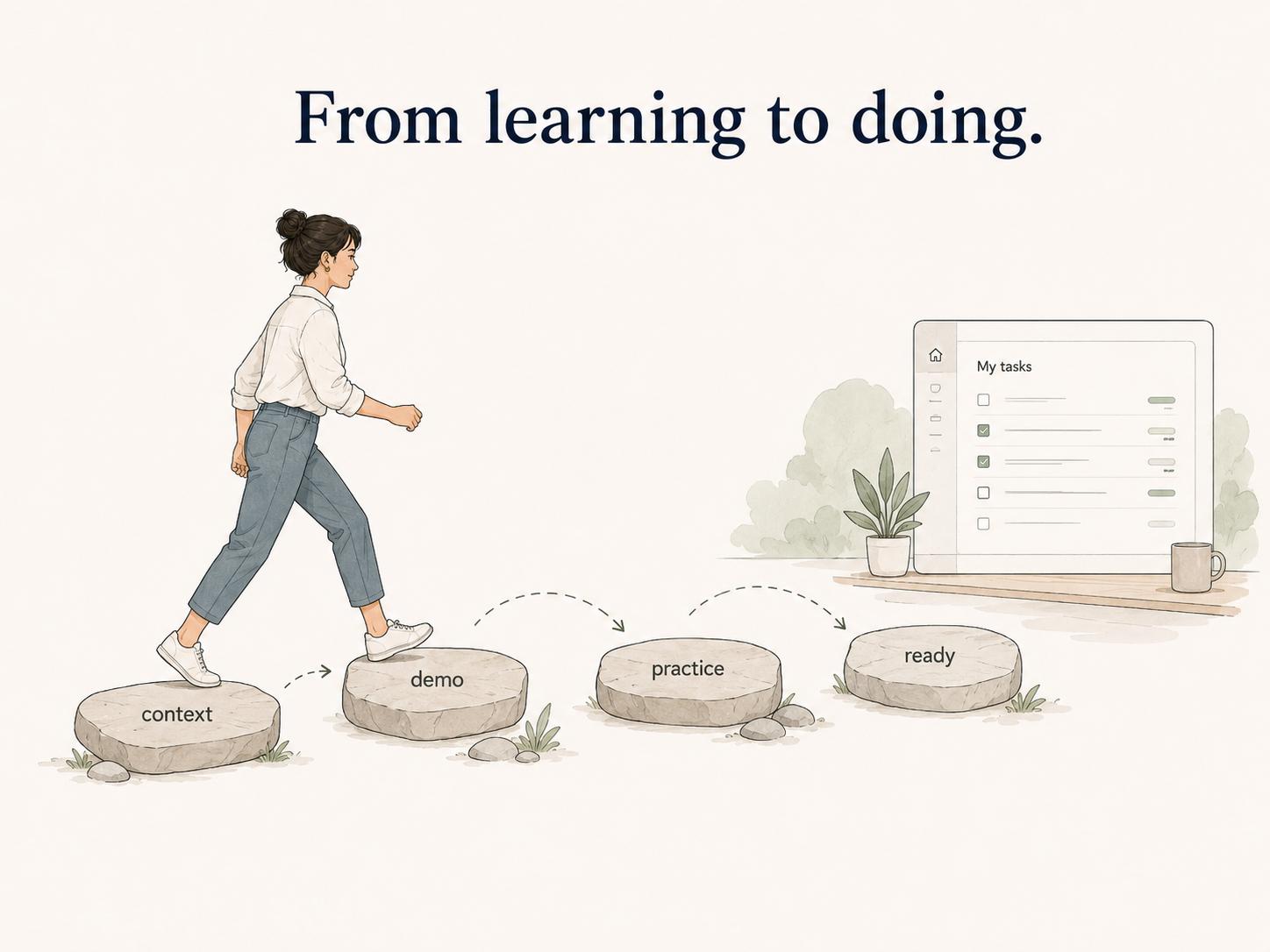
That structure also echoes NIST's Training Within Industry summary: prepare, demonstrate, let the trainee try the task, then follow up.2 For a refund SOP, training should cover more than the button sequence. It should show refund eligibility, approval thresholds, customer language, required notes, and the evidence that proves the case was handled correctly.
SOP training vs training SOP
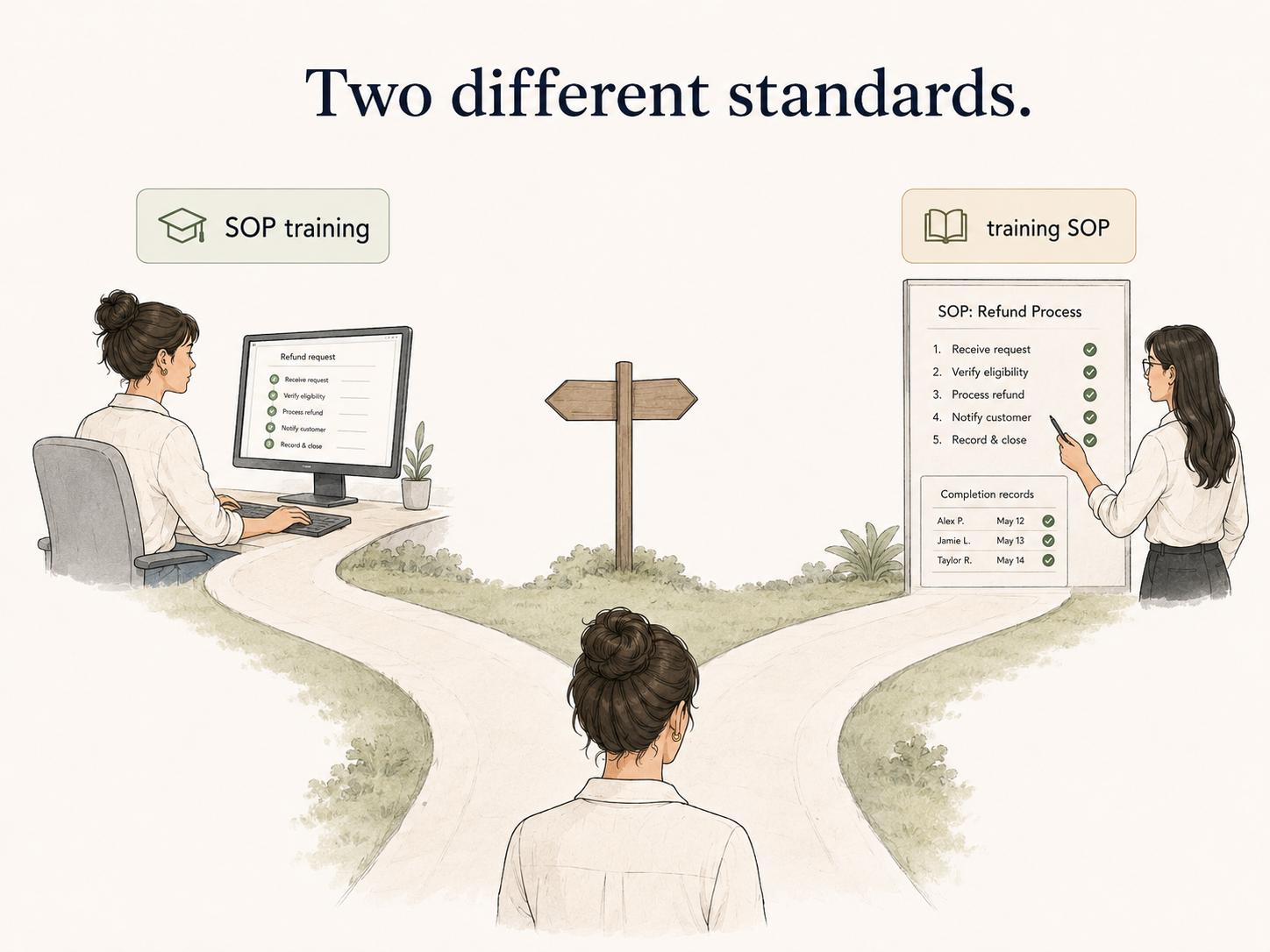
These phrases sound similar, but they point to different work.
| Term | Meaning | Use it when |
|---|---|---|
| SOP training | The learning process used to teach an SOP | Rolling out a procedure, onboarding, cross-training, or retraining after errors |
| Training SOP | A standard operating procedure for how training itself should happen | Standardizing instructor steps, learner evidence, and completion records |
| Work instruction | A more detailed task-level guide | The task needs exact steps, screenshots, tool settings, or safety details |
| SOP manual | A collection of approved procedures | Teams need a reference library or audit-ready process documentation |
An SOP can anchor training, but it is rarely the whole training experience. People still need to see the work, try the work, and understand where the procedure sits in the larger process.
How to structure SOP training
A practical SOP training plan should answer three questions: who needs to learn this, what must they be able to do, and what evidence proves they can do it. CDC's Quality Training Standards similarly emphasize needs assessment, learning objectives, learner engagement, assessment, and follow-up support.3
Start with the training trigger. A new hire, process change, quality issue, compliance requirement, and role transfer can require different depth. OSHA's training-requirements reference is a reminder that regulated work may also define specific training and recordkeeping obligations.4 A senior teammate learning a small update does not need the same training as a new employee learning the workflow from scratch.
Then decide how the learner will practice. Reading can orient someone, but practice is where gaps show up. If the SOP includes judgment, approvals, customer communication, safety checks, or data entry, use a realistic scenario instead of a perfect example.
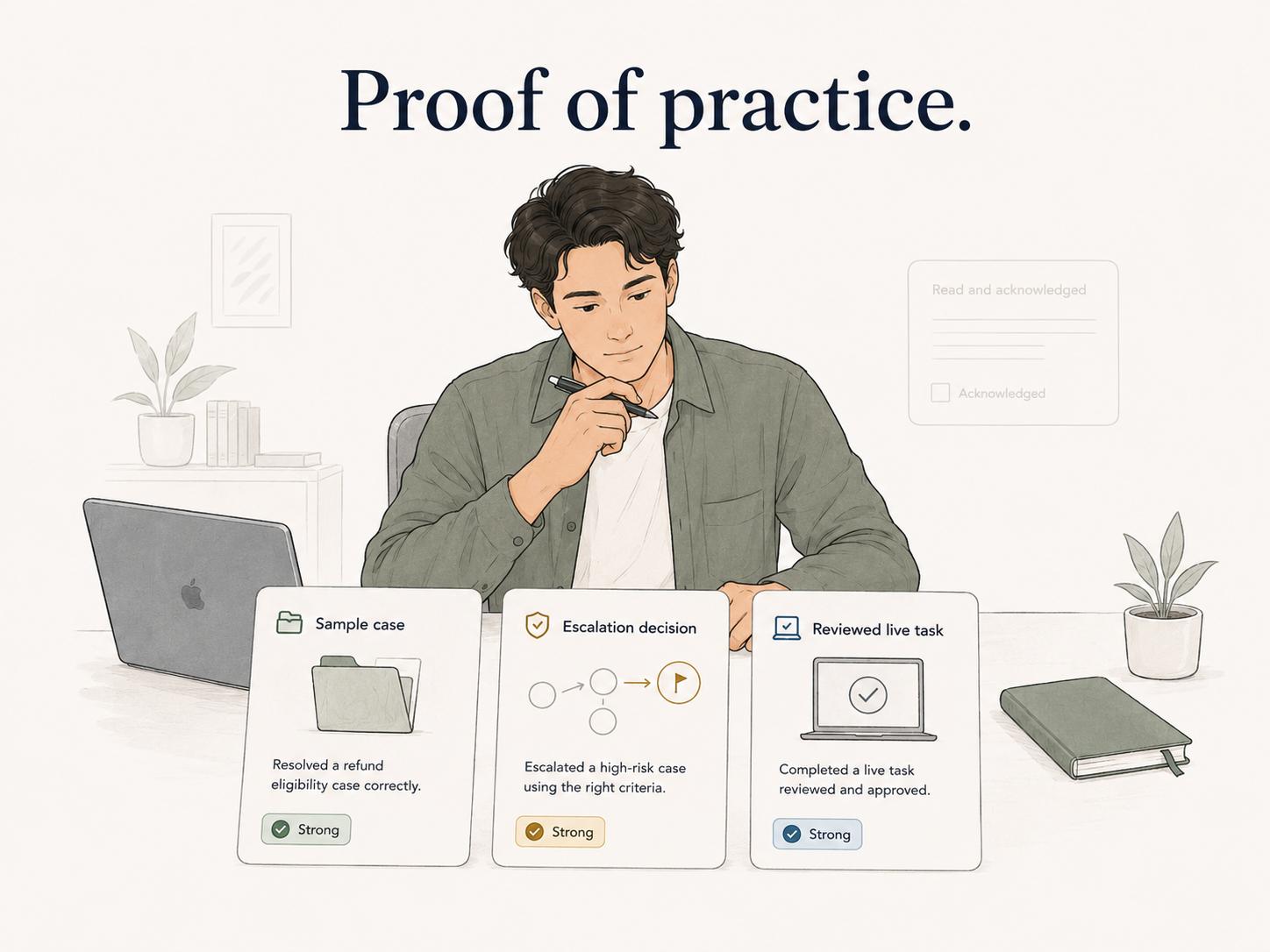
Finally, define completion evidence. "Read and acknowledged" is weak proof for a complex procedure. "Completed two sample cases, explained the escalation rule, and had one live case reviewed by a manager" gives the manager something real to inspect.
Common mistakes in SOP training
The most common mistake is confusing awareness with competence. Someone can understand the words in an SOP and still miss a handoff, skip a required note, or make the wrong decision under time pressure.
Another mistake is training only the happy path. Real procedures include missing information, unavailable approvers, unusual customer requests, unclear ownership, and systems that behave differently from the guide. Good SOP training names the exceptions most likely to change the outcome.
Teams also let training assets drift away from the SOP. When the procedure changes, the walkthrough, video, quiz, or practice scenario has to change too. Employees will trust whichever version they saw most recently.
AI prompt for an SOP training plan
## SOP Training Plan Prompt

**Glossary term:** SOP Training
**Source:** Trails Glossary — trails.so/glossary/sop-training

---

### 01. Create an SOP training plan

"Create an SOP training plan for [team] using this procedure: [paste SOP].

Audience: [role, experience level, and location]
Training trigger: [new hire, process change, audit finding, cross-training, refresher]
Work environment: [tools, systems, equipment, forms, or customer context]
Risk if done incorrectly: [quality, compliance, safety, cost, customer impact]

Include:
- Plain-English training objective
- Prerequisites and access needed before training
- 30-minute walkthrough outline
- One realistic practice scenario
- Questions that test judgment, not just recall
- Completion evidence a manager can review
- When refresher training should happen
- Where the SOP should be linked during daily work"
Use AI for structure, not authority. The process owner should still verify that the examples, risks, approvals, and completion criteria match the real workflow.
Documentation takeaway
SOP training works best when the procedure is easy to find at the moment of work. A training session can introduce the standard, but the SOP should remain close to the tools, queues, forms, or handoffs where people use it.
If the procedure is hard to locate after training, employees fall back on memory, Slack history, or whoever happens to be nearby. That is how process drift starts.
How Trails helps
Trails helps teams turn real workflows into training-ready process documentation. A teammate can capture a process while doing the work, turn it into a polished step-by-step guide, and create an AI-narrated video version for onboarding or refresher training.
That makes SOP training easier to maintain because the training material starts from the actual workflow, not from a blank document someone has to reconstruct later.
- Standard operating procedure
- Training SOP
- Process training
- Skills training
- Refresher training
- Training records
- SOP assessment
Sources
- 1
Centers for Disease Control and Prevention. Evaluate Training: Measuring Effectiveness. CDC. www.cdc.gov/training-development/php/about/evaluate-training-measuring-effectiveness.html. Accessed July 6, 2026.
- 2
National Institute of Standards and Technology. Training Within Industry (TWI). NIST MEP. www.nist.gov/mep/training-within-industry-twi. Accessed July 6, 2026.
- 3
Centers for Disease Control and Prevention. Quality Training Standards. CDC. www.cdc.gov/training-development/php/qts/index.html. Accessed July 6, 2026.
- 4
Occupational Safety and Health Administration. Training Requirements in OSHA Standards. OSHA. www.osha.gov/sites/default/files/publications/OSHA2254.pdf. Accessed July 6, 2026.