
Glossary
Employee Handbook
 ChatGPT
 Perplexity
 Gemini
 Claude
What is an employee handbook?
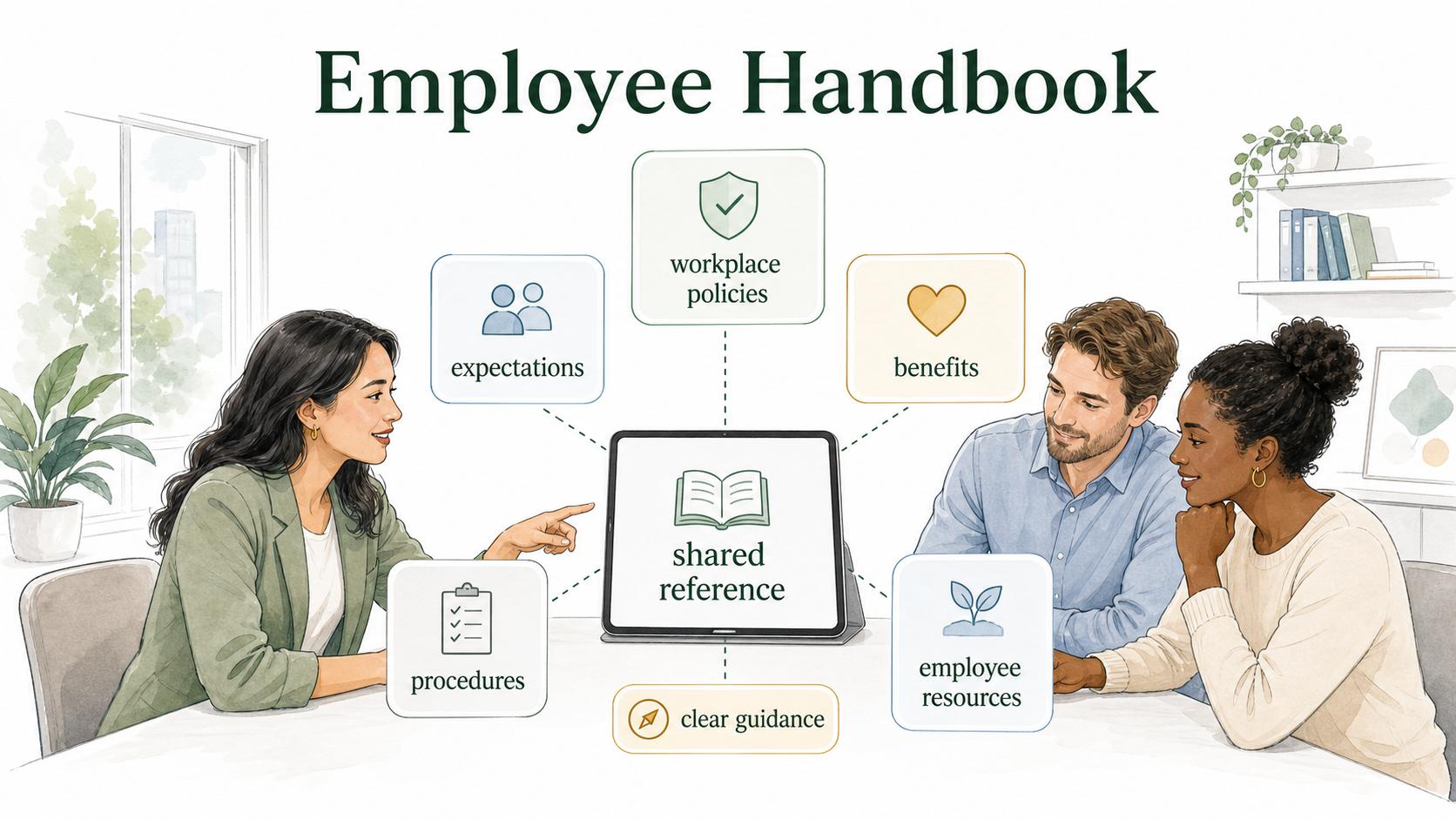
An employee handbook is a central document that explains a company's workplace policies, expectations, benefits, procedures, and employee resources. It gives employees a shared reference for how the organization works and what they can expect from the company.
A useful handbook turns policy into clear, findable guidance. Employees, managers, and HR should be able to reach the same answer without relying on memory, one-off Slack replies, or inconsistent manager judgment.
Why an employee handbook matters
Employee handbooks sit at the intersection of communication, consistency, and risk management. SHRM's handbook guidance emphasizes legal compliance, clarity, feasibility, and leader training as part of keeping handbook content accurate and usable. 1 They help new hires understand the company, managers answer common policy questions, and HR keep important guidance in one place.
The practical value shows up in everyday moments: an employee wants to understand paid time off, a manager needs to handle a performance concern, a remote teammate is unsure about equipment rules, or a new hire needs to know where benefits information lives. Without a handbook, those questions scatter across Slack, email, outdated PDFs, and informal judgment.
The hidden failure mode is treating the handbook as a document people sign once and never use. If it is hard to search, written in legal-heavy language, or disconnected from actual workflows, employees will stop using it. The handbook still exists, but the working policy becomes whatever people remember.
What an employee handbook usually includes
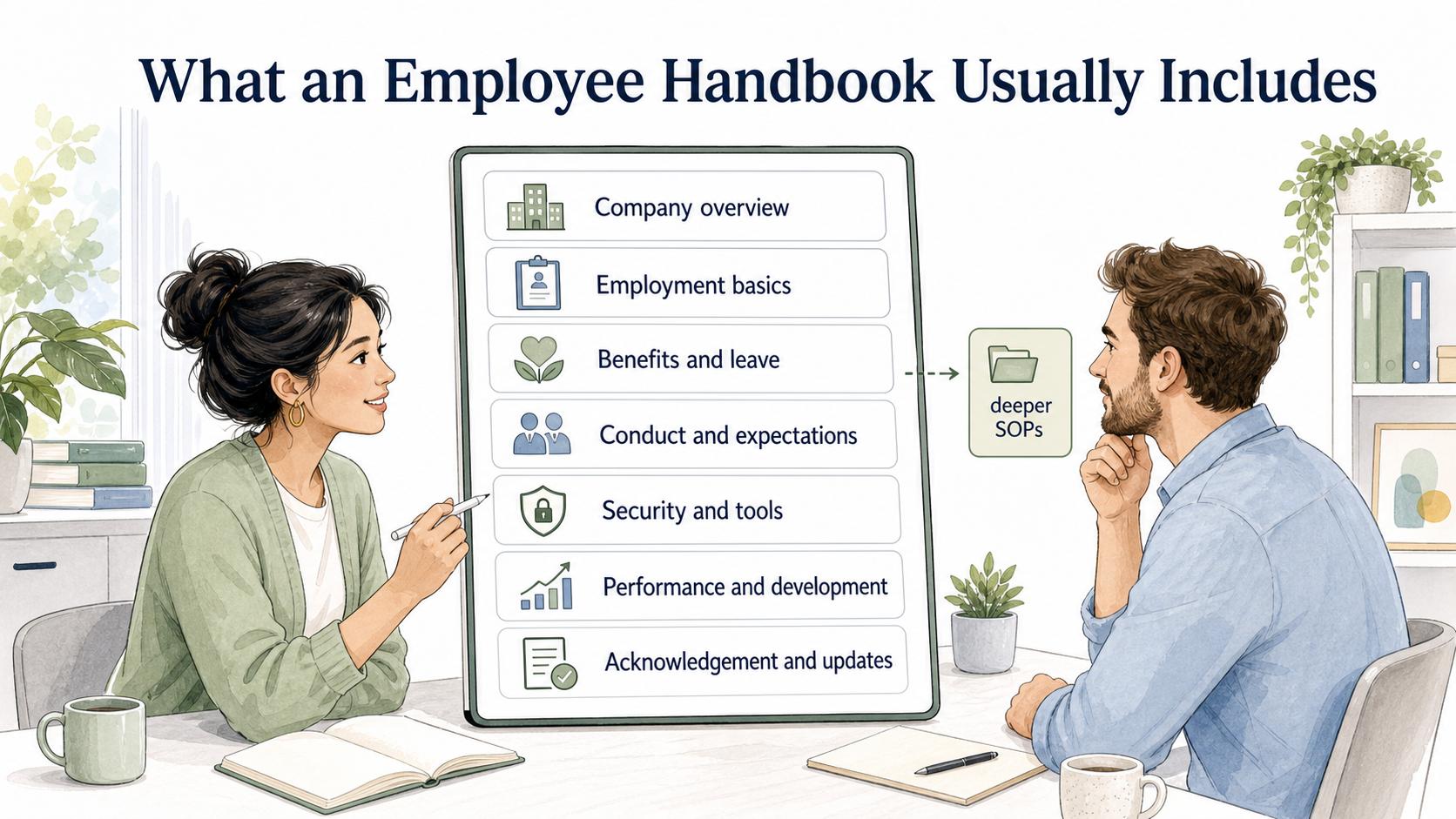
An employee handbook should reflect the organization, industry, location, and employment model. Common sections include:
| Section | What it should clarify | What to avoid |
|---|---|---|
| Company overview | Mission, values, working norms, employee resources | Culture language so vague it does not guide behavior |
| Employment basics | Classifications, work hours, pay practices, attendance expectations | Policy summaries that conflict with formal HR systems |
| Benefits and leave | Where to find benefits, time off, leave, and support resources | Rewriting complex benefit rules in a way that becomes outdated; the U.S. Department of Labor notes that some laws require employee notices or workplace postings, which should stay aligned with handbook guidance. [2] |
| Conduct and expectations | Workplace behavior, harassment reporting, conflicts of interest | Dense policy text with no reporting path or owner; EEOC guidance encourages clearly communicated anti-harassment expectations, an effective complaint process, training, and prompt action on complaints. [3] |
| Security and tools | Acceptable use, access, data handling, equipment, remote work | Rules that do not match the tools employees actually use |
| Performance and development | Feedback rhythm, reviews, promotions, learning support | Promising a process the company does not consistently follow |
| Acknowledgement and updates | How employees confirm receipt and how changes are communicated | Treating acknowledgement as a substitute for understanding |
The handbook does not need every procedural detail. Often it should point to deeper SOPs, benefits systems, or manager playbooks instead of becoming an unmaintainable mega-document.
Employee handbook vs policy manual
An employee handbook is written for employees as a practical reference. A policy manual is usually a more formal internal control document that defines policy in greater detail for HR, legal, compliance, or management use.
The same topic may appear in both places. For example, the handbook might explain how employees request time off and where to find the leave policy. The policy manual may define eligibility, approval rules, recordkeeping, exceptions, and legal review requirements.
That distinction matters because employees need clarity, while managers and HR need the deeper policy logic. Mixing both audiences often makes the handbook too dense for employees and too shallow for policy owners.
What makes a handbook useful
Answer the questions employees actually ask. A handbook should be shaped by real employee confusion, not a generic table of contents. If HR gets the same question every month, the handbook either lacks the answer or hides it badly.
Separate policy from procedure. A policy says what the rule or expectation is. A procedure explains how to follow it. Employees usually need both, but they should be clearly labeled so nobody mistakes a workflow step for the whole policy.
Name owners and update paths. Every section should have a responsible owner, even if that owner is not visible to every reader. Benefits, security, finance, IT, and people operations content changes at different speeds. Without ownership, outdated handbook content becomes a quiet source of bad guidance.
Use plain language for employee-facing guidance. Some language may need formal review, but the employee-facing explanation should still be readable. The goal is usability, not casual policy language.
Avoid overpromising. A handbook should not describe a perfect process that managers do not follow. If the company says performance reviews happen twice a year, employees will notice when that rhythm slips. Handbook language should match operating reality or trigger an operating change.
How to maintain an employee handbook
The best maintenance rhythm is tied to change. Review the handbook when benefits change, tools change, policies change, teams move remote or hybrid, new locations are added, or repeated employee questions show a gap. SHRM's update guidance makes the same point: handbook review should account for compliance, accuracy, and whether leaders can actually implement the policy as written. 4
- Assign an owner for each major section.
- Keep a change log for material updates.
- Separate evergreen guidance from details that change often.
- Link to deeper procedures instead of duplicating them.
- Ask managers and employees where the handbook still creates confusion.
For legal-sensitive or compliance-sensitive sections, the right HR, legal, or compliance owner should review the language before publication. A glossary article can explain the concept, but it cannot decide what language is appropriate for a specific employer or jurisdiction.
Documentation takeaway
An employee handbook should act as a hub. It should help employees find the right answer quickly and point them to the deeper procedure when the topic needs more detail. If every policy, SOP, benefit explanation, and manager-only note is crammed into one document, the handbook becomes technically complete and practically unusable.
The most useful handbooks are clear about three things: what employees need to know, where the detailed process lives, and who owns the answer when something changes.
How Trails helps
Trails helps teams create and maintain the process documentation that sits behind an employee handbook. HR, IT, finance, and operations teams can capture workflows such as requesting time off, setting up payroll, submitting expenses, updating access, or completing onboarding tasks. Trails turns those workflows into polished step-by-step guides and can create AI-narrated videos for training or handoff.
That keeps the handbook lighter while still giving employees and managers clear paths for the work behind each policy.
Sources
- 1
SHRM. How to Update Employee Handbooks for Compliance and Accuracy. www.shrm.org/topics-tools/employment-law-compliance/5-tips-updating-employee-handbooks.
- 2
U.S. Department of Labor. Workplace Posters. www.dol.gov/general/topics/posters.
- 3
EEOC. Harassment. www.eeoc.gov/harassment.
- 4
SHRM. Building a Better Employee Handbook. www.shrm.org/topics-tools/flagships/hr-daily/building-a-better-employee-handbook.