
Glossary
New Hire Training
 ChatGPT
 Perplexity
 Gemini
 Claude
What is new hire training?
New hire training is the structured learning that teaches a new employee how to perform their role. Indeed describes new employee training as a structured program for teaching the skills, processes, and expectations required to succeed in a role.1 In practice, that means the workflows, tools, product context, policies, safety rules, and practice tasks the person needs before they can work without constant handholding.
Keep it separate from the broader employee transition. SHRM distinguishes orientation from onboarding and notes that onboarding can involve managers and other employees over a longer period.2 Onboarding helps someone enter the company and team. New hire training teaches them how to do the work they were hired to do.
What new hire training includes
A useful new hire training plan starts with the job, not with a folder of links. The plan should tell the employee what to learn, where the current instructions live, who reviews their work, and what readiness looks like.
The exact content depends on the role, but most plans need a few concrete pieces:
- Core workflows: The recurring tasks the person must perform, tied to SOPs, checklists, videos, or practice assignments.
- Tool fluency: The systems the person will use in real work, not just account setup.
- Role context: Product, customer, safety, compliance, or operational knowledge that changes how the work should be done.
- Supported practice: A sequence for watching, trying with help, and completing the task independently.
- Readiness signals: Evidence that the person can perform the work at the expected quality level.
A support hire might train on ticket triage, escalation rules, refund workflows, and product troubleshooting. A warehouse hire might train on safety checks, scanning workflows, quality standards, and shift handoffs. The shared pattern is the same: training should map to the work the person will actually perform.
New hire training vs onboarding vs orientation
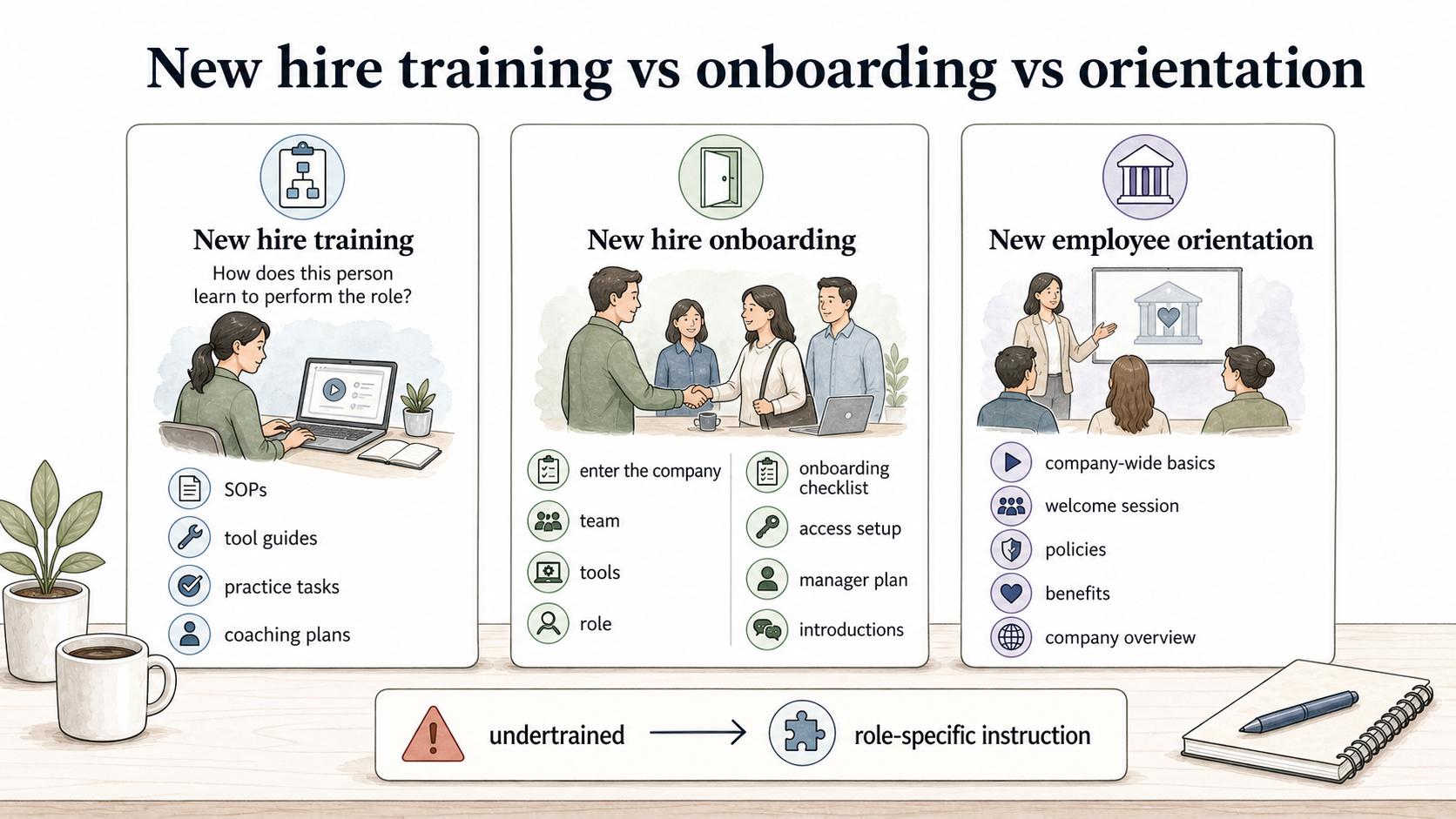
These terms overlap, but they answer different operating questions. Keeping them separate helps teams avoid a common failure: giving someone a polished welcome experience without enough role-specific instruction.
| Term | Primary question | Typical assets |
|---|---|---|
| New hire training | How does this person learn to perform the role? | SOPs, tool guides, practice tasks, coaching plans |
| New hire onboarding | How does this person enter the company, team, tools, and role? | Onboarding checklist, access setup, manager plan, introductions |
| New employee orientation | What company-wide basics should every employee understand? | Welcome session, policies, benefits, company overview |
A new hire can complete orientation and still be undertrained. They can also finish several training modules and still feel poorly onboarded if they lack context, manager support, or team connection. ATD's onboarding model includes role clarity, relationship building, and results, which reinforces why training assets alone don't cover the whole employee transition.3
How to structure new hire training
Start by naming the work the employee must be able to do, then build backward from those outcomes. A clean training structure usually includes:
- First real tasks: Choose low-risk tasks the new hire can complete early. Training gets easier to prioritize when it's connected to actual work.
- Required workflows: List the workflows the role depends on, then attach each one to an SOP, guide, video, trainer, or practice assignment.
- Practice sequence: Decide what the new hire should observe, try with support, and complete independently. Skipping supported practice is where many training plans quietly fail.
- Readiness checks: Define what good enough looks like. A completed course isn't the same as being ready to handle a customer issue, process an order, or close a shift.
- Feedback loop: Track repeated questions, mistakes, and workarounds. Those are usually signs that the training material or process documentation needs to improve.
The point is to shorten the distance between instruction and competent execution. Training-transfer research describes the movement from learning into workplace application, with consequences for competence, errors, and performance.4
Common new hire training mistakes
New hire training usually breaks for predictable reasons.
One mistake is relying on whoever happens to be available. Shadowing can help, but unsupported shadowing often teaches personal habits instead of the agreed process.
Another mistake is organizing training by content type instead of job task. A long list of videos, policies, and links can look complete while leaving the new hire unsure what to do first.
Access is also easy to mistake for training. Getting someone into the CRM, LMS, warehouse system, or support desk doesn't mean they know how to use it correctly.
The final mistake is never defining readiness. Without a clear signal, managers either release people too early or keep them dependent on trainer approval for too long.
AI-ready new hire training prompt
Use this prompt to draft a role-specific training plan:
## New Hire Training Plan Prompt

**Glossary term:** New Hire Training
**Source:** Trails Glossary — trails.so/glossary/new-hire-training

---

### 01. Draft a role-specific training plan

"Create a new hire training plan for [role] on [team]. Organize it by week one, weeks two to four, and first 60 days. Include the workflows to learn, SOPs or guides to use, practice tasks, trainer or manager owner, readiness signals, and common mistakes to watch for. Separate role-specific training from company-wide onboarding or orientation."
How Trails helps
Trails helps teams turn real work into training material. A team can capture a workflow as someone performs it, turn that workflow into a polished step-by-step guide, and create an AI-narrated video version for training or sharing.
That gives new hires a clearer bridge from explanation to execution. Instead of being told to learn a system from memory, they can follow the exact workflow they need to perform.
Explore Trails for learning and development for creating reusable workflow training, or compare training documentation software for the wider content library.
Sources
- 1
Indeed. New Employee Training. www.indeed.com/hire/c/info/new-employee-training. Accessed July 24, 2026.
- 2
Society for Human Resource Management. Complete Employee Onboarding Guide. www.shrm.org/topics-tools/topics/onboarding. Accessed July 24, 2026.
- 3
Association for Talent Development. New Employee Onboarding Certificate. www.td.org/education-courses/new-employee-onboarding-certificate. Accessed July 24, 2026.
- 4
European Journal of Work and Organizational Psychology. How to maximize the impact of workplace training. www.tandfonline.com/doi/full/10.1080/1359432X.2024.2319082. Accessed July 24, 2026.