
Glossary
New Employee Orientation
 ChatGPT
 Perplexity
 Gemini
 Claude
What is new employee orientation?
New employee orientation is the introductory part of onboarding where a new hire learns the company's basics: what the organization does, how work happens, which policies matter immediately, where to find help, and what happens next. 1 It usually happens on day one or during the first week.
Orientation gives employees enough company-wide context to start. It doesn't replace onboarding or role training. 2 Onboarding is the full transition into the company, team, tools, and role. Training teaches the job-specific workflows and skills the person needs to perform the work.
What new employee orientation includes
Orientation should cover the information most employees need regardless of role. The job is to give the new hire a usable first-day map, then point them to the right owner or resource for deeper follow-up.
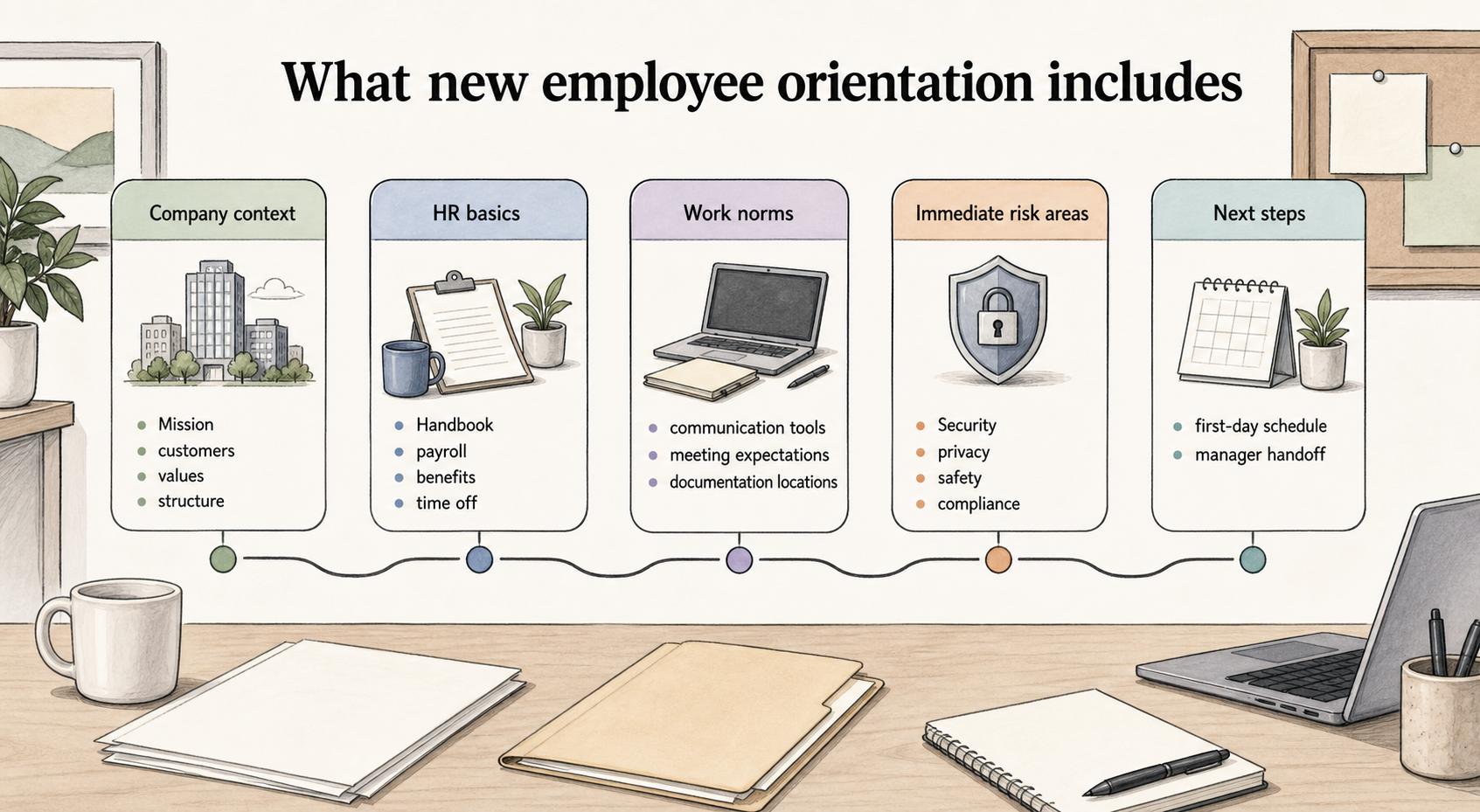
Strong orientation programs usually cover:
- Company context: Mission, customers, values, structure, and the teams the employee will hear about often.
- HR basics: Handbook, payroll, benefits, time off, workplace policies, and where to ask questions.
- Work norms: Communication tools, meeting expectations, office, remote, or hybrid practices, and internal documentation locations.
- Immediate risk areas: Security, privacy, safety, compliance, or reporting expectations that matter on day one.
- Next steps: The first-day schedule, manager handoff, and where onboarding or role training continues.
The best orientation programs are selective. 3 They explain what the employee needs now and point to reliable references for what they'll need later.
Orientation vs onboarding vs training
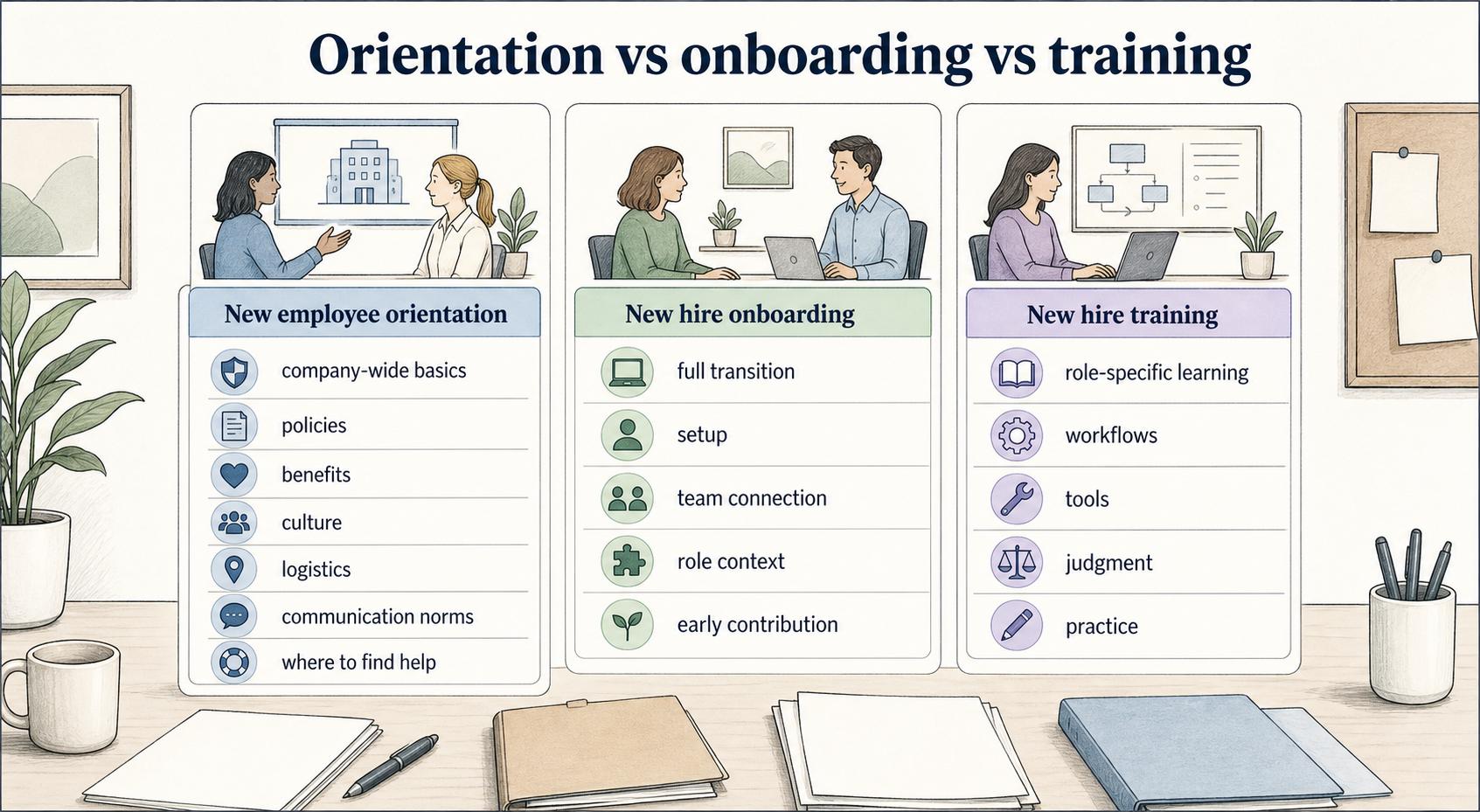
These terms sit close together, but they answer different questions. New employee orientation introduces company-wide basics: policies, benefits, culture, logistics, communication norms, and where to find help. New hire onboarding starts before day one and carries the employee through setup, team connection, role context, and early contribution. New hire training is role-specific learning: workflows, tools, judgment, and practice.
This distinction prevents a common mistake: assuming a new hire is onboarded because they attended orientation. Orientation may explain how the company works. It doesn't, by itself, teach the employee how to perform the job or make onboarding handoffs happen.
A practical orientation agenda
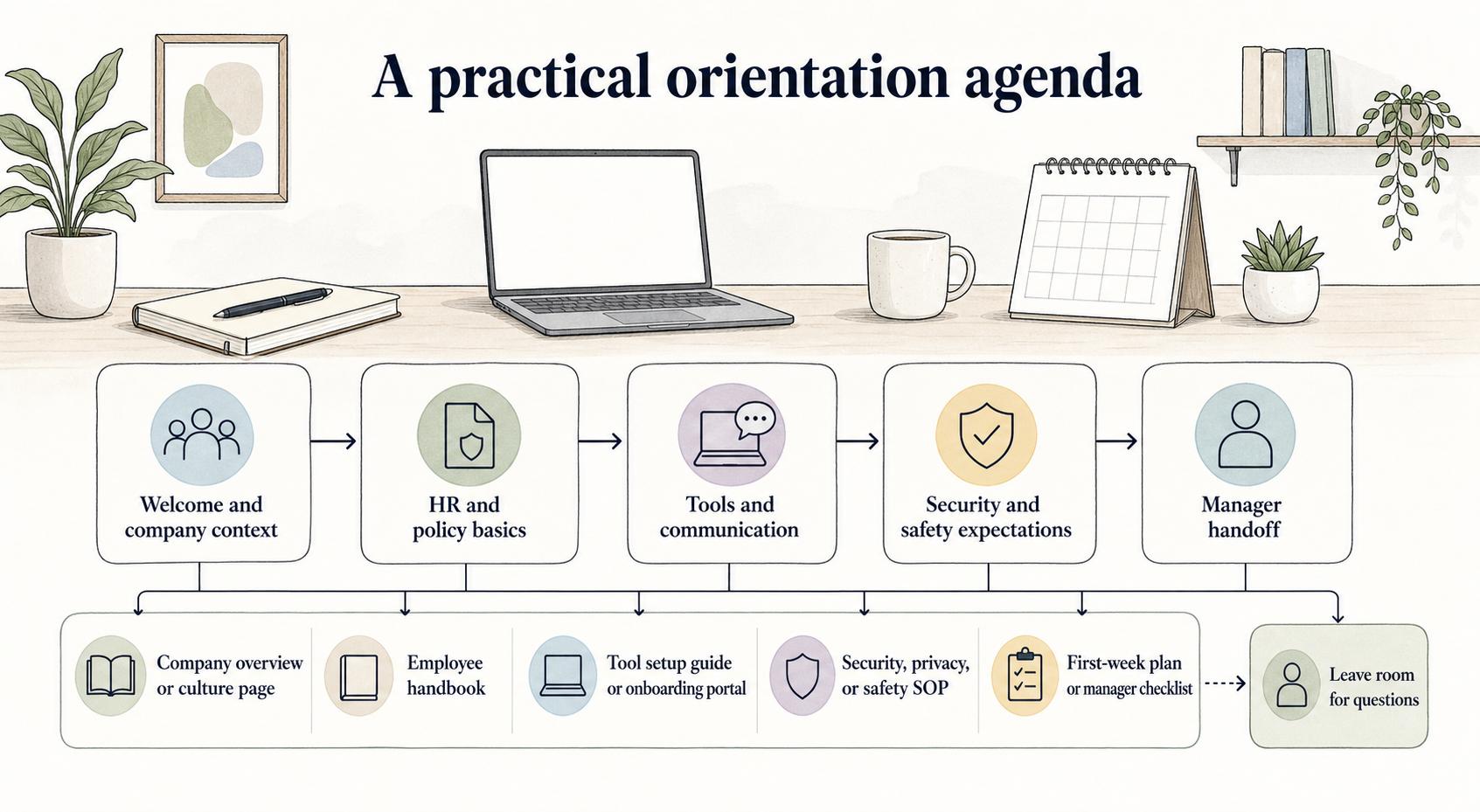
A useful orientation agenda gives structure without trying to answer every question at once.
| Agenda item | What it should answer | Follow-up resource |
|---|---|---|
| Welcome and company context | Why does this organization exist, and who does it serve? | Company overview or culture page |
| HR and policy basics | What rules, benefits, and employee responsibilities matter immediately? | Employee handbook |
| Tools and communication | Where does work happen, and how should people communicate? | Tool setup guide or onboarding portal |
| Security and safety expectations | What must the employee protect, avoid, or report? | Security, privacy, or safety SOP |
| Manager handoff | What happens after orientation ends? | First-week plan or manager checklist |
Leave room for questions. A rushed slide deck can technically cover the material while doing very little to orient the person.
Common orientation mistakes
Orientation fails when it becomes an information dump. New employees are absorbing names, systems, expectations, and logistics at the same time. More information isn't automatically more useful.
Watch for these patterns:
- Every policy is covered in one sitting, whether or not it matters immediately
- Link lists are long but priorities are unclear
- Slides are read aloud instead of translated into practical expectations
- Orientation never connects to the manager's first-week plan
- Remote, hybrid, or location-specific details are handled as afterthoughts
- Screenshots, contacts, benefits links, or policy references are stale
- Employees leave without knowing where to ask basic questions
The useful test is simple: can the employee take the next step without guessing?
How to make orientation repeatable
Repeatable orientation needs ownership, maintenance, and a small set of dependable materials. 4 Useful assets include a standard agenda, employee handbook link, first-day checklist, tool setup guide, support contact list, and manager handoff checklist.
The hidden maintenance issue is that orientation content ages quickly. Benefits change, tools change, org charts change, remote norms change, and policy links move. If orientation materials are stale, the company teaches a new employee on day one that internal documentation can't be trusted.
Use a simple review rule: update orientation materials whenever policies, benefits, core tools, company structure, workplace norms, or support contacts change.
AI-ready orientation agenda prompt
Use this prompt to draft a focused orientation agenda:
## New employee orientation agenda prompt

**Glossary term:** New Employee Orientation
**Source:** Trails Glossary — trails.so/glossary/new-employee-orientation

---

### 01. Create a new employee orientation agenda

"Create a new employee orientation agenda for [company/team]. Keep it focused on company-wide information a new employee needs in the first day or first week. Include agenda item, owner, purpose, materials needed, follow-up resource, and what should be handled later in onboarding or role-specific training."
Documentation takeaway
New employee orientation exposes the quality of internal documentation. If HR, IT, and managers can't point a new employee to clear first-day information, the same gaps will show up in every onboarding cycle.
Keep orientation materials short, current, and connected to the next step. Save deeper job instruction for the training plan, and save the full transition workflow for onboarding.
Sources
- 1
SHRM. Onboarding Process. www.shrm.org/topics-tools/topics/onboarding/process.
- 2
Gallup. Employee Experience and Workplace Culture. www.gallup.com/workplace/323573/employee-experience-and-workplace-culture.aspx.
- 3
CDC. Clear Communication Index. www.cdc.gov/ccindex/index.html.
- 4
U.S. Office of Personnel Management. Employee orientation elements. www.opm.gov/policy-data-oversight/human-capital-management/hiring-reform/orientationelements/.