
Glossary
Manager Onboarding
 ChatGPT
 Perplexity
 Gemini
 Claude
What is manager onboarding?
Manager onboarding is the process of helping a new manager understand the people, expectations, processes, tools, operating rhythms, and decision rights they need to lead a team effectively. 1 It applies to external hires and internal employees moving into management roles.
Manager onboarding includes normal employee onboarding, but it adds a more sensitive layer: how leadership actually works inside the company. A manager needs the local context behind team rituals, performance practices, escalation paths, and unwritten decision patterns.
Why manager onboarding matters
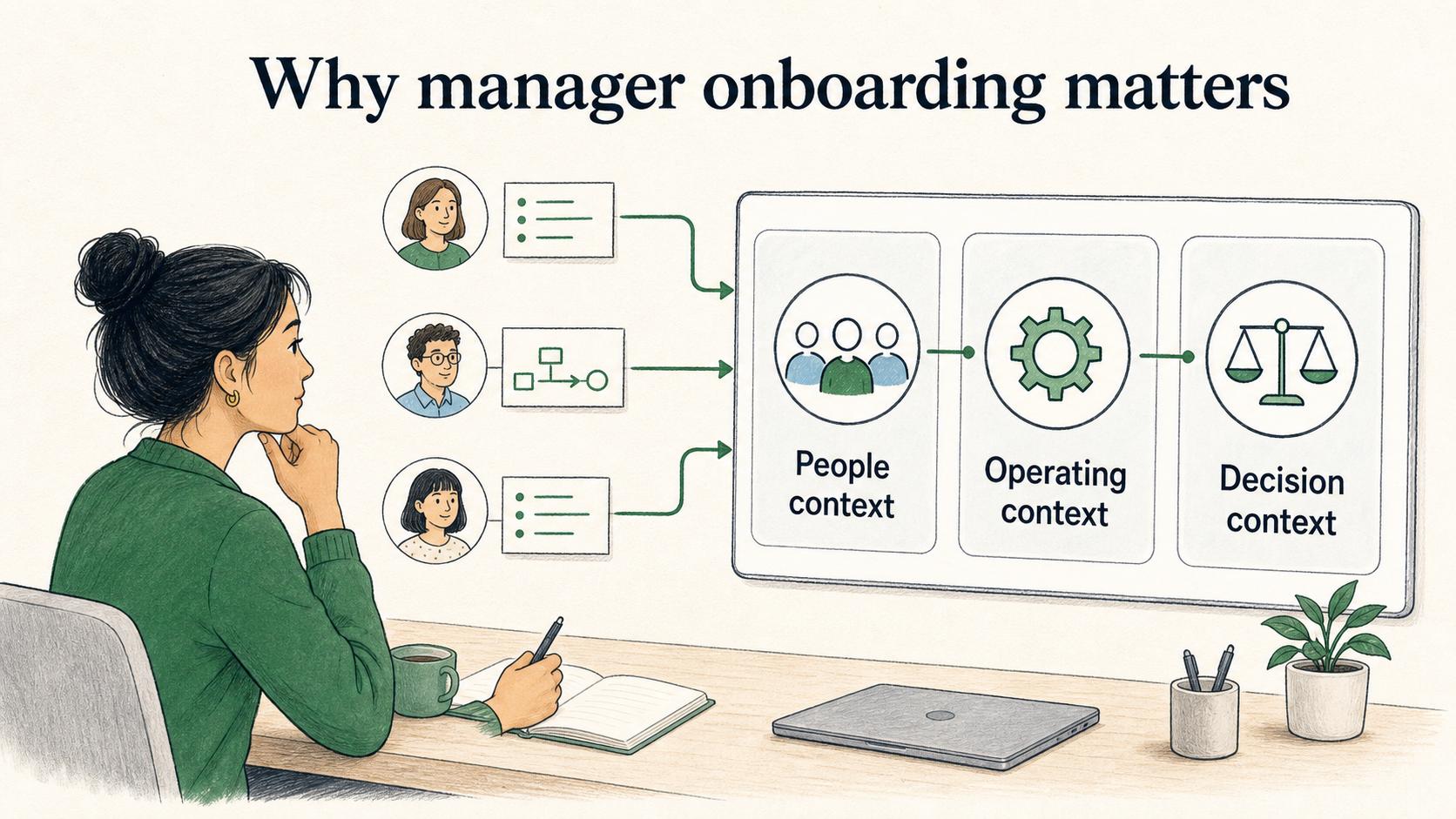
A new individual contributor can often ramp by learning their role, tools, and immediate work. A new manager ramps through other people. 2 That makes the onboarding gap larger and more visible.
If manager onboarding is weak, the manager spends months guessing how performance is handled, which meetings matter, what the team already tried, who owns cross-functional decisions, and where process knowledge lives. The result is usually not one dramatic failure. It's slow trust-building, inconsistent coaching, missed context, and decisions made with incomplete information.
Good manager onboarding shortens that guessing period. It gives the manager enough operating context to listen well, make better calls, and avoid accidentally resetting work the team already understands.
Manager onboarding vs employee onboarding
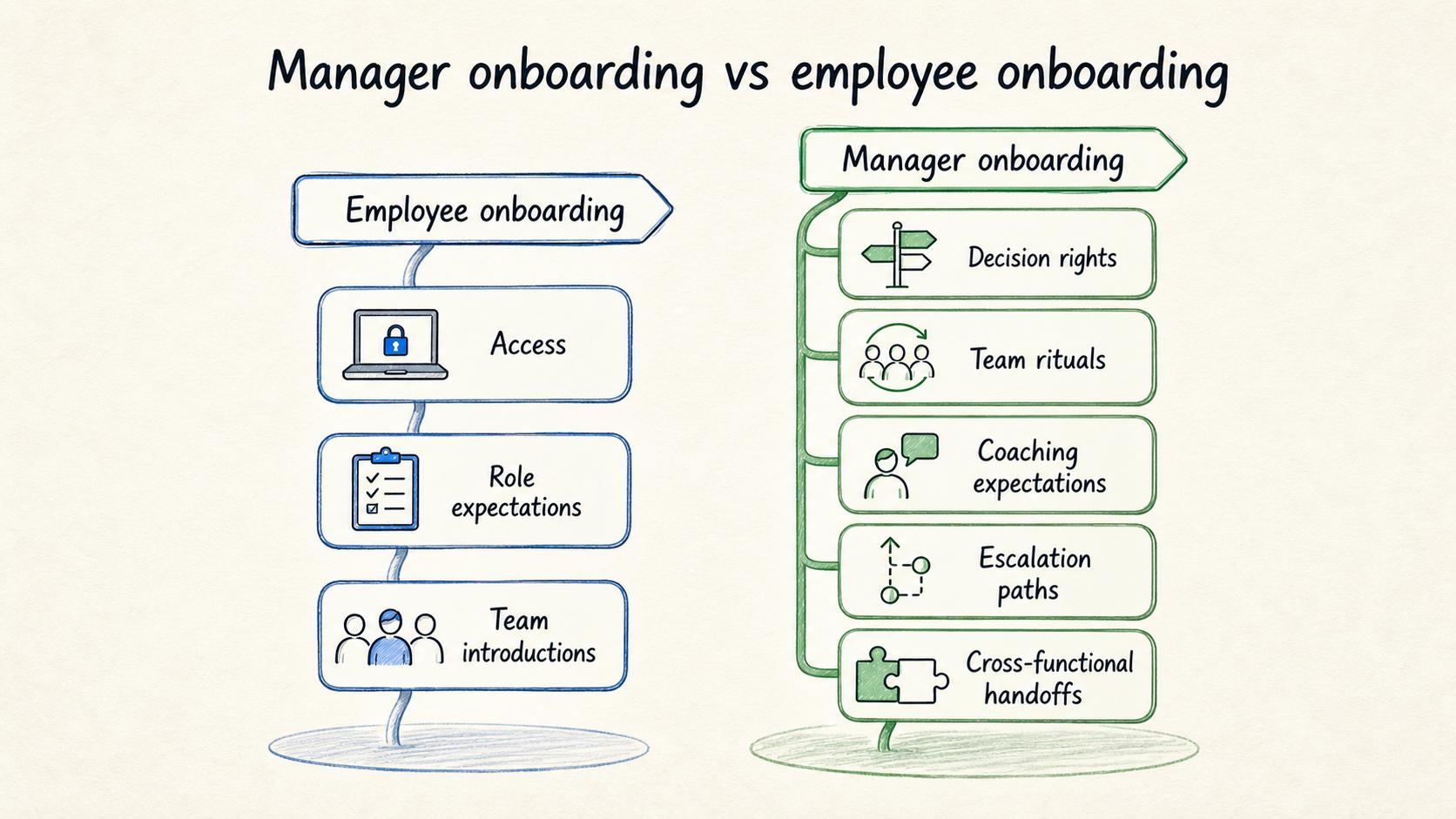
Employee onboarding helps someone join the company, get access to tools, understand their role, and start productive work. Manager onboarding adds responsibility for other people's work: decision rights, team rituals, coaching expectations, performance practices, escalation paths, and cross-functional handoffs. That management transition is its own leadership challenge, not just a longer orientation checklist. 3
Every manager still needs the basics: systems access, benefits, company orientation, role expectations, and team introductions. The manager layer explains how to lead in this specific environment, not how to be a manager in general.
What manager onboarding should include
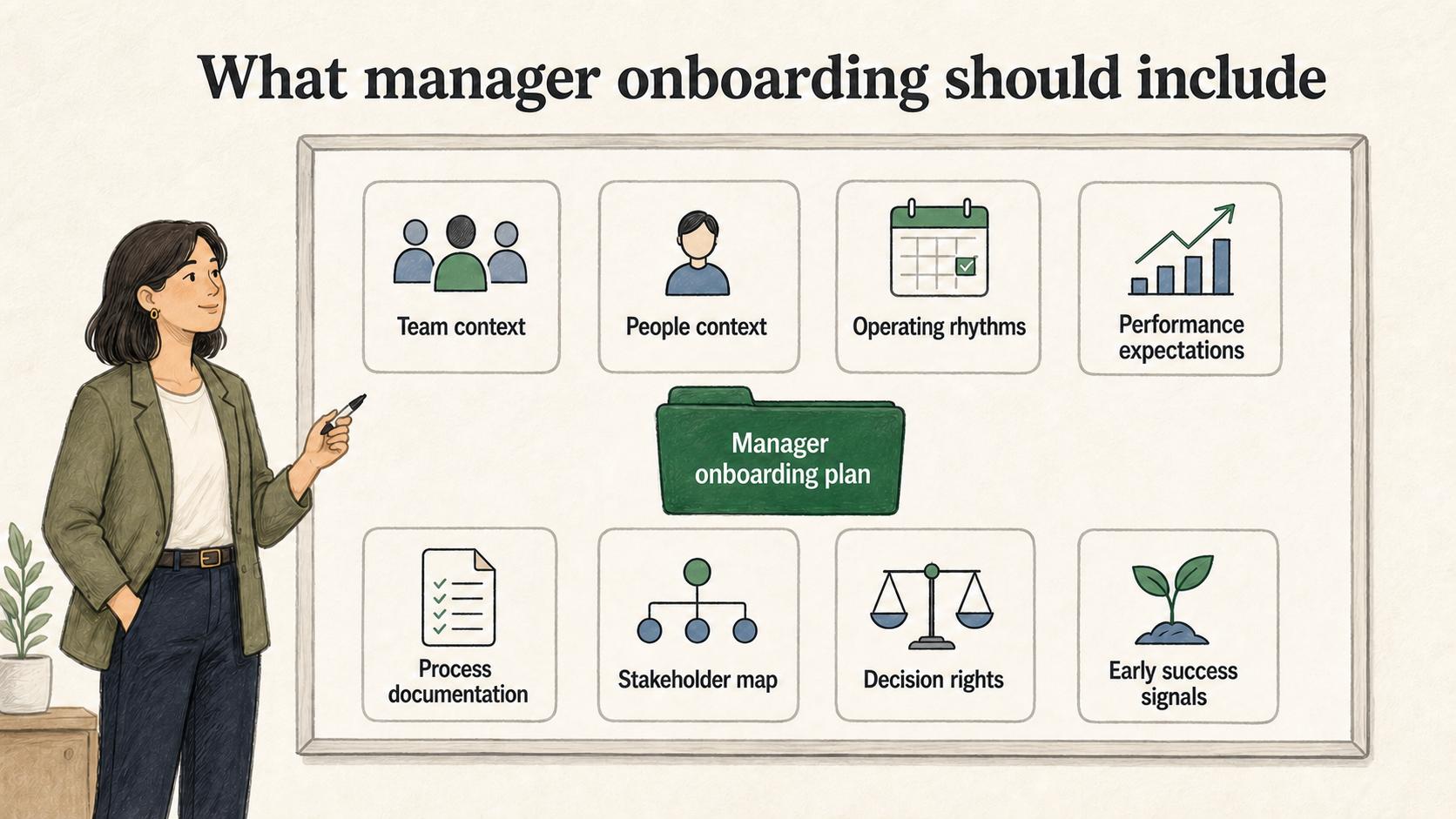
A useful manager onboarding plan should cover:
- Team context: Current goals, responsibilities, constraints, history, and open commitments.
- People context: Direct reports, roles, strengths, risks, development needs, and current one-on-one cadence.
- Operating rhythms: Team meetings, reporting routines, planning cycles, escalation paths, and decision forums.
- Performance expectations: How goals, feedback, reviews, promotions, and performance concerns are handled.
- Process documentation: SOPs, playbooks, dashboards, customer handoffs, and recurring workflows the manager owns or influences.
- Stakeholder map: Key partners, dependencies, approval paths, and places where handoffs commonly break.
- Decision rights: What the manager can decide, what needs approval, and what should be escalated.
- Early success signals: What should be true after 30, 60, and 90 days.
The hidden failure mode is assuming a capable manager can infer company-specific leadership norms. Experience helps, but it doesn't replace local context.
A practical 30-60-90 day manager onboarding timeline
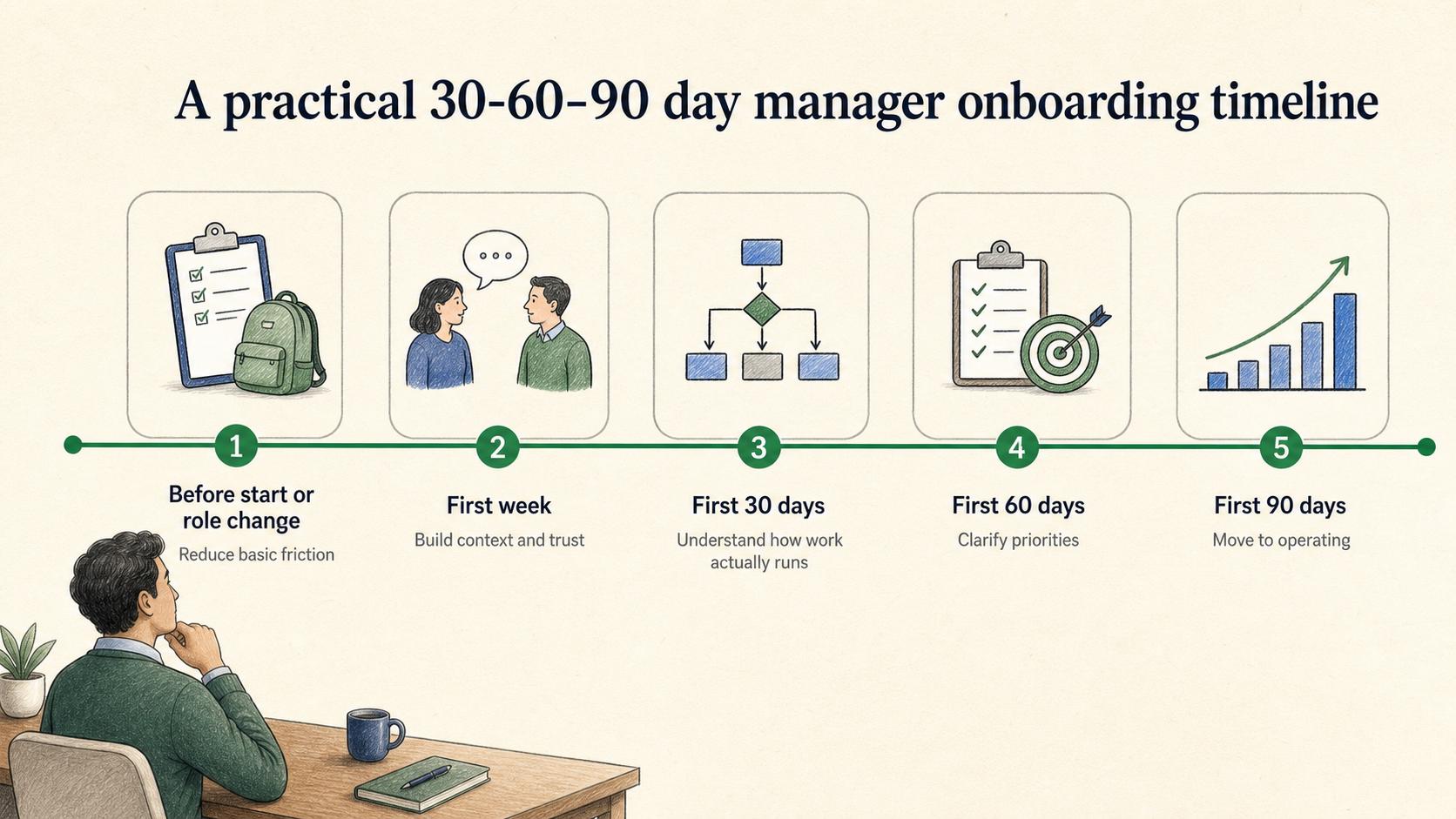
A manager onboarding timeline should balance learning with accountability. 4 The manager needs room to understand the system before changing it.
| Timing | Primary goal | Useful onboarding work |
|---|---|---|
| Before start or role change | Reduce basic friction | Prepare access, team overview, org chart, stakeholder list, manager playbook, and key documentation |
| First week | Build context and trust | Meet direct reports, review current priorities, understand team rituals, and learn critical systems |
| First 30 days | Understand how work actually runs | Review SOPs, dashboards, handoffs, customer issues, performance context, and recurring meetings |
| First 60 days | Clarify priorities and decision patterns | Align with leadership, identify process gaps, confirm team goals, and improve one or two obvious handoffs |
| First 90 days | Move from learning to operating | Own the management cadence, document gaps, improve team rituals, and set development priorities |
The sequence matters. A manager who starts by changing process before understanding history creates noise. A manager who waits too long to act loses momentum. The onboarding plan should make both risks visible.
Documentation that helps managers ramp
Manager onboarding works better when important context is written down before the manager needs it. Useful materials include a team playbook, role expectations, decision-rights guide, process maps, SOPs, meeting SOPs, reporting routines, stakeholder map, escalation procedures, performance review guide, and current priorities list.
These artifacts don't replace conversations. They make conversations better. A manager can spend less time asking where things live and more time asking why the team works that way.
The most useful documents are specific to the team. Generic leadership training may help, but it won't explain the team's current risks, customers, systems, or handoffs.
Common manager onboarding mistakes
The first mistake is treating manager onboarding as a longer version of new hire onboarding. Managers need people context, decision context, and operating context, not just access and orientation.
The second mistake is hiding sensitive context until it becomes urgent. Performance issues, unresolved team conflict, customer escalations, and broken handoffs should be introduced carefully, but they shouldn't be invisible.
The third mistake is giving the manager a list of meetings without explaining the purpose of each one. A meeting cadence is only useful if the manager understands what decisions, records, and follow-up each meeting is supposed to produce.
How Trails helps
Trails helps teams capture repeatable workflows as someone performs them and turn those workflows into polished step-by-step guides. Teams can also create AI-narrated video versions for training or sharing.
For manager onboarding, that means important operating knowledge can live outside scattered conversations: recurring team processes, meeting routines, handoffs, dashboard updates, customer workflows, and tool procedures. New managers get a clearer starting point, and existing teams avoid re-explaining the same process from memory every time leadership changes.
Sources
- 1
SHRM. Viewpoint: 5 Key Steps to Effective Manager Onboarding. www.shrm.org/topics-tools/news/employee-relations/viewpoint-5-key-steps-to-effective-manager-onboarding.
- 2
Gallup. Engage Frontline Managers. www.gallup.com/workplace/395210/engage-frontline-managers.aspx.
- 3
Center for Creative Leadership. First-Time Managers Must Conquer These Challenges. www.ccl.org/articles/leading-effectively-articles/first-time-managers-must-conquer-these-challenges/.
- 4
Harvard Business School Alumni. Tackle the First 90 Days of Your Next Role: A 5-Step Process for Success on the Job. www.alumni.hbs.edu/careers/blog/post/tackle-the-first-90-days-of-your-next-role-a-5-step-process-for-success-on-the-job.