
Glossary
Welcome Kit
 ChatGPT
 Perplexity
 Gemini
 Claude
What is a welcome kit?
A welcome kit is a curated set of materials, instructions, and context that helps someone get oriented at the start of a relationship with a company, team, program, or product. It may be used for employees, customers, contractors, partners, volunteers, or event participants.
A good welcome kit is not just a box of branded items or a folder of links. Its job is to reduce first-week uncertainty: what should I do first, where do I find the essentials, who can help me, and what does success look like here?1
What a welcome kit includes
The contents should match the audience. A new employee needs access instructions and team context. A new customer needs implementation steps and support channels. A partner may need brand assets, process expectations, and a point of contact.
Most welcome kits still do the same core jobs:
| Component | Purpose | Example |
|---|---|---|
| Welcome message | Sets tone and names the relationship | Note from a manager, founder, or customer success owner |
| First-step checklist | Turns arrival into action | Account setup, kickoff booking, required forms, first training task |
| Key links | Prevents link hunting | HR portal, product docs, internal knowledge base, support channel |
| Context guide | Explains what matters | Team charter, customer goals, company overview, project brief |
| Support map | Shows who to ask | Manager, buddy, IT contact, payroll owner, CSM |
| Practical assets | Removes early friction | Equipment, access badge, product samples, templates, workspace supplies |
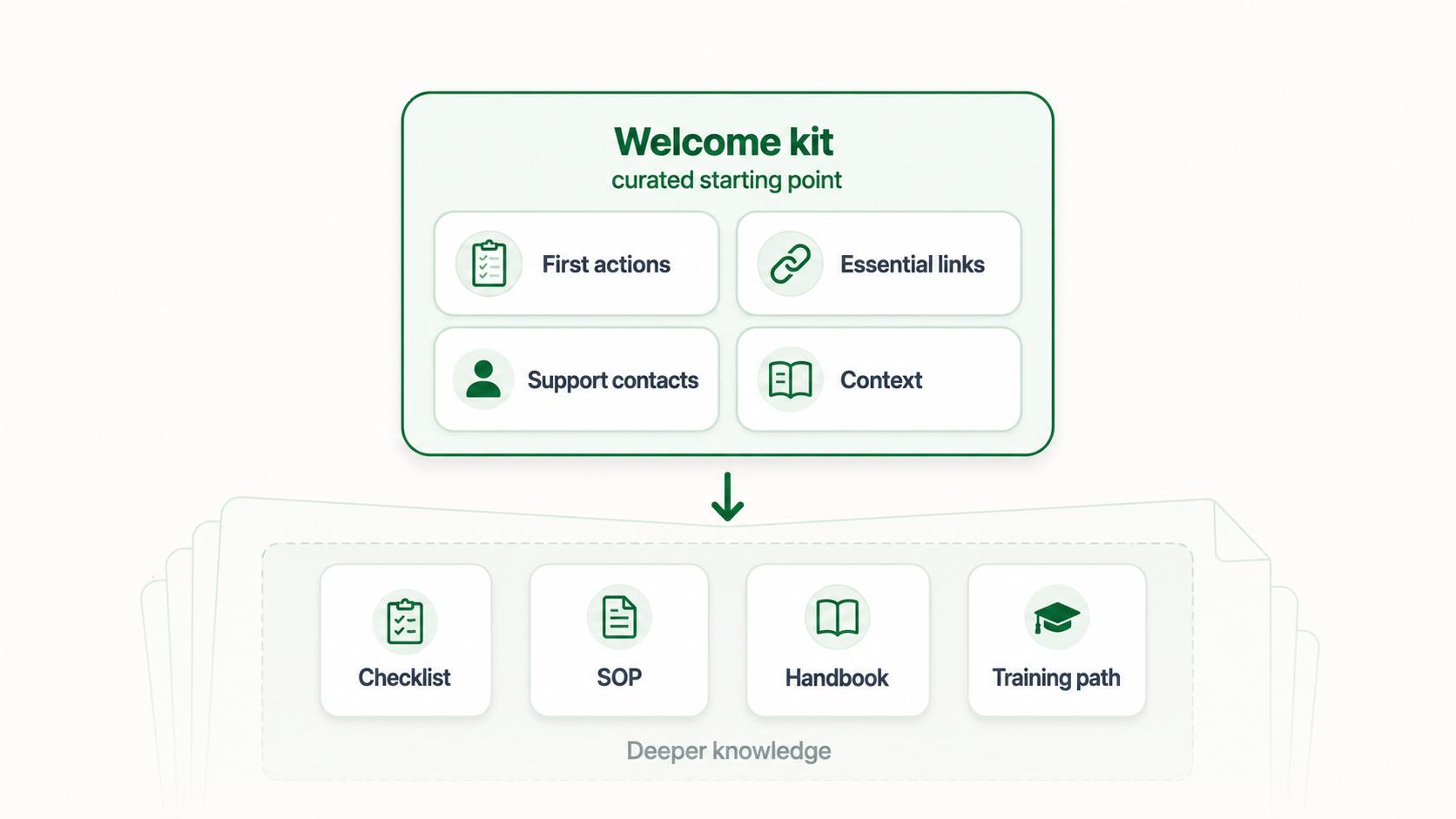
The best kits are selective. They do not try to teach everything at once. They point people to the right next few things and make it clear where deeper documentation lives.2
Employee welcome kit vs customer welcome kit
An employee welcome kit helps someone join the organization. It usually includes company context, role expectations, first-week tasks, equipment details, benefits links, security basics, team introductions, and onboarding milestones.
A customer welcome kit helps someone start using a product or service. It may include kickoff instructions, account setup steps, implementation timeline, training resources, support contacts, billing information, and success criteria.
The mistake is using one structure for both. Employees need belonging and operating context. Customers need progress and confidence. Both need clarity, but the emotional and practical jobs are different.
What makes a welcome kit useful
A welcome kit becomes useful when it is organized around the first real questions the recipient will have. Those questions usually come in order:
- What is happening next?
- What do I need to complete before that?
- Where do I get access or help?
- What should I read now, and what can wait?
- How will I know I am on track?
That order matters. Many welcome kits fail because they are built around what the company wants to share, not what the recipient can absorb. A 40-link kit looks thorough, but it asks a new person to sort the system before they understand the system; Gallup's onboarding research suggests that strong onboarding is still uncommon, which makes clarity a practical advantage.3
A sharper kit creates a guided path. It might say: complete these three setup tasks, read this short team overview, join these two channels, meet these people, and save these deeper resources for week two.
Common mistakes
The first mistake is confusing a welcome kit with an employee handbook. A handbook is the policy reference. A welcome kit is the first-mile guide. Link to the handbook where needed, but do not make the new person hunt through a policy document to learn what to do on day one.
The second mistake is overloading the kit with culture language and underloading it with operational help. A warm message is useful. So is a company story. But a new hire still needs laptop setup, calendar expectations, access instructions, and an answer to "Where do I ask if this does not work?"
The third mistake is leaving the kit ownerless. Welcome kits go stale quickly because tools, links, people, benefits, product names, and onboarding sequences change. If no one owns the kit, it becomes a time capsule.
Welcome kit template
Use this compact structure when building a new welcome kit:
## Welcome Kit Template

**Glossary term:** Welcome Kit
**Source:** Trails Glossary — trails.so/glossary/welcome-kit

---

### 01. Build a focused welcome kit

"Welcome kit for: [audience]
Owner: [team or person]
Primary outcome: By the end of [time period], the recipient should be able to [outcome].

1. Welcome note
- Who is welcoming them?
- What should they feel confident about next?

2. First actions
- Before day one / before kickoff:
- Day one / kickoff:
- First week / first milestone:

3. Essential links
- Setup:
- Policies or requirements:
- Training:
- Support:

4. People and support
- Main contact:
- Backup contact:
- Specialist contacts:

5. Do not include yet
- Resources that are useful later but too early for this kit:

6. Maintenance
- Review cadence:
- What should trigger an update:"
The most valuable line is often "Do not include yet." It forces the team to separate orientation from the full knowledge base.
Documentation takeaway
A welcome kit should be a doorway into the larger documentation system. It should not contain every answer. It should route someone to the right checklist, SOP, policy, product guide, or training material at the right moment.
That means the kit needs to be maintained like a product surface. If a setup process changes, update the kit. If the same question comes up in every onboarding cycle, add the answer or link to the guide. If a resource is no longer part of the first week, remove it.
How Trails helps
Trails helps teams create the guides that a welcome kit points to. A teammate can capture a setup workflow, onboarding task, or internal process as they perform it, then turn that capture into a polished step-by-step guide.
That keeps the welcome kit lighter and more useful. Instead of cramming every instruction into one document, the kit can link to accurate guides and AI-narrated video walkthroughs for the tasks people actually need to complete.
FAQ
What is the purpose of a welcome kit?
The purpose of a welcome kit is to help someone get oriented quickly. It gives them the first actions, essential resources, support contacts, and context they need to start well.
Is a welcome kit only for employees?
No. Welcome kits can be used for employees, customers, contractors, partners, volunteers, program members, or event participants. The contents should change based on what that audience needs first.
What should not go in a welcome kit?
Avoid dumping every policy, training resource, and company document into the kit. Long references should live in a handbook, knowledge base, or training path and be linked only when they are useful for the recipient's next step.
- Employee onboarding
- New hire onboarding
- Onboarding checklist
- Onboarding SOP
- Manager onboarding
- Employee handbook
- New employee orientation
Sources
- 1
SHRM. Onboarding. SHRM. www.shrm.org/topics-tools/topics/onboarding. Accessed June 23, 2026.
- 2
SHRM Foundation. Onboarding New Employees: Maximizing Success. SHRM Foundation. penedulearning.com/wp-content/uploads/2019/05/Onboarding-New-Employees_Maximizing-Success.pdf. Accessed June 23, 2026.
- 3
Gallup. Why the Onboarding Experience Is Key for Retention. Gallup. www.gallup.com/workplace/235121/why-onboarding-experience-key-retention.aspx. Accessed June 23, 2026.