
Glossary
Digital Marketing SOP
 ChatGPT
 Perplexity
 Gemini
 Claude
What is a digital marketing SOP?
A digital marketing SOP is a standard operating procedure that explains how a repeatable marketing workflow should be performed, reviewed, published, measured, or maintained in digital channels. It gives marketing teams a shared way to run work such as campaign launches, SEO publishing, email sends, paid ad QA, social media approvals, analytics reporting, and content updates.
A digital marketing SOP protects creative time by making recurring production work reliable. The team should spend its judgment on strategy, creative decisions, and customer insight, not on rediscovering the same launch steps every week.
Why digital marketing SOPs matter
Marketing teams run on recurring workflows with a lot of small risks. A landing page needs tracking. An email needs segmentation, proofing, and compliance checks. 1 A campaign needs naming conventions, approvals, creative assets, UTM parameters, publishing timing, and post-launch monitoring. 2 When these details live only in people's heads, quality depends on whoever happens to be available.
A digital marketing SOP makes the operating pattern visible. It tells the team what good looks like, who owns each handoff, what must be checked before publishing, and what happens when something does not fit the standard path.
This gets harder as marketing work becomes more cross-functional. 3 A single campaign may involve product marketing, demand generation, design, sales, customer success, legal, and analytics. Judgment still matters; the SOP handles routine coordination so reviewers can spend attention on exceptions, quality, and customer impact.
What makes a marketing SOP digital
A digital marketing SOP is usually stored and maintained in a digital workspace, but the format alone does not make it useful. It has to fit the way marketing work actually happens.
For example, an email launch SOP should link to the email platform, show the required QA checks, define who approves audience selection, and explain what to do if a metric looks wrong after send. A social media SOP should cover the planning workflow, approval path, channel-specific constraints, and escalation rules for sensitive replies.
A PDF that says "review campaign before launch" gives the team a file, but not enough operational detail. A strong digital SOP names the specific checks, the owner, the tool, the evidence of completion, and the exception path.
Common digital marketing SOP examples
| Workflow | What the SOP should clarify | Hidden failure mode |
|---|---|---|
| Campaign launch | Brief, assets, approvals, tracking, QA, launch owner | The launch happens, but attribution or follow-up is broken |
| SEO publishing | Keyword, outline, review, internal links, metadata, publish checklist | Content ships without the search or conversion basics |
| Email send | Segment, suppression, personalization, testing, approval, monitoring | The message reaches the wrong audience or misses a required proofing step |
| Paid ad QA | Creative, URL, budget, audience, tracking, compliance notes | Ads go live with broken links or inconsistent naming |
| Social media publishing | Calendar, copy, creative, channel rules, approvals, response plan | Posts are approved but no one owns monitoring or escalation |
The best SOPs are specific enough to prevent known mistakes without turning every campaign into bureaucracy. If a step never changes the outcome, it probably belongs in training material or background context, not the SOP itself.
How to create a digital marketing SOP
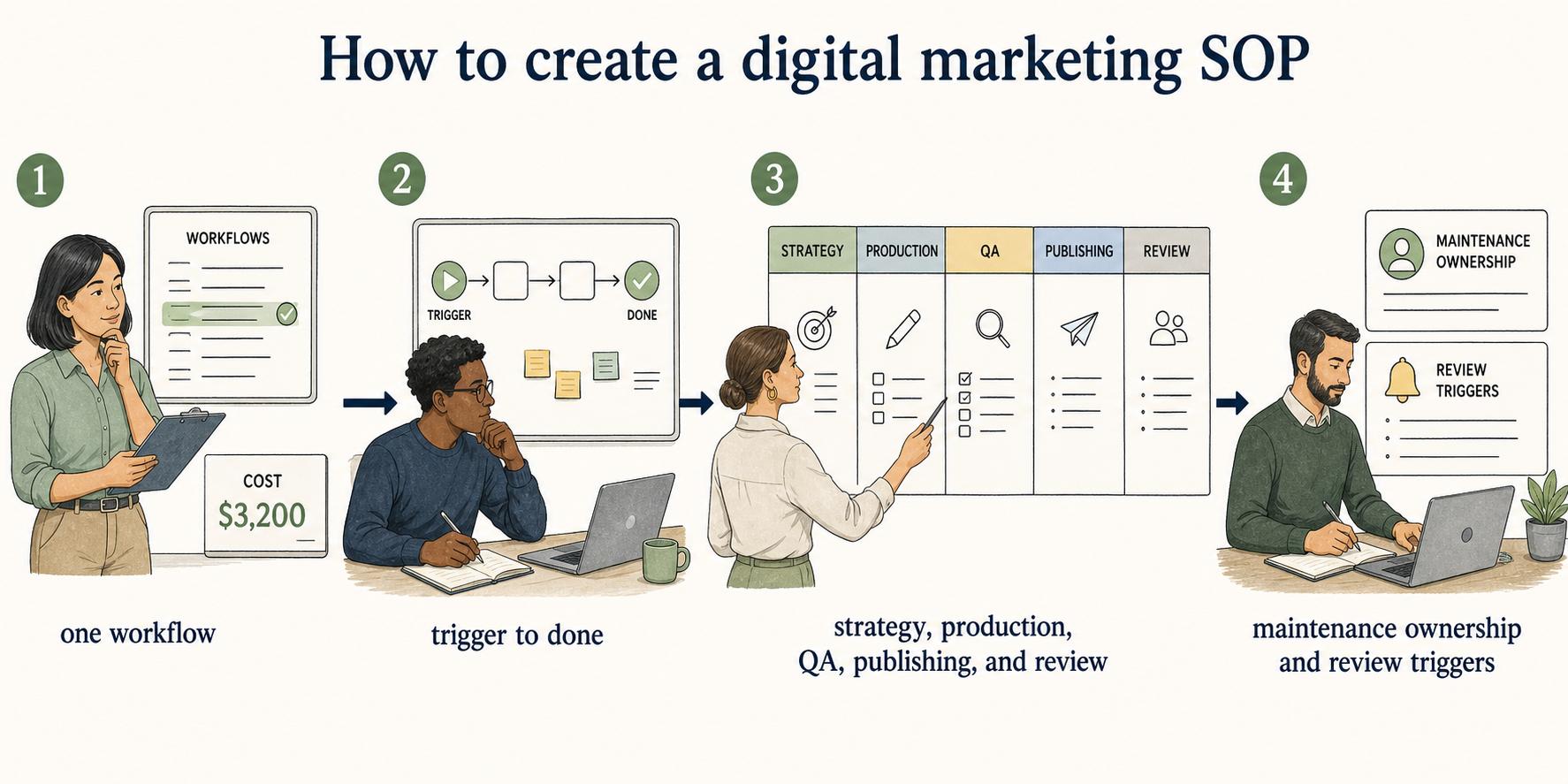
Start with one workflow that repeats and creates real cost when it goes wrong. Don't begin by documenting everything in the marketing department. Good candidates include work with handoffs, compliance sensitivity, frequent rework, external deadlines, or reporting dependencies.
Next, capture the workflow as it actually runs. Ask the person who does the work to walk through the process from trigger to done. Watch for the moments where they switch tools, wait for approval, copy a field, check a naming convention, or rely on memory. Those are usually the steps that deserve documentation.
Then separate the SOP from the strategy. A strategy explains what audience, message, and offer the team should pursue. The SOP explains how the approved work moves through production, QA, publishing, and review. Mixing the two makes the SOP harder to use.
Finally, assign maintenance ownership. Marketing workflows change whenever tools, channels, positioning, compliance needs, or reporting expectations change. 4 A digital SOP should name who owns updates and what events trigger review.
A practical SOP structure
For most digital marketing workflows, use this structure:
## Digital Marketing SOP Template

**Glossary term:** Digital Marketing SOP
**Source:** Trails Glossary — trails.so/glossary/digital-marketing-sop

---

### 01. Create a digital marketing SOP

"SOP name: [workflow name]\nPurpose: [what this workflow protects or standardizes]\nTrigger: [when the SOP starts]\nScope: [included channels, teams, assets, or campaign types]\nRoles: [owner, contributors, approvers, backups]\nInputs required: [brief, assets, audience, offer, tracking plan]\nWorkflow steps: [ordered steps with tools and owners]\nQA checks: [what must be verified before publish/send/launch]\nException path: [what to do when work does not fit the standard process]\nCompletion evidence: [what proves the workflow is done]\nReview owner and cadence: [who keeps it current]"
The most useful fields are often trigger, QA checks, exception path, and completion evidence. Those are where vague SOPs usually fail.
Common mistakes
The first mistake is creating one giant "marketing SOP." Break SOPs into real operating units: newsletter send, webinar promotion, SEO refresh, paid campaign launch, social publishing, or customer story publication.
The second mistake is documenting the manager's memory instead of the operator's work. If the SOP does not include the fields, tools, screenshots, approvals, and edge cases that appear during execution, people will still need side conversations to finish the task.
The third mistake is ignoring the post-launch phase. Many marketing SOPs stop at publish or send, but the risk often continues afterward. Someone may need to monitor replies, check attribution, confirm landing page performance, capture learnings, or update a campaign log.
How Trails helps
Trails fits digital marketing SOPs because many marketing workflows happen across several browser-based tools. A marketer can perform the workflow once while Trails captures the steps, then turn that capture into a polished step-by-step guide. Trails can also create an AI-narrated video version for training teammates or handing work to a new owner.
That helps teams document the actual workflow instead of asking someone to reconstruct it from memory. It is especially useful for recurring workflows like publishing content, updating landing pages, preparing campaign assets, or running QA before launch.
Compare SOP software for maintaining campaign procedures. If the handoff already exists as a recording, you can also turn that video into a written SOP.
Sources
- 1
Federal Trade Commission. FTC CAN-SPAM Act compliance guide for business. Federal Trade Commission. www.ftc.gov/business-guidance/resources/can-spam-act-compliance-guide-business.
- 2
Google Analytics Help. Google Analytics help on campaign URL builders. Google. support.google.com/analytics/answer/10917952?hl=en.
- 3
Gartner. Gartner survey on marketing collaboration drag. Gartner. www.gartner.com/en/newsroom/press-releases/2024-05-14-gartner-survey-reveals-eighty-four-percent-of-marketers-report-experiencing-high-collaboration-drag-from-cross-functional-work.
- 4
Content Marketing Institute. Content Marketing Institute 2025 B2B content marketing benchmarks. Content Marketing Institute. contentmarketinginstitute.com/b2b-research/b2b-content-marketing-trends-research-2025.