
Glossary
Social Media SOP
 ChatGPT
 Perplexity
 Gemini
 Claude
What to include in approval rules
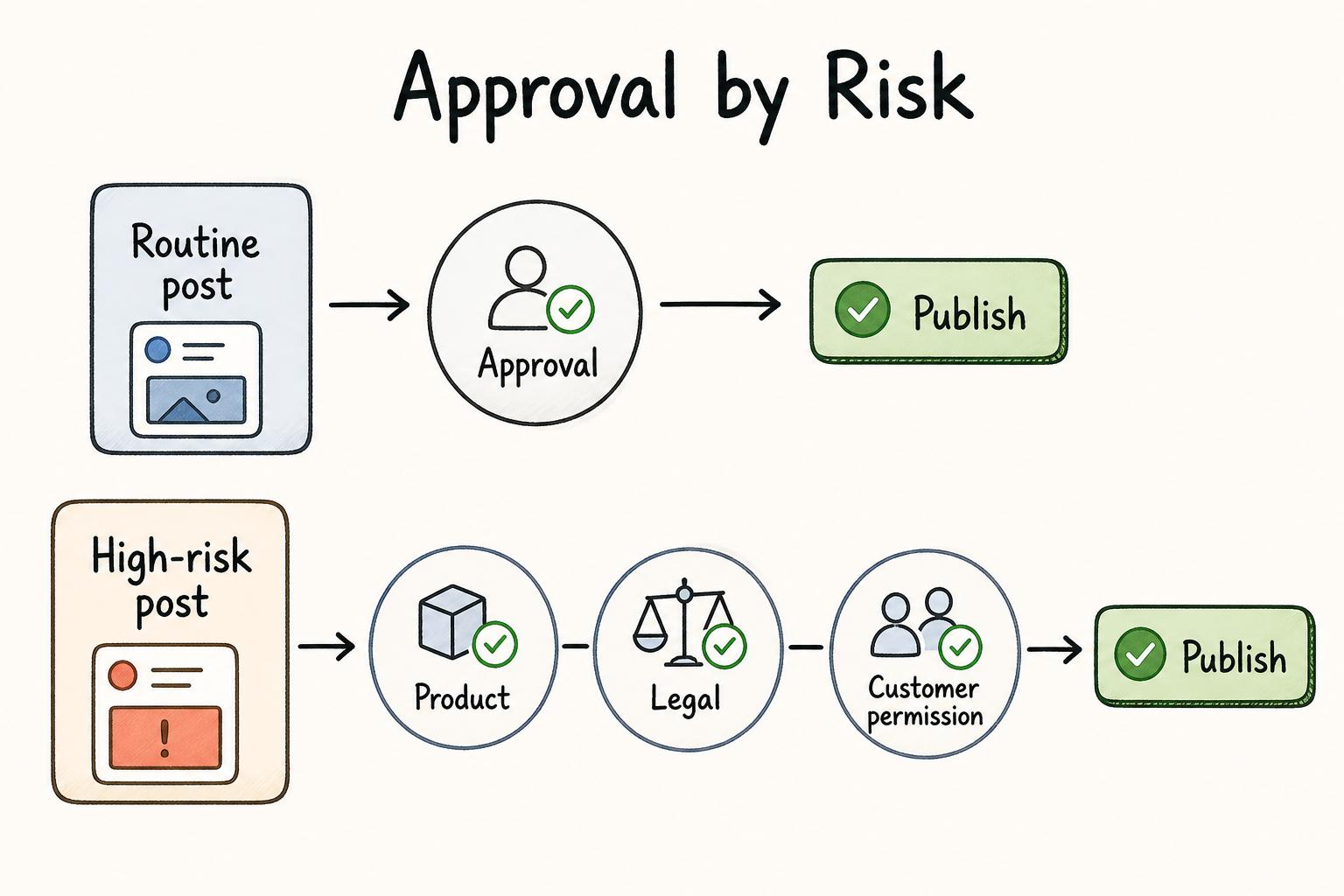
Approval rules should track risk. If every post needs three reviewers, the team slows down. If no post has review criteria, the wrong claim can go live.
A strong social media SOP separates low-risk content from posts that need specialist review. A routine culture post might need only a social lead. A launch post with product claims may need product marketing. A customer quote, pricing statement, security claim, legal topic, or crisis response needs a stricter path. FTC endorsement guidance is especially relevant because endorsements and testimonials must be honest and not misleading.3
- Routine evergreen post: social lead approval.
- Product feature post: product or product marketing approval.
- Customer quote, logo, or case result: customer permission confirmed before publishing.
- Pricing, security, compliance, legal, or financial claim: specialist review required.
- Complaint, crisis, safety issue, or sensitive public thread: escalation owner approves before reply.
Good approval rules remove guesswork. They should make a low-risk post easy to publish and a high-risk post hard to rush.
Social media SOP template
Use this template to draft a social media SOP that stays close to the real workflow:
## Social Media SOP Template

**Glossary term:** Social Media SOP
**Source:** Trails Glossary — trails.so/glossary/social-media-sop

---

### 01. Draft a social media SOP

"Social media SOP title: [brand, channel, or workflow]
Purpose: [why this SOP exists]
Scope: [channels, regions, brands, campaign types]
Roles: [planner, drafter, reviewer, approver, publisher, monitor]
Planning workflow: [how ideas enter the calendar]
Drafting requirements: [copy, creative, links, tags, accessibility]
Approval rules: [who reviews which content types]
Publishing steps: [tool, timing, final checks]
Monitoring steps: [comments, DMs, mentions, response windows]
Escalation triggers: [legal, PR, customer, safety, security]
Reporting cadence: [metrics, owner, and review rhythm]
Account access rules: [who can publish, approve, and remove access]
Owner: [person or team]
Review cadence: [monthly, quarterly, after channel or policy changes]"
Keep the first version close to the real workflow. If the SOP describes an ideal process nobody follows, it will be ignored.
- Standard operating procedure
- Marketing SOP
- SOP scope
- SOP training
- SOP software
- Publishing workflow
- Content approval workflow
Sources
- 1
Federal Trade Commission. Advertising and Marketing. FTC. www.ftc.gov/business-guidance/advertising-marketing. Accessed July 6, 2026.
- 2
U.S. General Services Administration. Social Media. Section508.gov. www.section508.gov/create/social-media/. Accessed July 6, 2026.
- 3
Federal Trade Commission. The FTC's Endorsement Guides: What People Are Asking. FTC. www.ftc.gov/business-guidance/resources/ftcs-endorsement-guides-what-people-are-asking. Accessed July 6, 2026.
- 4
Cybersecurity and Infrastructure Security Agency. Require Multifactor Authentication. CISA. www.cisa.gov/audiences/small-and-medium-businesses/secure-your-business/require-multifactor-authentication. Accessed July 6, 2026.
Social media SOP workflow example
A practical SOP often follows this flow:
The roles can change by team. The SOP should still name who owns each stage and what must be true before the work moves forward. For scheduled posts, accessibility checks such as alt text should be part of the publishing step.2