
Glossary
Marketing SOP
 ChatGPT
 Perplexity
 Gemini
 Claude
What is a marketing SOP?
A marketing SOP is a standard operating procedure that explains how a repeatable marketing workflow should be completed. It defines the steps, owners, tools, approvals, quality checks, handoffs, and records for work such as campaign launches, content publishing, email sends, social posts, lead handoff, and reporting.1
A good marketing SOP doesn't remove creative judgment. It protects the operational path around creative work so the team doesn't skip approvals, break tracking, miss launch steps, or ask the same handoff questions every week.
Why marketing SOPs matter
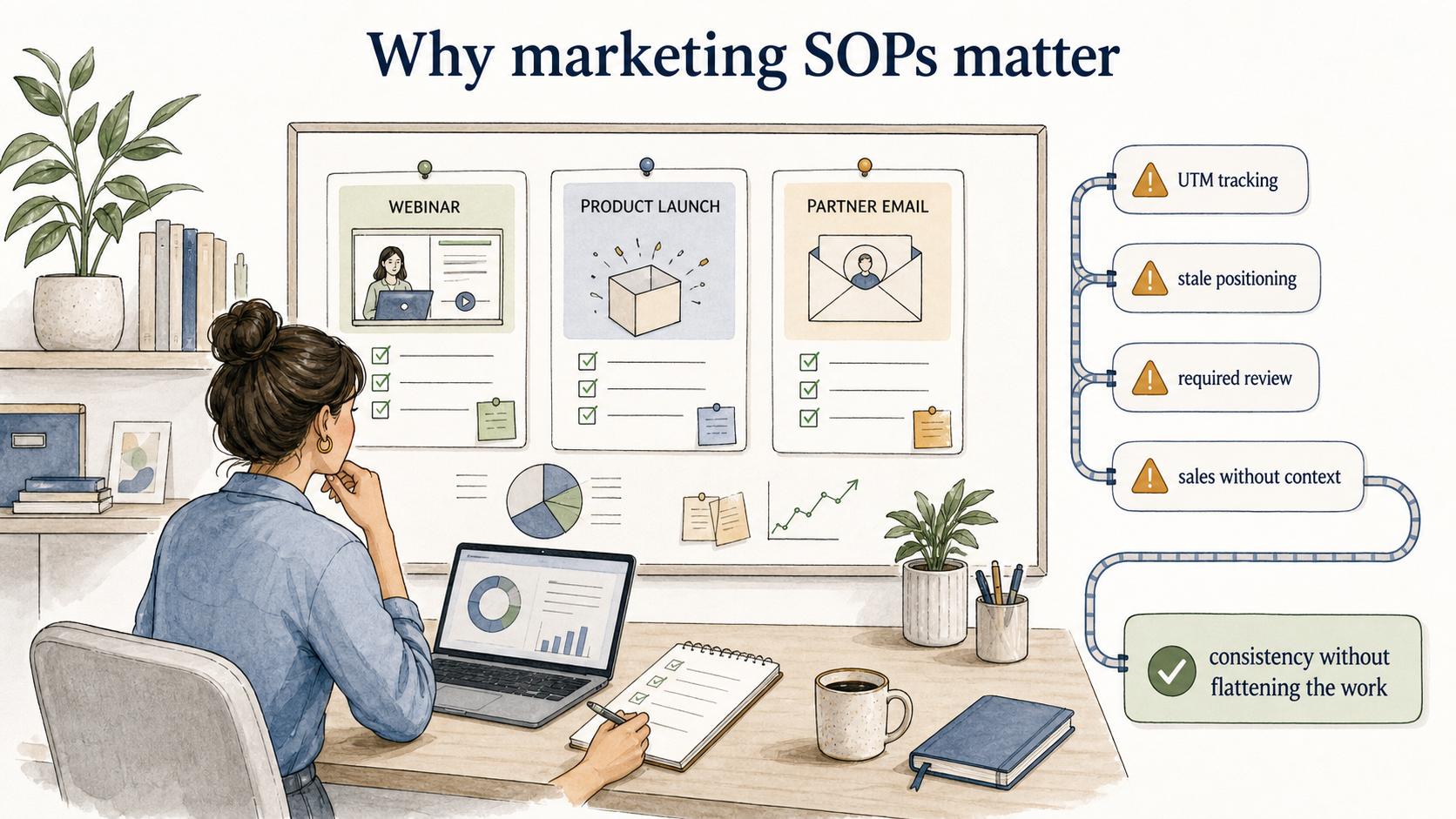
Marketing work often looks custom on the surface. One campaign is a webinar, another is a product launch, and another is a partner email. Underneath, the same operating questions keep coming back: who owns the brief, who reviews copy, who checks links, who approves the audience, who publishes, and who reads the results?
A marketing SOP makes those answers explicit. It helps teams avoid preventable misses such as launching without UTM tracking, publishing with stale positioning, skipping required review, or sending leads to sales without context.2
The useful stance is consistency without flattening the work. The SOP should define the rails around the campaign, not write the campaign for the marketer.
Which marketing workflows need SOPs
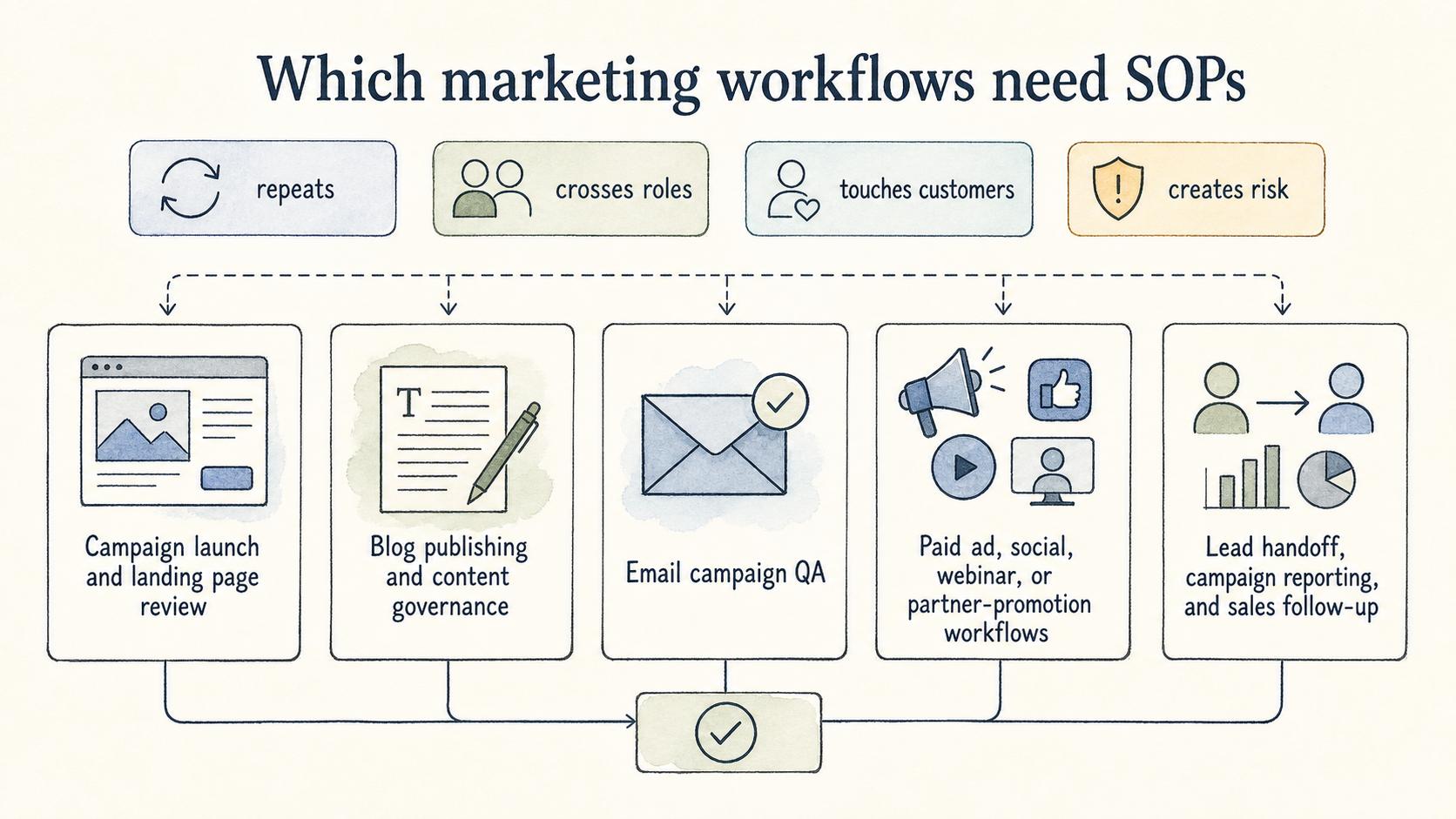
A workflow usually needs a marketing SOP when it repeats, crosses roles, touches customers, or creates risk when someone improvises. Common candidates include:
- Campaign launch and landing page review.
- Blog publishing and content governance.
- Email campaign QA, audience selection, and send approval.
- Paid ad, social, webinar, or partner-promotion workflows.
- Lead handoff, campaign reporting, and sales follow-up.
A one-off experiment may only need a project plan. Once the team repeats the work, sees the same mistakes, or trains someone else to do it, an SOP becomes worthwhile.
What a marketing SOP should include
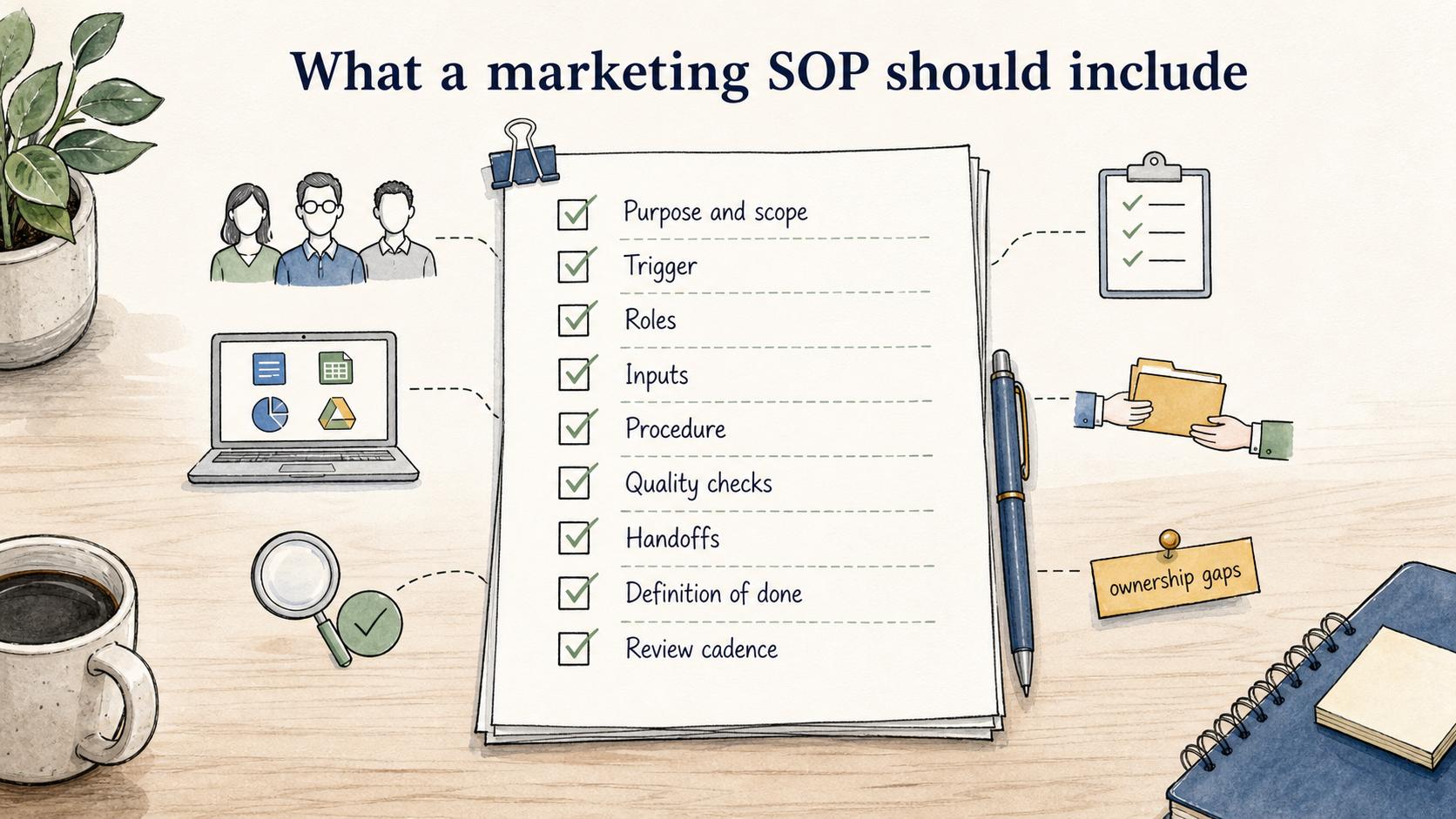
A practical marketing SOP should be specific enough to guide execution and light enough to survive real work:
- Purpose and scope: What the SOP covers and what it intentionally leaves out.
- Trigger: What starts the workflow, such as an approved campaign brief or publish-ready draft.
- Roles: Owner, contributors, reviewers, approvers, and backup owner.
- Inputs: Briefs, assets, audience lists, source copy, budget, tracking plan, or launch date.
- Procedure: The steps in the order they actually happen.
- Quality checks: Links, forms, attribution, audience filters, brand review, legal review when endorsements or testimonials are involved, and accessibility checks for web content.34
- Handoffs: Where work moves between marketing, sales, product, customer success, design, or operations.
- Definition of done: What must be true before the workflow is complete.
- Review cadence: Who updates the SOP when channels, tools, or approval rules change.
The handoff section is often the most important part. Many marketing misses aren't strategy failures; they're ownership gaps at the moment work crosses from one person or system to another.
Marketing SOP example
For an email campaign SOP, the trigger might be an approved campaign brief. The owner is the lifecycle marketer. Inputs include audience criteria, copy, design, suppression rules, links, tracking parameters, and send date.
The procedure might cover draft creation, peer review, design QA, audience check, link test, approval, test send, final scheduling, post-send monitoring, and reporting. The definition of done might require the email to be sent, performance captured, follow-up tasks created, and learnings added to the campaign record.
That level of detail prevents avoidable mistakes without pretending every email should sound the same.
AI-ready marketing SOP template
Use this prompt to create a useful first draft:
## Marketing SOP Template

**Glossary term:** Marketing SOP
**Source:** Trails Glossary — trails.so/glossary/marketing-sop

---

### 01. Create a marketing SOP

"Create a marketing SOP for [workflow] used by [team].

Context:
- Workflow goal: [goal]
- Trigger: [what starts the work]
- Main owner: [role]
- Contributors: [roles]
- Reviewers or approvers: [roles]
- Tools used: [tools]
- Required inputs: [briefs, assets, audience, budget, tracking, copy, etc.]
- Required outputs: [published asset, campaign, report, handoff, decision, etc.]

Write the SOP with these sections:
1. Purpose and scope
2. Roles and responsibilities
3. Required inputs
4. Step-by-step procedure
5. QA checks and approval rules
6. Handoffs
7. Definition of done
8. Records to store
9. Review cadence

Keep creative judgment separate from operational requirements. Name the failure modes the SOP is meant to prevent."
After drafting, test it against the most recent time the workflow ran. If the SOP can't explain the real handoffs, approvals, and cleanup work, it's still too generic.
Common mistakes
The first mistake is documenting preferences as rules. Brand voice, campaign strategy, and required compliance review don't belong in the same category.
The second mistake is leaving tool setup out of the SOP. Marketing work often breaks in the details: tracking parameters, CRM fields, audience suppression, form routing, CMS status, or calendar timing.
The third mistake is treating the SOP as finished after launch. Marketing channels and tools change quickly, so SOPs need clear ownership and lightweight review.
How Trails helps
Trails helps marketing teams capture repeatable workflows as they happen and turn them into polished step-by-step guides. It can also create AI-narrated video versions for training or handoff.
That is useful for marketing SOPs because many workflows live inside tools: CMS publishing, email QA, campaign setup, reporting, lead routing, and social scheduling. Capturing the actual steps makes the SOP easier to follow than a checklist built from memory.
Sources
- 1
The Pedowitz Group. How Do I Document Marketing Operations Processes Effectively?. The Pedowitz Group. www.pedowitzgroup.com/how-do-i-document-marketing-operations-processes-effectively. Accessed July 24, 2026.
- 2
Google Analytics Help. URL builders: Collect campaign data with custom URLs. Google. support.google.com/analytics/answer/10917952?hl=en. Accessed July 24, 2026.
- 3
Federal Trade Commission. Endorsements, Influencers, and Reviews. Federal Trade Commission. www.ftc.gov/business-guidance/advertising-marketing/endorsements-influencers-reviews. Accessed July 24, 2026.
- 4
WebAIM. WebAIM's WCAG 2 Checklist. WebAIM. webaim.org/standards/wcag/checklist. Accessed July 24, 2026.