
Glossary
Competency Based Training
 ChatGPT
 Perplexity
 Gemini
 Claude
What is competency based training?
Competency based training teaches and assesses people against observable job skills. Learners progress by showing they can perform a defined task to the required standard, instead of only attending a class or finishing a module. It asks a practical question: can this person do the work well enough for the role?1
For teams, that distinction matters. Course completion can show exposure to information. Demonstrated competency shows whether someone can apply it in the setting where mistakes cost time, quality, safety, or customer trust.
How competency based training works
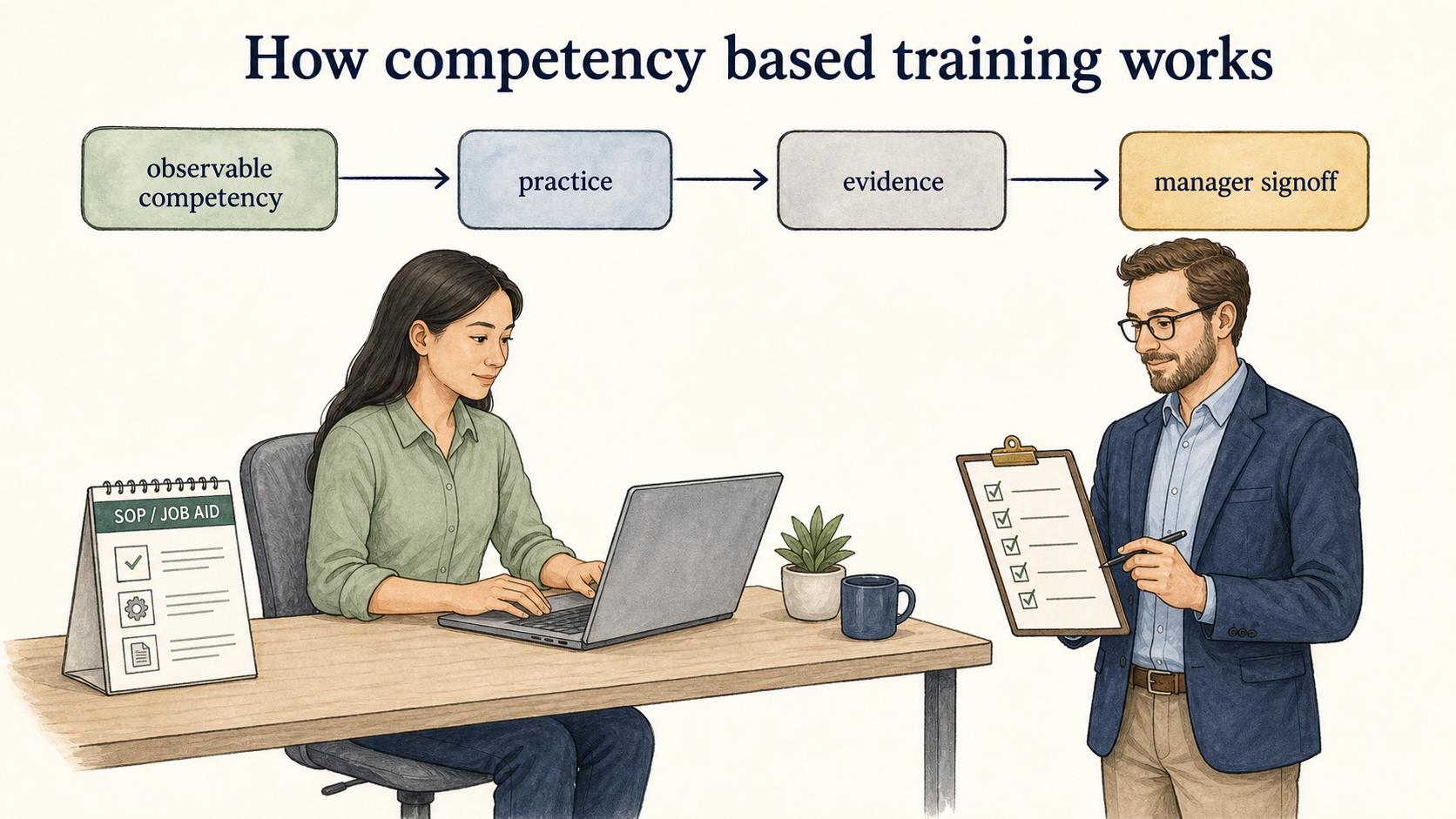
Competency based training starts by defining the outcomes that matter. Those outcomes are usually written as observable competencies: handle a refund request, complete a quality inspection, close a shift, configure a customer account, or respond to a security alert.2
Once the competency is defined, the training path works backward from proof. What practice does the learner need? What job aid or SOP supports the work? What evidence would make a manager comfortable signing off? The assessment should test whether the learner can perform the task consistently enough for the role, not whether they consumed the material.
That makes competency based training especially useful for onboarding, role changes, compliance-heavy work, customer support, operations, and any process where inconsistent execution creates downstream problems.
Competency based training vs traditional training
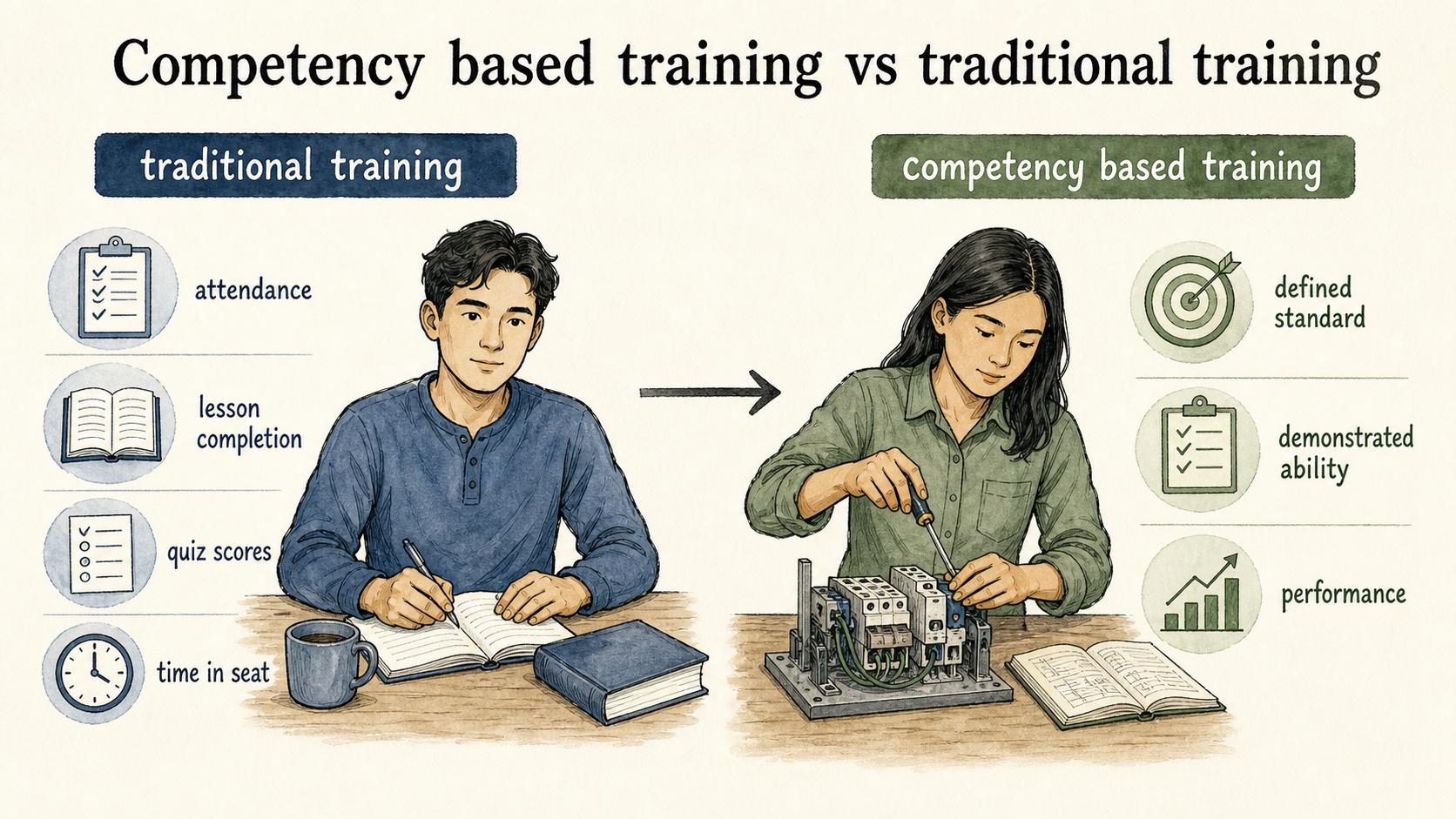
Traditional training often measures participation: attendance, lesson completion, quiz scores, or time in seat. Those signals are easy to track, but they can hide weak transfer to the job. Someone may pass a quiz and still freeze when a customer asks a messy question.
Competency based training measures performance against a defined standard. It may still include lessons, videos, readings, or workshops, but those are inputs. The output is demonstrated ability.
The tradeoff is effort. Competency based programs take more upfront design because the team must define the skill, the standard, and the evidence. That work is worth it when the task is important enough that “I covered it in training” is not a satisfying answer.3
What a good competency looks like
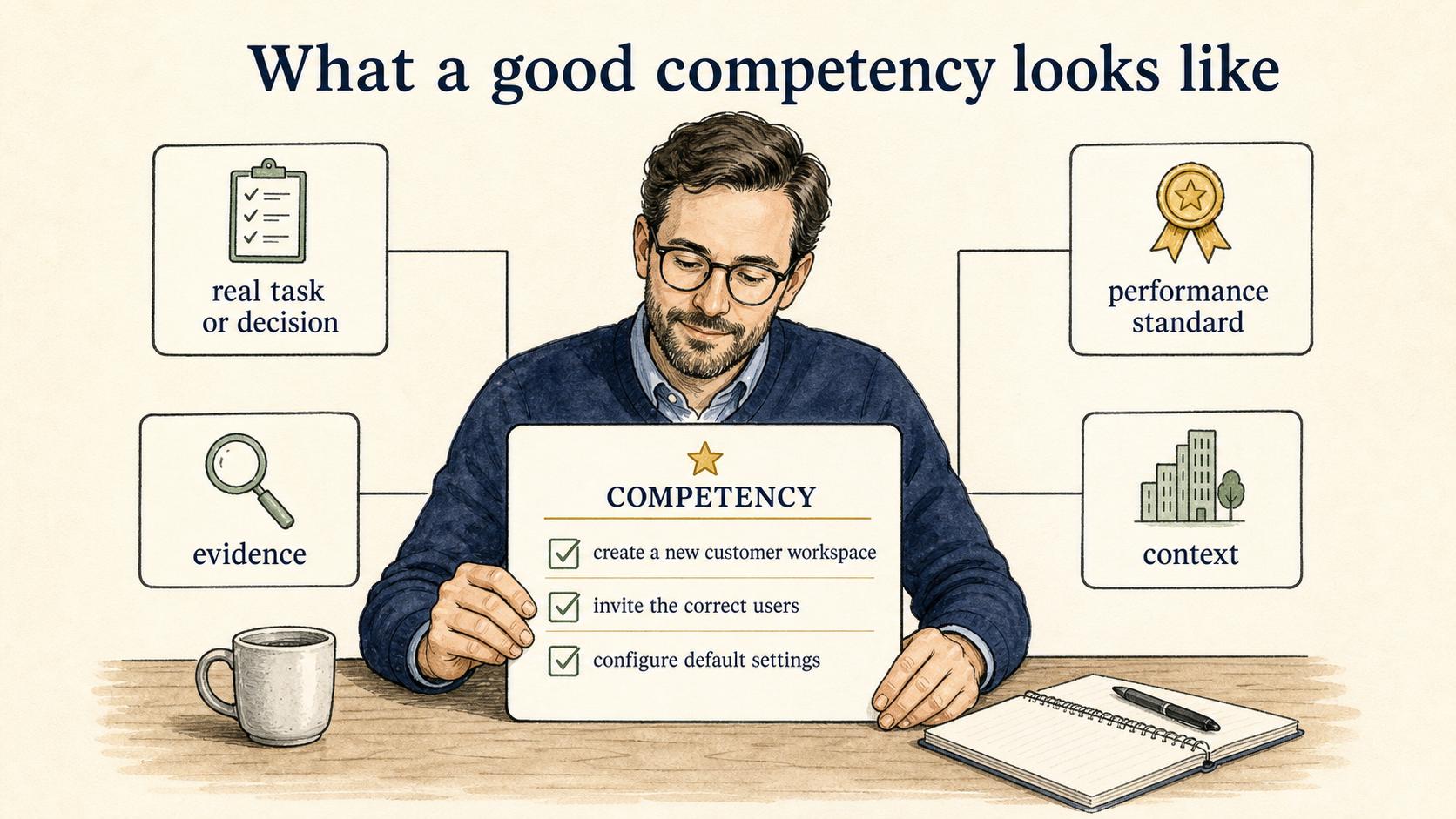
A useful competency is specific enough to observe. “Understands customer onboarding” is too vague. “Can create a new customer workspace, invite the correct users, configure default settings, and explain the first three actions to the customer” gives a manager something to evaluate.
A good competency usually includes:
- A real task or decision. The competency should map to work the person actually performs.
- A performance standard. Name what good looks like, including quality, timing, judgment, or escalation rules.
- Evidence. Decide whether proof comes from manager observation, a completed work sample, a simulation, a checklist, a recorded workflow, or system data.
- Context. Include the conditions that matter. A person may be competent with a clean example but not with an exception case.
The hidden failure mode is writing competencies that sound official but cannot be assessed. If two managers would score the same performance differently, the competency probably needs a clearer standard or a better example.
Example: support team onboarding
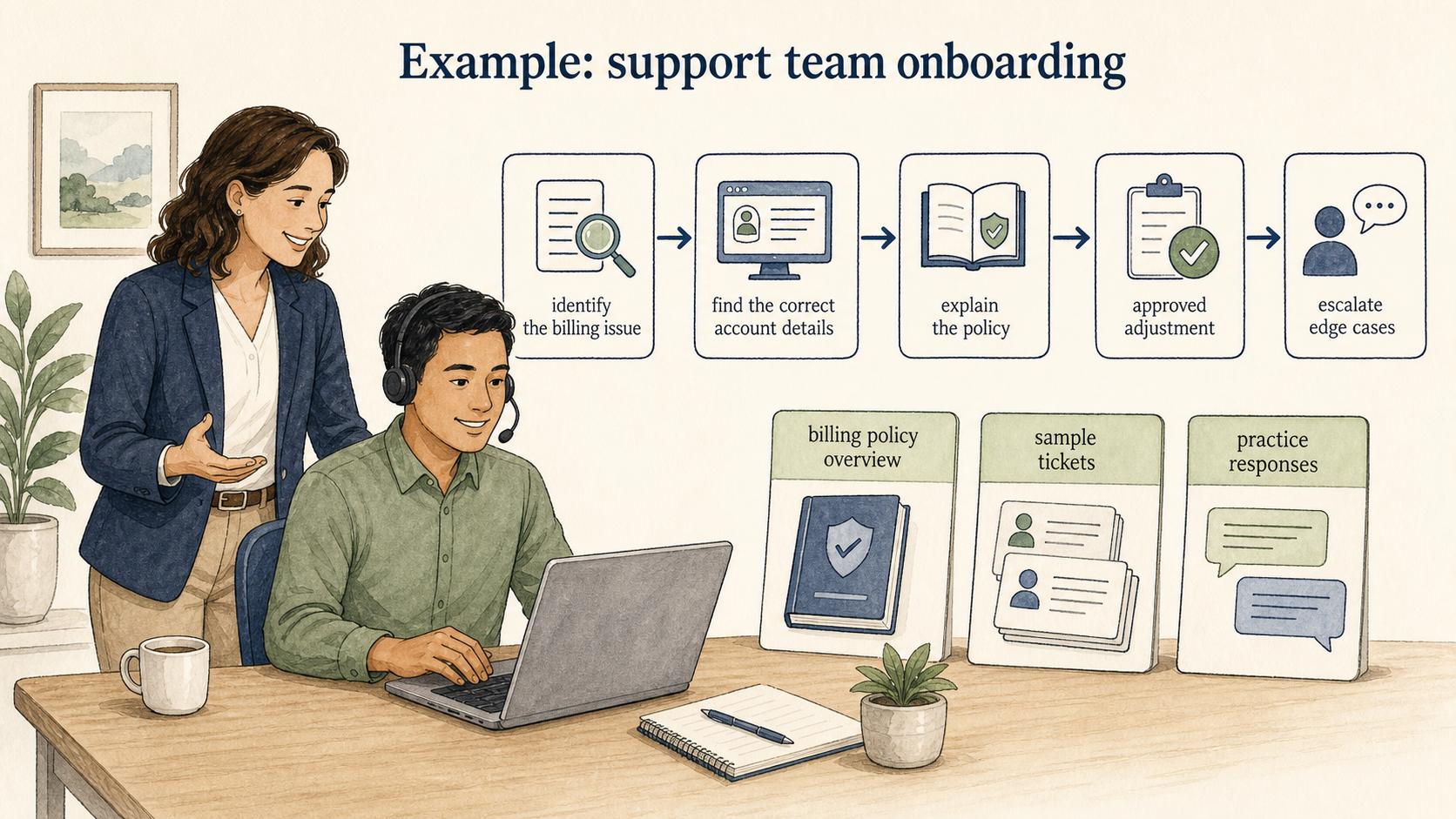
A support team might use competency based training for a new hire who needs to handle billing questions. The training path could include a billing policy overview, sample tickets, a recorded walkthrough, and practice responses.
The competency is judged by performance: the employee can identify the billing issue, find the correct account details, explain the policy in plain language, issue an approved adjustment when appropriate, and escalate edge cases without inventing an answer.
That framing changes the training conversation. Instead of asking whether the employee finished the billing module, the manager asks whether the employee can handle the billing workflow with enough accuracy and judgment to protect the customer experience.
AI-ready competency map template
Use this prompt to turn a role or process into clearer training outcomes:
## Create a competency based training map

**Glossary term:** Competency Based Training
**Source:** Trails Glossary — trails.so/glossary/competency-based-training

---

### 01. Prompt

"Create a competency based training map for [role/team] learning [process/task].

Include:
- 5-7 observable competencies
- the performance standard for each competency
- the evidence that would prove the competency
- common mistakes or edge cases to test
- the SOP, checklist, or job aid the learner should use
- a simple manager signoff rubric

Context:
- Team: [team]
- Process: [process]
- Audience: [new hires, existing employees, contractors, managers]
- Risk if performed poorly: [risk]
- Tools involved: [tools]"
A useful output from this prompt gives the manager a bridge between training content and on-the-job proof.
How to document competency based training
Documentation keeps competency based training from becoming subjective. Each competency should have a named owner, the current training materials, the assessment method, and the evidence record.
For repeatable tasks, pair the competency with the SOP or work instruction that teaches the process. The learner can see what standard they are practicing against, and the manager has a shared reference for coaching. When the process changes, update both the SOP and the competency check; otherwise, employees get assessed against outdated work.
How Trails helps
Trails helps teams turn real workflows into step-by-step training materials. A subject matter expert can perform a task once, and Trails captures the workflow and converts it into a polished guide. That gives learners a concrete reference for the competency they are expected to demonstrate.
For competency based training, this is useful because the training asset stays close to the real work. Teams can also create AI-narrated video versions for training, review, or manager signoff, which makes it easier to show what competent performance looks like.
FAQ
Is competency based training only for regulated industries?
No. It is common in regulated or safety-sensitive work, but it also helps support, sales, operations, onboarding, and software teams where people need to perform repeatable tasks well.
What is the difference between a competency and a learning objective?
A learning objective describes what someone should learn. A competency describes what they can demonstrate. The best training connects the two, but the competency is closer to job performance.
How do you assess competency based training?
Use observable evidence: work samples, manager observation, simulations, checklist completion, customer scenarios, or system records. The assessment should match the real task as closely as practical.
Why does competency based training fail?
It fails when competencies are vague, managers assess inconsistently, or the training materials do not match the current process. The fix is usually clearer standards, better examples, and tighter documentation.
Sources
- 1
International Labour Organization. Guide to competency-based training. www.ilo.org/sites/default/files/wcmsp5/groups/public/%40arabstates/%40ro-beirut/documents/publication/wcms_757836.pdf.
- 2
BMC Medical Education. Competency-based education: a scoping review. pmc.ncbi.nlm.nih.gov/articles/PMC10308607/.
- 3
University of Windsor. Implementing Competency-Based Education. celt.uwindsor.ca/index.php/CELT/article/view/4716/4201.