
Glossary
Employee Development
 ChatGPT
 Perplexity
 Gemini
 Claude
What is employee development?
Employee development is the ongoing process of helping employees build the skills, knowledge, judgment, and experience they need to grow in their current role and prepare for future responsibilities. It can include training, coaching, mentoring, stretch assignments, feedback, career planning, and documented learning paths.
Development should change what a person can do, decide, or own at work. A course may be part of that, but the outcome is capability.
Why employee development matters
Employee development helps teams close capability gaps before they become performance problems. The World Economic Forum's Future of Jobs Report 2025 says employers expect 39% of key skills required in the job market to change by 2030, which makes capability building an operating need. 1 A growing company needs people who can learn new tools, handle more complex work, step into leadership, improve processes, and transfer knowledge to others.
The common mistake is treating development as a perk separate from work. A learning stipend, training catalog, or occasional lunch-and-learn can be useful, but they do not guarantee capability. Development becomes meaningful when it is tied to the work the team needs to perform and the skills the employee needs to build next.
For employees, development answers a practical question: "How do I get better here?" Gallup identifies opportunities to learn and grow as a key driver of employee engagement, which is why development affects both capability and commitment. 2 For managers, it answers another: "What capability will this team need six months from now, and who is being prepared to provide it?"
Employee development vs employee training
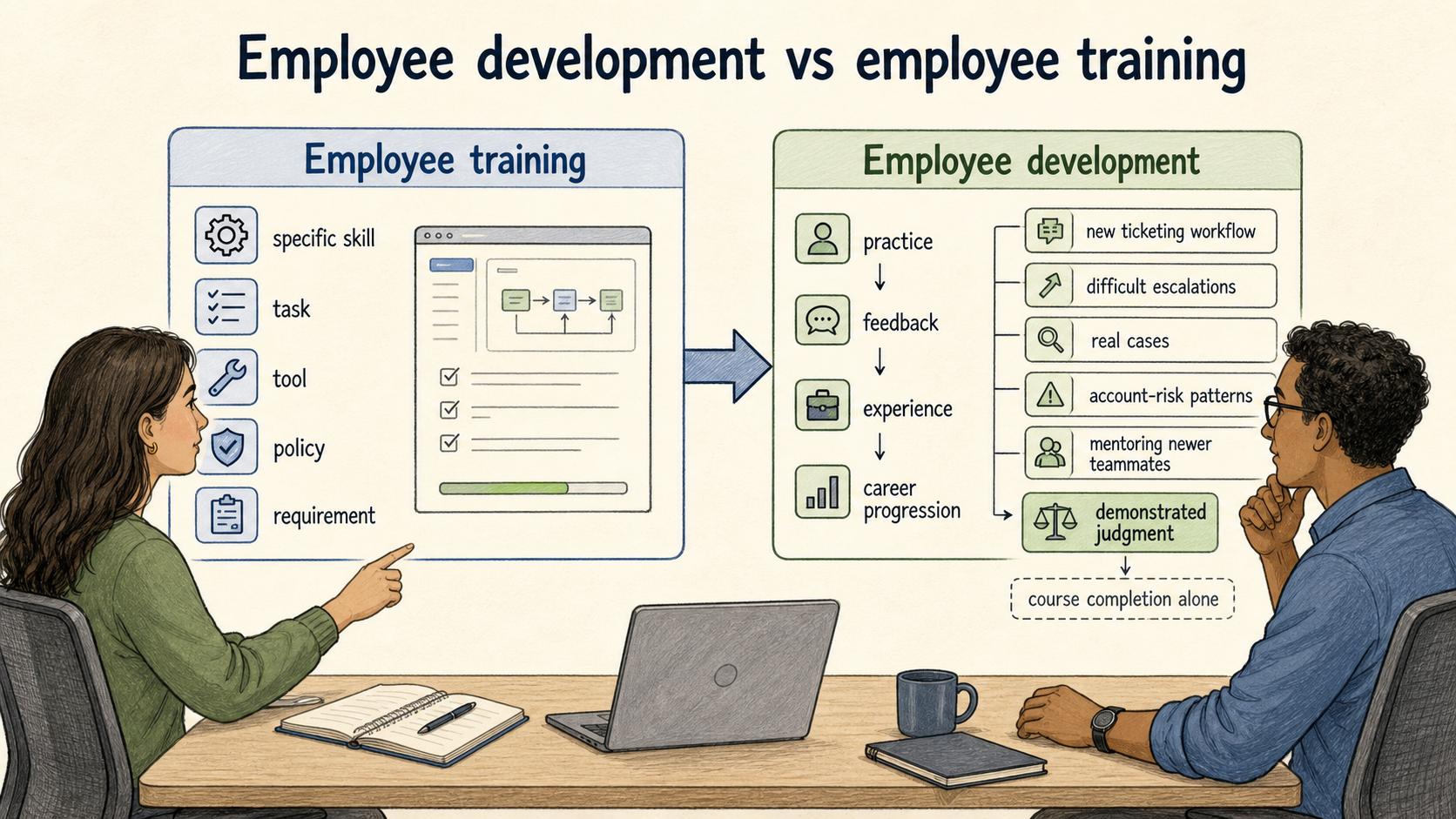
Employee training is usually focused on a specific skill, task, tool, policy, or requirement. Employee development is broader. It connects training with practice, feedback, experience, and career progression.
For example, a support agent might complete training on a new ticketing workflow. Development would include practicing difficult escalations, reviewing real cases with a manager, learning how to spot account-risk patterns, and eventually mentoring newer teammates. The difference shows up in demonstrated judgment, not course completion alone.
What employee development can include
A useful development program mixes methods because different capabilities grow in different ways:
- Formal learning for core concepts, tools, policies, or compliance requirements
- On-the-job practice where the employee applies the skill in real work
- Coaching and mentoring for feedback, judgment, and career context
- Stretch assignments that expand ownership without setting the person up to fail
- Knowledge sharing so one person's growth strengthens the team
Match the method to the gap. A course may teach terminology, but it will not build judgment by itself. A stretch assignment may build judgment, but it can feel like abandonment if the person has no support. ATD's 2025 State of the Industry release shows that organizations still invest formal time and budget in learning, while declining average learning hours per employee underline why practice and support have to make that time count. 3 Good employee development combines challenge with structure.
How to design an employee development plan
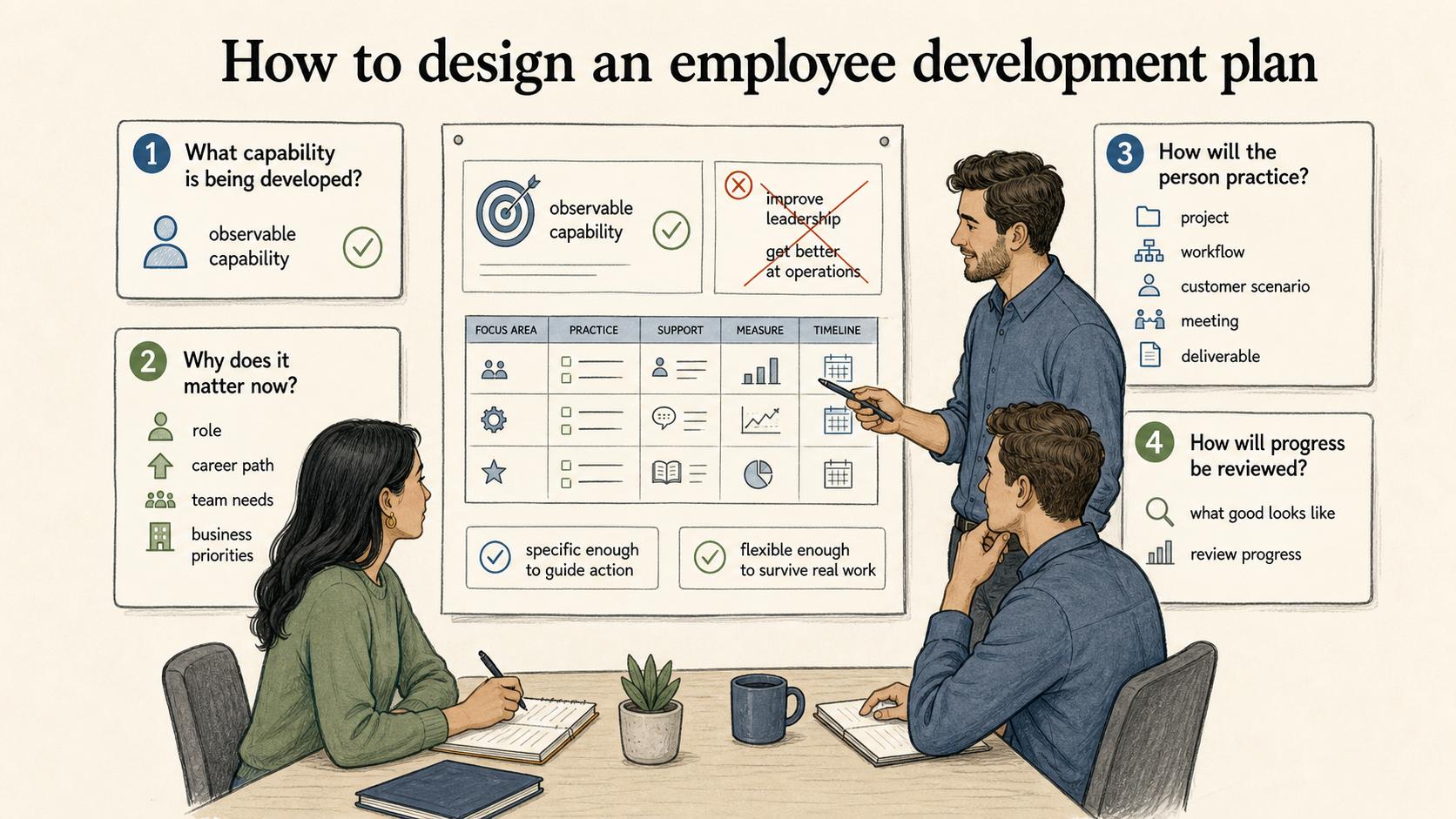
A development plan should be specific enough to guide action and flexible enough to survive real work. The strongest plans answer four questions.
What capability is being developed? Avoid vague goals like "improve leadership" or "get better at operations." Name the observable capability: running weekly team standups, analyzing process defects, handling enterprise support escalations, creating documentation, or managing a hiring process.
Why does it matter now? Development should connect to the employee's role, career path, team needs, or business priorities. Without a reason, the plan becomes a wish list.
How will the person practice? Practice is where development becomes real. Identify the project, workflow, customer scenario, meeting, or deliverable where the skill will be used.
How will progress be reviewed? Managers should define what good looks like and when they will review progress. Waiting until a formal performance review is too late for meaningful course correction.
AI-ready employee development plan template
Use this template to turn a vague growth goal into a practical plan:
## Employee Development Plan Template

**Glossary term:** Employee Development
**Source:** Trails Glossary — trails.so/glossary/employee-development

---

### 01. Create an employee development plan

"Create an employee development plan for [employee role] at [team/company].
Development goal: [specific capability to build]
Why it matters: [role need, team need, career path, business priority]
Current baseline: [what the employee can already do]
Target behavior: [what the employee should be able to do differently]
Practice opportunities: [projects, workflows, meetings, cases, or assignments]
Support needed: [manager coaching, mentor, documentation, training, tools]
Milestones: [30/60/90-day observable checkpoints]
Feedback rhythm: [how often progress will be reviewed]
Evidence of progress: [work sample, metric, completed task, peer feedback, manager observation]
Risks to watch: [overload, unclear ownership, insufficient practice, weak feedback]"
The evidence field is the part most teams skip. Without evidence, development stays subjective. LinkedIn's 2025 Workplace Learning Report notes that career development champions most often measure business impact through employee engagement and retention, which makes observable evidence important for connecting development to outcomes. 4 A completed project, stronger handoff, cleaner documentation, improved customer escalation, or demonstrated process improvement gives the conversation something concrete to inspect.
Common employee development mistakes
Treating aspiration as a plan. "Become a manager" is a direction. The plan needs the capabilities that make management plausible: giving feedback, running meetings, delegating work, making tradeoffs, and coaching others.
Leaving managers out of the system. HR or L&D can provide structure, but managers create most of the practice environment. If managers do not know how to support development, employees are left with resources but no operating rhythm.
Separating development from work. Development that only happens outside normal responsibilities is easy to postpone. The best growth opportunities are often embedded in real workflows, with enough support to make them safe.
Forgetting knowledge transfer. When one person gets better, the team should benefit. Development plans can include creating a guide, teaching a teammate, documenting a process, or improving the way the work is done.
Documentation takeaway
Employee development improves when learning paths, role expectations, process guides, and feedback rhythms are documented. Documentation does not replace coaching, but it gives coaching a shared reference. It also helps managers avoid reinventing development plans for every employee from scratch.
The most useful documentation is specific to the role: what skills matter, what good work looks like, what workflows must be mastered, what milestones show readiness, and where examples or templates live.
How Trails helps
Trails helps teams turn work-based learning into repeatable documentation. A high-performing employee can capture a workflow as they do it, and Trails can turn that into a polished step-by-step guide or AI-narrated video. That gives managers and L&D teams practical material for onboarding, cross-training, upskilling, and role development without relying only on live shadowing.
Sources
- 1
World Economic Forum. Future of Jobs Report 2025. www.weforum.org/stories/2025/01/future-of-jobs-report-2025-jobs-of-the-future-and-the-skills-you-need-to-get-them/.
- 2
Gallup. How to Improve Employee Engagement in the Workplace. www.gallup.com/workplace/285674/improve-employee-engagement-workplace.aspx.
- 3
ATD. 2025 State of the Industry Report release. www.td.org/content/press-release/atd-research-optimism-remains-strong-for-future-of-learning-in-organizations.
- 4
LinkedIn. Workplace Learning Report 2025. business.linkedin.com/content/dam/lem/business/en/learn/workplace-learning-report-2025/LinkedIn-Workplace-Learning-Report-2025.pdf.