
Glossary
Certification
 ChatGPT
 Perplexity
 Gemini
 Claude
What is certification?
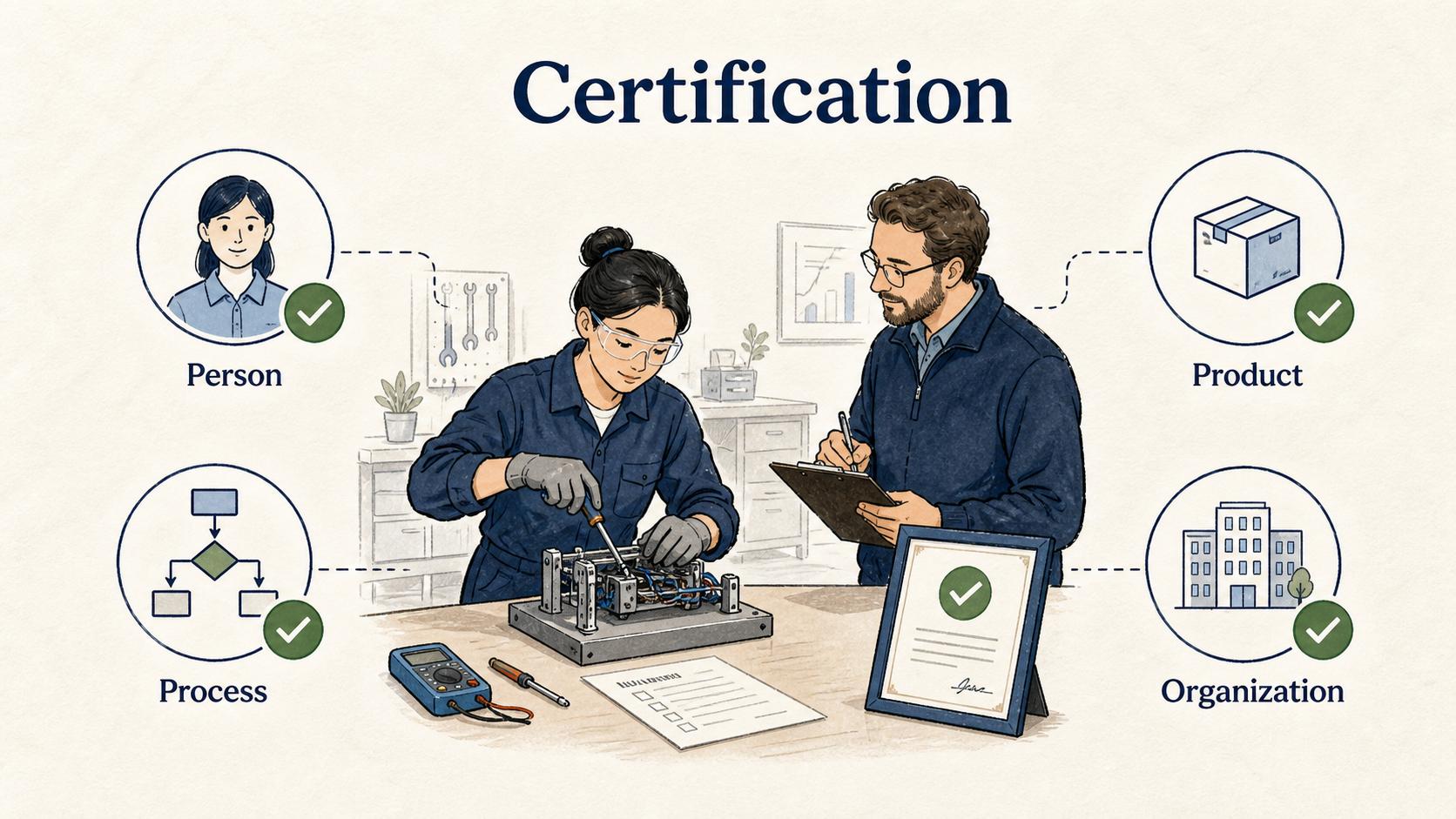
Certification is formal confirmation that a person, process, product, organization, or system meets defined requirements. In workplace settings, certification often proves that someone completed required training, demonstrated a skill, passed an assessment, or that a process meets a specified standard.
The practical value is evidence. A certificate can be a piece of paper; certification should tell a manager what requirement was met, how it was checked, and what proof was retained.
Teams use certifications in training, compliance, safety, quality, customer support, IT, and professional development. A support agent might be certified to handle escalations, a technician might be certified to perform a controlled procedure, or a company might maintain certifications that show its management system follows an external framework. The meaning depends on context, so the documentation around certification matters as much as the badge.
Why certification matters
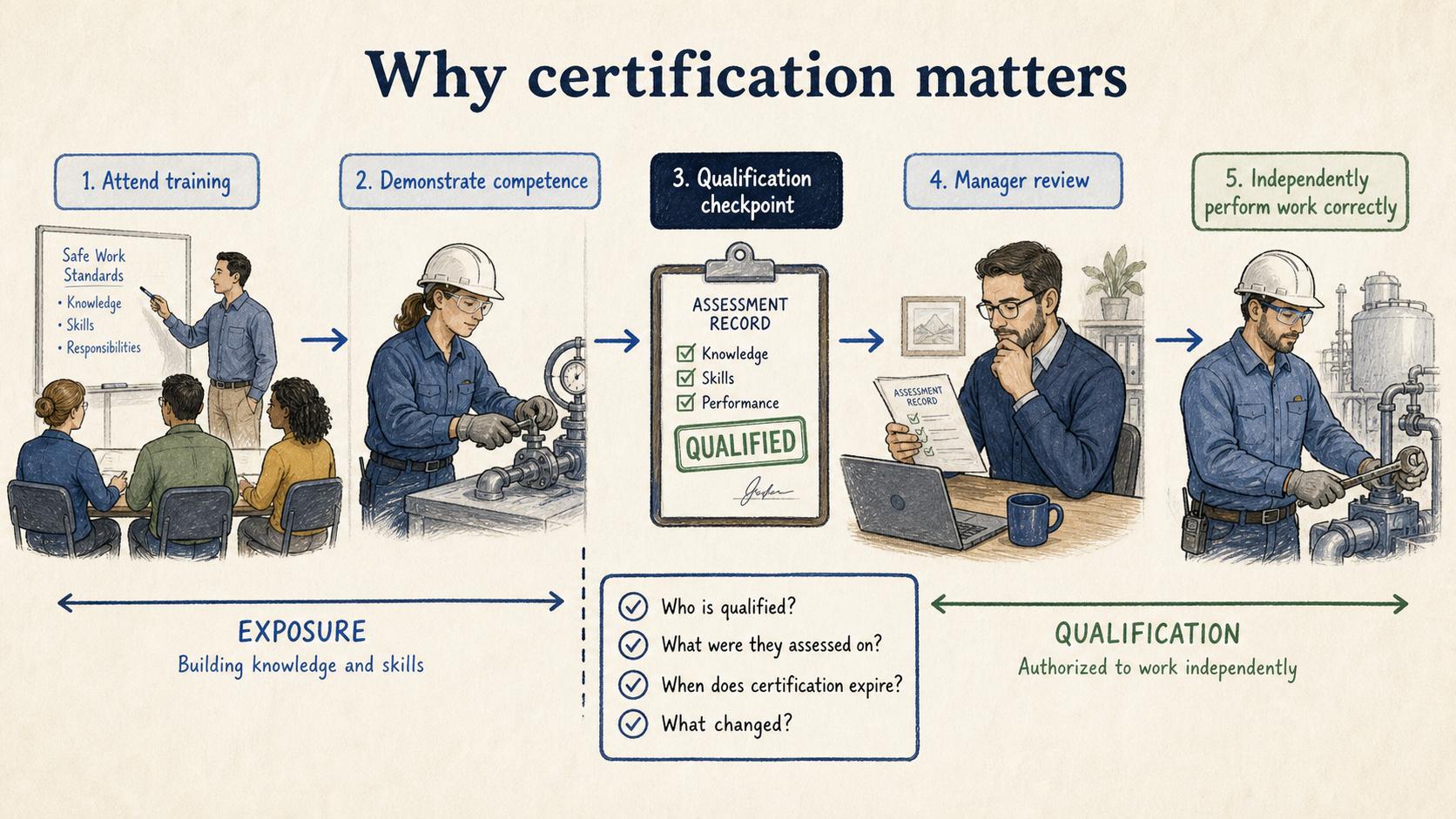
Certification creates a clear line between exposure and qualification. Someone can attend training and still be unready to perform the work independently. ISO/IEC 17024:2026 describes certification of persons as assurance that an individual meets defined competence requirements within a certification scheme. A certification process should say what competent performance looks like, how it will be checked, and what proof will be kept. 1
That line matters most when mistakes are expensive, hard to detect, or difficult to undo. OSHA's confined-spaces training rule, for example, requires training records that include each employee's name, trainer names, and training dates. For safety-sensitive or regulated work, managers need a repeatable way to answer: Who is qualified? What were they assessed on? When does the certification expire? What changed since the last certification? 2
A good certification system also protects employees. It makes expectations visible instead of leaving people to guess whether they are ready. When the criteria are clear, certification supports consistent work rather than vague gatekeeping.
Certification vs. training, certificate, and license
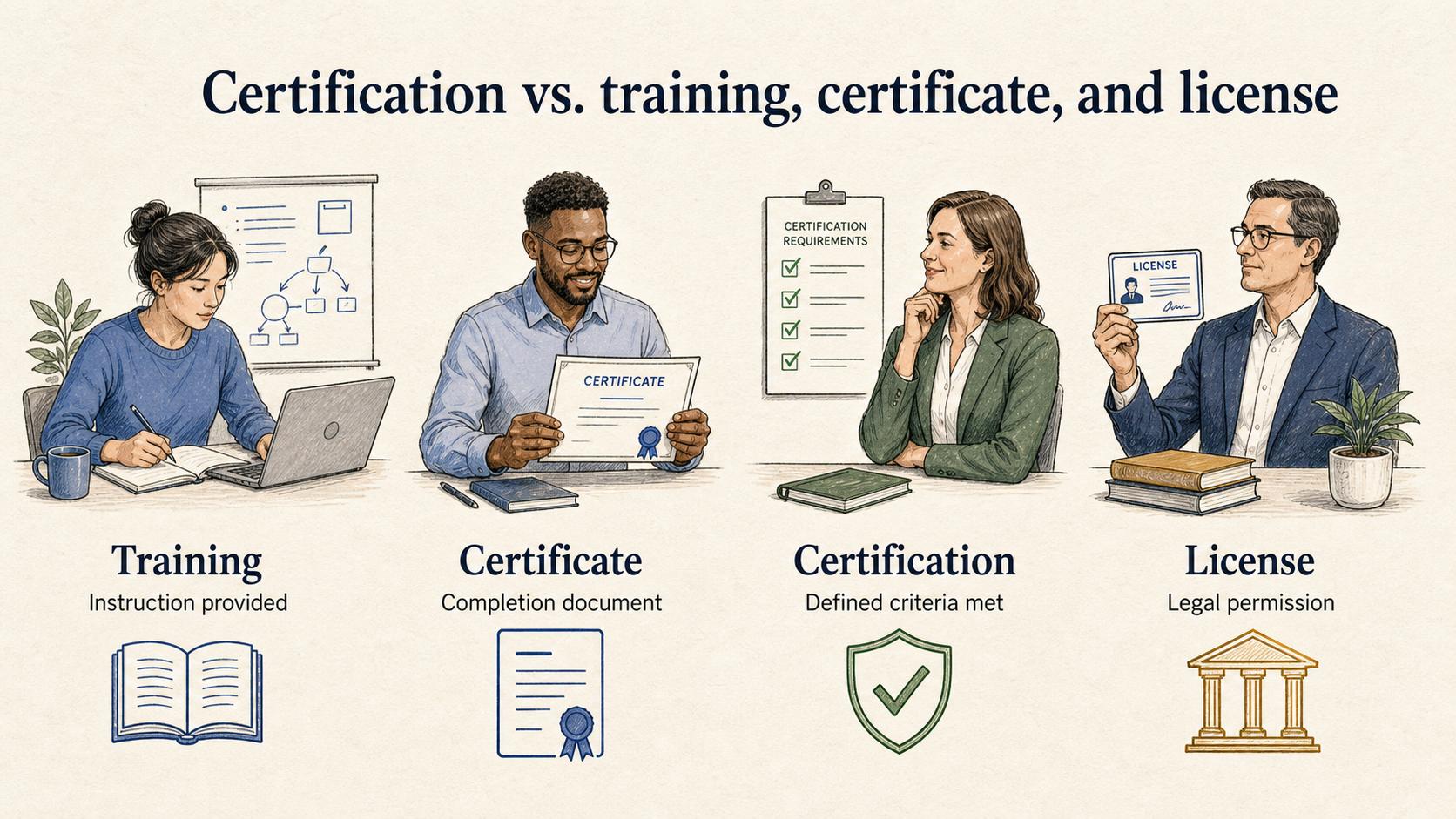
These terms are often used loosely, but they aren't interchangeable.
| Term | What it usually means | Practical risk if confused |
|---|---|---|
| Training | Learning or instruction has been provided | Attendance gets mistaken for competence |
| Certificate | A document showing completion or recognition | The document may not prove assessed ability |
| Certification | A requirement has been met against defined criteria | Criteria must be clear and defensible |
| License | Legal or regulatory permission to perform certain work | Internal approval may not satisfy external rules |
For internal operations, the distinction is useful even when the stakes aren't regulatory. If a team says people are certified to follow a new refund process, the team should know whether that means they watched a video, passed a quiz, completed a live practice case, or were approved by a manager after observation.
What a strong certification process includes
A certification process doesn't need to be heavy, but it does need to be specific. Weak programs usually fail at the assessment step: people complete training, receive a certificate, and no one can later explain what the certificate proves.
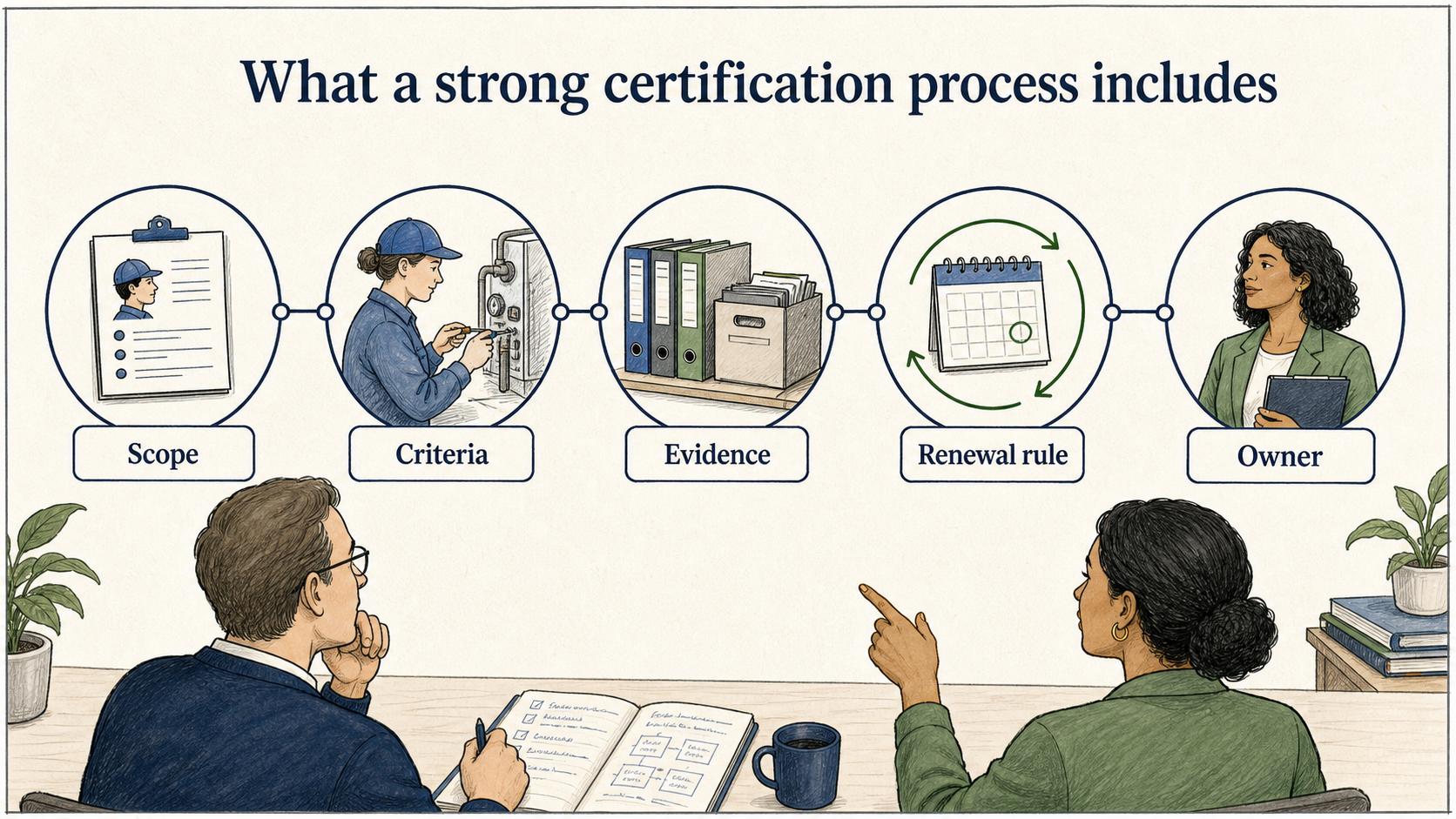
A stronger certification process defines five things.
Scope. Name the work, role, system, or procedure the certification covers. A broad label like “operations certified” is rarely useful. A specific label like “certified to approve tier-two refund exceptions” is easier to train, assess, and audit.
Criteria. State what someone must know or do. Criteria might include completing a course, passing a scenario-based assessment, demonstrating a workflow, following a safety checklist, or documenting a real case correctly.
Evidence. Decide what proof will be retained. This could include assessment results, manager sign-off, completion records, workflow documentation, or an audit trail. ISO 9001 auditing guidance on competence points to retaining appropriate documented information as evidence of competence while leaving room for organizations to decide what evidence has value. 3
Renewal rule. Certifications can go stale when tools, policies, or risks change. Even when there is no formal expiration date, teams should know what triggers recertification: a new system, a policy update, an incident, or a long period without using the skill. Certification-body guidance under ISO/IEC 17024 also treats maintaining, recertifying, suspending, and withdrawing certification as explicit responsibilities. 4
Owner. Someone has to maintain the criteria, answer edge-case questions, and retire certifications that no longer match the work. Without an owner, certification records can look official long after they stop being trustworthy.
Common mistakes
Certifying memory instead of performance. A quiz can be useful, but many workflows fail between knowledge and action. If the job requires judgment, include a scenario, observed practice, or example case.
Letting the certificate carry more meaning than the criteria. A polished certificate doesn't make a weak assessment stronger. The value of certification comes from the standard behind it.
Forgetting the maintenance burden. Every certification creates an obligation to keep requirements current. If the underlying SOP changes, certification materials may need to change too.
Using one certification for too many roles. Managers, frontline employees, and reviewers may need different proof of competence. A single certification can hide important differences in responsibility.
AI-ready certification design prompt
Use this prompt to turn a training requirement into a certification plan:
## Design an internal certification process

**Glossary term:** Certification
**Source:** Trails Glossary — trails.so/glossary/certification

---

### 01. Prompt

"Design an internal certification process for [role/team] to perform [task/process].

Context:
- Why certification is needed: [risk, customer impact, compliance need, or quality issue]
- Work covered: [specific workflow or procedure]
- People being certified: [roles]
- Existing training materials: [links or summaries]
- Renewal triggers: [policy change, annual review, incident, system change]

Create:
1. Certification scope statement
2. Competency criteria
3. Assessment method
4. Evidence to retain
5. Renewal or recertification rule
6. Owner and review cadence
7. A short checklist a manager can use before approving certification

Keep the plan practical. Separate proof of attendance from proof of ability."
How Trails helps
Certification is easier to manage when the expected workflow is documented clearly. Trails captures a process as someone performs it, turns it into a polished step-by-step guide, and can create an AI-narrated video version for training or sharing. That gives teams a concrete reference for what certified work should look like, especially when certification depends on following a repeatable procedure.
FAQ
What is certification in the workplace?
Workplace certification is a formal way to confirm that an employee, team, process, or organization meets defined requirements. It may be internal, external, role-specific, or tied to a particular procedure.
Is certification the same as completing training?
No. Training provides instruction. Certification confirms that a requirement has been met. A strong program can include training, but it also defines how competence or completion will be verified.
When should a team require certification?
Certification is useful when work carries safety, compliance, quality, financial, customer, or operational risk. It is also useful when managers need consistent proof that people can perform a process correctly.
What records should certification include?
At minimum, keep the person or entity certified, the scope, the criteria, the date, the approver or assessment method, and any renewal trigger. For regulated work, confirm record requirements with the responsible authority or internal compliance owner.
Sources
- 1
ISO. ISO/IEC 17024:2026 Conformity assessment. www.iso.org/standard/17024.
- 2
Occupational Safety and Health Administration. 1926.1207 - Training. www.osha.gov/laws-regs/regulations/standardnumber/1926/1926.1207.
- 3
ISO 9001 Auditing Practices Group. Guidance on Competence. committee.iso.org/files/live/sites/tc176/files/documents/ISO%209001%20Auditing%20Practices%20Group%20docs/Auditing%20to%20ISO%209001%202015/APG-Competence.pdf.
- 4
International Accreditation Forum. Workshop on Persons Certification (ISO/IEC 17024). iaf.nu/wp-content/uploads/2021/05/02_GA_ISO_17024_IAFILAC_presentation.pdf.