
Glossary
Compliance Manual
 ChatGPT
 Perplexity
 Gemini
 Claude
What is a compliance manual?
A compliance manual is a structured reference that explains an organization's compliance program, policies, roles, reporting channels, procedures, and expectations. It helps employees and managers understand how the company prevents, detects, reports, and responds to compliance issues.
A useful compliance manual is more than a policy folder. DOJ guidance looks for compliance programs whose policies and procedures are accessible, operationally integrated, and understood in practice.1
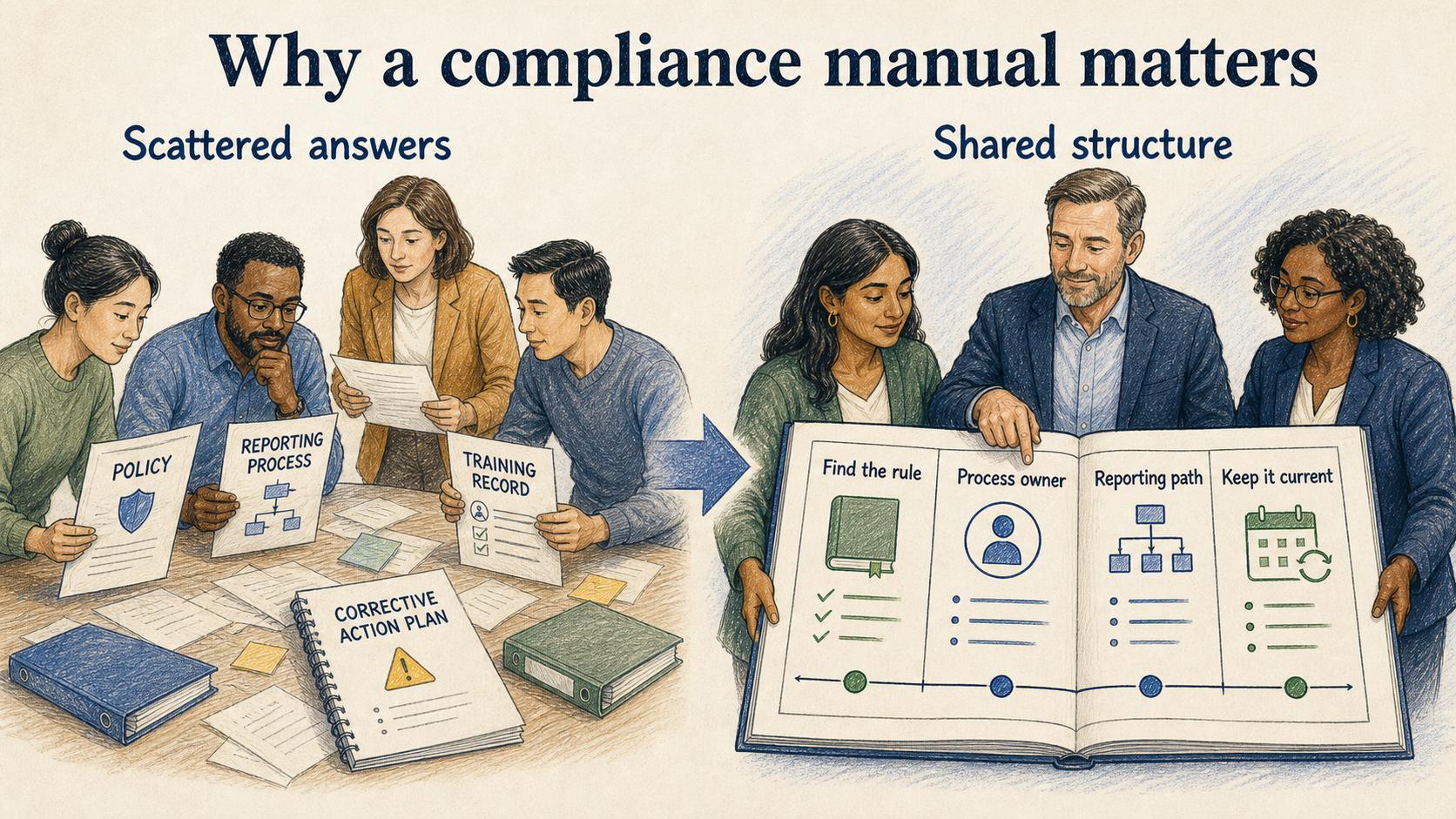
The manual should act as the operating map for the compliance program: where to find the rule, who owns the process, what to do when something goes wrong, and how the organization keeps the program current.
Why a compliance manual matters
Compliance work becomes messy when every answer lives in a different place. A policy sits in a drive folder. A reporting process appears only in onboarding slides. A training record lives in an LMS. A corrective action plan sits in an audit tracker. The compliance manual gives those pieces a shared structure.
The manual is especially useful for employees who need orientation and managers who need to understand their responsibilities. It can also help compliance officers, auditors, legal reviewers, and executives see whether the program is documented clearly enough to operate. The Federal Sentencing Guidelines describe effective programs in terms of standards and procedures, oversight, training and communication, monitoring and auditing, reporting systems, enforcement, and periodic evaluation.2
The risk is that a manual becomes decorative. If it is too long, too legalistic, or disconnected from daily work, employees will ignore it. The best compliance manuals are clear, searchable, role-aware, and honest about where a reader should go next.
What a compliance manual should include
The exact contents depend on industry, size, geography, and risk profile, but most compliance manuals include the same core building blocks. HHS OIG's general compliance guidance uses a similar infrastructure model: written policies and procedures, compliance leadership, training, communication, auditing and monitoring, enforcement, and corrective action.3
| Manual section | What it should explain | Practical check |
|---|---|---|
| Program overview | The purpose, scope, and principles of the compliance program | Can a new manager explain what the program is for? |
| Roles and governance | Compliance officer, leadership, managers, employees, board or committee responsibilities | Is ownership visible, not implied? |
| Code of conduct and policies | The major policy areas and where approved policies live | Are policies searchable and current? |
| Reporting channels | How employees ask questions, report concerns, and escalate issues | Would an employee know what happens after reporting? |
| Training requirements | Required training, audiences, timing, and completion records | Is training tied to role-specific risk? |
| Monitoring and auditing | How the company reviews controls, records, and program effectiveness | Are findings tracked to owners and deadlines? |
| Investigations and remediation | How concerns are triaged, documented, resolved, and corrected | Are repeat issues connected to process fixes? |
| Document control | Version history, owner, review cadence, and update triggers | Can people tell whether they are using the current manual? |
The manual should point to detailed SOPs instead of absorbing every procedure. The manual tells the reader what exists and how the program works. SOPs tell the reader how to complete a specific process.
Compliance manual vs employee handbook
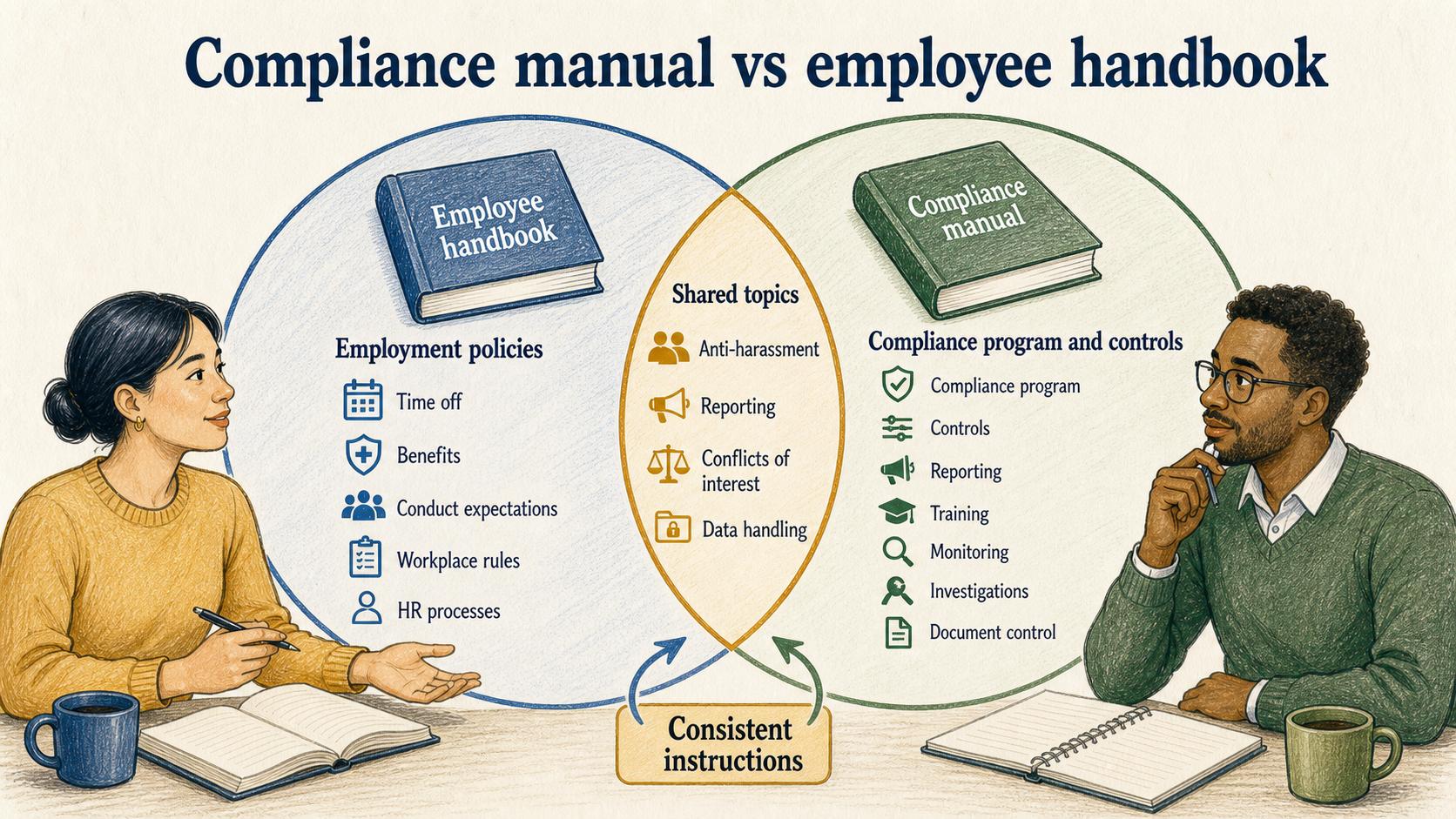
An employee handbook usually covers general employment policies: time off, benefits, conduct expectations, workplace rules, and HR processes. A compliance manual focuses on the compliance program and the controls that help the organization follow laws, regulations, contracts, ethical standards, and internal policies.
There may be overlap. Anti-harassment, reporting, discipline, conflicts of interest, and data handling may appear in both. The important thing is to avoid conflicting instructions. If the handbook says one thing and the compliance manual says another, employees will choose the easier path or ask the same question repeatedly.
How to build a useful compliance manual
Start by inventorying the program, not by opening a blank document. List the current policies, procedures, owners, training requirements, reporting channels, audit routines, and record locations. Then identify the gaps: missing owners, outdated policies, unclear escalation paths, or procedures that exist only in someone's head.
Next, organize the manual around reader questions. An employee may ask, “What should I report?” A manager may ask, “What do I do if someone raises a concern?” A compliance officer may ask, “Where is the evidence that this control happened?” If the manual is organized only by department or legal category, it may be technically complete but hard to use.
Then connect the manual to workflow evidence. A compliance manual should not merely say that the company trains employees or reviews vendors. NIST SP 800-53 treats control implementation, assessment, accountability, and records as part of showing how controls operate, which maps well to the manual's job of pointing readers to evidence. It should identify where training records, vendor reviews, approvals, investigations, and corrective actions are documented.4
Finally, assign an owner and update triggers. A manual should be reviewed after regulatory changes, policy updates, incidents, audit findings, system changes, reorganizations, or repeated employee confusion. Calendar reviews help, but real-world events are usually better signals that the manual needs attention.
AI-ready compliance manual prompt
## Create a compliance manual outline

**Glossary term:** Compliance Manual
**Source:** Trails Glossary — trails.so/glossary/compliance-manual

---

### 01. Prompt

"Create an outline for a compliance manual for [company/team/industry].
Use these known program elements: [paste policies, roles, training, reporting channels, SOPs, and audit routines].
Organize the manual around employee, manager, and compliance-owner questions.
Include sections for program overview, roles, policies, reporting, training, monitoring, investigations, remediation, records, and document control.
Flag missing information instead of inventing legal or regulatory requirements."
Use the output as a structure, not as final authority. The finished manual should be reviewed by the responsible compliance, legal, HR, security, or finance owners depending on the content.
How Trails helps
A compliance manual becomes more useful when its linked procedures reflect how work actually happens. Trails can capture repeatable workflows as people perform them, turn those workflows into polished step-by-step guides, and create AI-narrated video versions for training or sharing. That helps compliance teams keep manuals connected to real SOPs instead of static policy text.
FAQ
Is a compliance manual required?
It depends on the organization's industry, legal obligations, contracts, and internal control expectations. Even when a manual is not explicitly required, it can help make the compliance program easier to operate, train, audit, and improve.
Who should own the compliance manual?
The compliance officer or compliance function often owns the manual, but individual sections may need review from legal, HR, finance, security, operations, or executive leadership. Ownership should be explicit so the manual does not drift.
How long should a compliance manual be?
Long enough to orient readers and connect them to the right policies, procedures, and reporting paths. If the manual becomes too detailed, move task-level instructions into separate SOPs and link to them.
Sources
- 1
U.S. Department of Justice. Evaluation of Corporate Compliance Programs. www.justice.gov/criminal/criminal-fraud/page/file/937501/dl?inline=.
- 2
U.S. Sentencing Commission. U.S. Sentencing Guidelines §8B2.1. guidelines.ussc.gov/apex/r/ussc_apex/guidelines?app_gl_id=%C2%A78B2.1.
- 3
HHS OIG. General Compliance Program Guidance. oig.hhs.gov/compliance/general-compliance-program-guidance/.
- 4
NIST. SP 800-53 Rev. 5. csrc.nist.gov/pubs/sp/800/53/r5/upd1/final.