
Glossary
Training Manual
 ChatGPT
 Perplexity
 Gemini
 Claude
What is a training manual?
A training manual is a structured reference that helps people learn and perform a role, process, system, or set of tasks. It usually combines explanations, procedures, examples, screenshots, checklists, practice activities, and links to related documentation.
A useful training manual is not a warehouse for everything a team knows. It is a guided path from "I'm new to this" to "I can do the work correctly with a reliable reference nearby."
What a training manual is used for
Training manuals are common in employee onboarding, customer support, operations, software training, compliance programs, product education, and role-based enablement. They give learners a consistent starting point and reduce the need for every manager or trainer to explain the same work from scratch.1
The best manuals explain just enough context, then show how the work is done. A manual for a support agent might cover account setup, ticket triage, refund exceptions, escalation rules, response examples, and quality expectations. A manual for an internal tool might cover access, core workflows, common errors, and troubleshooting paths.
The manual should be broad enough to orient the learner, but narrow enough that someone can actually use it during the first weeks of work.
What to include in a training manual
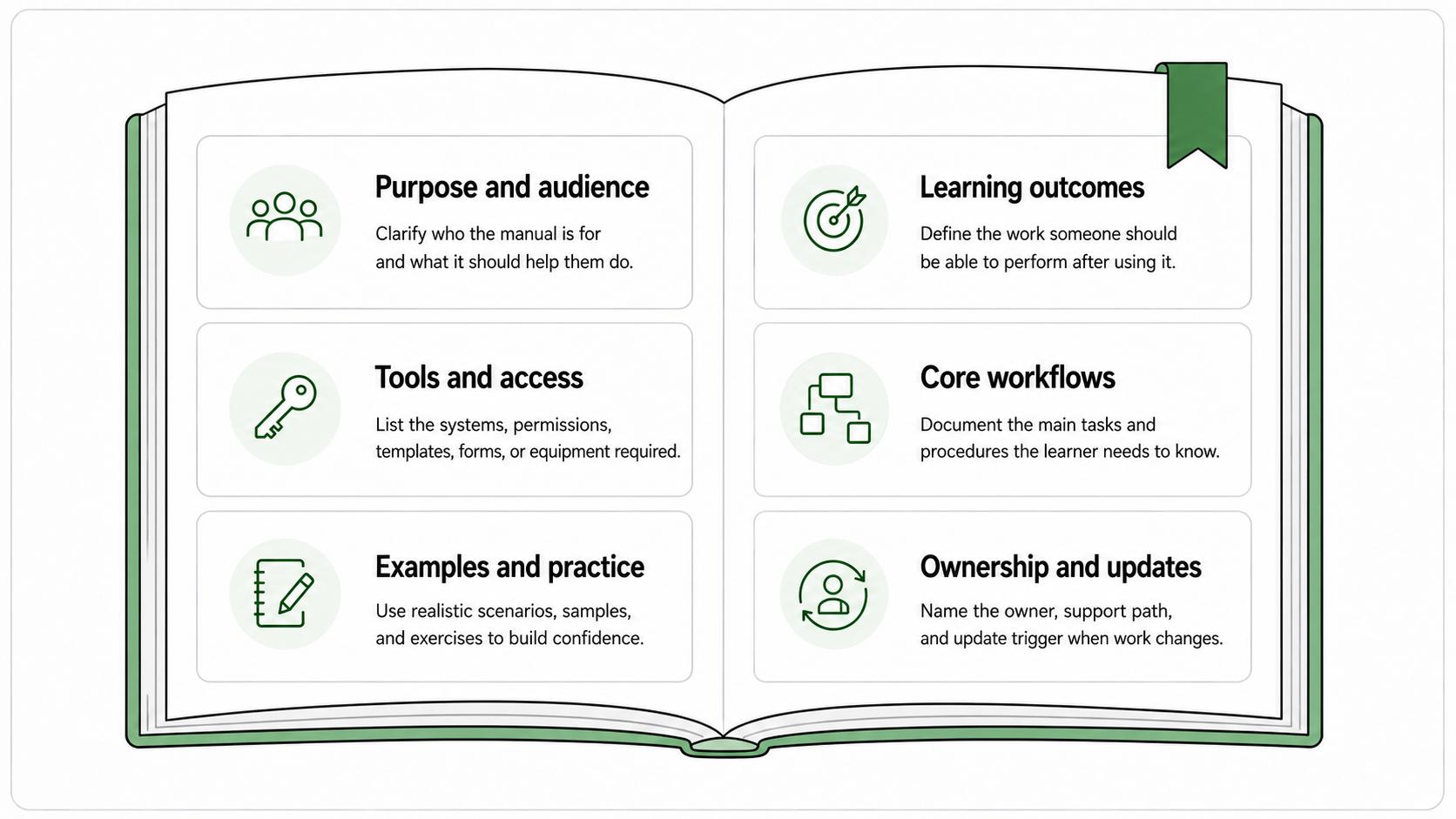
The right contents depend on the audience and job outcome, but most training manuals need these pieces:2
- Purpose and audience: Who the manual is for and what it helps them do.
- Learning outcomes: The work the learner should be able to perform after using it.
- Tools and access: Systems, permissions, forms, templates, or equipment required.
- Core workflows: The main tasks or procedures the learner needs to know.
- Examples and practice: Realistic scenarios, completed samples, exercises, or checks for understanding.
- Readiness and support: How competence is checked, where to ask questions, and who owns updates.
The overlooked section is usually ownership. Without an owner, the manual becomes stale quietly. People keep using it until they discover, at the worst possible moment, that the process changed.
Training manual vs. training materials
Training materials are the broader set of resources used to teach or reinforce learning. A training manual is one format within that set.
A slide deck may work for a facilitated session. A video may show a visual workflow quickly. A checklist may help during the task. A training manual pulls the larger story together: what the learner needs to know, what to do, where to find details, and how to tell whether they are ready.
That does not mean a manual should absorb every asset. Long manuals often fail because they bury the few pages people actually need. A better manual acts as a home base that links to deeper procedures, videos, examples, and job aids.
How to structure a training manual
Structure the manual around the learner's progression, not the company's org chart. New learners do not need every department's background before they learn how to complete their first important task.
A practical sequence is:
- 1. Orientation: what this work is and why it matters.
- 2. Setup: tools, access, permissions, and prerequisites.
- 3. Core tasks: the workflows the learner must perform most often.
- 4. Examples: realistic cases, exceptions, and completed samples.
- 5. Practice: exercises that look like the real work.3
- 6. Readiness: how the learner, manager, or trainer checks competence.
- 7. Reference: glossary, templates, related procedures, and change history.
The strongest manuals separate concept from action. Give enough context to prevent blind rule-following, then make the steps easy to find when someone is doing the job.
A lean training manual template
Use this as a starting point:
## Lean Training Manual Template

**Glossary term:** Training Manual
**Source:** Trails Glossary — trails.so/glossary/training-manual

---

### 01. Create a focused training manual

"Training manual: [role, process, system, or program]
Audience: [who this manual is for]
Purpose: [what the learner should be able to do]
Owner: [person or team responsible]
Last reviewed: [date]

1. Overview
- What this work is
- Why it matters
- When the learner will use it

2. Setup
- Required tools and access
- Prerequisites
- Common setup issues

3. Core workflows
For each workflow:
- Trigger
- Step-by-step instructions
- Expected result
- Common mistakes
- Escalation path

4. Examples and practice
- Realistic scenario
- Completed example
- Practice task
- Readiness check

5. Reference
- Glossary
- Templates
- Related SOPs or guides
- Change history"
Keep the first version focused. A manual that explains the five workflows people actually need is more useful than a comprehensive manual nobody can finish.
Common mistakes
The first mistake is treating the manual as a one-time project. A manual should change when tools, policies, products, responsibilities, or workflows change.4
The second mistake is writing from the expert's memory. Experts skip context because the work feels obvious. Test the manual with a newer employee or someone outside the process to find missing steps.
The third mistake is using a manual where a smaller asset would work better. If someone only needs a reminder during a task, a checklist or job aid may be more useful than a full manual.
Documentation takeaway
A training manual should live inside the documentation system, not off to the side. It should link to current procedures, guides, templates, and examples. When a source procedure changes, the manual should be easy to update.
Disconnected manuals create training debt. The team keeps teaching old work while the actual process moves on.
How Trails helps
Trails helps teams build the task-level pieces that make a training manual useful. A team member can capture a workflow as they perform it, turn that workflow into a polished step-by-step guide, and create an AI-narrated video version for training or sharing. Those guides can become the core workflow sections inside a manual.
- Training documentation
- Training materials
- Training SOP
- User manual
- Technical manual
- Service manual
- Procedure manual
Sources
- 1
National Institute of Standards and Technology. Training Within Industry. NIST MEP. www.nist.gov/mep/training-within-industry-twi. Accessed June 30, 2026.
- 2
Centers for Disease Control and Prevention. Quality Training Standards. CDC. www.cdc.gov/training-development/php/qts/index.html. Accessed June 30, 2026.
- 3
Dunlosky et al.. Improving Students' Learning With Effective Learning Techniques. Psychological Science in the Public Interest. www.psychologicalscience.org/publications/journals/pspi/learning-techniques.html. Accessed June 30, 2026.
- 4
Centers for Disease Control and Prevention. Building a Training Evaluation Plan. CDC. www.cdc.gov/training-development/php/about/evaluate-training-building-an-evaluation-plan.html. Accessed June 30, 2026.