
Glossary
Cross Training
 ChatGPT
 Perplexity
 Gemini
 Claude
What is cross training?
Cross training teaches someone to cover a workflow outside their main role. It is not a mandate for everyone to learn everything; it is targeted backup coverage for work that would stall, slow down, or become risky if one person were unavailable. 1
Good cross training turns a live walkthrough into repeatable capability. The backup person understands the steps, the judgment calls, the permissions they have, and the point where they should escalate instead of guessing. 2
Why cross training matters
Cross training usually becomes urgent when a key employee takes vacation, resigns, gets promoted, or becomes the only person who understands a recurring task. By then, the training window is often too small. The team tries to transfer years of context in a few rushed sessions, and the backup learns the visible steps without the reasoning behind them.
The better reason to cross train is operational resilience. A cross-trained team can absorb absences, seasonal volume, role changes, and handoffs without turning every exception into a fire drill. It also improves collaboration because people understand what happens before and after their own piece of the workflow. 3
The tradeoff is focus. Cross training should not erase ownership or spread people across every task. If the program is too broad, it creates shallow knowledge and fuzzy accountability. The goal is enough coverage for work that matters, not a rotating cast of semi-trained backups.
Where cross training works best
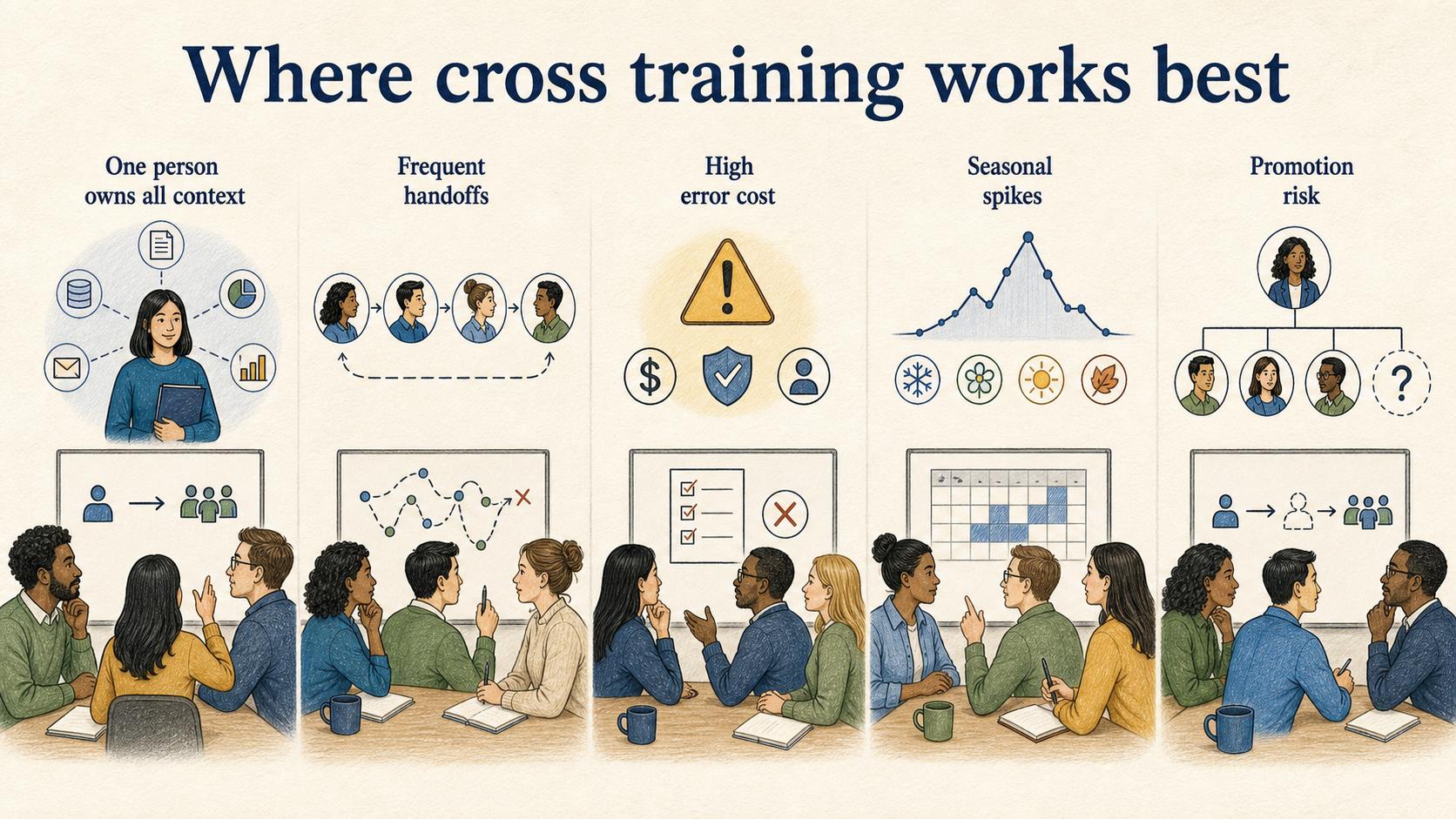
Cross training works best for recurring work with real business consequences: month-end finance tasks, customer support escalations, account handoffs, onboarding sessions, inventory checks, quality reviews, or publishing workflows.
Prioritize workflows where one of these signals is already visible:
| Signal | What it means | Cross-training response |
|---|---|---|
| One person owns all context | The task stops when that person is unavailable | Train one backup and document the exact workflow |
| Frequent handoffs | Work crosses departments or roles | Teach upstream and downstream context, not just steps |
| High error cost | Mistakes affect customers, revenue, compliance, or operations | Pair training with review checkpoints and escalation rules |
| Seasonal spikes | Volume rises at predictable times | Train temporary coverage before the busy period |
| Promotion risk | The expert is ready to move up, but the work has no successor | Use cross training as succession preparation |
This keeps cross training tied to business risk instead of turning it into a vague professional development exercise. 4
How to build a cross-training plan
Start with the workflow, not the job title. A role like "operations coordinator" may contain dozens of tasks, but only a few need backup coverage. Pick one workflow and define what competent coverage means: can the backup complete the work alone, handle routine cases, or prepare the work for review by the primary owner?
Then capture the task as it actually happens. The hard parts are usually hidden in judgment calls: which customer requests are exceptions, which spreadsheet fields are easy to break, which approval shortcut is acceptable, or which symptom means the process should stop. A useful training guide makes those moments visible.
Separate practice from authority. A backup might learn to process a refund, but not approve refunds above a certain amount. A teammate might learn how to publish a help article, but still need a content owner to review it. Without those boundaries, people can mistake training for full ownership.
Finally, test the handoff. Have the backup complete the workflow while the primary owner watches silently, then review what was missed. That test shows whether the documentation works and whether the learner understands the why behind the steps.
Cross-training plan template
Use this prompt to turn one important workflow into a practical cross-training plan:
## Cross-Training Plan

**Glossary term:** Cross Training
**Source:** Trails Glossary — trails.so/glossary/cross-training

---

### 01. Create a cross-training plan

"Create a cross-training plan for [workflow] on the [team] team.

Primary owner: [name or role]
Backup trainee: [name or role]
Business risk if no one else can do this work: [risk]
Expected coverage level: [observe only / routine cases / full backup / emergency-only]

Include:
1. The exact workflow the backup must learn
2. Prerequisite knowledge, systems, permissions, and files
3. The steps that should be documented before training starts
4. Judgment calls or exceptions the backup must recognize
5. Practice tasks the backup should complete
6. Review checkpoints and escalation rules
7. How we will confirm the backup is ready

Keep the plan specific enough that a manager can assign the first training session this week."
The coverage level is the useful constraint. It prevents the team from marking someone "trained" when they have only watched the process once.
Common cross-training mistakes
The most common mistake is training from memory. Experienced employees skip steps because the work feels obvious to them. The session feels efficient, but the backup has no way to recover when the situation changes.
Another mistake is confusing cross training with job rotation. Job rotation may be about career exposure. Cross training is about coverage and continuity. Both can be useful, but they need different success measures.
Teams also forget to maintain the materials. A cross-training guide that was accurate six months ago may drift after a software change, policy update, or new customer segment. The primary owner should keep the source workflow current, even if the backup practices it occasionally.
How Trails helps
Trails helps teams turn cross training from a one-time explanation into reusable process documentation. A primary owner can capture a workflow while performing it, and Trails turns that capture into a polished step-by-step guide. Teams can also create an AI-narrated video version for training, review, or asynchronous handoff.
That shared reference matters. If every backup person learns from a different verbal walkthrough, the team never knows which version of the process is current.
FAQ
What is an example of cross training?
A customer support team might cross train senior agents to handle billing escalations when the billing specialist is unavailable. The agents do not need to own billing permanently, but they need enough training, documentation, and authority rules to handle routine cases safely.
Is cross training the same as upskilling?
No. Upskilling usually means building deeper or more advanced skills for an employee's current or future role. Cross training focuses on learning adjacent work so the team has better coverage and continuity.
How many people should be cross trained on a process?
For most small teams, one primary owner and one trained backup is a good starting point. Add more backups only when the workflow is high volume, high risk, or frequently affected by absences.
Sources
- 1
UK Ministry of Justice Digital. How we identify and mitigate single points of failure (SPOF). mojdigital.blog.gov.uk/2021/08/03/how-we-identify-and-mitigate-single-points-of-failure-spof/.
- 2
NIOSH. Review of workplace training effectiveness. www.cdc.gov/niosh/bulletin/2010/workplace-training.html.
- 3
SHRM. Enhance HR effectiveness with cross-training. www.shrm.org/topics-tools/news/hr-magazine/enhance-hr-effectiveness-cross-training.
- 4
Virginia DHRM. Engaging in succession planning. www.dhrm.virginia.gov/docs/default-source/succession-planning/engaging-in-succession-planning.pdf?sfvrsn=0.