
Glossary
Compliance Documentation
 ChatGPT
 Perplexity
 Gemini
 Claude
What is compliance documentation?
Compliance documentation is the policies, procedures, records, approvals, training materials, and evidence that show an organization is meeting a requirement. It turns compliance from a verbal promise into something a manager, auditor, customer, or regulator can inspect.1
Strong documentation proves three things: the right work happened, the right people understood it, and exceptions were handled deliberately. A folder full of polished PDFs rarely does that on its own.
Why compliance documentation matters
Compliance work fails quietly when the organization relies on memory. A team may have the right policy, but if nobody can show who approved it, when it changed, how employees were trained, or what happened when an exception came up, the policy is weak evidence.
Good compliance documentation gives teams a defensible operating trail. It should answer:
- What rule, policy, control, or customer requirement applies?
- Who owns the requirement internally?
- What procedure turns the requirement into daily work?
- What proof shows the procedure was followed?
- How are changes, exceptions, and reviews handled?
The practical value shows up during audits, security reviews, customer due diligence, incident response, and leadership handoffs. Those are the moments when scattered screenshots, old files, and “ask Jordan” knowledge stop being enough.
What counts as compliance documentation
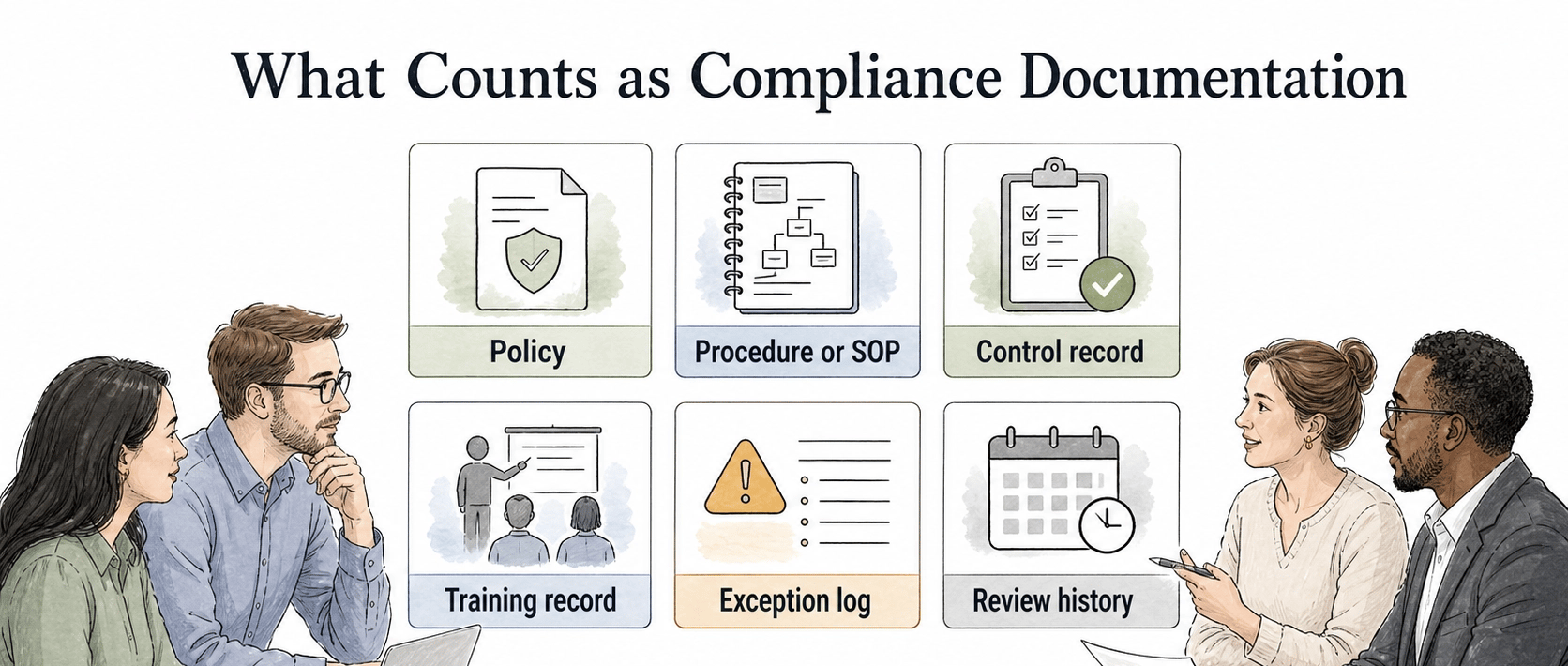
Compliance documentation usually includes both instructions for how work should happen and records proving that work actually happened. Teams often mix those together, which creates confusion. A policy explains the rule. A procedure explains the work. Evidence shows the work occurred.2
| Documentation type | What it proves | Example |
|---|---|---|
| Policy | The organization has made a clear commitment | Data retention policy |
| Procedure or SOP | People know how to carry out the policy | Access review SOP |
| Control record | A required activity happened | Quarterly access review export |
| Training record | People were taught the requirement | Completion report for compliance training |
| Exception log | Deviations were approved, tracked, and resolved | Temporary access exception with expiration date |
| Review history | The documentation is maintained | Annual policy review and approval note |
The strongest systems connect these pieces. If an auditor asks about access control, the team should be able to move from policy to SOP to evidence without reconstructing the story from scratch.
The documentation mistake that creates audit pain
The common mistake is treating compliance documentation as a folder of finished files. That works until a requirement changes, a customer asks for proof, or a process owner leaves.
Compliance documentation works better as a living evidence system. Each document needs an owner, a review rhythm, and a clear relationship to the work it governs. Otherwise, teams keep outdated policies because deleting them feels risky, duplicate procedures appear in different tools, and nobody knows which version is authoritative.
Use this test: if a new manager had to prove this control tomorrow, could they do it without asking five people for context? If not, the documentation may exist, but it isn't operationally useful yet.
How to create usable compliance documentation
Start with the requirement, not the document. A team should be able to say, “We need to prove X,” before deciding whether X needs a policy, checklist, SOP, log, approval workflow, or training record.
Tie every document to a requirement or risk
Vague documentation grows fast because it's easy to write. Useful documentation has a reason to exist. Name the regulation, framework, customer commitment, internal policy, or business risk it supports.
Separate instruction from evidence
If the SOP says managers must review user access every quarter, the evidence should show which access was reviewed, by whom, when, and what changed. The SOP and the proof are related, but they aren't the same artifact.
Document exceptions as first-class work
Compliance programs often look clean because exceptions live in side conversations. If people need a workaround, capture who approved it, why it was necessary, when it expires, and what compensating control applies.
Keep review history lightweight but visible
A short review note with date, owner, change summary, and approval is more useful than an invisible “last edited” timestamp. The useful signal is confidence that the document still reflects the real process.3
Documentation takeaway
Compliance documentation should be boring in the best way: easy to find, specific enough to prove what happened, and maintained close to the work. The more a team has to explain around the document, the less the document is doing.
For operations, support, IT, and people teams, the useful move is to connect policy-level requirements to the workflows employees actually perform. That usually means turning broad rules into step-by-step SOPs, then pairing those SOPs with the evidence a reviewer would expect.
How Trails helps
Trails helps teams document repeatable compliance-related workflows as they happen. A person performs the process once, and Trails turns that workflow into a polished step-by-step guide that is easier to share, review, and keep current.
That is especially useful for procedures that support compliance documentation, such as access reviews, customer data handling, incident intake, approval routing, or document control. Trails can also create an AI-narrated video version for training or handoff, so the documentation is not limited to a static checklist.
FAQ
Is compliance documentation the same as a compliance policy?
No. A policy states the rule or expectation. Compliance documentation includes the policy, the procedures that put it into practice, and the evidence that shows the work was completed.
Who owns compliance documentation?
Ownership depends on the requirement. Compliance, legal, security, HR, finance, and operations teams may all own different pieces. The important part is that each document has one accountable owner, not a vague department name.
How often should compliance documentation be reviewed?
Review timing should follow risk and change. High-risk procedures, customer-facing requirements, or fast-changing systems need more frequent review than stable internal policies. At minimum, each critical document should have a visible review date and owner.
What makes compliance documentation audit-ready?
Audit-ready documentation is complete enough for a reviewer to understand the requirement, the responsible owner, the procedure, the evidence, and any exceptions without relying on verbal explanation.
Sources
- 1
eCFR. 21 CFR Part 11. www.ecfr.gov/current/title-21/chapter-I/subchapter-A/part-11.
- 2
ISOQAR. What documents are required for ISO 9001?. isoqar.com/resources/blog/what-documents-are-required-for-iso-9001/.
- 3
NIST. SP 800-53 Rev. 5. csrc.nist.gov/pubs/sp/800/53/r5/upd1/final.