
Glossary
Waste Elimination
 ChatGPT
 Perplexity
 Gemini
 Claude
What is waste elimination?
Waste elimination is the practice of finding and reducing work that consumes time, effort, money, materials, attention, or capacity without adding value to the customer or intended outcome. In Lean management, waste isn't only scrap or physical excess. It can also be waiting, rework, duplicate entry, unclear handoffs, unnecessary approvals, and instructions trapped in one person's head.1
The goal isn't to make people busier. It's to make the work easier to complete correctly. Done well, waste elimination frees people to spend more time on useful work. Done poorly, it cuts slack while leaving the broken process intact.
What counts as waste
A practical test is simple: does this activity change the work in a way the customer, downstream team, or required outcome actually needs? If not, it may be waste. Some steps that look inefficient still earn their place because they reduce risk, protect quality, or satisfy a real requirement. The job is to tell the difference.
Common waste categories translate well outside manufacturing:2
| Waste type | What it looks like | Example outside manufacturing |
|---|---|---|
| Defects | Work has to be corrected or redone | A support ticket is escalated because the first response used the wrong policy |
| Overproduction | Work is created before it is needed | A team builds reports nobody reads each week |
| Waiting | People or systems pause for input | Customer onboarding stalls until someone approves access |
| Unused talent | Skills or judgment are not used well | Frontline staff ask managers for every small exception because the rule is unclear |
| Transportation | Work moves unnecessarily between systems or places | Data is exported, emailed, and re-uploaded into another tool |
| Inventory | Work piles up before the next step | A backlog of unreviewed applications grows silently |
| Motion | People search, click, or navigate more than needed | Employees hunt through chat to find the latest instructions |
| Extra processing | More work is done than the outcome requires | A simple internal request needs a long form, a meeting, and two approvals |
These labels are useful only when they change a decision. The goal isn't to tag every annoyance with a Lean term; it's to make friction visible enough to improve.
How to identify waste in a workflow
Start with the real workflow, not the ideal version in a process diagram. Watch the work happen, review a recent example, or ask the people doing the work to walk through what actually happened.3
Look for evidence that changes what you'd fix first:
- Work waits because nobody knows who decides, what input is missing, or what standard applies.
- People copy the same information into multiple systems because the process never named a source of truth.
- Rework clusters around one step, policy, handoff, or missing instruction.
- Approvals catch no meaningful risk, or they catch risk only because the earlier criteria are unclear.
- The process depends on one person's memory, spreadsheet, saved message, or workaround.
Waste often hides between teams. A form may be easy for the sender but confusing for the receiver. A manager approval may feel safe but create a bottleneck. A spreadsheet may work until the person who built it is unavailable.
Waste elimination vs cutting corners
Waste elimination shouldn't mean removing every pause, check, or human judgment call. Some steps are valuable because they prevent defects, protect customers, reduce risk, or create a better employee experience.
The better question is: does this step earn its place?
A compliance review may be necessary, but the intake form feeding it might be bloated. A QA check may be useful, but the criteria might be vague. A customer handoff may need human review, but the supporting context shouldn't require someone to search across five tools.
Healthy waste elimination protects safeguards while removing the drag around them. Cutting the safeguard may make the process look faster until defects show up later.
A simple waste elimination workflow
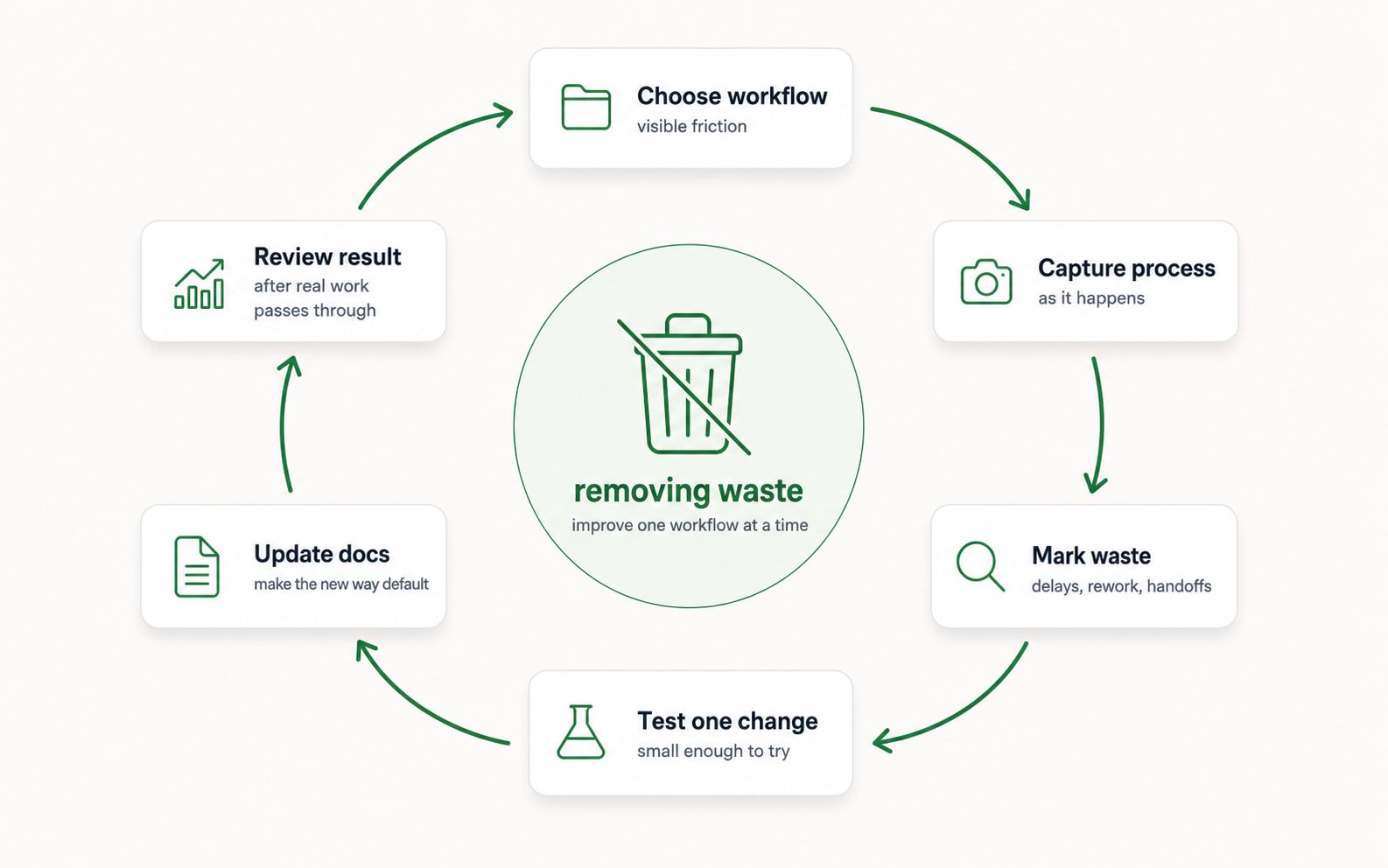
Use a small improvement loop instead of a giant redesign:
- Choose one workflow with visible friction.
- Capture the current process as it actually happens.
- Mark delays, rework, duplicate entry, unclear ownership, and unnecessary handoffs.
- Pick one improvement small enough to test quickly.
- Update the process documentation so the new way becomes the shared default.
- Review the result after real work has passed through the process.
This loop keeps improvement grounded. Teams get into trouble when they redesign a process in a meeting without checking how the work behaves in practice.
AI-ready waste review prompt
Use this prompt to review a workflow for likely waste:
## Waste Review Prompt

**Glossary term:** Waste Elimination
**Source:** Trails Glossary — trails.so/glossary/waste-elimination

---

### 01. Review a workflow for waste elimination opportunities

"Review this workflow for waste elimination opportunities.

Workflow:
[Paste steps, transcript, or process notes]

Audience: [team]
Goal: [business outcome]

Identify:
1. Steps that add clear value.
2. Steps that may be necessary safeguards.
3. Likely waste: waiting, rework, duplicate entry, unclear ownership, extra approvals, searching, or unnecessary handoffs.
4. The highest-impact improvement to test first.
5. Documentation updates needed if the improvement is adopted.
6. Risks of removing the wrong step.

Do not suggest broad cost-cutting. Focus on flow, clarity, quality, and repeatability."
The last line matters. Waste elimination should improve the work, not squeeze the people doing it.
Documentation takeaway
Waste elimination and documentation reinforce each other. Clear documentation exposes waste because it forces the team to name each step, owner, input, output, and decision. It also helps the improvement survive after the initial burst of attention fades.
If a team removes a redundant approval from customer onboarding, the updated guide should explain the new owner, the decision rule, and the exception path. Otherwise, people may quietly recreate the old approval chain the next time something feels uncertain.
How Trails helps
Trails helps teams capture a workflow as someone performs it, then turn that workflow into a polished step-by-step guide. That gives process improvement teams a clearer view of the real work: which steps exist, where handoffs happen, and which instructions are missing.
Once waste is reduced, the updated guide helps the better process become repeatable instead of living only in the improvement team's notes.
FAQ
Is waste elimination only for manufacturing?
No. The term is common in Lean operations, but the same thinking applies to service teams, support, HR, finance, IT, onboarding, and administrative workflows.
What is the easiest waste to find first?
Start with waiting, rework, duplicate entry, and searching for information. These show up quickly in everyday operations and are often easier to improve than larger structural problems.
Can too much waste elimination hurt a team?
Yes. If a team removes every buffer, review, or exception path, the process can become brittle. The goal is to remove work that does not add value, not the capacity needed for judgment, learning, and resilience.
- Lean management
- Lean manufacturing
- Lean documentation
- Process improvement
- Continuous improvement
- Kaizen
- Value stream mapping
- Standard work
Sources
- 1
Lean Enterprise Institute. Seven wastes. Lean Enterprise Institute. www.lean.org/lexicon-terms/seven-wastes/. Accessed June 23, 2026.
- 2
Lean Construction Institute. 8 wastes of Lean. Lean Construction Institute. leanconstruction.org/lean-topics/8-wastes-of-lean/. Accessed June 23, 2026.
- 3
U.S. Environmental Protection Agency. Lean and Environment Toolkit: Chapter 3. EPA. www.epa.gov/sustainability/lean-environment-toolkit-chapter-3. Accessed June 23, 2026.