
Glossary
Lean Management
 ChatGPT
 Perplexity
 Gemini
 Claude
What is lean management?
Lean management is a way of running work that focuses on customer value, flow, problem-solving, and continuous improvement. It applies lean thinking to how teams are led, how priorities are made visible, how problems are escalated, and how managers help people improve the system they work in.
Lean management is not lean manufacturing with a broader label. Manufacturing is one place lean developed. Lean management is the operating discipline that helps any repeatable team environment learn, improve, and keep work moving.
What lean management means in practice
Lean management turns improvement into a management habit instead of a special project. A manager does not wait for a quarterly initiative to fix broken work. They create routines that make problems visible early and help the team learn from them.
That can include daily huddles, visual management boards, leader standard work, gemba walks, process metrics, improvement experiments, escalation paths, and standard work updates.
The point is not to add more meetings. The point is to create a system where people can answer a few useful questions quickly: what matters most, where is it stuck, what standard should we be following, what problem are we solving, and what did we learn from the last change?
Lean management vs lean manufacturing
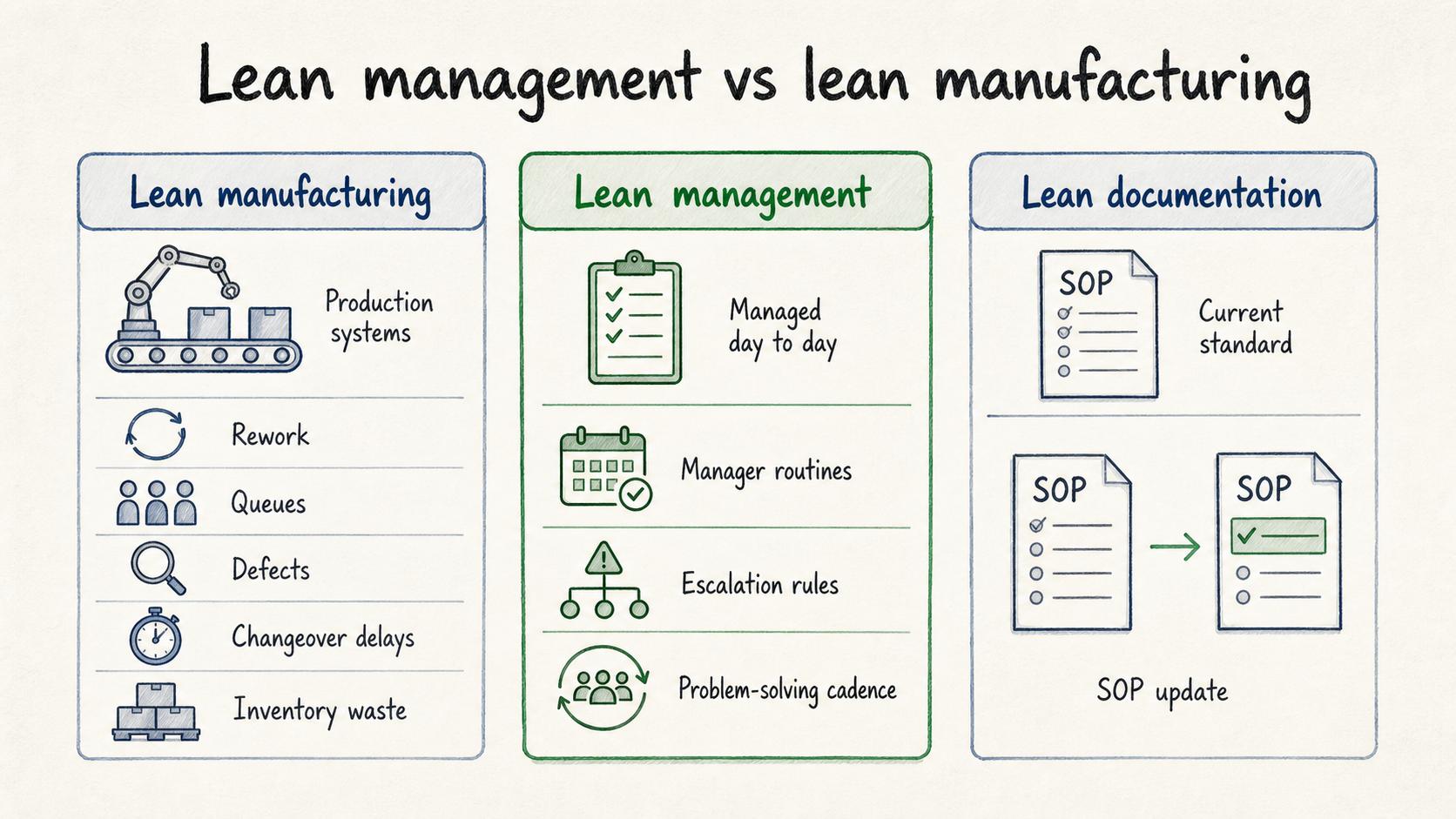
Lean management and lean manufacturing share principles, but they focus on different layers of the work.
| Concept | Main focus | Example |
|---|---|---|
| Lean manufacturing | Improving production systems and material or information flow | Reducing rework, queues, defects, changeover delays, or inventory waste |
| Lean management | Improving how work is managed and improved day to day | Visual priorities, manager routines, escalation rules, problem-solving cadence |
| Lean documentation | Keeping the current standard clear, useful, and easy to improve | Updating an SOP after a kaizen change becomes the new way to work |
A factory can have lean manufacturing tools without strong lean management if supervisors are not coaching problem-solving, standards are ignored, and improvements fade after the event. A software, support, HR, or operations team can use lean management even when nothing is being manufactured.
Core lean management practices
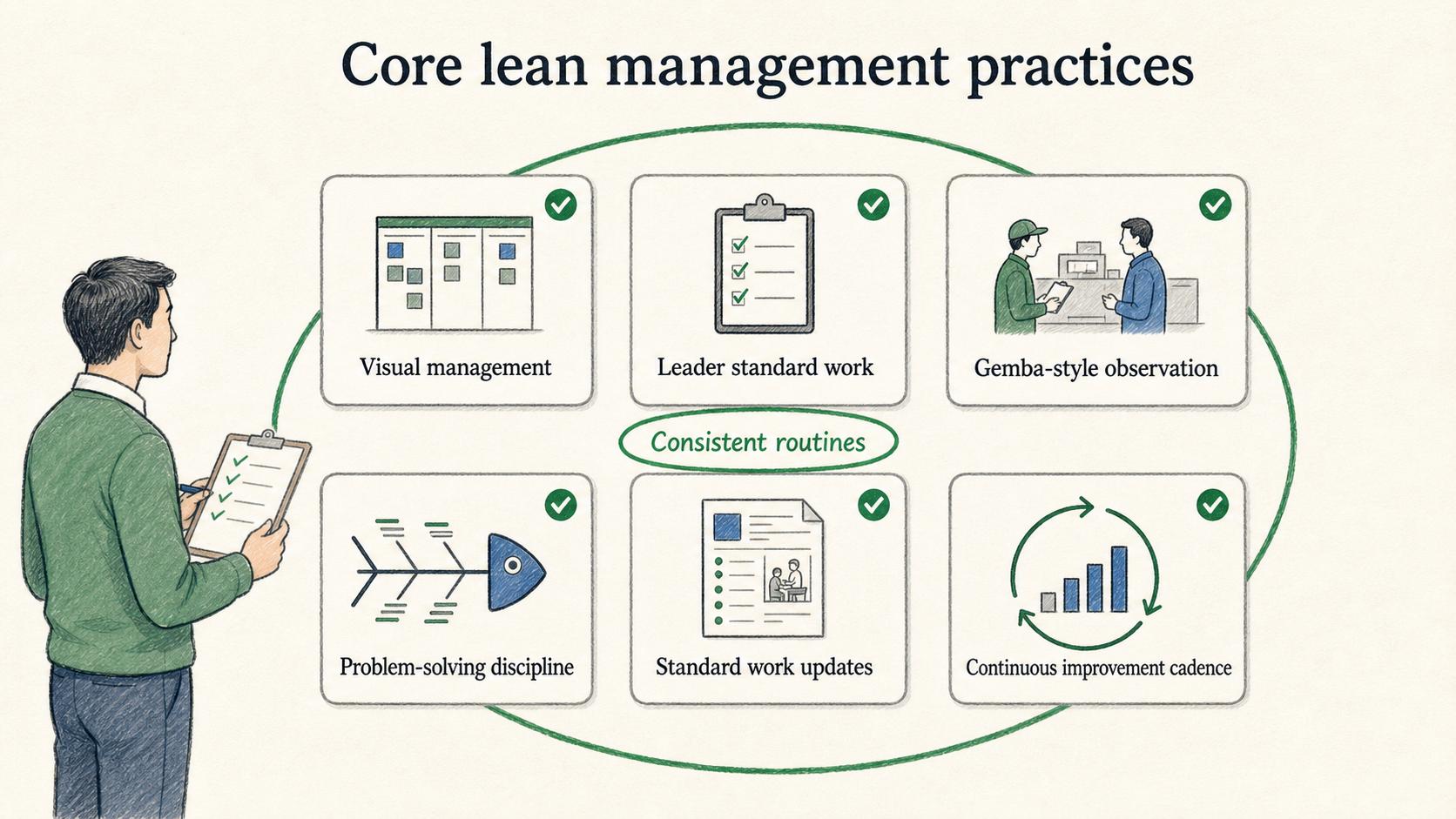
Lean management usually shows up through small routines that repeat consistently:
- Visual management: Make work status, blockers, and priorities easy to see without requiring a status chase.
- Leader standard work: Define the recurring checks and coaching routines managers use to support the process.
- Gemba-style observation: Understand work close to where it happens instead of managing only through reports.
- Problem-solving discipline: Separate symptoms from root causes before jumping to fixes.
- Standard work updates: Change the documented standard when an improvement proves better than the old method.
- Continuous improvement cadence: Run small experiments often enough that learning becomes normal.
The hidden value is consistency. Lean management works when routines are boring enough to be trusted and useful enough that people do not treat them as theater.
What lean managers pay attention to
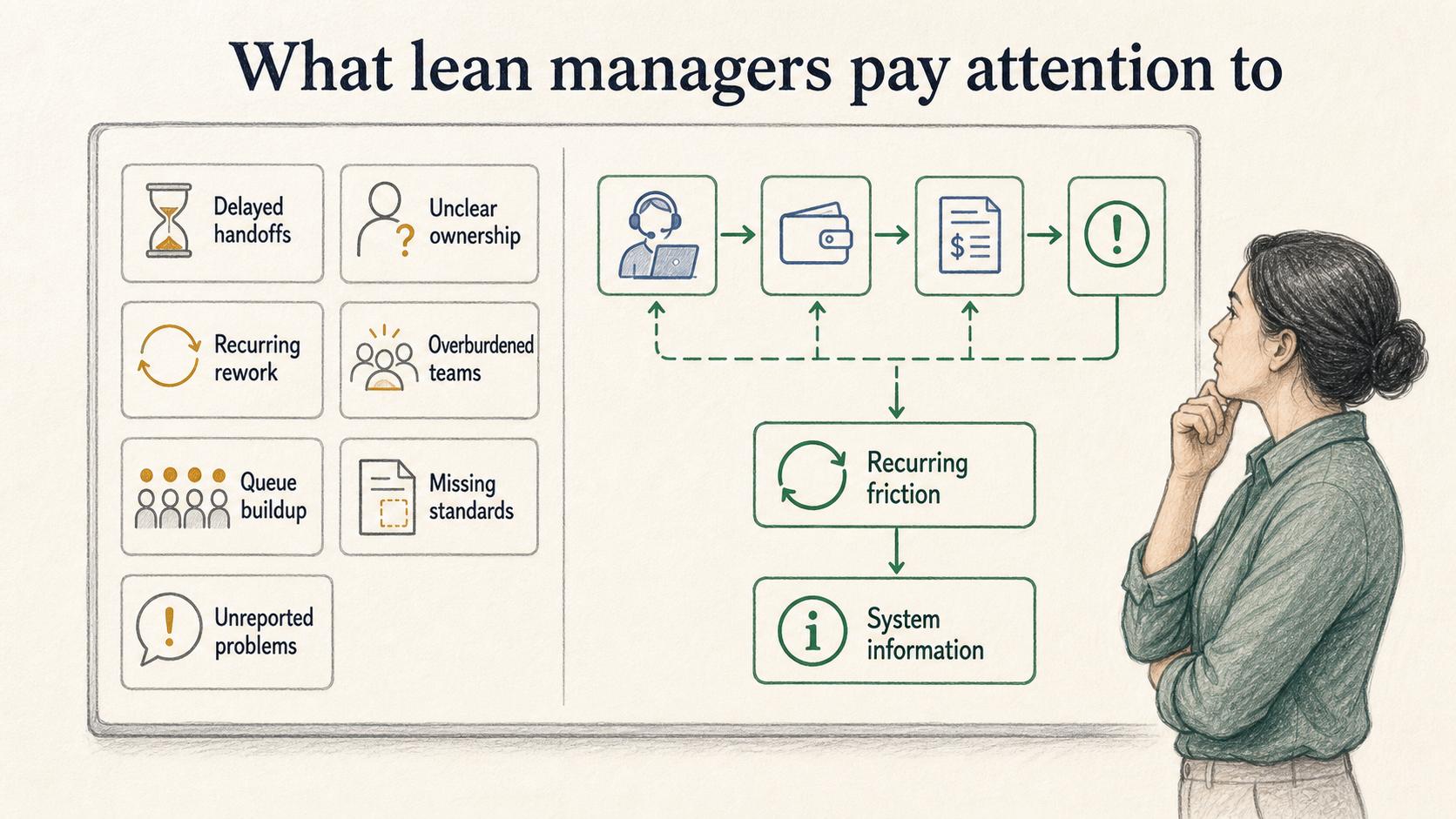
A lean manager is less interested in whether everyone looks busy and more interested in whether the system is healthy. That means watching for delayed handoffs, unclear ownership, recurring rework, overburdened teams, excess approvals, queue buildup, missing standards, and problems people have stopped reporting because nothing changes.
For example, a customer support team might see the same billing issue escalated every week. A non-lean response might be to remind agents to be more careful. A lean management response asks where the work breaks: is the policy unclear, is the tool workflow confusing, is the billing handoff slow, or is the standard guide missing an exception?
That shift matters. Lean management treats recurring friction as information about the system, not just evidence that individuals need another reminder.
Common mistakes
Lean management fails when the rituals survive but the learning disappears. A daily huddle that only recites yesterday's numbers is not lean. A visual board that no one uses to make decisions is decoration. A manager checklist that never changes the work is paperwork.
Watch for these failure modes:
- Metrics are used to pressure people instead of improve the process.
- Leaders ask for transparency but punish bad news.
- Standards exist, but teams work around them because they are stale.
- Improvement ideas are collected without being tested or closed out.
- Managers copy lean tools from another environment without understanding the problem.
- Documentation is treated as final instead of as the current best-known method.
The test is simple: does the management system help people see problems sooner and improve work faster? If not, the team may have lean vocabulary without lean management.
AI-ready lean management prompt
Use this prompt to assess a team or workflow:
## Lean management prompt

**Glossary term:** Lean Management
**Source:** Trails Glossary — trails.so/glossary/lean-management

---

### 01. Assess a team or workflow

"Analyze how [team/process] is currently managed using lean management principles. Identify how work is made visible, how blockers are escalated, what standard work exists, what metrics are reviewed, how managers observe the work, how improvement ideas are tested, and where the management routine creates waste instead of learning. Recommend one small management habit to change first."
Documentation takeaway
Lean management needs documentation because improvement needs a shared baseline. If every person follows a different version of the process, the team cannot tell whether a change worked.
Useful documentation includes standard work, manager routines, escalation paths, meeting guides, visual board definitions, process maps, and improvement logs. The goal is not to document everything. The goal is to make the current standard clear enough that teams can use it, question it, and improve it.
How Trails helps
Trails helps teams turn repeatable work into clear, maintainable guides. A team can capture a workflow as it happens, turn it into a polished step-by-step guide, and create an AI-narrated video version for training or sharing.
That supports lean management by making standards visible, easier to train, and easier to update after the team improves the work.
- Lean manufacturing
- Lean documentation
- Leader standard work
- Visual management
- Gemba walk
- Kaizen
- Process improvement
- Operational excellence