
Glossary
Process Improvement
 ChatGPT
 Perplexity
 Gemini
 Claude
What is process improvement?
Process improvement is the practice of making an existing workflow easier, faster, more reliable, or more valuable to the people who use it. It usually starts by understanding how work happens today, finding the constraint or failure pattern, testing a better way, and making that better way repeatable. 1
For operations, support, enablement, and documentation teams, process improvement is most useful when it turns a vague complaint into a specific workflow change: fewer delays, cleaner handoffs, less rework, better training, or a more consistent customer experience.
Why process improvement matters
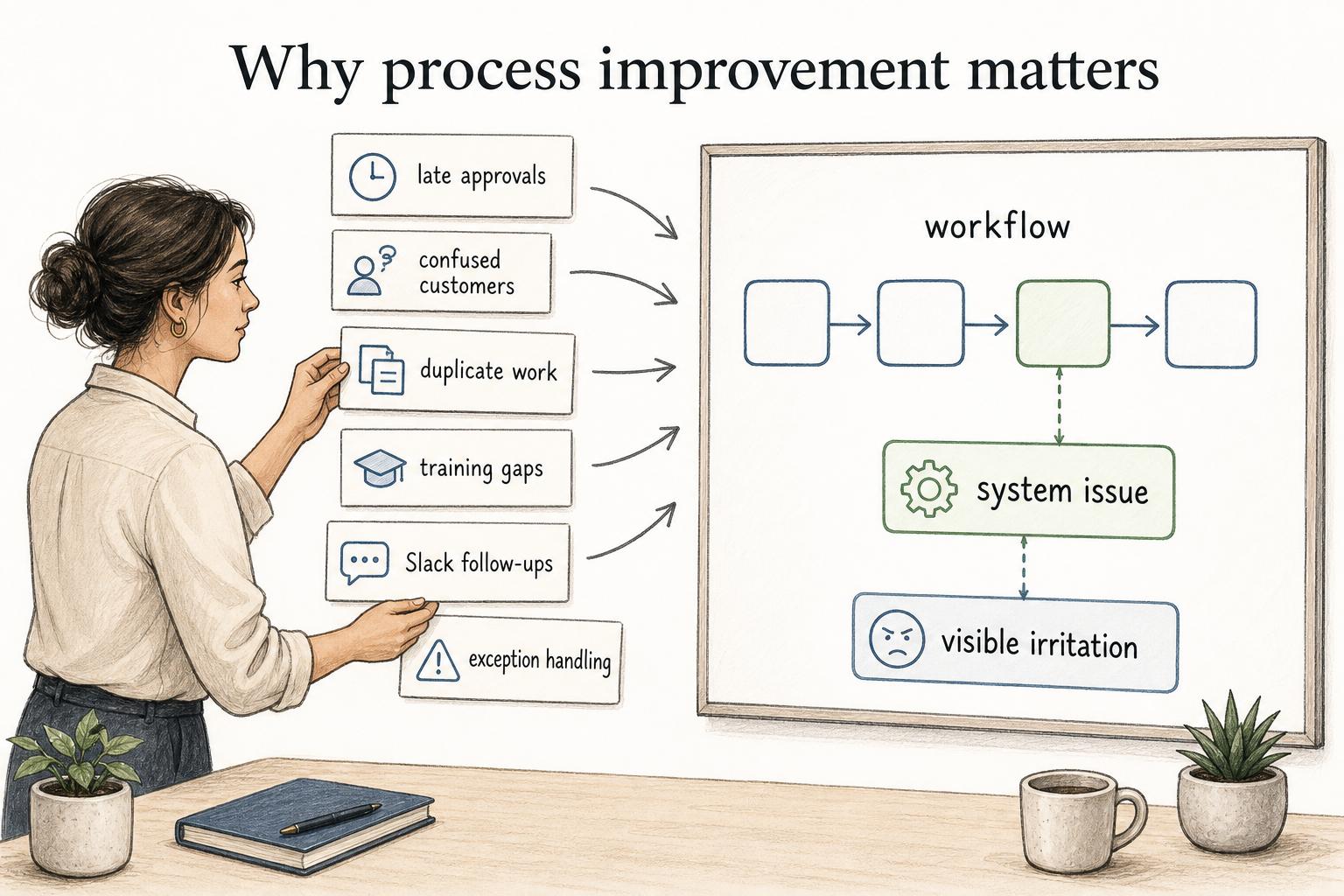
Most process problems do not announce themselves as process problems. They show up as late approvals, confused customers, duplicate work, training gaps, Slack follow-ups, exception handling, or people saying, "I think this is how we do it."
A good process improvement effort turns those symptoms into a sharper question: what part of the workflow is causing the outcome we do not want?
If a customer support escalation process is slow, the fix may not be asking agents to move faster. The real issue might be unclear severity criteria, missing account context, too many approval layers, or an escalation guide that no longer matches the product. Process improvement works when it finds the system issue behind the visible irritation.
How process improvement works
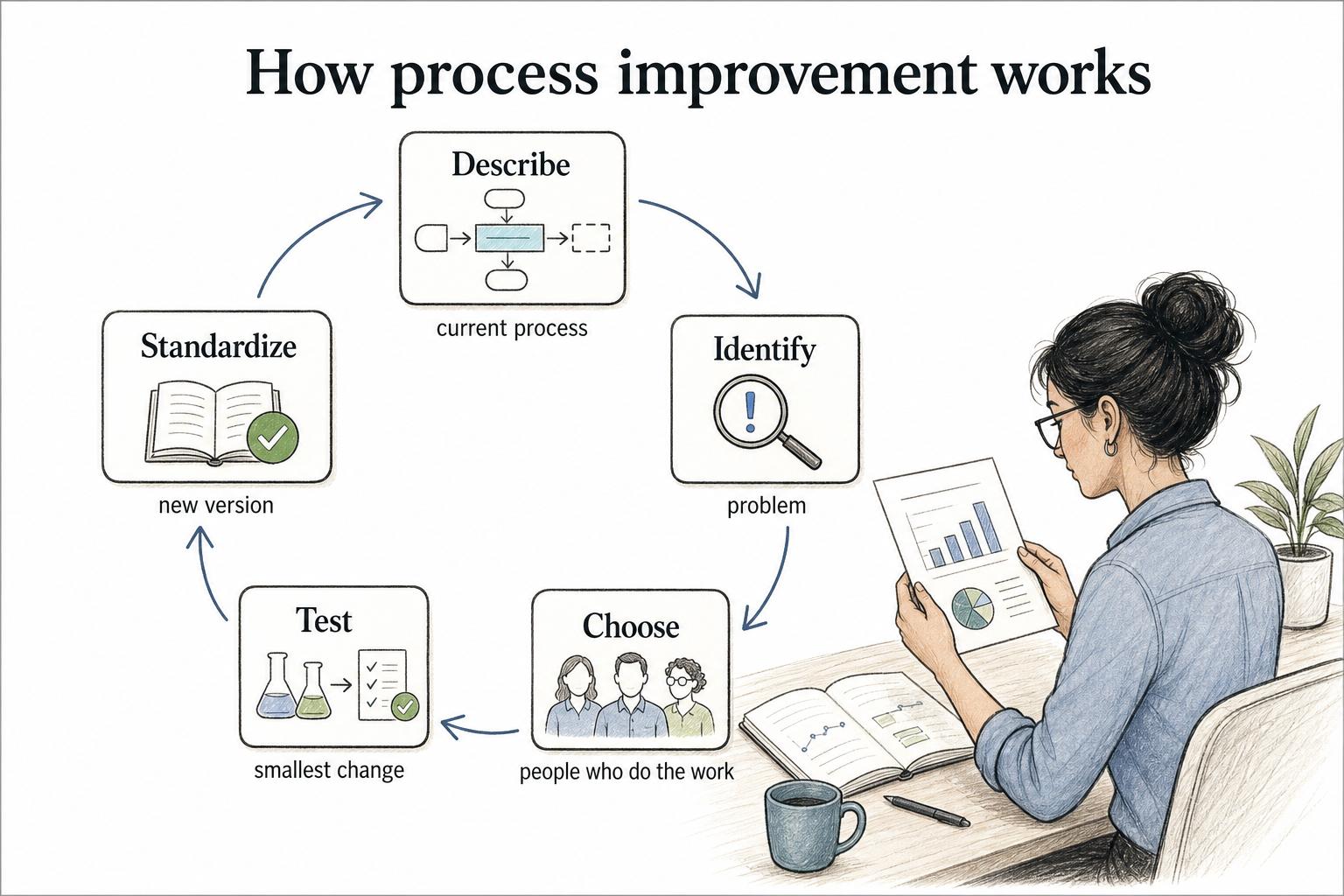
A practical process improvement cycle usually has five moves, similar to the plan-do-study-act habit of testing changes in context before standardizing them: 2
- Describe the current process as it actually happens, including workarounds and exception paths.
- Identify the problem using examples, metrics, interviews, tickets, recordings, or operational evidence.
- Choose the smallest change that could remove the bottleneck or reduce the error pattern.
- Test the change with the people who do the work.
- Standardize the new version if it performs better.
The order matters. Teams often jump from complaint to solution because the pain is obvious. But an obvious pain can still have a non-obvious cause. If a handoff keeps failing, another reminder may help for a week. Clarifying ownership, required inputs, and the decision rule may fix the handoff more permanently.
What process improvement should change
Process improvement can change different layers of work:
- The flow: removing unnecessary steps, changing sequence, simplifying approvals, or splitting a process into clearer phases.
- The decision rules: defining when to escalate, when to pause, when to reject incomplete inputs, or when to use a different path.
- The artifacts: replacing scattered notes with an intake form, checklist, template, process map, or work instruction.
- The ownership model: naming who starts the process, who approves work, who handles exceptions, and who keeps the documentation current.
- The measurement: tracking cycle time, error rate, rework, customer impact, or another signal that proves whether the change helped. 3
The strongest improvements usually touch more than one layer. A new form without ownership still creates confusion. A new metric without a changed workflow only makes the problem more visible.
Example of process improvement
Imagine a customer onboarding team keeps delaying launches because kickoff notes arrive incomplete. The first instinct might be to ask sales for "better notes," but that is too vague to change behavior.
A process improvement pass might reveal that sales, implementation, and customer success each define a complete handoff differently. The better fix could be a required handoff template with three sections: customer goal, promised scope, and known risks. The process owner also adds a rule: implementation can send the handoff back if those fields are missing.
That improvement changes the artifact, the decision rule, and the accountability. The result is easier to train because the new standard is visible.
A simple process improvement prompt
Use this when you need an AI-assisted first pass, then validate it with the people who perform the work:
## Process Improvement Prompt

**Glossary term:** Process Improvement
**Source:** Trails Glossary — trails.so/glossary/process-improvement

---

### 01. Analyze a process

"Analyze this process for improvement opportunities: [process name].
Current goal: [what the process is meant to accomplish].
Current steps: [paste steps, notes, or transcript].
Known problems: [delays, errors, rework, customer complaints, handoff issues].
Constraints: [compliance, tools, staffing, approval requirements].
Suggest: 1) likely root causes, 2) one low-risk improvement, 3) one larger redesign option, 4) what documentation should change, and 5) what metric would show whether the change worked."
The useful output is the set of questions the team can bring into a real process review. Validate the answer against examples, metrics, and people close to the work before changing the process.
Common mistakes
The most common mistake is improving the documented process instead of the real one. If people have developed workarounds, shadow spreadsheets, or side-channel approvals, those are part of the current process and need to be understood before anything is redesigned.
Another mistake is treating speed as the only sign of improvement. Faster is valuable only when quality, risk, customer experience, and employee workload remain acceptable. A process that moves quickly by skipping context may create more rework later.
A third mistake is failing to update the operating artifacts. If the SOP, checklist, training guide, or process map stays old, the organization will drift back toward the old behavior as soon as attention moves elsewhere. 4
How Trails helps
Trails helps teams capture a workflow as someone performs it, then turn that workflow into a polished step-by-step guide. When a process changes, the improved version can be documented quickly and shared as written instructions or an AI-narrated video.
That makes process improvement easier to operationalize: the new way of working is not trapped in a meeting recap, and the people doing the work have a clear reference when behavior needs to change.
Sources
- 1
IBM. Process improvement. IBM Think. www.ibm.com/think/topics/process-improvement.
- 2
Institute for Healthcare Improvement. Testing Changes. www.ihi.org/library/model-for-improvement/testing-changes.
- 3
APQC. Percentage change in cycle time reduction. www.apqc.org/what-we-do/benchmarking/open-standards-benchmarking/measures/percentage-change-cycle-time-reduction.
- 4
UC Berkeley. Process Documentation. bpm.berkeley.edu/process-documentation.