
Glossary
Continuous Improvement
 ChatGPT
 Perplexity
 Gemini
 Claude
What is continuous improvement?
Continuous improvement is the habit of making small, ongoing changes to a process, product, or workflow so it gets better over time. 1 Instead of waiting for a major redesign, teams observe how work actually happens, find friction, test a change, and keep what works.
The useful version is practical, not motivational. Continuous improvement is a repeatable operating habit: notice a problem, make the next improvement visible, and learn from the result.
Why continuous improvement matters
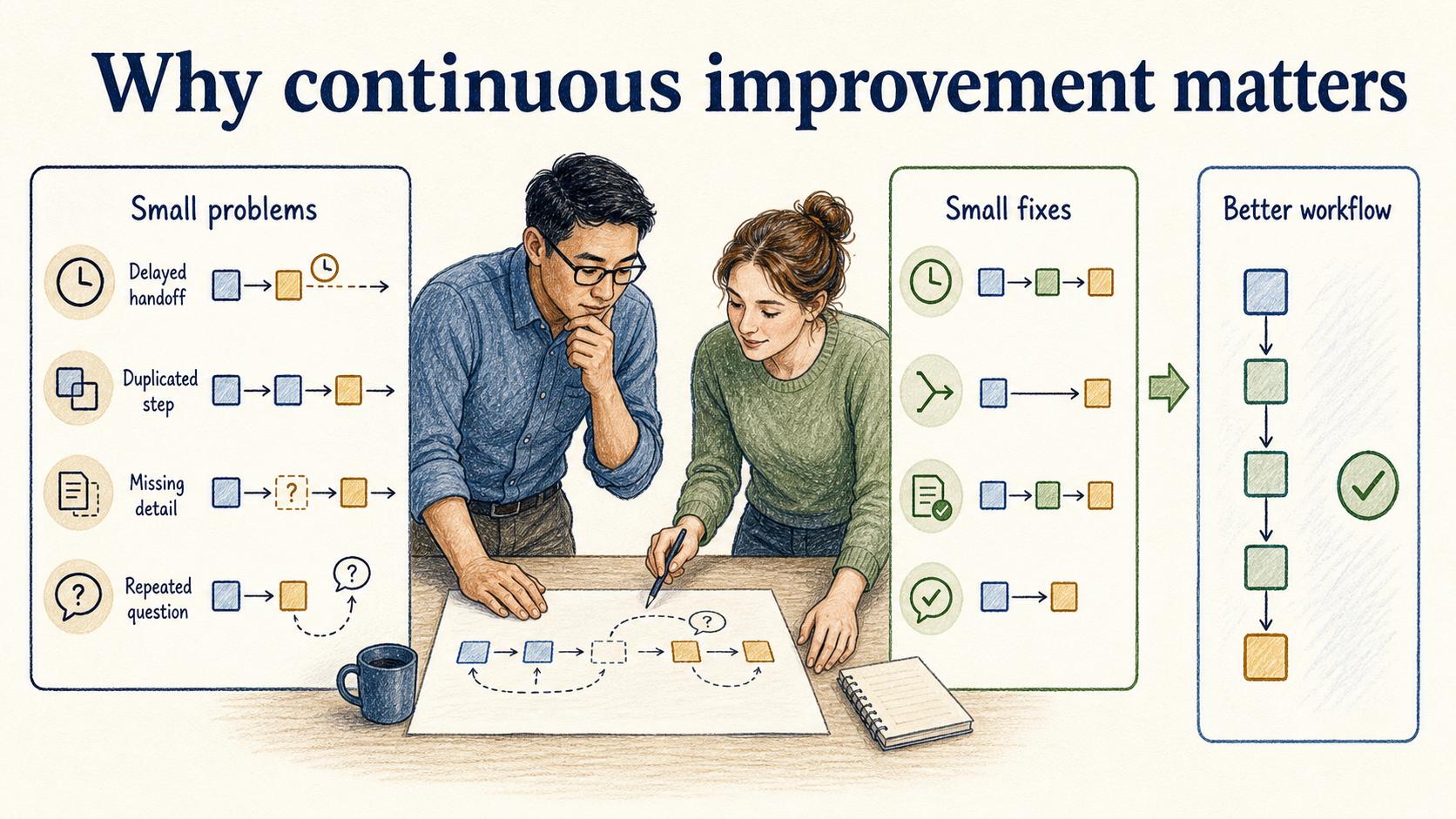
Continuous improvement matters because most process problems do not arrive as one dramatic failure. They show up as small delays, rework, duplicated steps, unclear handoffs, customer confusion, or tribal knowledge that slowly becomes normal.
A team that waits for a quarterly transformation project may tolerate those problems for months. A team with a continuous improvement habit can act while the work is still fresh. Small fixes compound when they stay attached to real workflows and the people who perform them.
The trap is confusing continuous improvement with endless tinkering. Not every suggestion deserves a change, and not every change deserves a rollout. The best teams keep improvement lightweight while still asking for evidence: what problem are we solving, what will be different, and how will we know if it worked?
How continuous improvement works
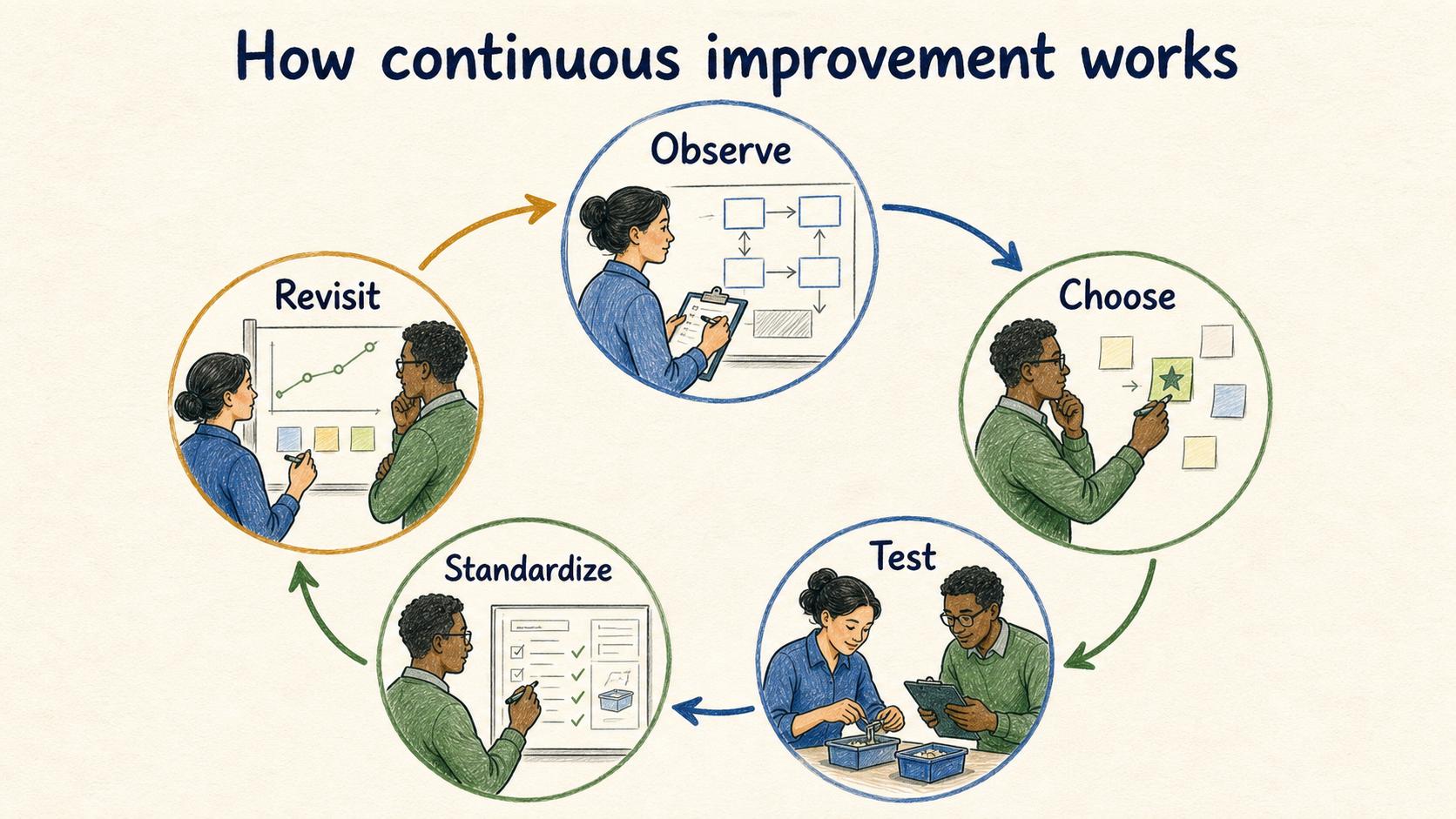
Continuous improvement usually follows a simple loop: observe, choose, test, standardize, and revisit. Frameworks vary, but the discipline is the same. PDCA and PDSA are common cycles for testing a change and learning from the result. 2
First, observe the current process. Include the real work, not just the formal SOP. If people skip steps, build spreadsheets, ask the same Slack question every week, or rely on one experienced person to interpret edge cases, that is part of the current state.
Second, choose one improvement small enough to test. A useful target is specific: reduce missing intake details, remove a duplicate approval, clarify a handoff, shorten a queue, or make an exception path visible. Vague goals like "improve quality" rarely lead to useful action.
Third, test the change close to the work. That might mean updating a checklist, changing a form field, adding a decision rule, recording a new walkthrough, or changing who owns a step. The change should be visible enough that people can try it and concrete enough that the team can discuss whether it helped.
Finally, standardize what works. This is where many teams lose the benefit. They make a good local fix but never update the procedure, training material, template, or tool setup. Continuous improvement compounds only when better ways of working become the new default. 3
Example: continuous improvement in a support process
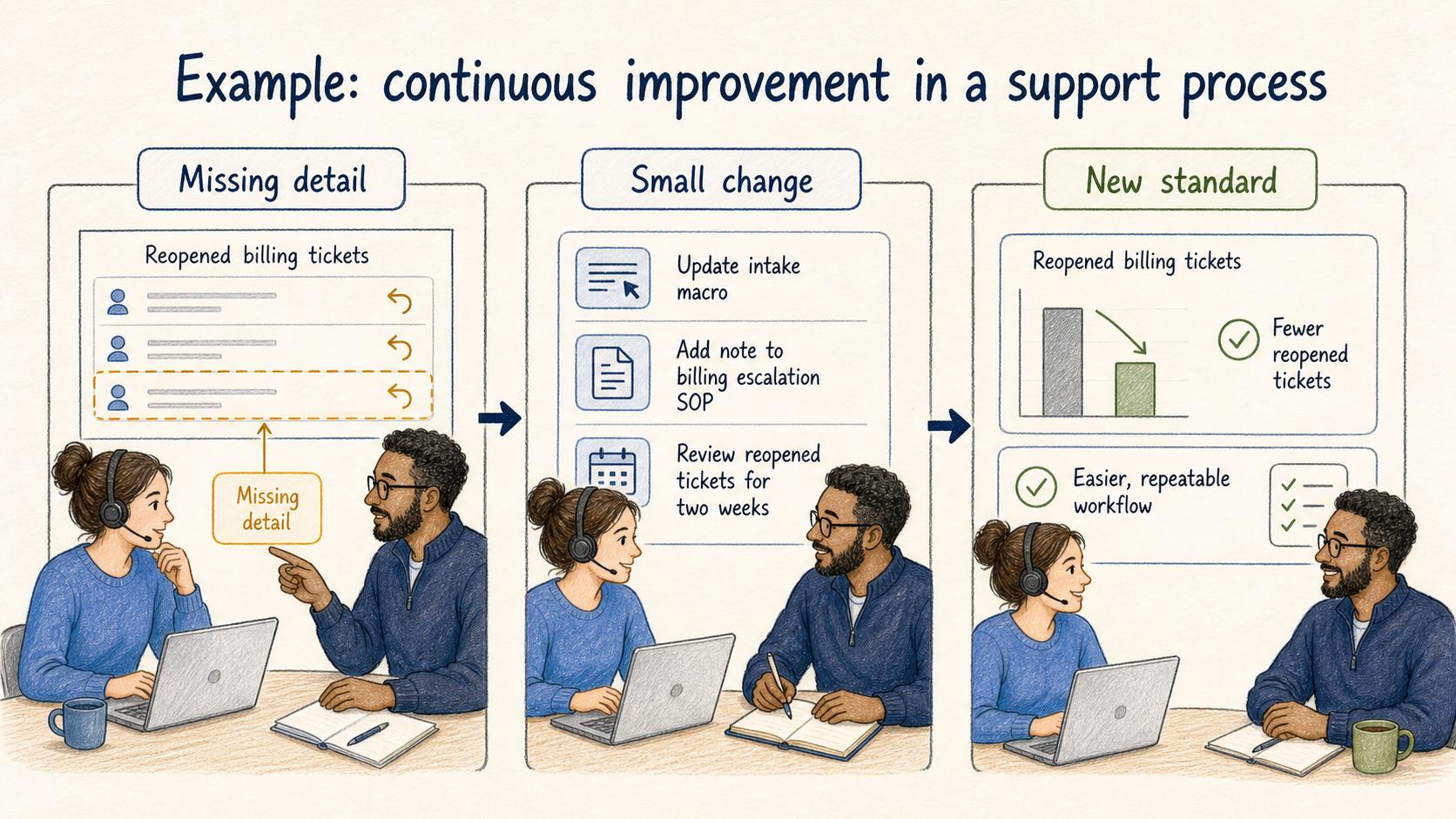
Imagine a customer support team keeps reopening billing tickets because agents forget to collect one required detail before escalating. A heavy process redesign would be overkill. The better first move is to review a few recent tickets and identify the exact missing field.
The team tests a small change: update the intake macro with a required question, add a short note to the billing escalation SOP, and ask team leads to review reopened tickets for two weeks. If reopened tickets drop and agents find the macro easy to use, the change becomes the new standard.
The improvement is small, but the lesson is larger. The team did not just ask people to be more careful. It changed the workflow so the better behavior became easier to repeat.
What makes continuous improvement stick
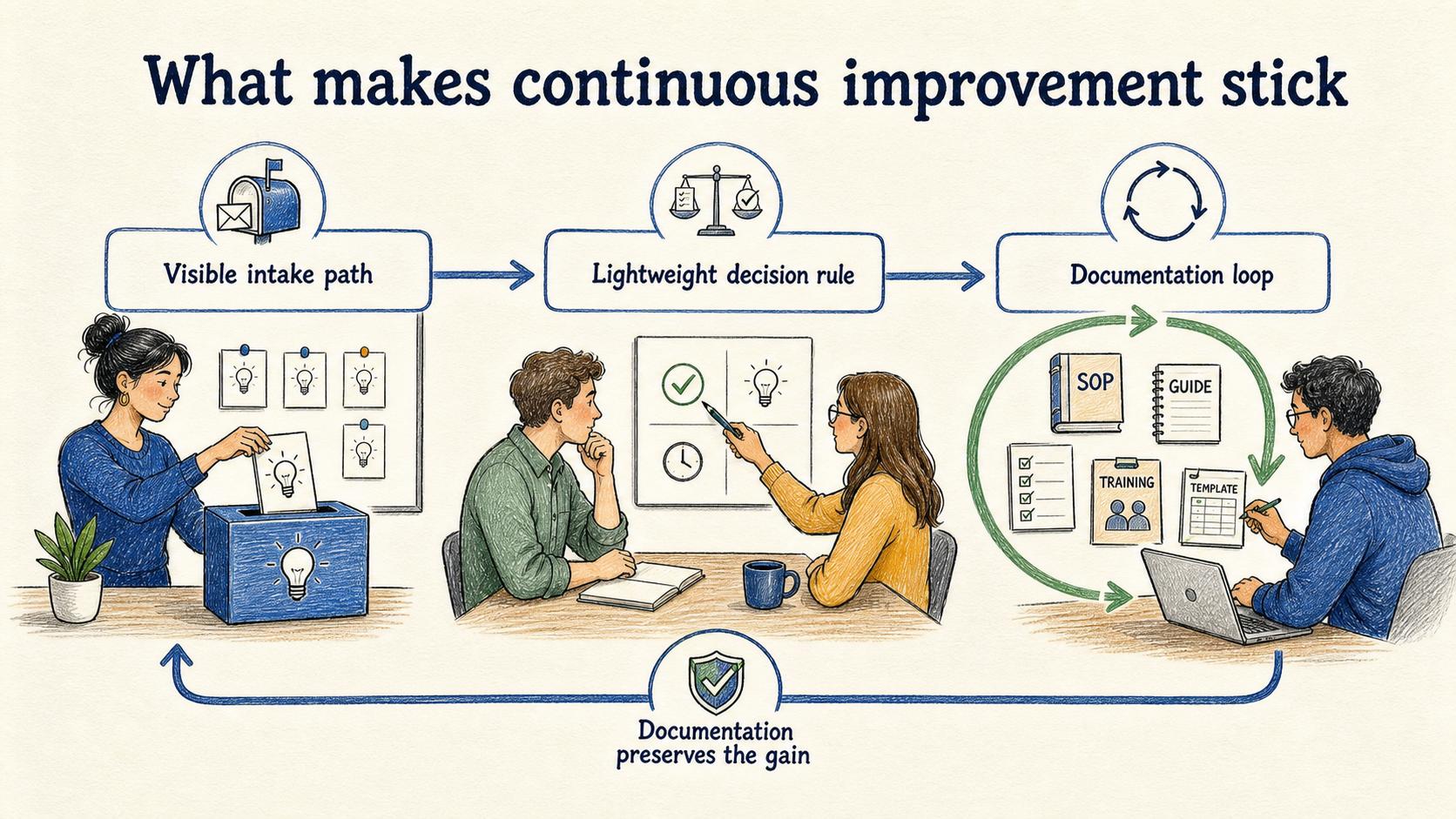
Continuous improvement sticks when it has a home. If every suggestion disappears into chat, people stop sharing useful observations. If every idea becomes a project, the habit becomes too heavy to maintain.
A practical system needs three things:
- A visible intake path: People know where to raise a friction point or improvement idea.
- A lightweight decision rule: The team knows which changes can be tested immediately and which need review.
- A documentation loop: Any accepted change updates the SOP, guide, checklist, training, or template that defines the work.
The documentation loop is the least glamorous part, but it preserves the gain. Without it, continuous improvement turns into oral tradition. The people in the room learn; everyone else inherits a stale process.
AI-ready template for a continuous improvement review
## Continuous Improvement Review

**Glossary term:** Continuous Improvement
**Source:** Trails Glossary — trails.so/glossary/continuous-improvement

---

### 01. Plan a small improvement test

"Help me turn this workflow problem into a small continuous improvement test.

Workflow: [process or task]
Team: [team]
Current problem: [specific friction, delay, rework, quality issue, or customer pain]
Evidence: [examples, metrics, ticket notes, observations]
Current documentation: [SOP, checklist, guide, or training material]
Constraints: [tools, approvals, compliance, staffing, timing]

Return:
1. The likely root cause or decision point to inspect.
2. One small change we can test in the workflow.
3. What documentation should change if the test works.
4. A simple before/after measure.
5. Risks or side effects to watch."
How Trails helps
Continuous improvement depends on seeing the real workflow clearly enough to improve it. Trails captures a workflow as someone performs it, turns it into a polished step-by-step guide, and can create an AI-narrated video version for training or sharing.
That gives teams a concrete baseline to improve. When a better workflow becomes the new standard, they can update the guide instead of relying on memory or scattered notes.
FAQ
Is continuous improvement the same as process improvement?
Not exactly. Process improvement can be a one-time project or a structured initiative. Continuous improvement is the ongoing habit of finding and applying smaller improvements over time.
Does continuous improvement require a formal lean program?
No. Lean methods can help, but teams can practice continuous improvement with simple routines: observe work, test small changes, document what works, and revisit the process regularly.
What is a good first continuous improvement project?
Start with a recurring friction point that is small, visible, and close to the team doing the work. Reopened tickets, duplicate approvals, missing intake details, and unclear handoffs are good candidates.
How do you avoid changing too many things at once?
Limit each test to one workflow change and one clear measure. If the team changes the form, owner, SLA, and tool at the same time, it becomes hard to know what actually helped.
Sources
- 1
Lean Enterprise Institute. Continuous Improvement. www.lean.org/lexicon-terms/continuous-improvement/.
- 2
ASQ. Plan-Do-Check-Act Cycle. asq.org/quality-resources/pdca-cycle.
- 3
Lean Enterprise Institute. Standardized Work. www.lean.org/lexicon-terms/standardized-work/.