
Glossary
Lean Manufacturing
 ChatGPT
 Perplexity
 Gemini
 Claude
What is lean manufacturing?
Lean manufacturing is a production approach focused on delivering customer value while reducing waste in the way work moves through a system. It looks at the full path from demand to delivery and asks where materials, information, decisions, people, and products wait, loop back, or fail to create value.
Good lean manufacturing does more than cut cost or speed people up. It makes work easier to see, easier to perform correctly, and easier to improve.
How lean manufacturing works
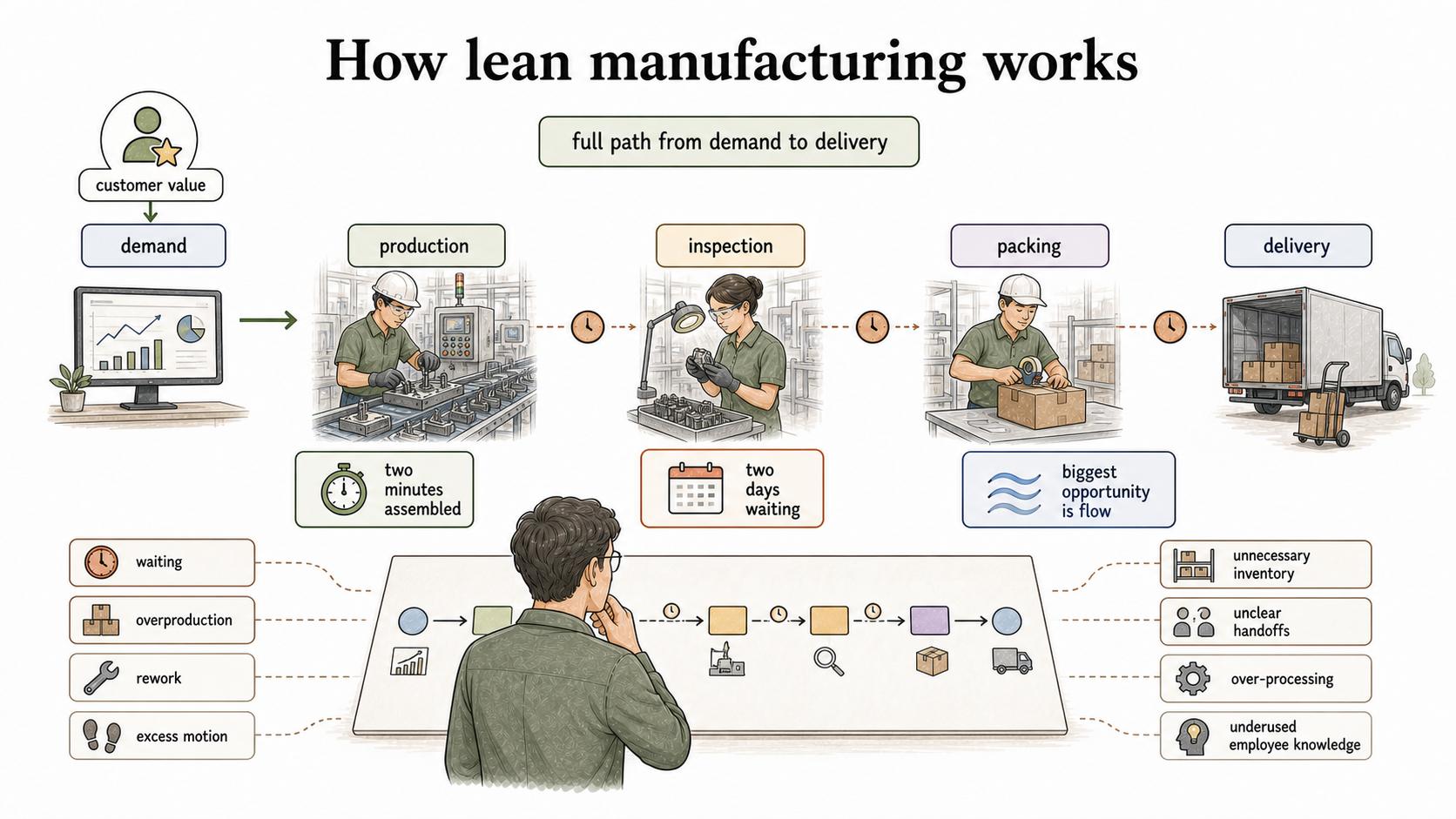
Lean manufacturing starts with the customer. What outcome does the customer actually value? Once that is clear, the team studies the process that creates the outcome: where work begins, how it flows, what gets inspected, where delays appear, where defects are introduced, and which steps exist only because the system is compensating for its own friction.
Lean teams look for waste such as waiting, excess motion, overproduction, unnecessary inventory, rework, unclear handoffs, over-processing, and underused employee knowledge.
A simple example: if a product spends two minutes being assembled but two days waiting between production, inspection, and packing, the biggest opportunity is not the worker's assembly speed. The bigger opportunity is flow.
Core lean manufacturing ideas
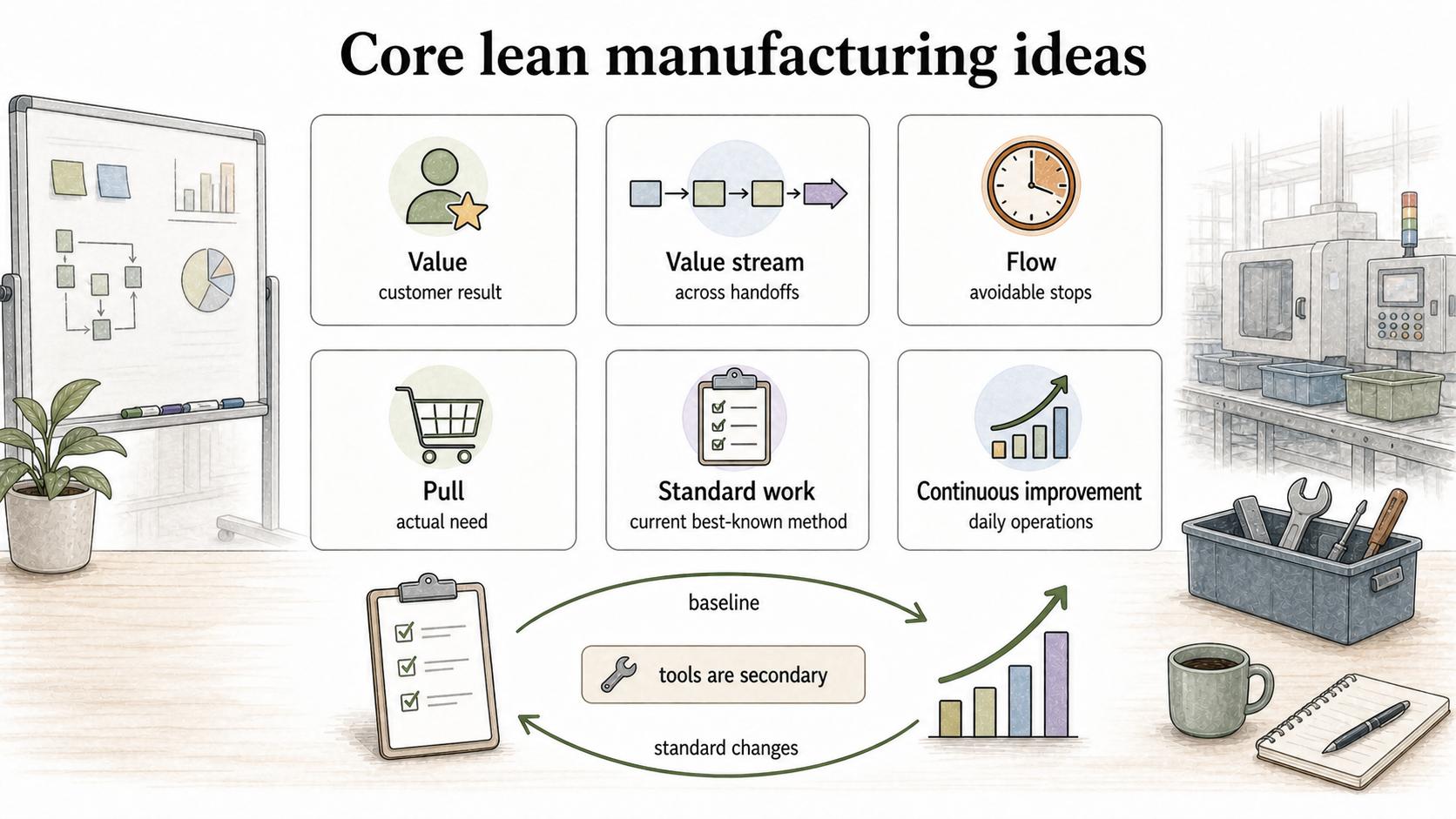
Lean manufacturing includes many tools, but the tools are secondary to the management logic behind them.
| Idea | What it means | What it changes in practice |
|---|---|---|
| Value | The outcome the customer cares about | Teams stop optimizing work that does not improve the customer result |
| Value stream | The end-to-end path that creates and delivers value | Teams look across handoffs instead of fixing one isolated step |
| Flow | Work moves steadily without avoidable stops | Queues, batching, rework, and waiting become visible problems |
| Pull | Demand triggers work instead of pushing excess output forward | Production is better matched to actual need |
| Standard work | The current best-known method for repeatable work | Improvement has a baseline instead of relying on memory |
| Continuous improvement | Teams keep testing better ways to work | Improvements become part of daily operations, not one-time events |
Standard work and improvement work together. Standard work gives the team something concrete to improve. When the better method is proven, the standard changes.
Common examples of lean manufacturing
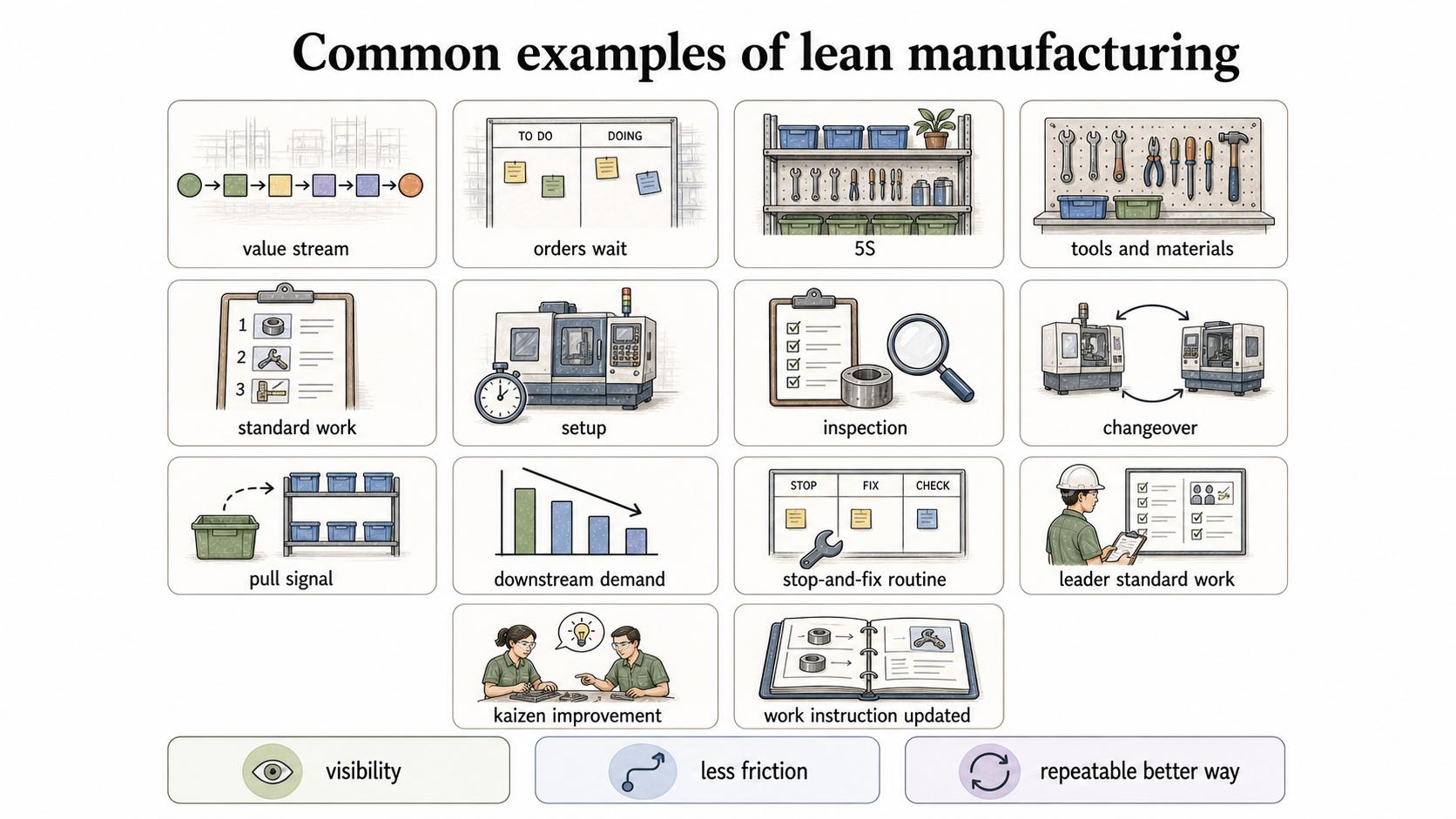
Lean manufacturing usually shows up as changes people can see in the work:
- A team maps a value stream to find where orders wait before the next step.
- A production cell uses 5S so tools, materials, and visual cues are easy to find and reset.
- Operators follow standard work for a setup, inspection, or changeover.
- A pull signal replenishes parts only when downstream demand appears.
- A defect triggers a stop-and-fix routine instead of being passed to the next station.
- A supervisor uses leader standard work to check process health at consistent times.
- A kaizen improvement changes the method, and the work instruction is updated afterward.
The pattern across these examples is visibility, less friction, and a repeatable better way.
Lean manufacturing vs ordinary process improvement
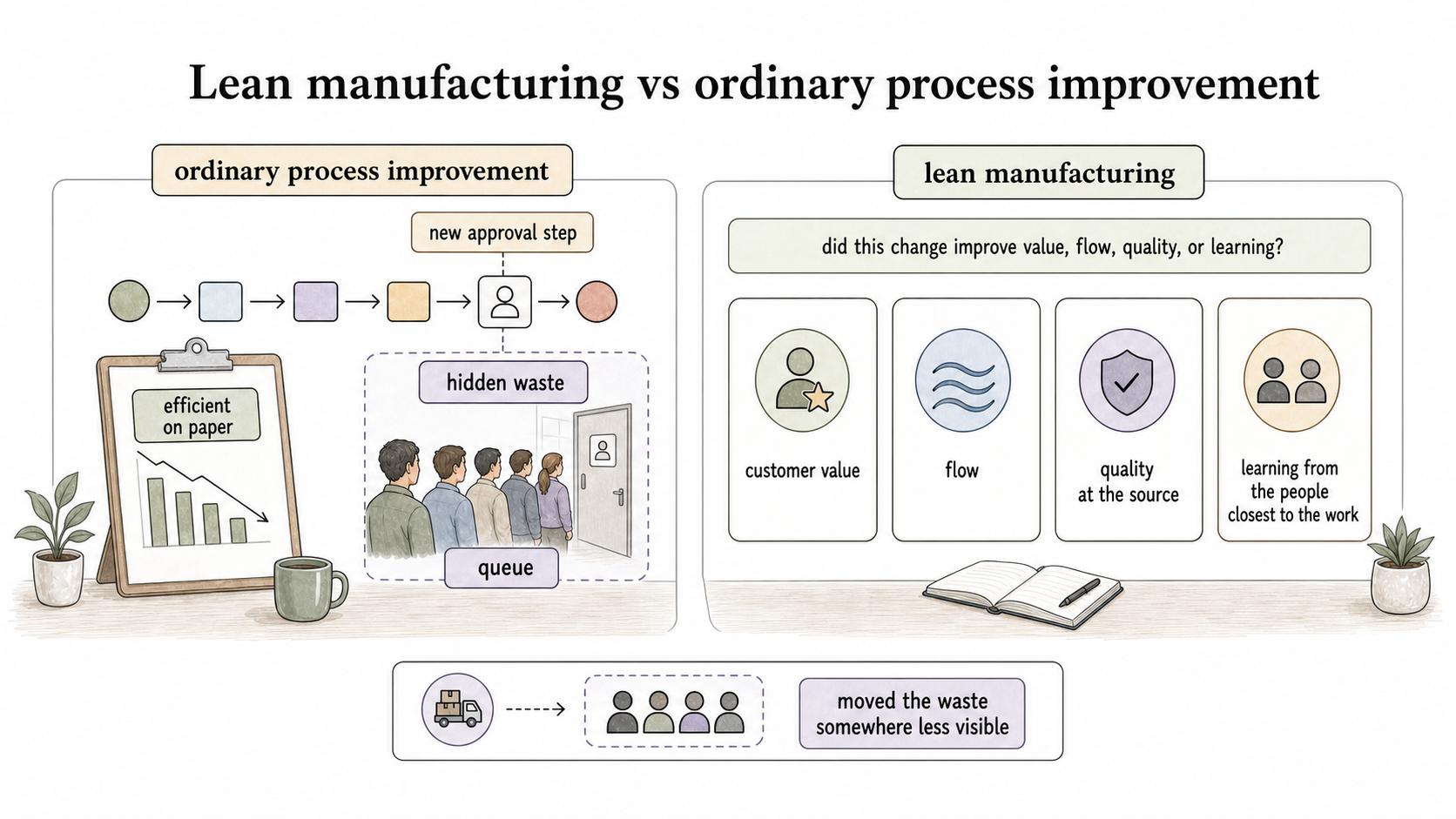
Lean manufacturing is a type of process improvement, but it has a sharper point of view. It does not treat every improvement as equally useful. It prioritizes customer value, flow, quality at the source, and learning from the people closest to the work.
That is why a lean team may reject a solution that looks efficient on paper but adds hidden waste. A new approval step might reduce one defect, but if it creates a queue that delays every shipment, the team needs to improve quality without slowing the whole system.
Lean thinking forces that tradeoff into the open. It asks: did this change improve value, flow, quality, or learning? If not, the team may just have moved the waste somewhere less visible.
Why documentation matters in lean manufacturing
Documentation supports lean manufacturing when it makes the current standard usable. If the best method lives only in an experienced operator's head, the team cannot train consistently, spot variation, or update the standard after an improvement.
Useful lean documentation usually falls into a few buckets: standard work and visual work instructions, inspection or setup checks, 5S standards, process maps, escalation paths, training guides, and improvement notes.
The risk is treating documentation like a museum. In a lean environment, a document should reflect the current best-known method. When the work changes, the guide should change too.
AI-ready lean workflow prompt
Use this prompt to analyze one production or operations workflow:
## Lean workflow prompt

**Glossary term:** Lean Manufacturing
**Source:** Trails Glossary — trails.so/glossary/lean-manufacturing

---

### 01. Analyze a workflow

"Analyze [workflow/process] using lean manufacturing thinking. Identify the customer value, major process steps, waiting points, handoffs, rework loops, quality checks, current standard work, visible waste, and one small improvement experiment. Then list which work instructions, training materials, or SOPs would need to change if the experiment becomes the new standard."
How Trails helps
Trails helps with the standard-work side of lean manufacturing. Teams can capture a workflow as someone performs it, turn it into a polished step-by-step guide, and create an AI-narrated video version for training or sharing.
That makes the current standard easier to teach, follow, and revise when a lean improvement changes how the work should be done.
- Lean management
- Lean documentation
- Kaizen
- 5S methodology
- Value stream mapping
- Continuous improvement
- Standard work
- Manufacturing SOP