
Glossary
Value Stream Mapping
 ChatGPT
 Perplexity
 Gemini
 Claude
What is value stream mapping?
Value stream mapping is a lean process improvement method for mapping how work and information move from trigger to customer outcome, including the delays in between.1
It helps a team see the full flow: where value is created, where work waits, and where handoffs, rework, or missing information slow things down.
A process map usually names the steps. A value stream map adds the conditions around those steps: queue time, approvals, inputs, owners, rework loops, and the gap between active work and waiting.2
That makes it useful when a process looks fine on paper but still feels slow in practice.
Why value stream mapping matters
Most teams can describe the work inside their own lane. The trouble starts when a customer, ticket, invoice, hire, or request crosses lanes.
Take customer onboarding. The official process might list kickoff, account setup, data import, training, and go-live. Each step may look reasonable on its own. On a value stream map, the useful discovery may be that account setup takes 30 minutes, while the customer waits three days for access, two days for a data answer, and another week for training.
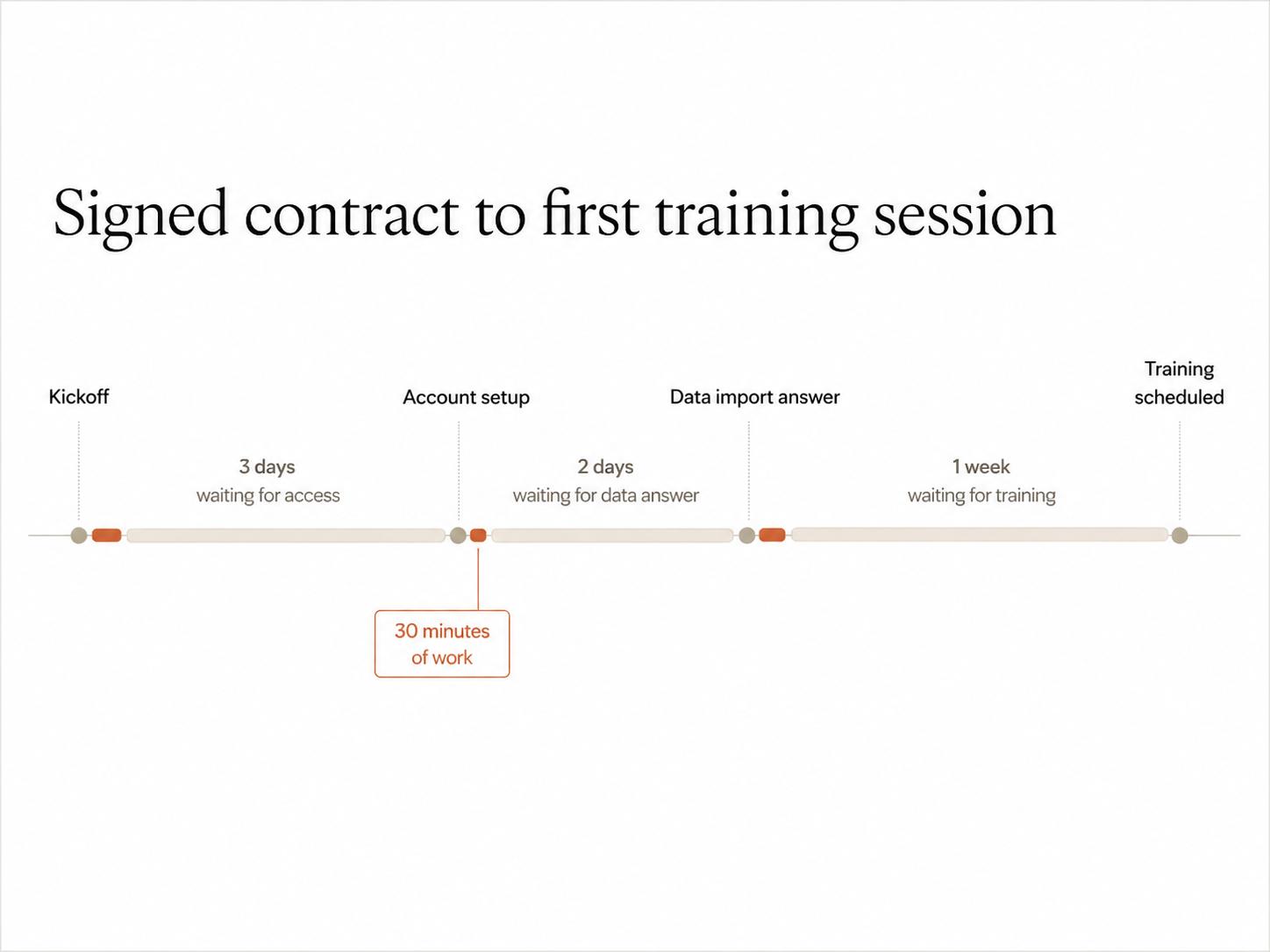
Value stream mapping separates motion from progress. It shows whether the process is slow because the work is hard, because decisions queue up, because information arrives incomplete, or because handoffs are unclear.
It also keeps improvement work focused on the system instead of guessing which person is holding things up.
What a value stream map includes
A useful value stream map follows a process from trigger to outcome and reflects how work actually happens. If people open requests in Slack before filling out the official form, the map should show Slack.
Capture the details that change the improvement decision:
- Boundaries: trigger, customer or recipient, and done condition.
- Major steps and owners: the activities and the roles responsible for them.
- Information flow: requests, decisions, updates, approvals, and systems used.
- Timing: active work time, wait time, queue time, cycle time, and lead time where available.
- Handoffs and rework: ownership changes, loops, missing inputs, and recurring corrections.
- Current and future state: how the flow works today and what should change after improvement.3
The timing data does not have to be perfect for a first pass. Directionally honest is better than polished fiction.
Value stream mapping vs process mapping
Value stream mapping and process mapping are related, but they answer different questions.
Process mapping asks, What are the steps? Value stream mapping asks, Where does value move, wait, loop back, or get blocked?
A process map is usually enough for training, documentation, or standardization. A value stream map is stronger for improvement across a whole flow, especially when individual steps look efficient but the end-to-end experience is slow.
Use them together: map the value stream to choose the improvement, then update the process documentation so the better workflow becomes repeatable.
How to run a lightweight value stream mapping session
Start with one process that is painful enough to matter and narrow enough to map. Improve onboarding is too broad. Move a new customer from signed contract to first training session is much better.
Invite the people who touch the work, including the ones who handle the messy handoffs. Managers can describe the policy; operators usually know the calendar gaps, informal messages, missing fields, unclear ownership, and workarounds that never make it into the official process.
Use this first-pass prompt:
## Value Stream Mapping Session Prompt

**Glossary term:** Value Stream Mapping
**Source:** Trails Glossary — trails.so/glossary/value-stream-mapping

---

### 01. Map a current value stream

"Map the current value stream for [process].

Customer or recipient: [who receives the outcome]
Start trigger: [what begins the process]
End outcome: [what counts as done]
Major steps: [list the steps in order]

For each step, capture:
- owner
- system or tool used
- active work time
- wait time
- handoff point
- common rework or missing information

Then identify:
1. Biggest delay
2. Most common rework loop
3. Handoff that could be simplified
4. Future-state change that reduces delay without hiding work in another team"
That last line matters. A future-state map that pushes work to another team has only moved the bottleneck.
Common mistakes
One mistake is mapping the ideal process instead of the real one. If the official process says requests come through a form but everyone actually starts in Slack, the map needs to show Slack.
Another mistake is deleting every non-value-added step. Some work does not directly create customer value but protects the business or the customer: compliance review, security checks, billing validation, or quality inspection. Mark it clearly before deciding whether to remove, simplify, or speed it up.4
A third mistake is ending with the map. The output should be an operating change: clearer ownership, fewer queues, revised SOPs, better training, or a redesigned handoff.
Documentation takeaway
Value stream mapping earns its keep when the future state becomes the standard way of working. After the team chooses the change, update the SOPs, guides, checklists, and training materials people actually use.
Trails can help by capturing the improved workflow as it happens and turning it into a step-by-step guide or AI-narrated training video. The map shows where the work should change; the documentation helps the change stick.
FAQ
Is value stream mapping only for manufacturing?
No. It is strongly associated with lean manufacturing, but the same method can be applied to service, support, onboarding, HR, finance, IT, and other repeatable work with handoffs and delays.
What is the difference between current-state and future-state mapping?
The current-state map shows how the process works today. The future-state map shows how the team wants it to work after removing waste, reducing delays, or simplifying handoffs.
Do you need exact timing data to start?
No. Exact data helps, but an honest first estimate can still reveal bottlenecks. Improve the timing data as the team tests the map against real work.
- Value stream
- Process map
- Process mapping
- Process improvement
- Continuous improvement
- Lean manufacturing
- Cycle time
- Lead time
Sources
- 1
Lean Enterprise Institute. Value-Stream Mapping. Lean Enterprise Institute. www.lean.org/lexicon-terms/value-stream-mapping/. Accessed June 25, 2026.
- 2
U.S. Environmental Protection Agency. Lean & Environment Toolkit Appendix A. EPA. 19january2017snapshot.epa.gov/lean/lean-environment-toolkit-appendix_.html. Accessed June 25, 2026.
- 3
Lean Enterprise Institute. Understanding the Fundamentals of Value-Stream Mapping. Lean Enterprise Institute. www.lean.org/the-lean-post/articles/understanding-the-fundamentals-of-value-stream-mapping/. Accessed June 25, 2026.
- 4
U.S. Environmental Protection Agency. Environmental Professional's Guide to Lean and Six Sigma. EPA. 19january2021snapshot.epa.gov/sustainability/environmental-professionals-guide-lean-and-six-sigma-chapter-2_.html. Accessed June 25, 2026.