
Glossary
Lean Documentation
 ChatGPT
 Perplexity
 Gemini
 Claude
What is lean documentation?
Lean documentation is documentation that helps people perform, check, train, or improve work with the least necessary friction. It gives teams enough clarity to follow the current standard without creating bloated manuals, duplicate records, or documents no one trusts.
The goal is not to document as little as possible. The goal is to document the right things in the right format, close enough to the work that people actually use it.
What lean documentation includes
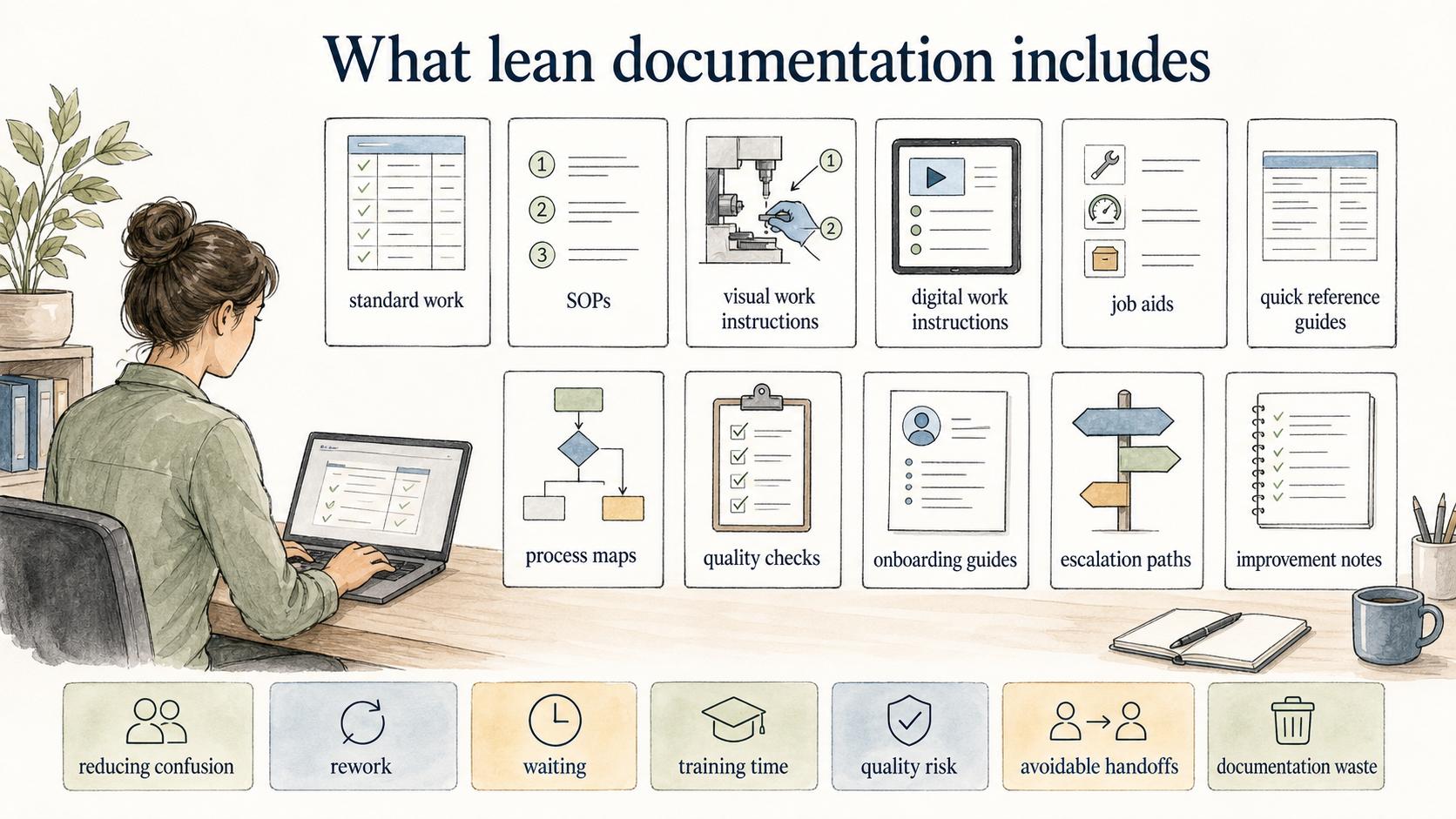
A high-risk inspection may need a precise checklist. A software workflow may need screenshots. A production setup may need visual work instructions. A new-hire workflow may need a short guide with decision points and examples.
Common forms include standard work, SOPs, visual and digital work instructions, job aids, quick reference guides, process maps, quality checks, onboarding guides, escalation paths, and improvement notes. A lean document earns its place by reducing confusion, rework, waiting, training time, quality risk, or avoidable handoffs.
Lean documentation vs. over-documentation
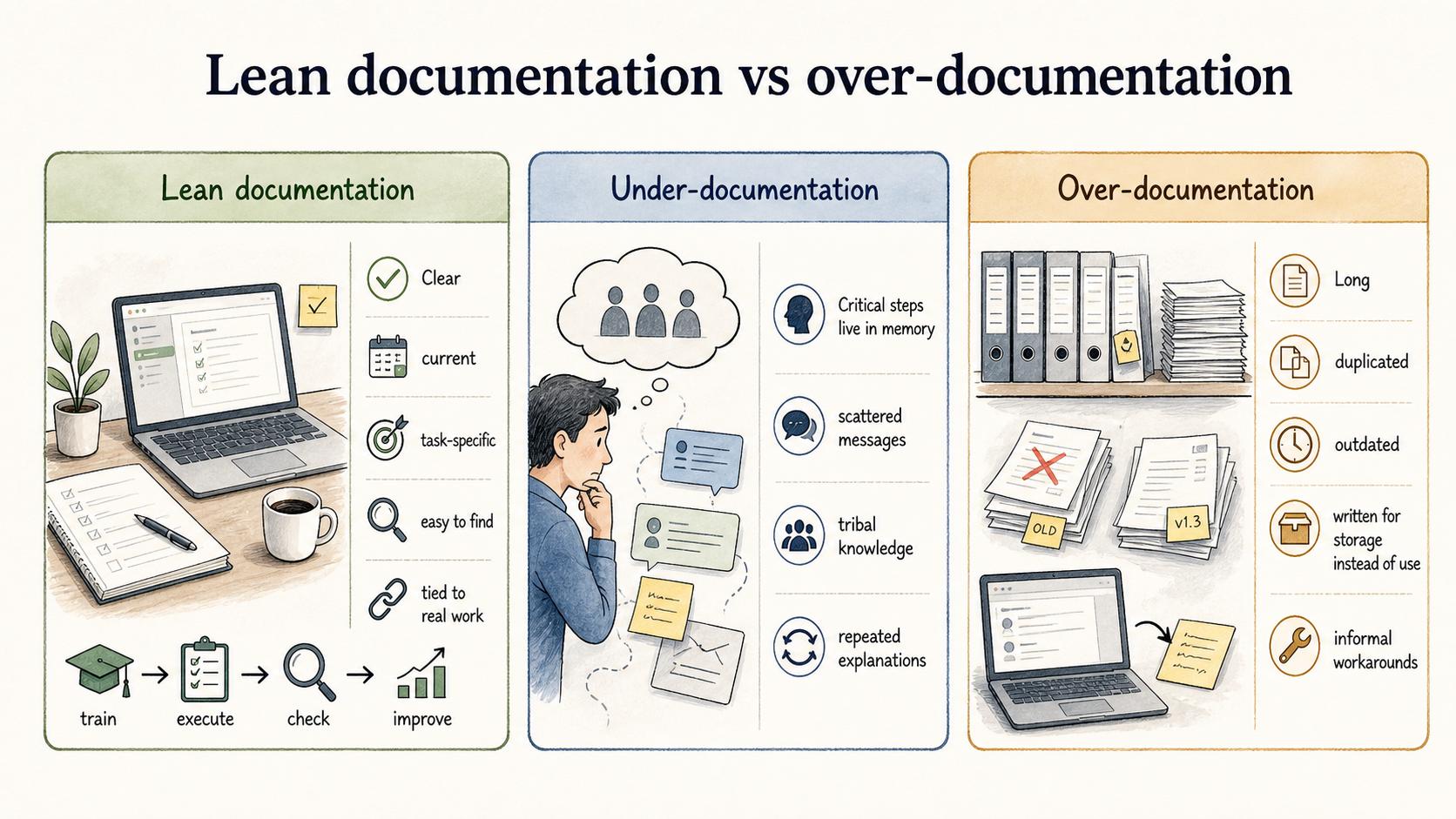
Lean documentation is not the same as short documentation. A short document can still be useless, and a longer document can be lean if the work genuinely needs detail.
| Approach | What it looks like | What usually happens |
|---|---|---|
| Lean documentation | Clear, current, task-specific, easy to find, tied to real work | People use it to train, execute, check, and improve |
| Under-documentation | Critical steps live in memory or scattered messages | Work depends on tribal knowledge and repeated explanations |
| Over-documentation | Long, duplicated, outdated, written for storage instead of use | People ignore it and create informal workarounds |
A practical rule for lean documentation
- What failure does this prevent?
- When will someone use it?
- What is the smallest format that still works?
This rule keeps documentation grounded in the work instead of the template. Start with the user moment and choose the format from there.
Examples and common mistakes
- A one-page setup guide at the point of use instead of a manual hidden in a shared drive
- A visual work instruction for a recurring production step
- A quick reference guide for a common support edge case
- A checklist for a quality inspection
- A process map used to expose waiting and handoffs
Lean documentation fails when teams treat a standard as permanent, write for storage instead of users, duplicate instructions, or let old versions remain after process improvement. Each important document needs an owner, a reason to exist, and a clear path for updates.
AI-ready lean documentation prompt
## Lean Documentation Plan

**Glossary term:** Lean Documentation
**Source:** Trails Glossary — trails.so/glossary/lean-documentation

---

### 01. Plan documentation

"Create a lean documentation plan for [process/task]. Identify who uses the document, when they use it, what failure it should prevent, the minimum useful format, the key steps or decisions to include, what can be omitted, where the document should live, who owns updates, and what should trigger a review after the process changes."
How Trails helps
Trails helps teams capture a workflow as someone performs it, turn it into a polished step-by-step guide, and create an AI-narrated video version for training or sharing. That keeps instructions close to real work and easier to update.