
Glossary
Quality Manual
 ChatGPT
 Perplexity
 Gemini
 Claude
What is a quality manual?
A quality manual is a document or documentation hub that explains how an organization manages quality. It usually describes the scope of the quality management system, the major quality processes, the roles responsible for them, and the controlled documents or records that support the system. 1
A useful quality manual is not a binder of copied procedures. It is a map. It helps employees, leaders, auditors, and customers understand how quality is governed and where the detailed instructions live.
What a quality manual is used for
A quality manual gives a quality management system a front door. It answers practical questions:
- What products, services, locations, or teams are covered?
- Which processes affect quality?
- Who owns the major quality responsibilities?
- Which SOPs, work instructions, forms, and records provide the details?
- How are issues found, corrected, reviewed, and improved?
This matters because quality documentation often sprawls. Policies sit in one place, SOPs in another, training records somewhere else, and audit evidence in a separate tool. The manual should help someone find the right controlled document without guessing where the system starts.
ISO describes ISO 9001 as a quality management standard for establishing, implementing, maintaining, and continually improving a quality management system. 2 A quality manual can make that system easier to understand, but the exact documentation requirements depend on the standard, customer, regulator, and industry involved. 3
What a quality manual should include
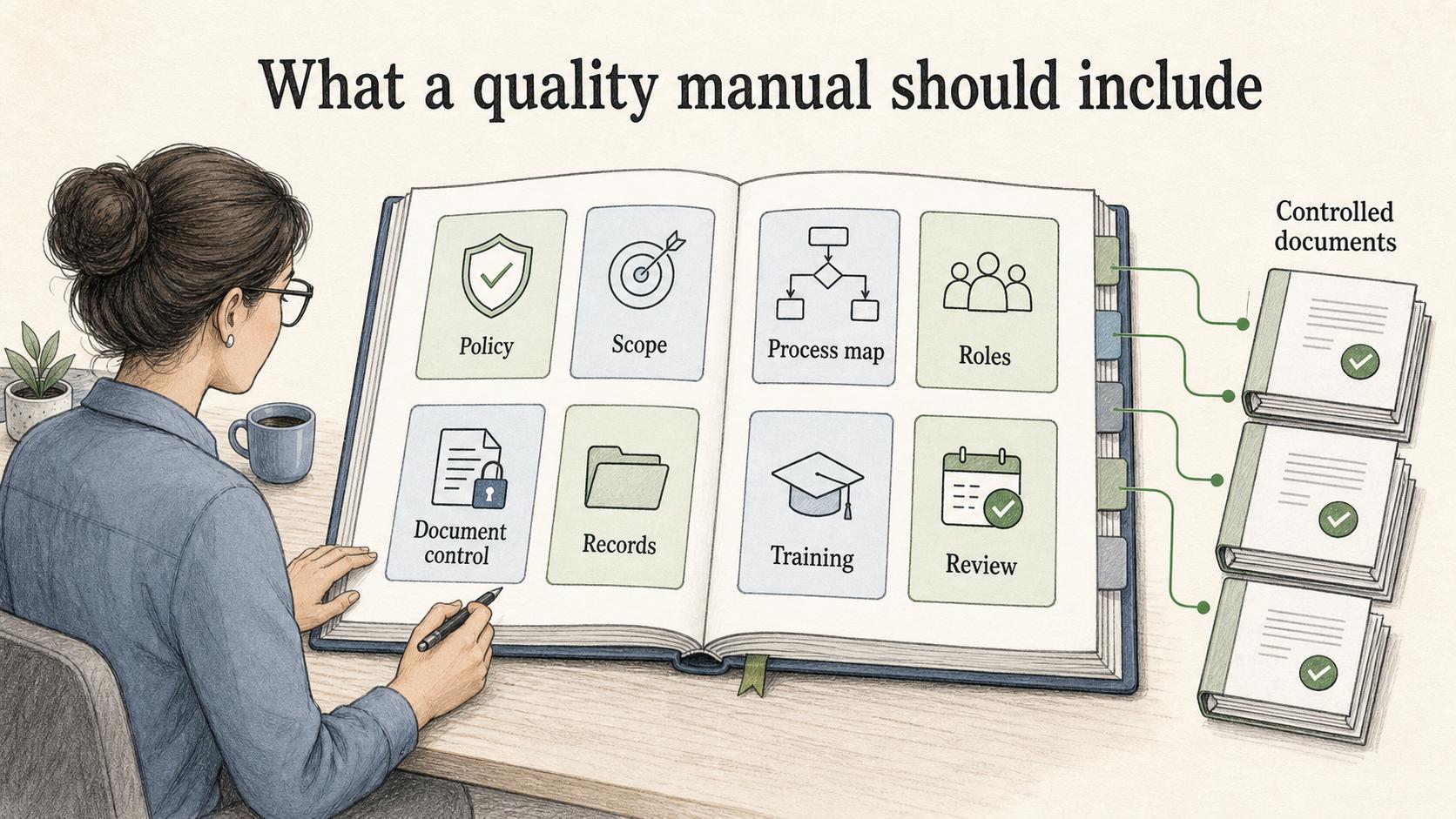
A useful manual covers the operating model of quality, not every instruction in full. Common sections include:
- Quality policy and quality objectives
- Scope of the quality management system
- Organization, sites, products, services, or functions covered
- Process map or explanation of major process interactions
- Roles and responsibilities for leadership, quality, operations, and process owners
- Document control and records management approach
- Training and competence expectations
- Audit, inspection, nonconformance, corrective action, and management review processes
- Links to supporting SOPs, work instructions, forms, logs, and records
- Review cadence and owner for the manual itself
Those links are part of the design. If the manual repeats every procedure, it becomes a version-control problem. If it points to controlled source documents, it stays lighter and more maintainable.
Quality manual vs SOP vs quality policy
| Document | Purpose | Practical example |
|---|---|---|
| Quality manual | Explains the overall quality system | How the company manages quality across teams and processes |
| Quality policy | States leadership's quality direction and commitments | A short policy about customer requirements, improvement, and accountability |
| Quality SOP | Defines one approved procedure | How to handle a nonconformance or approve a supplier |
| Quality record | Proves an activity happened | Training log, inspection result, audit finding, approval record |
| Work instruction | Gives task-level steps | How to calibrate a tool or complete an inspection form |
A quality manual should sit above the details. It explains how the system fits together. SOPs and work instructions explain how to do a specific piece of work.
How to build a quality manual that people can use
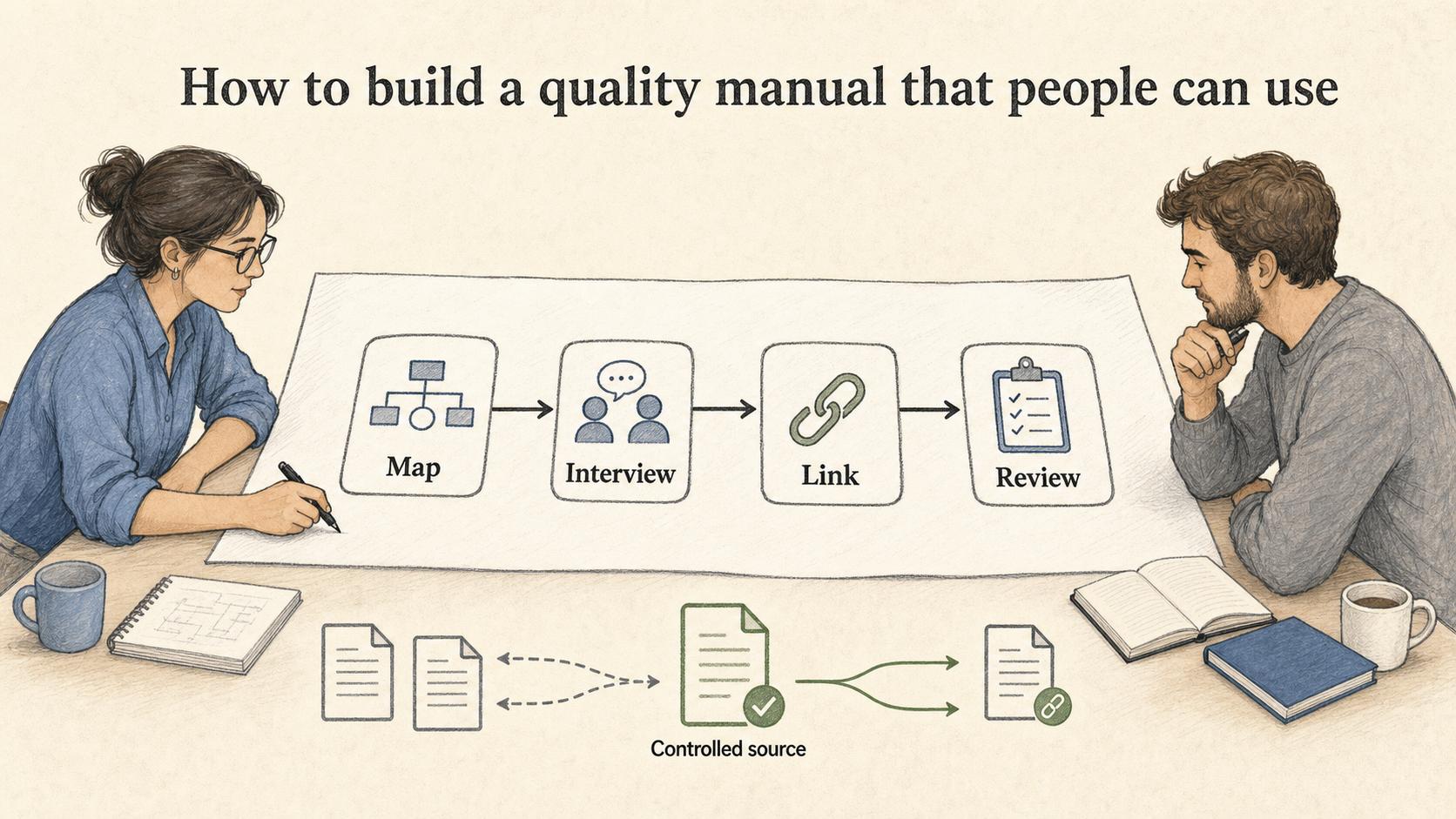
Start by mapping the real system before writing the document. Interview process owners, review existing SOPs, identify required records, and note where people actually go when they need quality instructions.
Then write the manual around navigation. A new quality manager, plant supervisor, support lead, or auditor should be able to open it and understand the structure of the system without hunting through disconnected folders.
A practical quality manual outline looks like this:
- Purpose and scope
- Quality policy and objectives
- Process map or QMS overview
- Roles and responsibilities
- Controlled-document structure
- Core quality processes
- Required records and evidence
- Supporting SOPs and forms
- Review, approval, and change-control rules
The hidden failure mode is duplication. Teams often copy SOP text into the manual because it feels complete. That creates two versions of the same instruction. A better manual explains the purpose of each process and links to the controlled procedure that owns the details.
Common mistakes
One common mistake is writing the manual only for an audit. Audit readiness matters, but the manual should also help employees find the right process and understand who owns it. If no one uses the manual outside audit week, it is probably too abstract or too detached from daily work.
Another mistake is making the manual so broad that it avoids commitments. A quality manual should be clear about scope, ownership, and evidence. Vague promises about “meeting customer expectations” are less useful than a map of the processes that actually protect quality.
A third mistake is forgetting the review trigger. A manual should be reviewed on a schedule and when the organization changes processes, locations, tools, products, regulatory commitments, or ownership. Otherwise, the manual slowly becomes a record of how quality used to work.
Documentation takeaway
A quality manual is the organizing layer for quality documentation. It connects policy, ownership, processes, SOPs, work instructions, and records into one understandable system.
The strongest manuals are concise and navigable. They do not try to contain every quality detail. They help people find the right detail quickly, trust that it is controlled, and understand how it supports the quality system as a whole.
How Trails helps
Trails helps teams create and maintain the step-by-step process documentation that a quality manual links to. A quality manual can explain the structure of the quality system, while Trails guides capture the workflows employees need to follow. Teams can document a process as someone performs it, turn it into a polished guide, and create an AI-narrated video version for training or handoff.
Sources
- 1
International Organization for Standardization. ISO 9000 family: Quality management. www.iso.org/standards/popular/iso-9000-family. Accessed July 15, 2026.
- 2
International Organization for Standardization. ISO 9001:2015 Quality management systems. www.iso.org/standard/62085.html. Accessed July 15, 2026.
- 3
International Organization for Standardization. ISO 9001:2015 implementation FAQ. committee.iso.org/files/live/sites/tc176sc2/files/documents/ISO%209001%202015%20-%20Implementation%20guidance%20docs/ISO9001_2015_Frequently_Asked_Questions.docx. Accessed July 15, 2026.