
Glossary
Quality Assurance
 ChatGPT
 Perplexity
 Gemini
 Claude
What is quality assurance?
Quality assurance is the practice of designing, documenting, and improving the system that helps work meet requirements consistently. Quality control checks a specific output; quality assurance focuses on the process that should make acceptable outputs repeatable. ISO 9001 describes quality management system requirements as a way to establish, implement, maintain, and continually improve how quality is managed. 1
In everyday operations, QA asks why the process allowed a mistake to happen and what should change so the same failure is less likely next time. It matters in manufacturing, software, healthcare, logistics, customer support, finance, education, and any other team where inconsistent work creates rework, compliance risk, or customer frustration.
What quality assurance includes
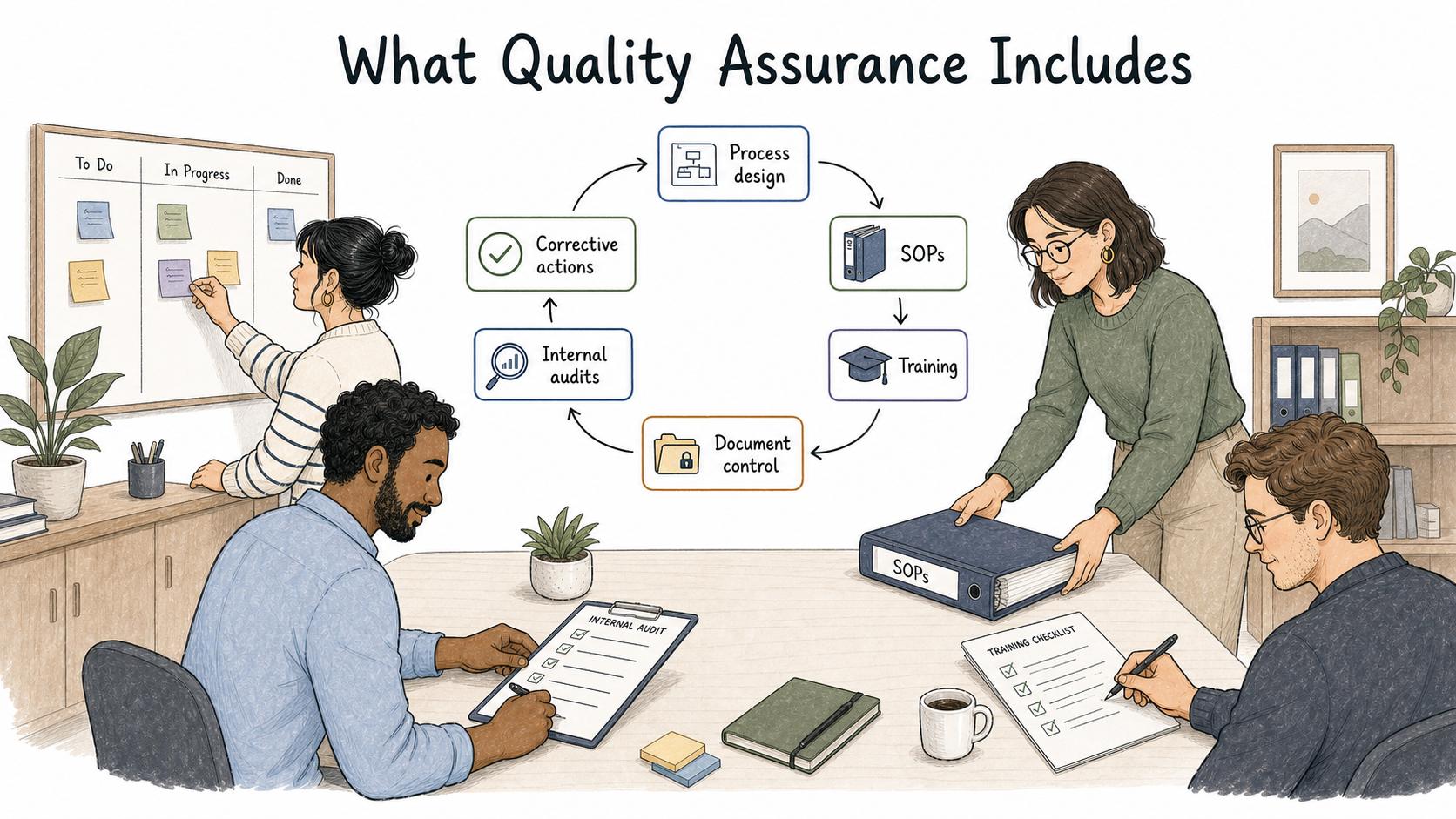
Quality assurance is a set of planned activities that make quality less dependent on luck, memory, or the most experienced person in the room.
A QA system may include process design, SOPs, training, document control, internal audits, supplier controls, change control, nonconformance handling, corrective actions, metrics, and management review. ISO 19011 is a useful reference for the audit side of that system because it covers audit-program management and management-system auditing principles. 2
The exact pieces depend on the industry, but the logic is stable: define what good work requires, design the process around those requirements, verify that the process is followed, and improve it when results show a pattern.
For example, a customer support QA program might define the expected case-handling process, train agents on the rubric, review sample tickets, coach recurring gaps, update macros or knowledge base articles, and revise the SOP when the support workflow changes. The scorecard is only one artifact; the QA system is the operating loop around it.
Quality assurance vs. quality control
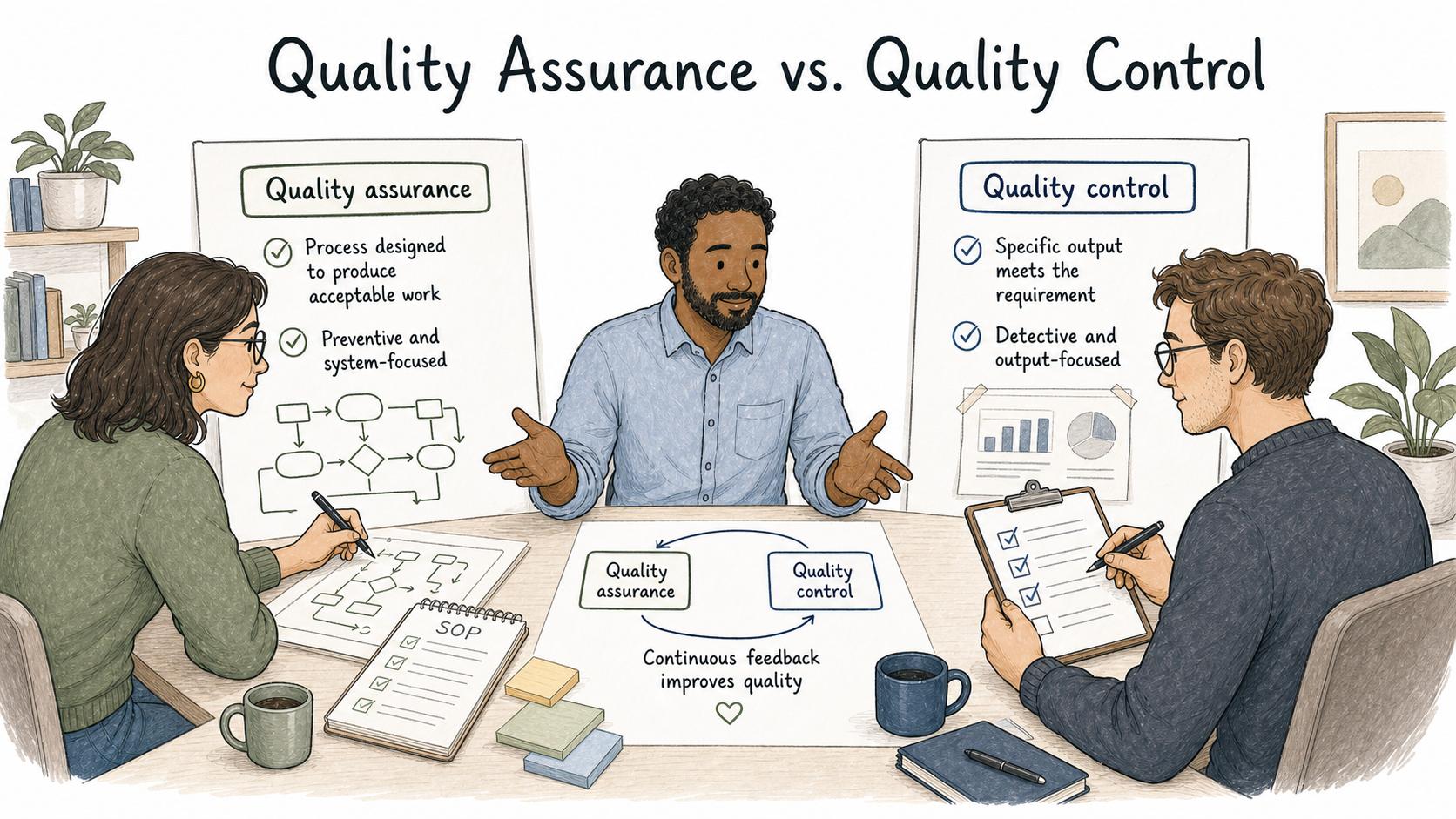
Quality assurance and quality control are often paired because they reinforce each other.
| Area | Quality assurance | Quality control |
|---|---|---|
| Core question | Is the process designed to produce acceptable work? | Did this specific output meet the requirement? |
| Orientation | Preventive and system-focused | Detective and output-focused |
| Typical work | SOPs, training, audits, process controls, change review | Inspection, testing, sampling, review, pass/fail checks |
| Example | Define the approved onboarding process and review cadence | Review completed onboarding records for missing steps |
QA reduces the chance of defects. QC catches defects that still happen. Choosing only one creates predictable trouble: QA without QC can become paperwork with no feedback from reality, while QC without QA can become endless inspection of the same preventable problems.
Why quality assurance matters
Quality problems rarely stay isolated. A missing handoff can become a customer complaint. A vague SOP can create inconsistent training. An uncontrolled document can lead employees to follow an outdated process. A recurring supplier issue can become a production delay.
Quality assurance gives teams a way to find the system behind the symptom. Instead of only fixing the failed item, QA asks whether the process, training, ownership, documentation, tooling, or measurement needs to change.
The practical payoff is consistency. People still need judgment, but they should not need to invent the process every time. QA turns expectations into a visible operating system that people can learn, audit, and improve.
What quality assurance should document
Good QA documentation should make the quality system usable, not just auditable. It should help people do the work correctly and give leaders enough evidence to see whether the system is working. ISO guidance on documented information emphasizes that organizations need enough documentation to demonstrate planning, operation, process control, and improvement of the quality management system. 3
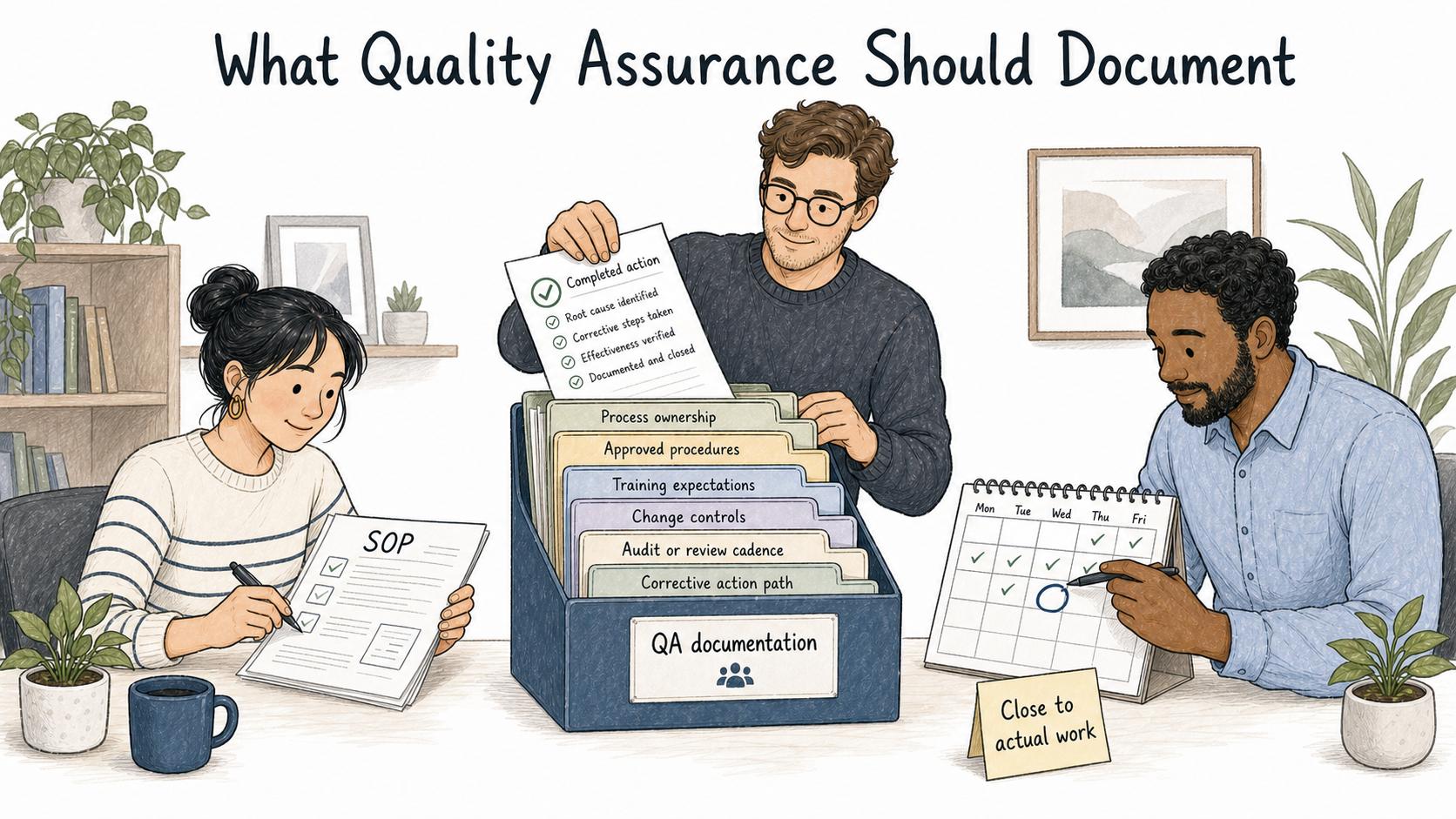
High-value QA documentation usually defines:
- Process ownership: who maintains the process, decides changes, and handles exceptions.
- Approved procedures: the SOPs, work instructions, scripts, rubrics, or job aids people are expected to follow.
- Training expectations: who must be trained, what competence looks like, and when retraining is required.
- Change controls: how changes to the process, tools, criteria, or documents are reviewed before rollout.
- Audit or review cadence: what is checked, how often, and what evidence is captured.
- Corrective action path: how recurring or serious problems become process improvements rather than one-off fixes.
The non-obvious part is keeping QA documentation close to actual work. If the official procedure says one thing but the real workflow lives in a spreadsheet, Slack thread, or senior employee's memory, the QA system is already drifting.
Common mistakes
A common mistake is using QA as a synonym for testing. Testing can be part of QA, especially in software, but QA is broader than test execution. It includes the conditions that make reliable work possible: requirements, procedures, training, review, ownership, and improvement.
Another mistake is measuring quality without giving teams a path to improve. A dashboard can show a declining score, but it does not fix unclear criteria, bad handoffs, missing training, or a tool that encourages the wrong behavior.
A third mistake is writing procedures for auditors instead of users. If the SOP is technically complete but too hard to follow, people will route around it. QA documentation should be precise enough for control and clear enough for daily work. In regulated medical-device work, FDA's current QMSR also ties quality management to risk management and to consistently meeting applicable requirements and specifications. 4
AI-ready QA diagnostic prompt
Use this prompt to pressure-test a QA system before rewriting documentation:
## Quality assurance diagnostic prompt

**Glossary term:** Quality Assurance
**Source:** Trails Glossary — trails.so/glossary/quality-assurance

---

### 01. Review a quality assurance system

"Review the quality assurance system for [process/team].

Context:
- Work being performed: [process]
- Quality requirement: [requirement]
- Known recurring issues: [issues]
- Current documentation: [SOPs, rubrics, training, forms]
- Current review cadence: [cadence]

Identify:
1. Where the process relies on memory or informal judgment
2. Which requirements are not translated into clear procedures
3. Which records prove the process was followed
4. Where QA and QC responsibilities are unclear
5. Which recurring issues should trigger training, SOP changes, or corrective action
6. The smallest documentation change likely to reduce repeat failures"
How Trails helps
Trails helps teams turn real workflows into step-by-step process documentation. A process owner can capture how a task is performed, convert it into a polished guide, and create an AI-narrated video version for training or sharing.
That supports quality assurance because QA depends on procedures people can actually follow. When workflows are easier to document and maintain, teams have a better chance of keeping process expectations aligned with the way work is done.
Sources
- 1
ISO. ISO 9001:2015 Quality management systems. www.iso.org/standard/62085.html. Accessed July 15, 2026.
- 2
ISO. ISO 19011:2026 Guidelines for auditing management systems. www.iso.org/standard/70017.html. Accessed July 15, 2026.
- 3
ISO. ISO documented information guidance. www.iso.org/iso/documented_information.pdf. Accessed July 15, 2026.
- 4
FDA. Quality Management System Regulation. www.fda.gov/medical-devices/postmarket-requirements-devices/quality-management-system-regulation-qmsr. Accessed July 15, 2026.