
Glossary
Quality Control
 ChatGPT
 Perplexity
 Gemini
 Claude
What is quality control?
Quality control is the practice of checking whether a product, service, record, or process output meets defined requirements. It usually happens through inspection, testing, measurement, review, sampling, or verification against a known standard. ISO's quality management standards frame this work as part of a system for consistently meeting customer and other applicable requirements. 1
Useful quality control is a repeatable decision system. It defines what counts as acceptable, who checks it, what evidence is recorded, and what happens when the work does not pass.
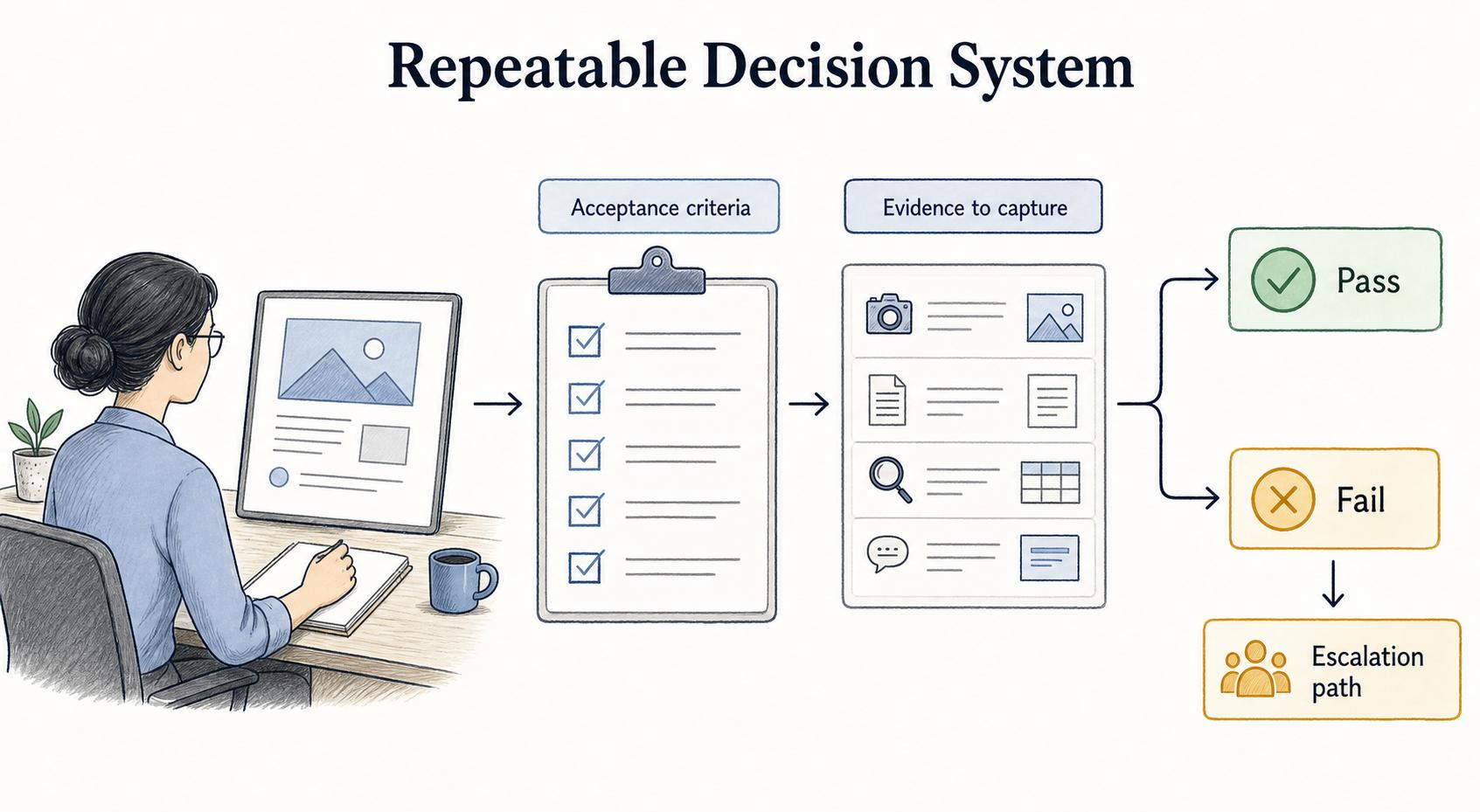
How quality control works
Quality control starts with acceptance criteria. A reviewer cannot make a consistent decision if the standard is vague, hidden, or different from person to person. The criteria might come from a customer requirement, internal policy, product specification, service-level promise, checklist, contract, or regulatory expectation.
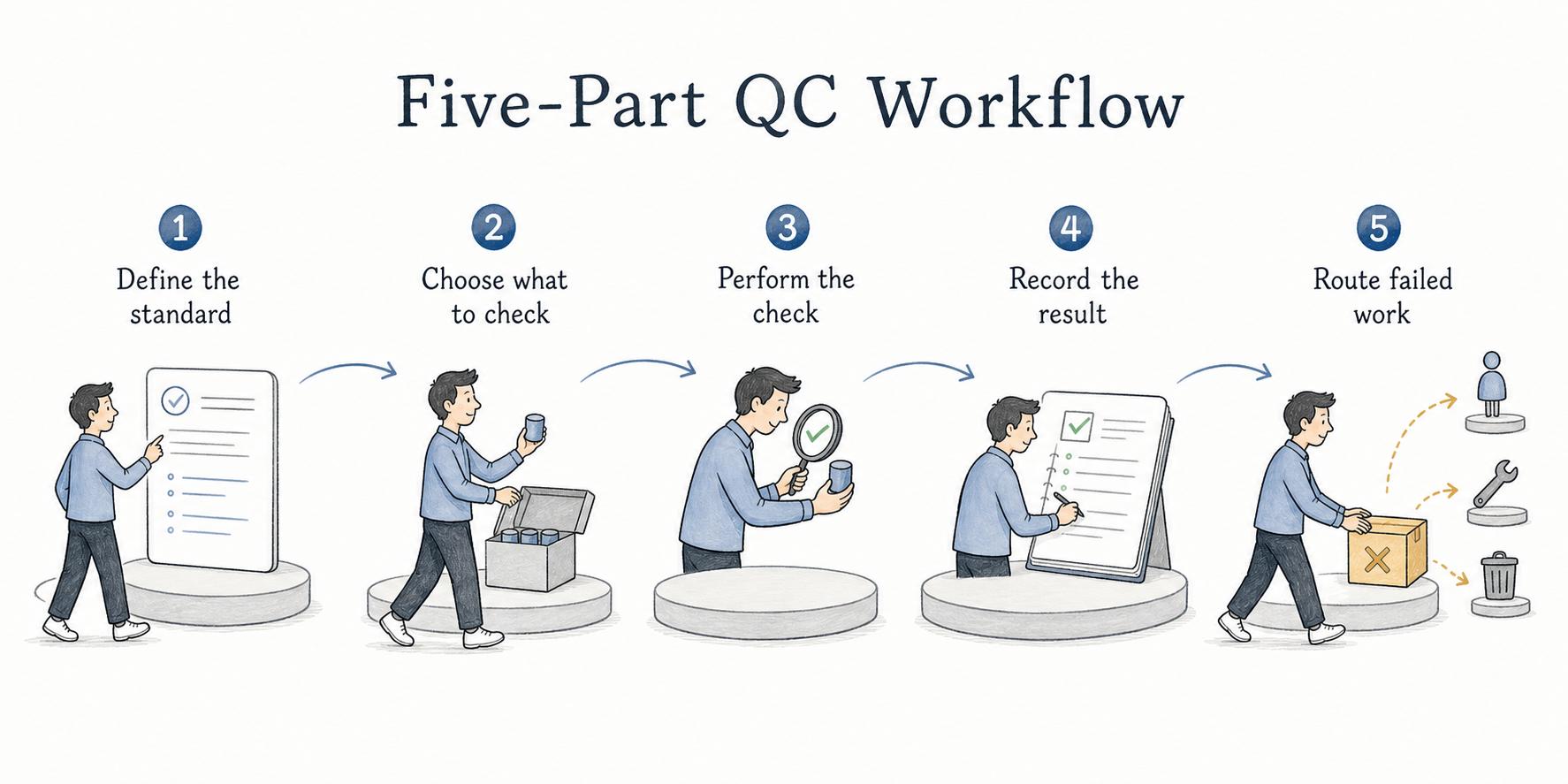
A practical QC workflow has five parts: define the standard, choose what to check, perform the check, record the result, and route failed work to the right next step. ISO 9001 guidance treats documented information as evidence a team can use to demonstrate effective planning, operation, control, and improvement of the QMS. 2
The order matters. If the team inspects before defining the standard, QC becomes personal taste. If it records failures but never feeds them back into training or process design, QC becomes a defect log instead of an improvement tool.
For example, a customer support team might review closed tickets against a rubric for accuracy, tone, completeness, and correct escalation. A finance team might review invoices against purchase orders and receipts before payment. A warehouse might inspect packed orders before shipment. The work is different, but the control logic is the same: compare the output to a defined requirement and make the pass/fail decision visible.
Quality control vs. quality assurance
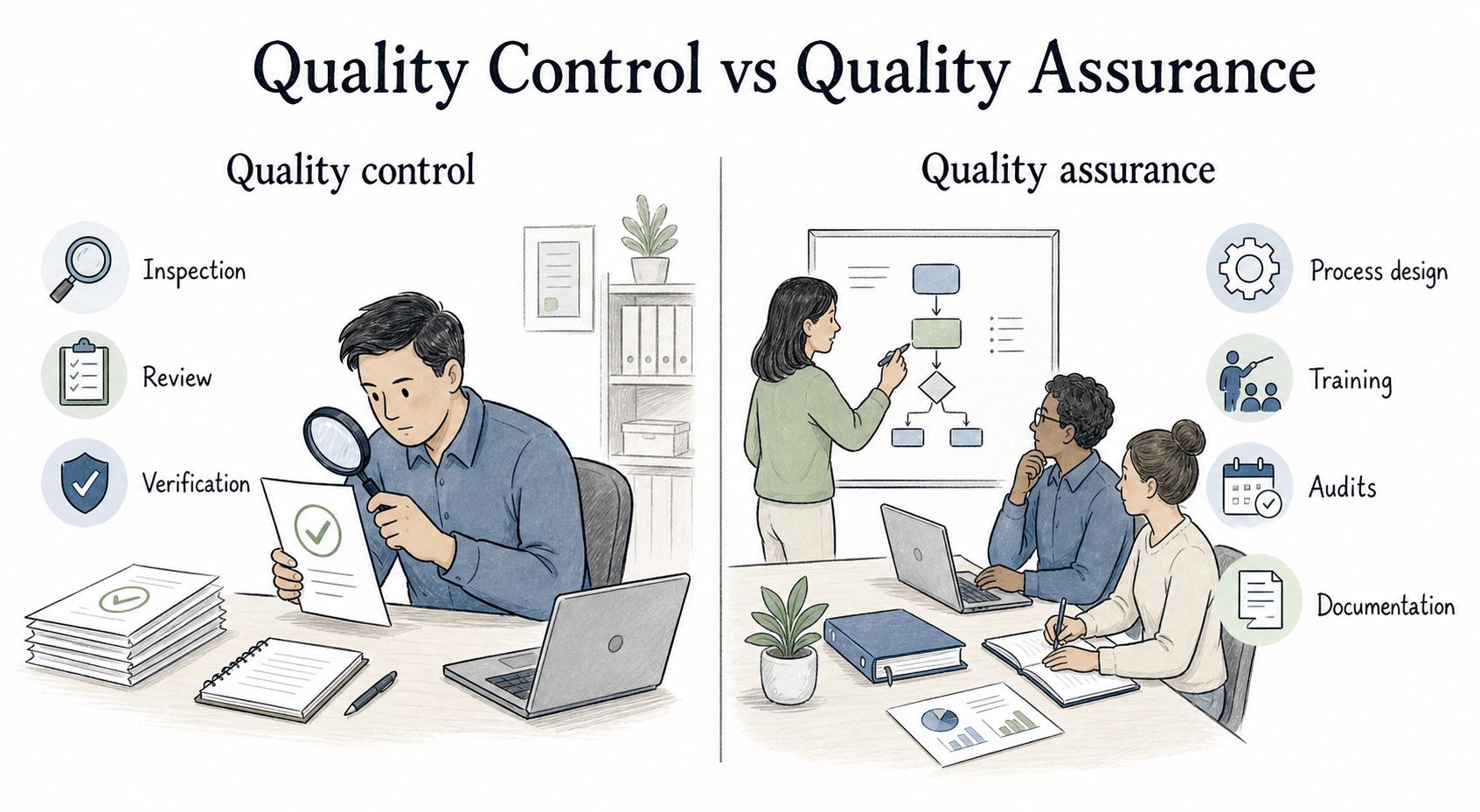
Quality control and quality assurance are related, but they do different jobs.
| Area | Quality control | Quality assurance |
|---|---|---|
| Core question | Did this output meet the requirement? | Is the process designed to produce acceptable output? |
| Focus | Inspection, testing, review, sampling, verification | Process design, training, audits, documentation, prevention |
| Timing | Usually during or after the work | Before, during, and after the work |
| Example | Review ten completed tickets for accuracy | Create the ticket-handling process, rubric, training, and audit cadence |
Quality assurance tries to prevent defects by improving the system. Quality control checks whether the result met the standard. Teams need both: inspection alone keeps finding the same problems, while procedures without output checks can hide process failure.
What quality control should document
Quality control gets fragile when the inspection method lives in someone's head. Two experienced people can look at the same work and make different calls unless the decision rules are explicit.
Strong QC documentation should define:
- Acceptance criteria: what must be true for the work to pass.
- Defect categories: which failures are minor, major, critical, or blocking.
- Sampling rules: whether every item is checked or only a defined sample, using a recognized sampling approach when the risk and volume justify it.
- Evidence to capture: screenshots, measurements, checklist responses, reviewer notes, approvals, or test results.
- Escalation path: who handles failures, rework, customer impact, or repeated defects.
- Feedback loop: how recurring QC findings turn into training, SOP updates, supplier conversations, automation, or process changes.
Defined sampling approaches can support inspection decisions when the risk and volume justify them. 3
The hidden failure mode is over-documenting the check and under-documenting the decision. A long checklist is not enough if nobody knows what to do with a borderline case, a recurring failure, or a reviewer disagreement.
Examples of quality control
Quality control can appear anywhere a team has a defined standard and a visible pass/fail decision:
- A documentation lead reviews a help article before publication to confirm accuracy, screenshots, links, and formatting.
- A clinic verifies intake records before a patient visit so missing information is caught early.
- A software team runs regression tests before releasing a change.
- An accounts payable team checks that an invoice matches the purchase order and receipt.
The common thread is not the industry. It is the presence of a defined standard, a check against that standard, and a record of the decision.
Common mistakes
The first mistake is treating QC as a last-minute gate. If quality control only happens at the end, failures are more expensive to fix and harder to trace. Good QC often places checks at the points where mistakes become costly: before payment, before shipment, before publication, before customer handoff, or before a regulated record is finalized. FDA's Quality Management System Regulation is one example of a regulated context where quality-system controls are tied to consistently meeting applicable requirements and specifications. 4
The second mistake is using subjective language. "Looks good," "review for quality," and "make sure it is correct" do not create repeatable decisions. A useful QC standard names the observable requirement.
The third mistake is collecting QC results without acting on patterns. One failed item may need rework. A pattern of failed items may mean the SOP is unclear, the training is weak, the supplier is unreliable, or the process is forcing people into a bad tradeoff.
AI-ready quality control prompt
Use this prompt to turn a real workflow into a sharper QC checklist:
## Quality control checklist prompt

**Glossary term:** Quality Control
**Source:** Trails Glossary — trails.so/glossary/quality-control

---

### 01. Create a quality control checklist

"Create a quality control checklist for [process/output].

Context:
- Team: [team]
- Output being checked: [output]
- Customer or stakeholder affected: [audience]
- Known failure modes: [failure modes]
- Required evidence: [screenshots, records, measurements, approvals, notes]

Return:
1. Acceptance criteria for a pass/fail decision
2. Defect categories with examples
3. Step-by-step review actions
4. Evidence the reviewer should capture
5. Escalation rules for borderline or failed work
6. Patterns that should trigger an SOP or training update"
How Trails helps
Trails helps teams document QC workflows by capturing the real inspection, review, approval, or verification steps as someone performs them. That workflow can become a polished step-by-step guide and, when useful, an AI-narrated video for training or sharing.
That matters because quality control is only reliable when people perform the check the same way. Clear process documentation makes the standard easier to follow, review, and update when criteria change.
Sources
- 1
ISO. ISO 9000 family: Quality management. www.iso.org/standards/popular/iso-9000-family.
- 2
ISO. ISO documented information guidance. www.iso.org/iso/documented_information.pdf.
- 3
ISO. ISO 2859-1:2026 Sampling procedures for inspection by attributes. www.iso.org/obp/ui/en/.
- 4
FDA. Quality Management System Regulation. www.fda.gov/medical-devices/postmarket-requirements-devices/quality-management-system-regulation-qmsr.