
Glossary
Records Management SOP
 ChatGPT
 Perplexity
 Gemini
 Claude
What is a records management SOP?
A records management SOP is a standard operating procedure for handling business records across their lifecycle. NARA's records scheduling guidance describes disposition as the final stage of the records lifecycle, after records are no longer needed for current agency business.1 A records management SOP explains how records are created or captured, classified, stored, protected, retrieved, retained, placed on hold, archived, or disposed of.
The job of the SOP is to turn records policy into daily behavior. A policy may say what the organization is responsible for. The SOP explains what someone actually does when a record is created, moved, requested, corrected, preserved, or retired.
Why a records management SOP matters
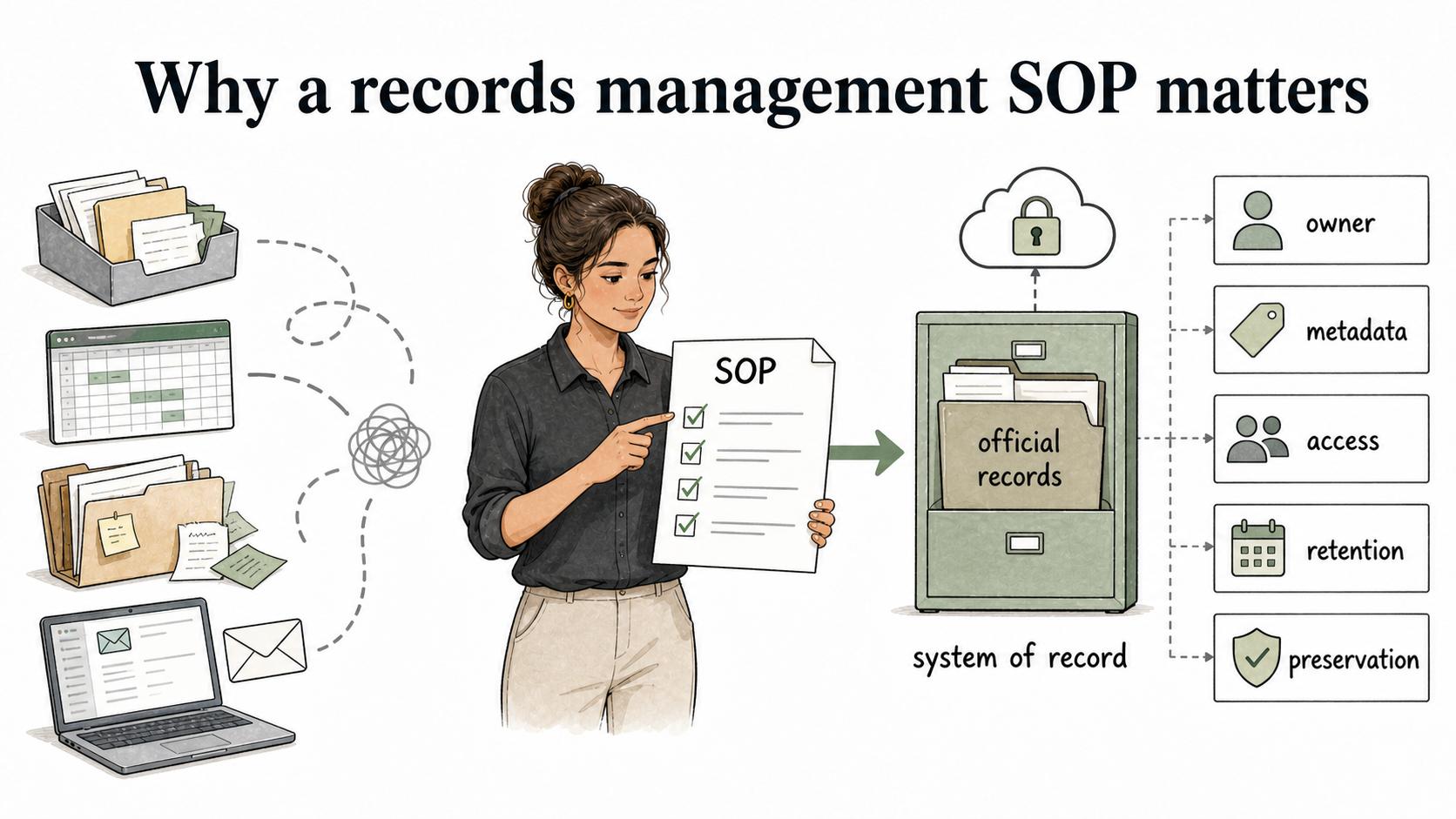
Records management usually fails quietly. A signed agreement sits in someone's inbox. A spreadsheet becomes the unofficial source of truth. A former employee's folder contains the only copy of a key approval. A team deletes convenience files but cannot tell which copy was the official record.
A records management SOP reduces that ambiguity. It defines where official records live, who owns them, what metadata is required, who can access them, and what happens when retention or preservation rules apply. Records-management metadata guidance emphasizes metadata's role in preserving authenticity, reliability, usability, and integrity over time.2
This is especially important when records are spread across shared drives, HR systems, finance tools, ticketing platforms, email, document management systems, and local files. The SOP should make the official path easier than the improvised path.
What a records management SOP should include
A useful records management SOP is specific about the record type and workflow. A generic instruction to "store records properly" is not enough.
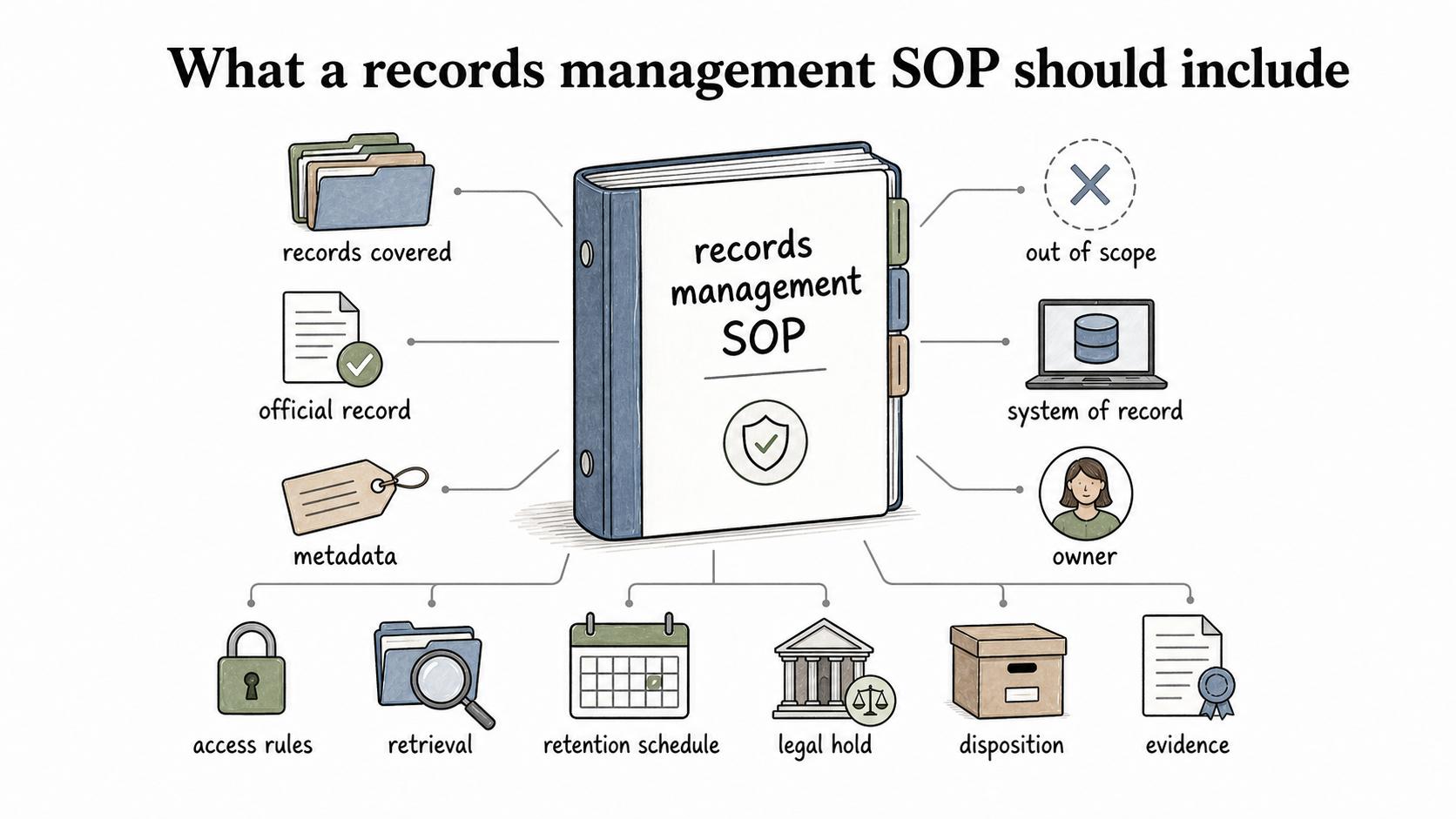
Most records management SOPs should define:
- Which records are covered and which materials are out of scope.
- What counts as the official record.
- The system of record or approved storage location.
- Required file naming, metadata, labels, or IDs.
- Who owns the record and who can change it.
- Access rules for viewing, editing, sharing, and deleting.
- How records are retrieved for business, audit, legal, or customer needs.
- Where the retention schedule or policy lives.
- What to do when a record is under legal hold or preservation review.
- How disposition is approved and documented.
- What evidence proves the SOP was followed.
The SOP should not invent retention rules. It should point to the approved retention schedule, policy owner, legal or compliance contact, or other authoritative internal source. NARA describes records schedules as disposition instructions for how to maintain operational records and what to do with them when they are no longer needed for current business.3
Example records management SOP workflow
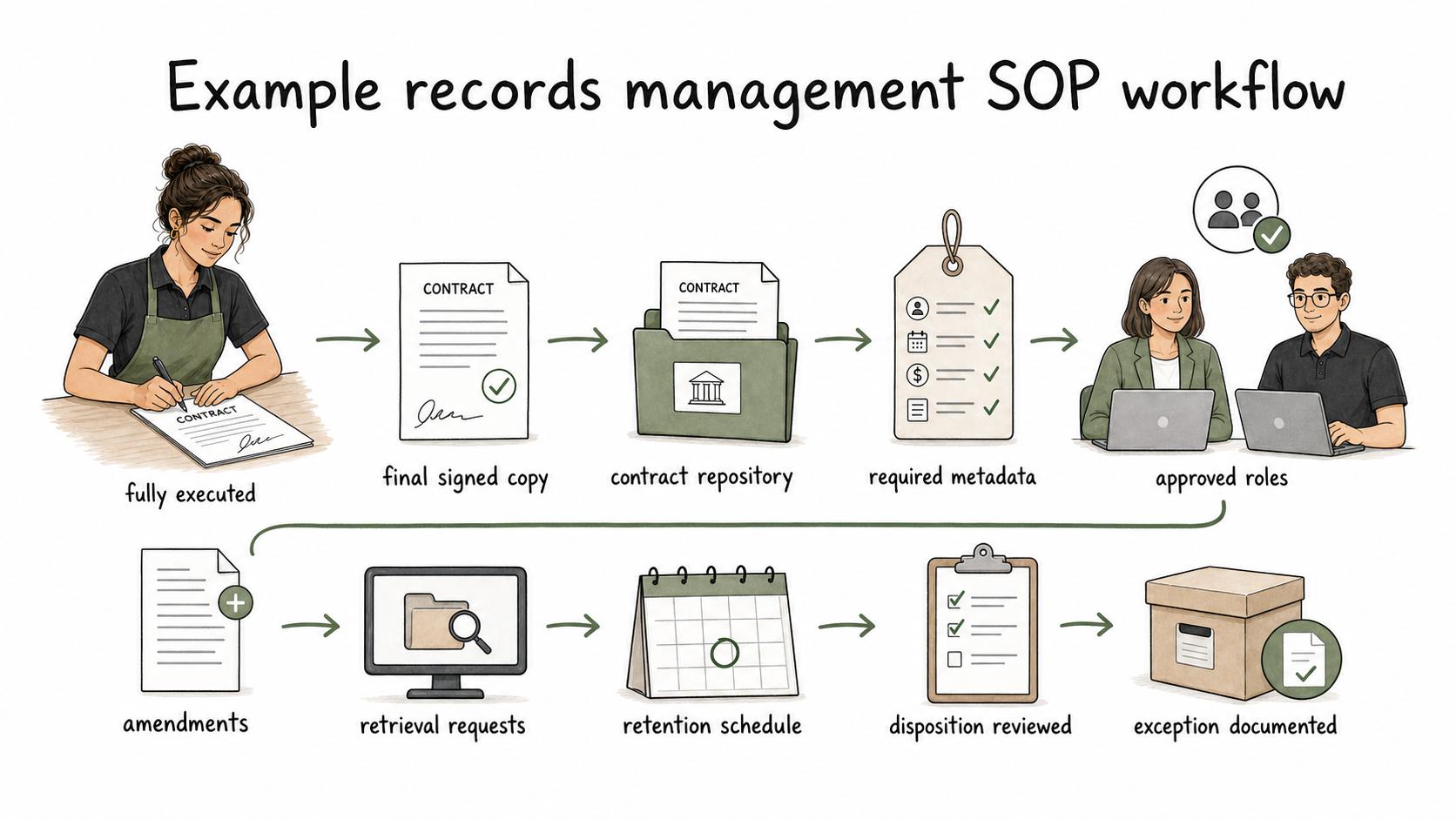
A records management SOP for signed customer contracts might look like this:
- Contract is fully executed in the approved signature tool.
- Contract owner confirms the final signed copy.
- Final copy is stored in the contract repository, not a personal drive.
- Required metadata is added: customer name, effective date, renewal date, owner, contract type, and related account ID.
- Access is limited to approved roles.
- Amendments are linked to the original agreement.
- Retrieval requests go through the contract owner or approved system workflow.
- Retention is checked against the organization's retention schedule.
- Disposition is reviewed before archive, deletion, or permanent preservation.
- Any exception is documented with owner, reason, and approval.
The workflow protects the link between the record, the business event it proves, and the people authorized to act on it.
Records management SOP vs document control SOP
Records management and document control are related, but they answer different questions.
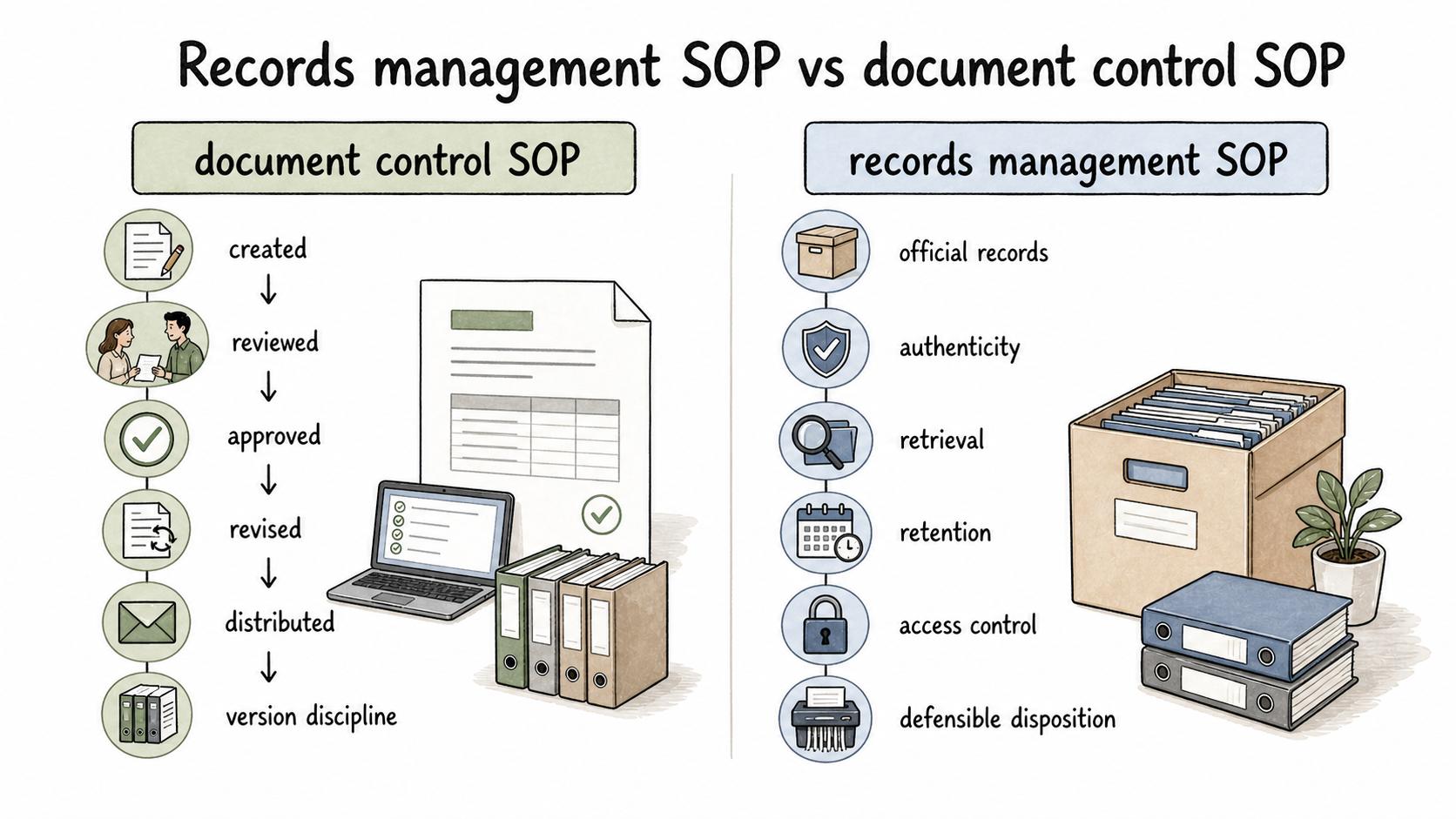
A document control SOP governs controlled documents while they are created, reviewed, approved, revised, and distributed. A records management SOP governs official records after they document an action, decision, transaction, approval, communication, or obligation.
For example, a quality procedure might be managed through document control while it is drafted and approved. Completed training acknowledgments for that procedure may then be governed by records management because they prove who completed required training.
The practical distinction is important. Controlled documents need version discipline. Records need authenticity, retrieval, retention, access control, and defensible disposition.
How to write a records management SOP
Start with one record category, not the entire company file system. Pick a record type with real operational risk, such as employee records, customer contracts, financial approvals, incident reports, training records, or policy acknowledgments.
Use this prompt to draft the SOP:
## Records Management SOP Template

**Glossary term:** Records Management SOP
**Source:** Trails Glossary — trails.so/glossary/records-management-sop

---

### 01. Create a records management SOP

"Create a records management SOP for [record type or workflow].

Purpose: [why this record needs controlled handling]
Scope: [record types, teams, systems, locations covered]
Official record: [what counts as the authoritative record]
Out of scope: [drafts, duplicates, convenience copies, non-record material]
Owner: [record owner, custodian, or responsible role]
System of record: [approved storage location]
Required metadata: [fields, labels, IDs, dates, owners]
Access rules: [who can view, edit, export, share, or delete]
Retrieval process: [how records are found and requested]
Retention reference: [approved schedule or policy owner]
Hold process: [what happens if records must be preserved]
Disposition: [archive, delete, transfer, preserve, or review]
Evidence: [logs, approvals, certificates, audit trails]
Exceptions: [missing, duplicate, misfiled, or corrupted records]
Review cadence: [who reviews the SOP and when]

Write the SOP as operational steps, not policy language. Include decision points and handoffs."
After drafting, test the SOP with a messy example. If a record exists in three places, which one is official? If a manager asks for deletion, who approves it? If legal says preserve records, what changes immediately? NARA's freeze guidance explains that a hold can suspend the normal disposition cycle to prevent premature disposal.4 The SOP should answer those questions before the team is under pressure.
Common mistakes
One mistake is treating every file as a record. That creates clutter and makes the official record harder to identify. The SOP should distinguish official records from drafts, working copies, and convenience copies.
Another mistake is naming a storage location but not the required metadata. A record that cannot be found by owner, date, customer, employee, contract, project, or transaction is only partly managed.
A third mistake is documenting retention without disposition. If the SOP says how long to keep records but not who approves archive, transfer, deletion, or preservation, the end of the lifecycle becomes informal.
Documentation takeaway
A records management SOP translates records governance into a repeatable workflow. It helps teams know what the official record is, where it belongs, who controls it, how it can be retrieved, and what should happen when the record reaches a retention or preservation decision.
The strongest SOPs are specific enough to use during real work. They name systems, owners, evidence, exceptions, and handoffs instead of relying on vague reminders to follow policy.
How Trails helps
Trails helps teams capture records workflows as people perform them, then turn those workflows into clear step-by-step guides. For records management SOPs, that can document how to store final documents, add metadata, route approvals, collect audit evidence, archive material, or handle exceptions. Teams can also create AI-narrated video walkthroughs for training people who touch sensitive or high-value records.
Sources
- 1
National Archives. Records Basics. National Archives and Records Administration. www.archives.gov/records-mgmt/scheduling/basics. Accessed July 13, 2026.
- 2
International Council on Archives. Principles and Functional Requirements. National Archives of Australia. www.naa.gov.au/sites/default/files/2019-09/Module%202%20-%20%20ICA-Guidelines-principles%20and%20Functional%20Requirements_tcm16-95419.pdf. Accessed July 13, 2026.
- 3
National Archives. NARA Records Schedule. National Archives and Records Administration. www.archives.gov/about/records-schedule. Accessed July 13, 2026.
- 4
National Archives. Freeze Process Overview/FAQ. National Archives and Records Administration. www.archives.gov/files/frc/arcis/freeze-faq.pdf. Accessed July 13, 2026.