
Glossary
Quality Control SOP
 ChatGPT
 Perplexity
 Gemini
 Claude
What is a quality control SOP?
A quality control SOP is a standard operating procedure that explains how a team checks whether a product, service, record, or process output meets defined quality requirements. It turns a quality check into a repeatable workflow with acceptance criteria, responsibilities, evidence, and escalation steps.
A useful QC SOP does three jobs: it defines the standard, shows people how to test or review against that standard, and tells them what to do when the work fails. Without that last part, the SOP becomes a checklist with no decision path.
What a quality control SOP covers
A quality control SOP should make the quality decision observable. It needs enough detail that two trained people would inspect the same work, use the same pass/fail criteria, and record the result in the same place.
At minimum, define:
- The output being checked, such as an order, form, ticket, release, batch, or finished product.
- The acceptance criteria, tolerance, standard, or rule that defines a pass.
- The trigger, owner, reviewer, tools, records, and sampling rule for the check.
- The defect, exception, or nonconformance categories that require action.
- The escalation path when work is rejected, reworked, quarantined, retested, refunded, or investigated.
ISO describes ISO 9001 as a quality management standard for establishing, implementing, maintaining, and continually improving a quality management system. 1 A quality control SOP is one practical layer inside that system: it shows people how to verify quality at a specific control point.
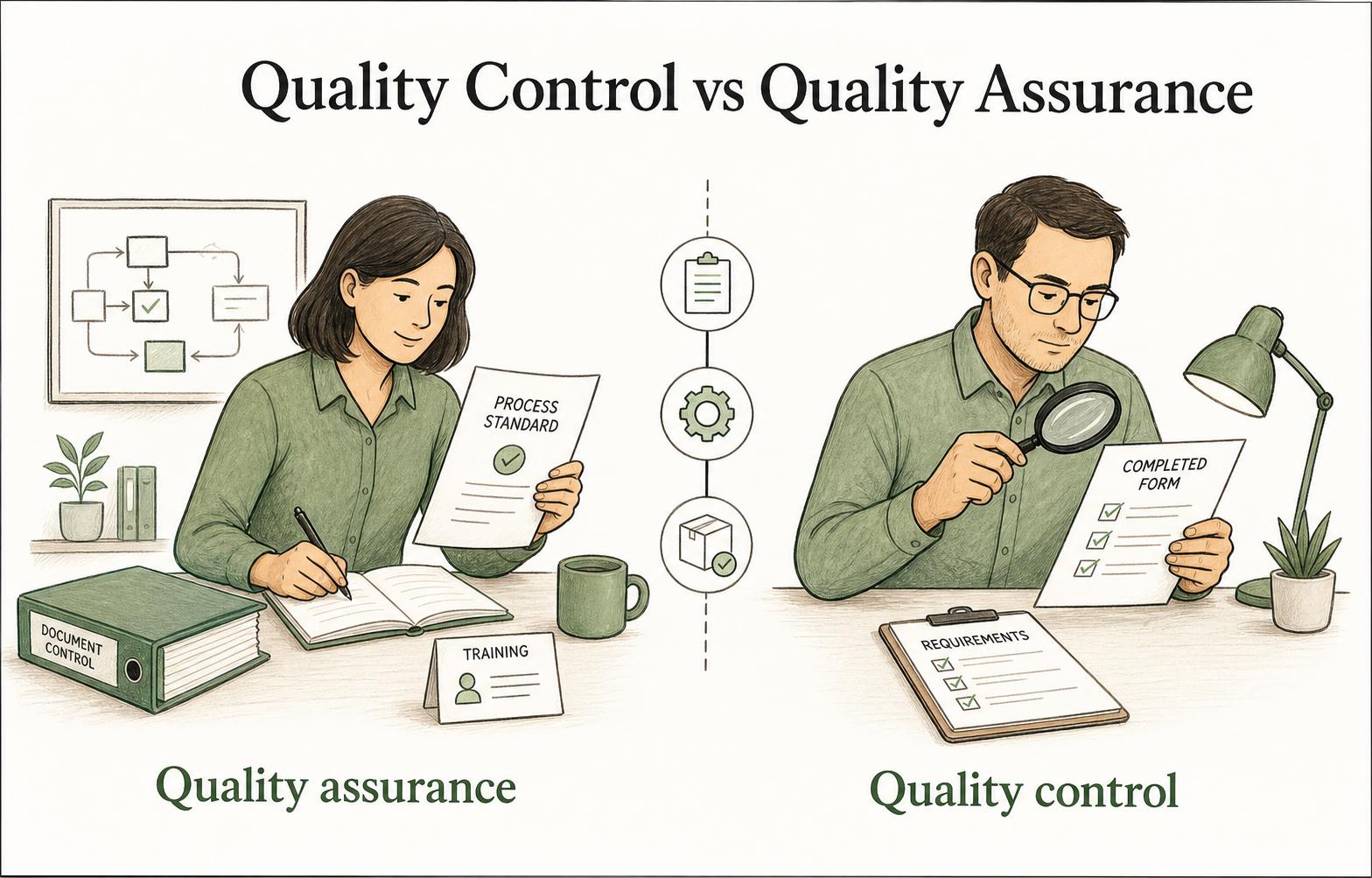
Quality control SOP vs. quality assurance SOP
| Procedure type | Main purpose | Example |
|---|---|---|
| Quality control SOP | Checks whether an output meets requirements | Inspect an order, review a support case, test a release, or verify a completed form |
| Quality assurance SOP | Defines how the system prevents problems | Document control, training, supplier approval, internal audit, or change control |
| Corrective action SOP | Explains how failures are investigated and fixed | Identify root cause, assign actions, verify effectiveness, and prevent recurrence |
| Work instruction | Gives task-level detail for one activity | How to complete a test, measurement, review, or inspection step |
Quality assurance makes good work more likely. Quality control checks whether the work actually met the standard. Most quality systems need both, but they should not be documented as if they are the same procedure.
How to write a quality control SOP
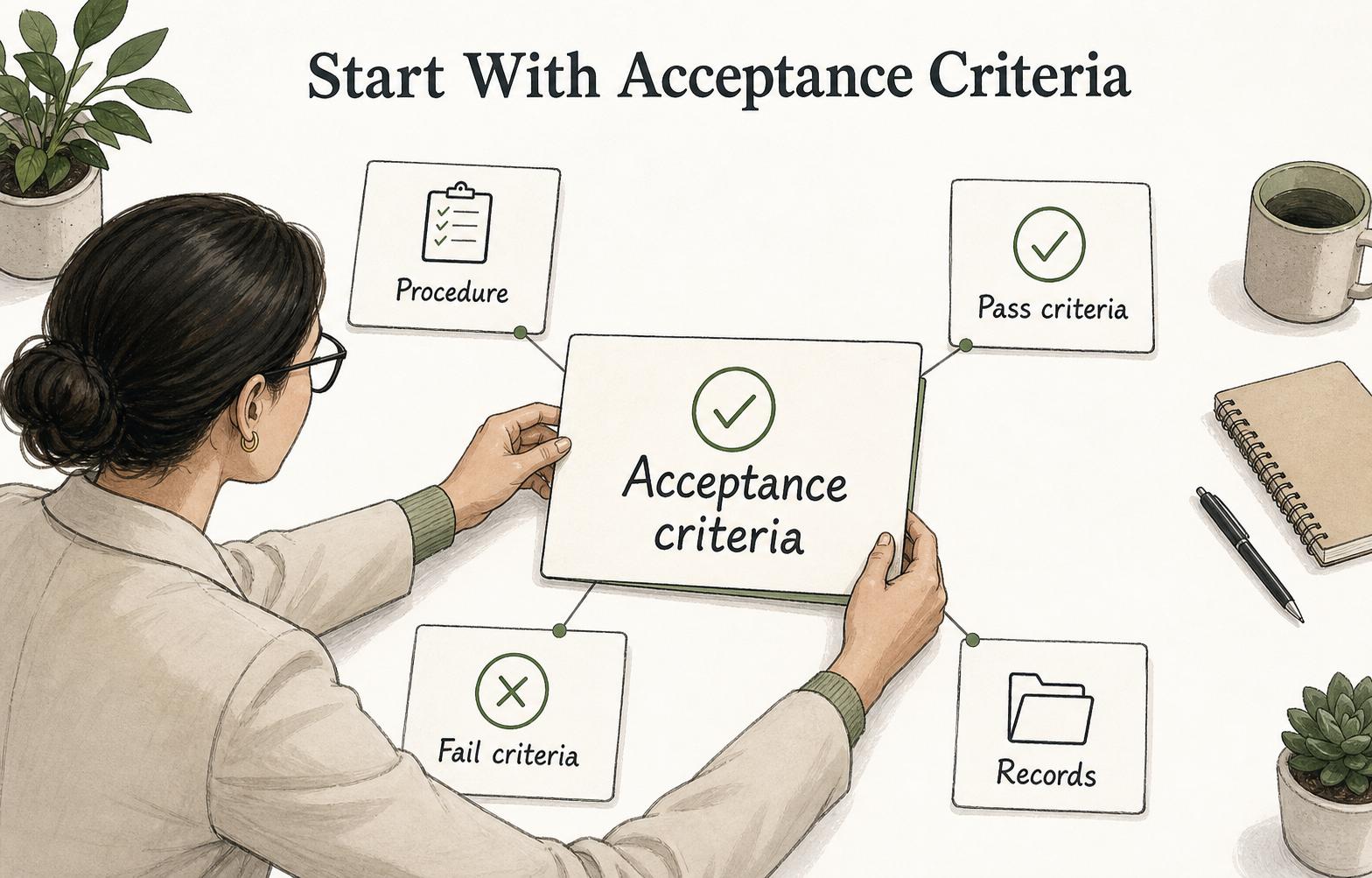
Start with the acceptance criteria. If the team can't say what acceptable work looks like, the SOP will become subjective no matter how detailed the steps are.
Use this structure:
## Quality control SOP template

**Glossary term:** Quality Control SOP
**Source:** Trails Glossary — trails.so/glossary/quality-control-sop

---

### 01. Quality control SOP template

"Quality control SOP template
Purpose: [why this quality check exists]
Scope: [products, services, records, teams, or sites covered]
Trigger: [when the check happens]
Roles: [who performs, reviews, approves, and escalates]
Requirements: [standards, tolerances, rules, or acceptance criteria]
Tools and records: [forms, systems, checklists, equipment]
Sampling rule: [what to check and how much to check]
Procedure: [step-by-step inspection or review workflow]
Pass criteria: [what must be true to accept the output]
Fail criteria: [what counts as a defect or nonconformance]
Escalation: [who is notified and what happens next]
Records: [where evidence is stored]
Review cadence: [how the SOP is maintained]"
Make each step observable. "Check for accuracy" is too soft. "Confirm the invoice total matches the approved purchase order and shipment receipt" is better because two trained people can apply it the same way.
Examples of quality control SOPs
A manufacturing team might use a quality control SOP to inspect finished products before packaging. The SOP would define measurement points, tolerances, tools, sample size, defect categories, rework instructions, and release approval. Formal sampling standards such as ISO 2859-1 are often used when inspection decisions depend on attribute-based sampling plans. 2
The same pattern works outside manufacturing. A support team can review closed tickets against accuracy, timeliness, tagging, and CRM documentation standards. A finance team can check accounts payable entries against matching rules and approval thresholds. A software or operations team can verify release readiness through regression checks, documentation review, rollback criteria, and final approval.
The common thread is repeatability. Any output with a standard can have a quality control procedure, even when the output is a service record, customer case, or operational task instead of a physical product.
Common mistakes
The first mistake is writing the SOP around the tool instead of the quality decision. The tool may be where the check happens, but the SOP should define the standard being applied. If the tool changes, the acceptance criteria should still make sense.
The second mistake is skipping escalation. A quality control SOP that only says how to find a failure is incomplete. It should explain who decides whether to accept, rework, reject, quarantine, refund, retest, or investigate, which aligns with the broader quality-system expectation that nonconforming outputs are controlled rather than informally worked around. 3
The third mistake is making one SOP cover too many checks. A single procedure for "all quality reviews" usually becomes vague. Teams get better results from focused SOPs for meaningful control points, supported by shared document control and records management rules.
Documentation takeaway
A quality control SOP makes quality checks repeatable and defensible. It defines what to inspect or review, how to judge the result, how to record evidence, and what to do when the work does not meet the standard. In regulated medical-device contexts, FDA's Quality Management System Regulation is explicit that manufacturers must establish and follow quality-system requirements so products consistently meet applicable requirements and specifications. 4
The best quality control SOPs are practical for the person doing the check and precise enough for a manager, customer, or auditor to understand why the result was accepted, reworked, rejected, or escalated.
How Trails helps
Trails helps teams document quality control workflows as they are performed. A quality manager or process owner can capture an inspection, review, approval, release, or records check, then turn that workflow into a clear step-by-step guide. Trails can also create an AI-narrated video version for training, which helps when quality procedures need to be followed consistently across teams, shifts, or locations.
Sources
- 1
ISO. ISO 9001:2015 Quality management systems. www.iso.org/standard/62085.html.
- 2
ISO. ISO 2859-1:2026 Sampling procedures for inspection by attributes. www.iso.org/obp/ui/en/.
- 3
ISO. ISO 9001 documented information guidance. www.iso.org/iso/documented_information.pdf.
- 4
FDA. Quality Management System Regulation. www.fda.gov/medical-devices/postmarket-requirements-devices/quality-management-system-regulation-qmsr.