
Glossary
Total Quality Management
 ChatGPT
 Perplexity
 Gemini
 Claude
What is total quality management?
Total quality management, often shortened to TQM, is a management approach where the whole organization is responsible for improving quality. ASQ summarizes TQM as a customer-focused management system that engages all employees in continual improvement.1
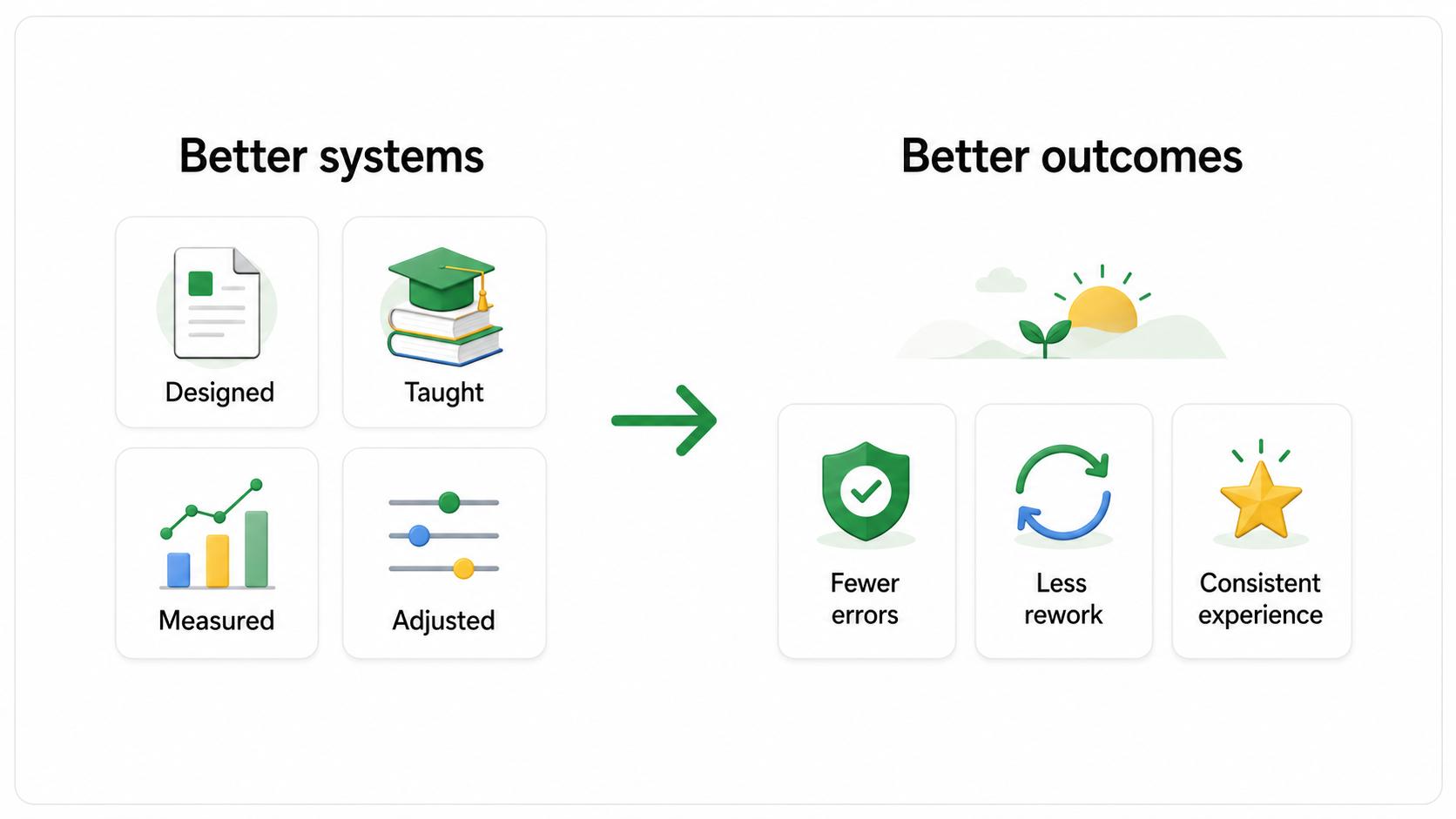
The practical idea is simple: better outcomes come from better systems. If a team wants fewer errors, less rework, and more consistent customer experiences, it has to improve how the work is designed, taught, measured, and adjusted over time.
Why total quality management matters
Quality problems often look personal at first: someone skipped a step, misunderstood a policy, shipped the wrong file, or gave a customer the wrong answer. TQM pushes the organization to look one layer deeper. What about the process made that mistake likely?
That shift matters because many quality issues repeat. A support team keeps giving inconsistent refund guidance. An onboarding team teaches the same process three different ways. A warehouse team catches errors only after orders are packed. A finance team depends on one person who knows the exception path. In each case, the visible mistake is the end of a process problem.
TQM gives teams a way to improve the system that creates the result. It connects customer expectations, process design, employee input, measurement, and continuous improvement into one operating discipline. NIST's Baldrige framework similarly evaluates organizational performance through leadership, customers, workforce, operations, measurement, and results.2
Core principles of TQM
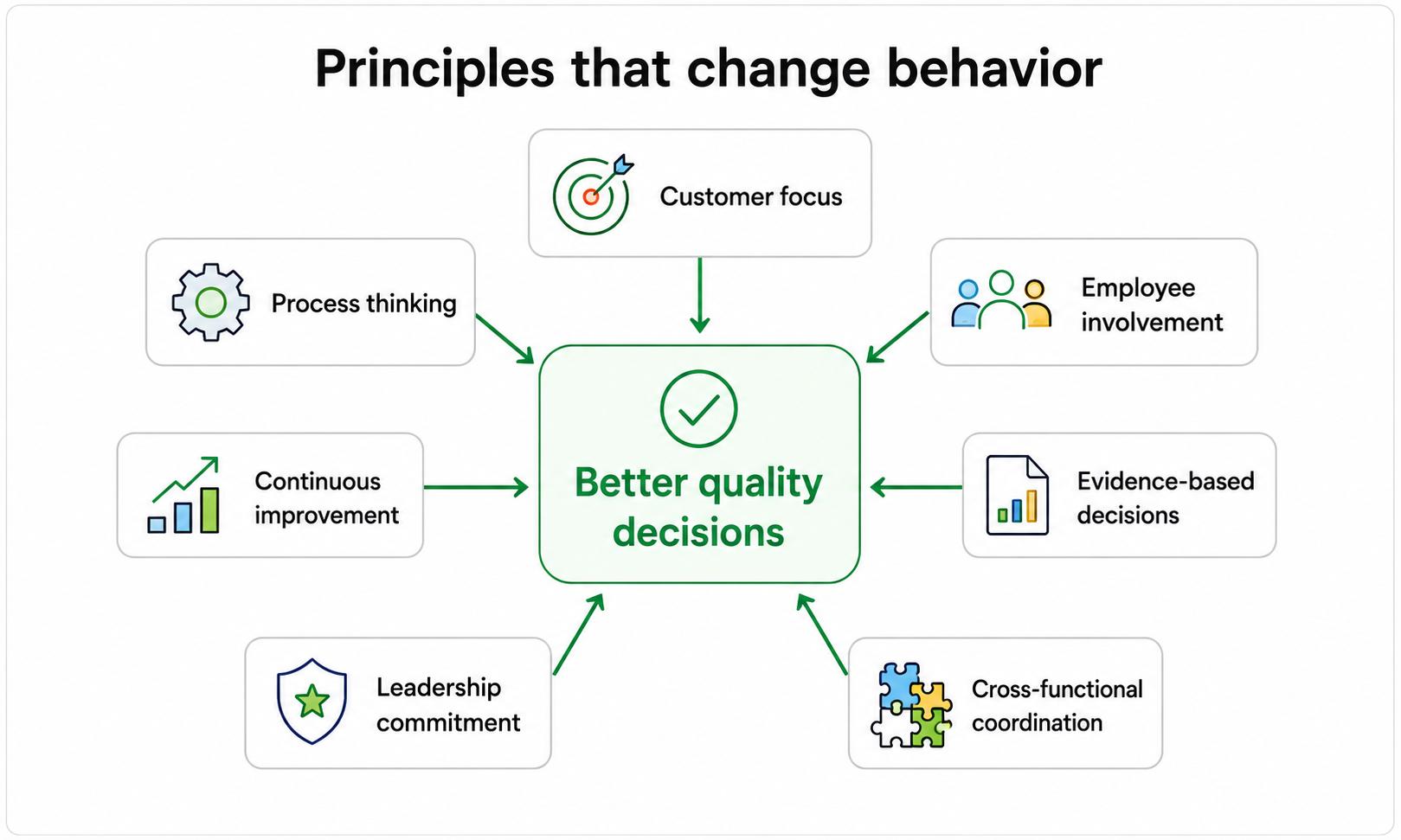
TQM is a set of principles that shape how teams make quality decisions. ISO's quality management principles include customer focus, leadership, engagement of people, process approach, improvement, evidence-based decision making, and relationship management.3
| Principle | What it means in practice |
|---|---|
| Customer focus | Define quality by the user's need, not just by internal preference |
| Process thinking | Improve the workflow that produces the result, not only the final output |
| Employee involvement | Include the people who do the work, because they see friction early |
| Continuous improvement | Make small, repeated improvements instead of waiting for a major redesign |
| Evidence-based decisions | Use data, examples, and observations to find where quality breaks down |
| Leadership commitment | Make quality visible in priorities, resources, standards, and follow-through |
| Cross-functional coordination | Fix handoffs, dependencies, and ownership gaps that create defects |
The useful test is whether these principles change behavior. If a team says it believes in quality but still rewards speed over accuracy, ignores employee feedback, and leaves procedures outdated, it is not really practicing TQM.
How TQM works in a real team
A practical TQM effort usually starts with a quality gap: customer complaints, rework, inconsistent decisions, missed service levels, audit findings, or variation between teams.
The team then studies the process that creates the output. That means looking at the steps, handoffs, tools, permissions, training, decision rules, and feedback loops. The point is to find where the system allows quality to drift.
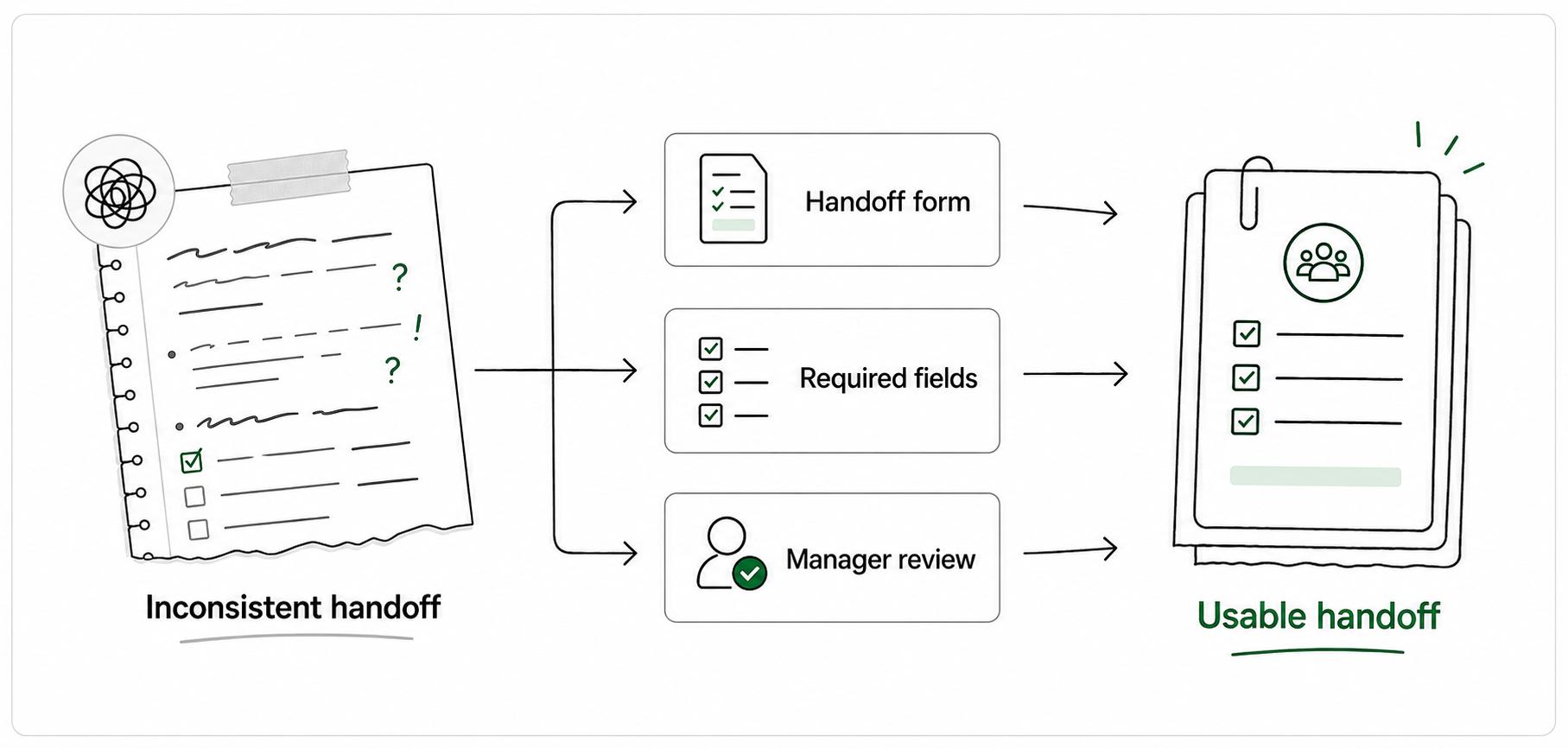
For example, imagine a customer success team notices that new customer handoffs from sales are inconsistent. Some implementation managers receive complete notes. Others receive vague context and have to ask the customer to repeat information. A TQM approach would not stop at telling sales reps to be more careful. It would examine the handoff form, required fields, sales incentives, CRM workflow, manager review, and the onboarding team's definition of a usable handoff.
The improvement might be a tighter handoff template, required fields, a manager spot-check, and a short guide showing what a good handoff looks like. The quality improvement becomes part of the process, not a reminder in a meeting.
TQM vs. quality control
Quality control checks whether outputs meet a standard. TQM asks how the organization can design work so outputs meet the standard more reliably in the first place.
Both are useful. Inspection catches problems before they reach customers. But inspection alone is a weak quality strategy because it happens late; Deming's management principles emphasize building quality into management systems rather than depending on end-stage inspection. TQM moves attention upstream: define the standard, teach it clearly, build it into the workflow, measure where it fails, and keep improving it.4
A good quality system catches defects and learns from them.
Common mistakes with TQM
The biggest mistake is treating TQM as a culture phrase. Saying "everyone owns quality" does not help if nobody owns the process, the metrics are unclear, and teams lack time to fix recurring problems.
Another mistake is over-documenting before understanding the work. A thick procedure can still describe a bad process. TQM documentation should capture the best known way to do the work after the team has tested what actually improves quality.
A third mistake is separating quality from everyday operations. If improvement only happens during quarterly projects, quality drifts between projects. The stronger habit is to make small defects visible, discuss root causes quickly, and update the standard when the team learns something better.
TQM improvement prompt
Use this prompt to apply TQM thinking to a repeatable process:
## TQM Improvement Prompt

**Glossary term:** Total Quality Management
**Source:** Trails Glossary — trails.so/glossary/total-quality-management

---

### 01. Apply TQM thinking to a repeatable process

"Process: [process name]
Customer or user expectation: [what quality means here]
Current quality gap: [defect, delay, complaint, rework, inconsistency]
Where the gap appears: [step, handoff, team, tool, or decision point]
Evidence available: [examples, metrics, observations, tickets, QA notes]
Likely system causes: [unclear standard, missing training, weak handoff, bad tool fit]
Improvement to test: [change the team can try]
New standard if it works: [how the process should run afterward]
Owner: [person or team]
Review cadence: [when results will be checked]"
The prompt works best when the team is specific. "Improve onboarding quality" is too broad. "Reduce missing account setup steps during the first customer handoff" is clear enough to investigate.
Documentation takeaway
TQM depends on a shared standard. When a team improves a process, that improvement has to be captured somewhere people can find, follow, and revise. SOPs, work instructions, checklists, templates, and training guides are how the quality system remembers what it learned.
Good documentation gives management judgment, coaching, and measurement a stable reference point.
How Trails helps
Trails helps teams capture repeatable workflows as people perform them, then turn those workflows into polished step-by-step guides. Teams can also create AI-narrated video versions for training and sharing.
That makes TQM improvements easier to standardize. Once a team finds a better way to do the work, Trails helps turn that better way into clear process documentation that can be reused and maintained.
- Quality control
- Quality assurance
- Quality manager
- Quality manual
- To-be process
- Takt time
Sources
- 1
American Society for Quality. Total Quality Management. ASQ. asq.org/quality-resources/total-quality-management. Accessed July 1, 2026.
- 2
National Institute of Standards and Technology. Baldrige Excellence Framework. NIST. www.nist.gov/baldrige/publications/baldrige-excellence-framework. Accessed July 1, 2026.
- 3
International Organization for Standardization. Quality Management Principles. ISO. www.iso.org/iso/pub100080.pdf. Accessed July 1, 2026.
- 4
The Deming Institute. 14 Points for Management. The Deming Institute. deming.org/explore/fourteen-points/. Accessed July 1, 2026.