
Glossary
Process Manager
 ChatGPT
 Perplexity
 Gemini
 Claude
What is a process manager?
A process manager is responsible for coordinating, monitoring, and improving a repeatable business process. The role focuses on how work moves across people, tools, policies, and handoffs so the process delivers a consistent outcome.
Process managers are common in operations, customer support, finance, HR, quality, manufacturing, implementation, and other teams where workflows need to be repeatable. They may not perform every step themselves, but they help make sure the process is clear, measured, documented, and improved over time.
What a process manager does
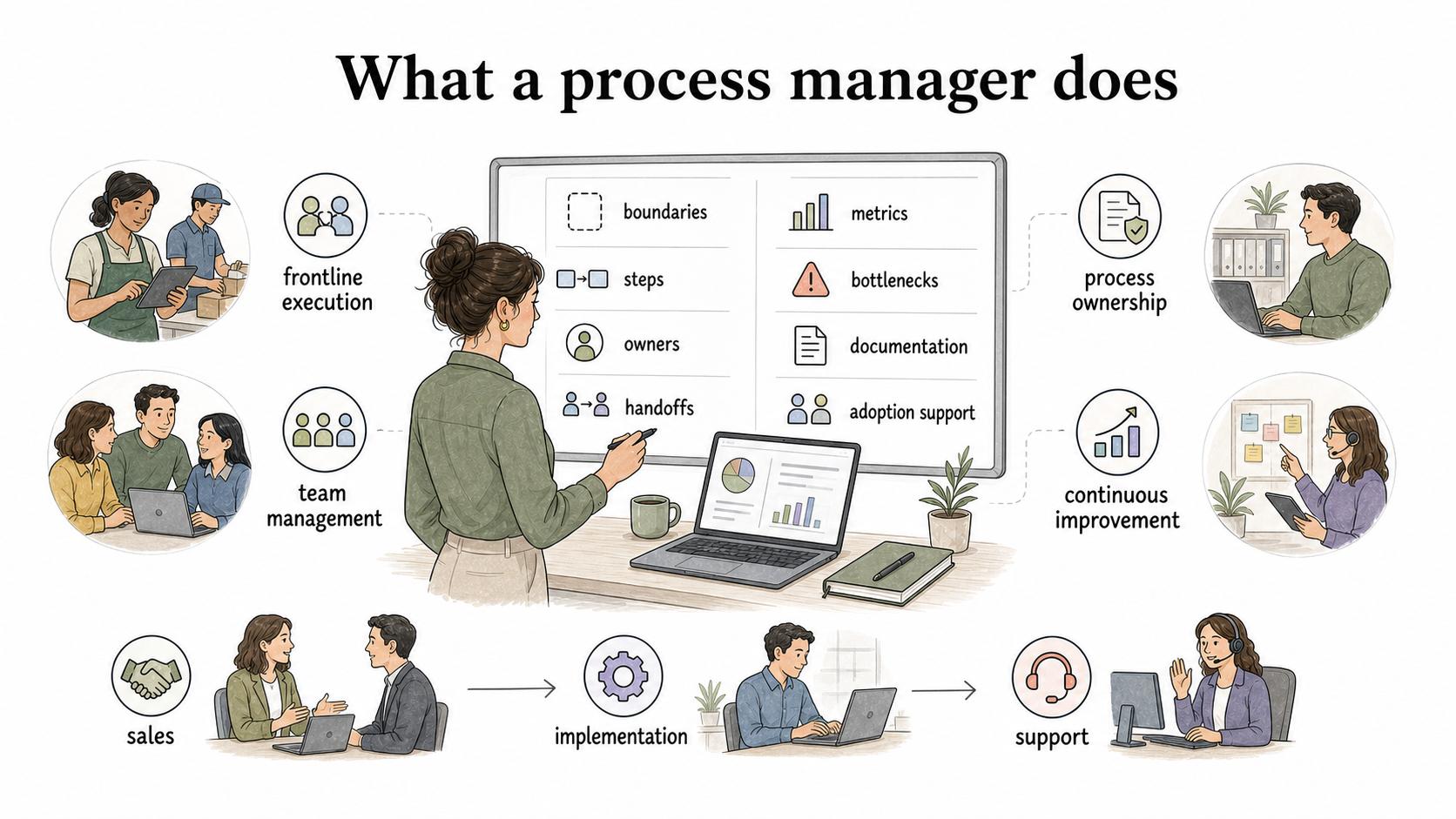
A process manager looks after the practical health of a workflow. Their work often sits between frontline execution, team management, process ownership, and continuous improvement.
Common responsibilities include:1
- Clarifying how the process works: boundaries, steps, owners, handoffs, rules, and expected outcomes.
- Monitoring process health: metrics, recurring issues, bottlenecks, delays, rework, and unclear ownership.
- Keeping documentation current: SOPs, checklists, guides, training materials, escalation rules, and process maps.
- Coordinating change: feedback from people close to the work, process updates, communications, and adoption support.
- Escalating improvement needs: recommendations for process owners, operations leaders, quality teams, or leadership.
For example, a process manager for customer onboarding might watch how work moves from sales to implementation to support. If customers wait too long for account setup, the process manager would investigate the handoff, review the guidance, check the data, and help fix the workflow.
Process manager vs. process owner
A process manager and a process owner may work closely together, but the emphasis is different.
A process owner is accountable for whether the process delivers the business outcome. They make decisions about goals, governance, priorities, and tradeoffs. A process manager is closer to the operating rhythm of the process: monitoring performance, coordinating improvements, and keeping the work understandable.
In a small team, one person may be both. In a larger organization, the process owner may set direction while the process manager handles day-to-day process health.
The process owner asks whether the process is producing the result the business needs. The process manager asks whether the workflow is clear, consistent, measurable, and improving.
Process manager vs. operations manager
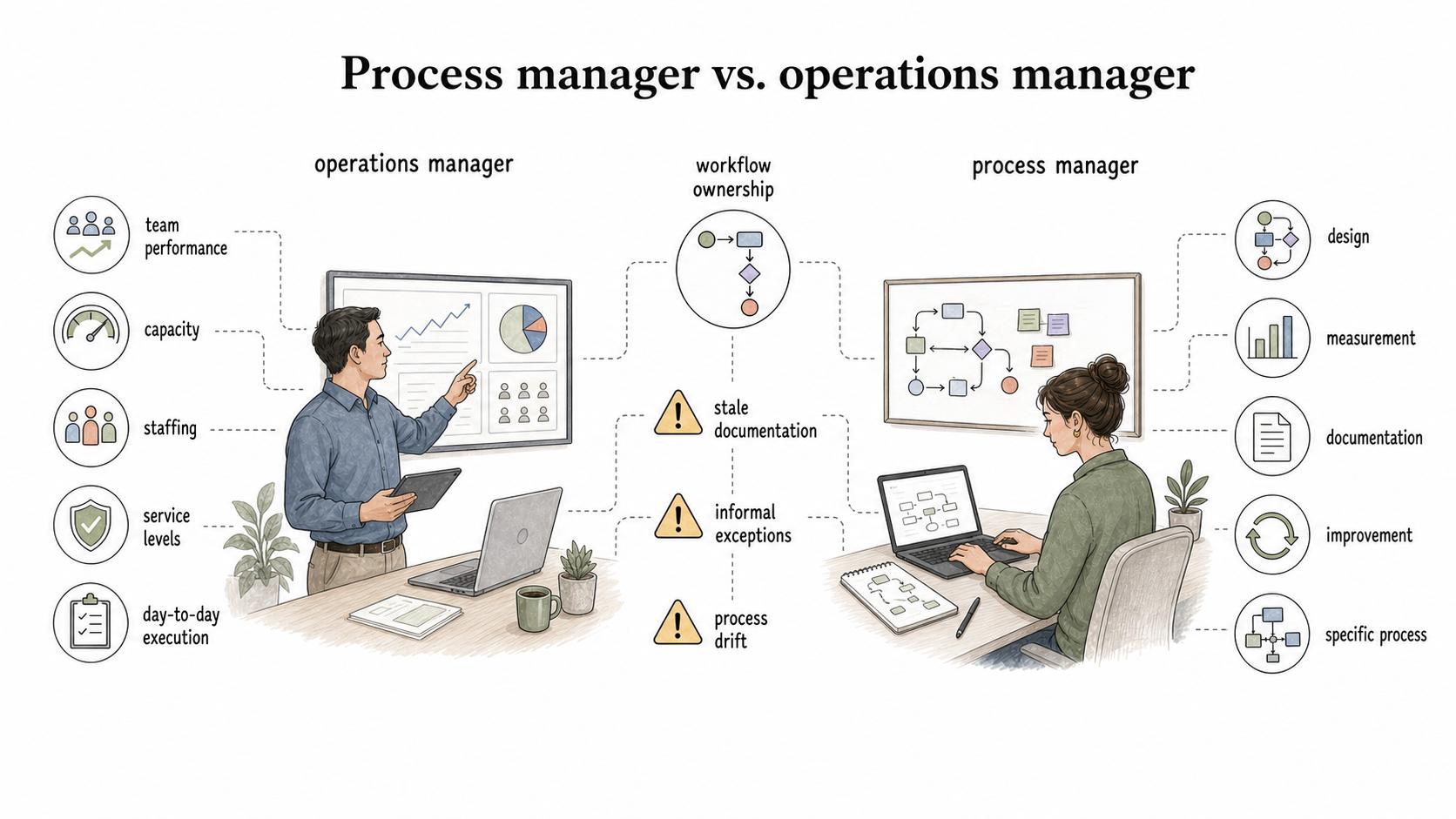
An operations manager usually manages broader team performance, capacity, staffing, service levels, and day-to-day execution. A process manager focuses more narrowly on the design, measurement, documentation, and improvement of a specific process or group of related processes.
The roles can overlap. An operations manager might act as the process manager for several core workflows. A dedicated process manager may support multiple operations leaders by standardizing work, improving handoffs, and maintaining process documentation.
The difference matters because process problems often hide inside general operations work. If everyone owns the team result but nobody owns the workflow, documentation gets stale, exceptions become informal, and process drift becomes normal.
Skills a process manager needs
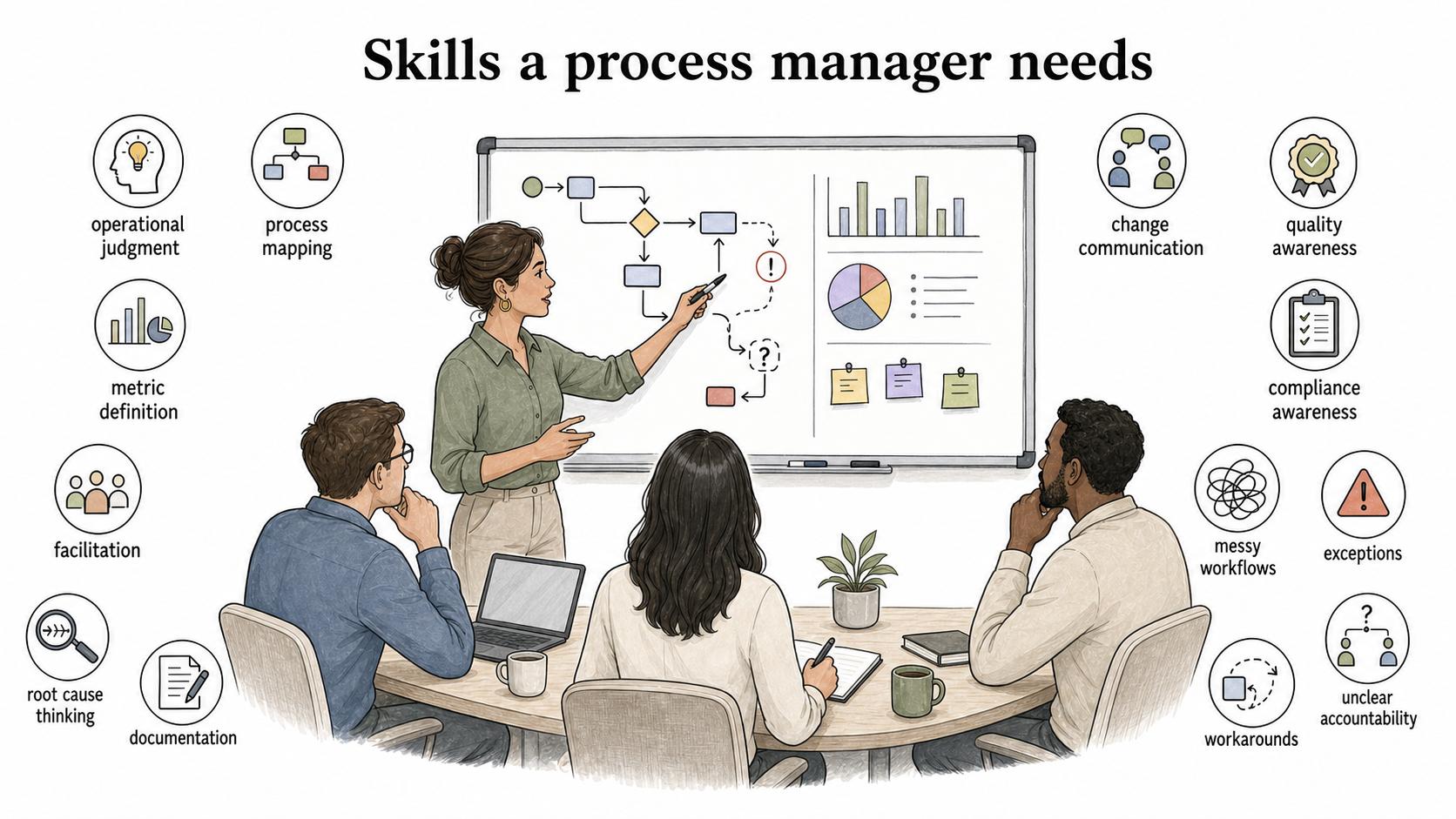
A strong process manager needs operational judgment more than perfect diagrams. They need to understand how work actually happens, where it breaks, and how people behave when the documented process does not match reality.
Useful skills include process mapping, metric definition, facilitation, root cause thinking, documentation, change communication, and quality or compliance awareness. The role also requires comfort with messy workflows. Many process issues come from exceptions, workarounds, legacy habits, and unclear accountability rather than one obvious broken step.
What a process manager should document
Documentation is how a process manager keeps repeatable work from depending on memory. The goal is to preserve the operating knowledge people need to perform, manage, and improve the process.2
A practical documentation set usually includes:
- A map of the process: the current flow, major decisions, roles, handoffs, and exception paths.
- Instructions for execution: SOPs, work instructions, checklists, templates, and job aids for important steps.
- Rules for control: escalation criteria, quality standards, review criteria, evidence requirements, and compliance notes.
- Signals for management: process metric definitions, targets, review cadence, known limitations, and open issues.
- Change history: what changed, why it changed, and which training or support materials were updated.
The most useful documentation connects the map, the instructions, and the metric. If a metric shows rework, the process manager should be able to trace the issue back to a step, owner, decision rule, or training gap.
Common mistakes
The first mistake is treating process management as paperwork. Documentation matters because it helps the process run better. A process manager should connect guides and SOPs to real outcomes such as speed, quality, consistency, risk, and customer experience.
The second mistake is managing the process from a distance. Dashboards and diagrams can miss the actual workaround employees use to get work done. Process managers need feedback from people close to the work.
The third mistake is changing the workflow without changing the support system. If the process changes, the training, guides, checklists, templates, metrics, and ownership notes may need to change too.
A practical operating cadence
A process manager does not need to redesign the workflow every week. They need a rhythm that keeps process drift visible.
A simple cadence might include a weekly review of key metrics, a monthly review of open process issues, a quarterly documentation check, and a change review whenever a tool, policy, role, or handoff changes.3
The cadence should be lightweight enough to survive busy weeks. The point is to notice when the process has changed in practice before the official documentation falls too far behind.
How Trails helps
Trails helps process managers capture real workflows and turn them into step-by-step documentation. When a process changes, a manager can record the work as it is performed, create a polished guide, and generate an AI-narrated video version for training or sharing.
That gives process managers a practical way to keep documentation aligned with how work actually happens.
Sources
- 1
APQC. Business Process Owners. www.apqc.org/resources/blog/business-process-owners.
- 2
APQC. Process Management FAQ: Roles and Skillsets. www.apqc.org/blog/process-management-faq-roles-and-skillsets.
- 3
ISO. The Process Approach in ISO 9001:2015. www.iso.org/iso/iso9001_2015_process_approach.pdf.