
Glossary
Process Owner
 ChatGPT
 Perplexity
 Gemini
 Claude
What is a process owner?
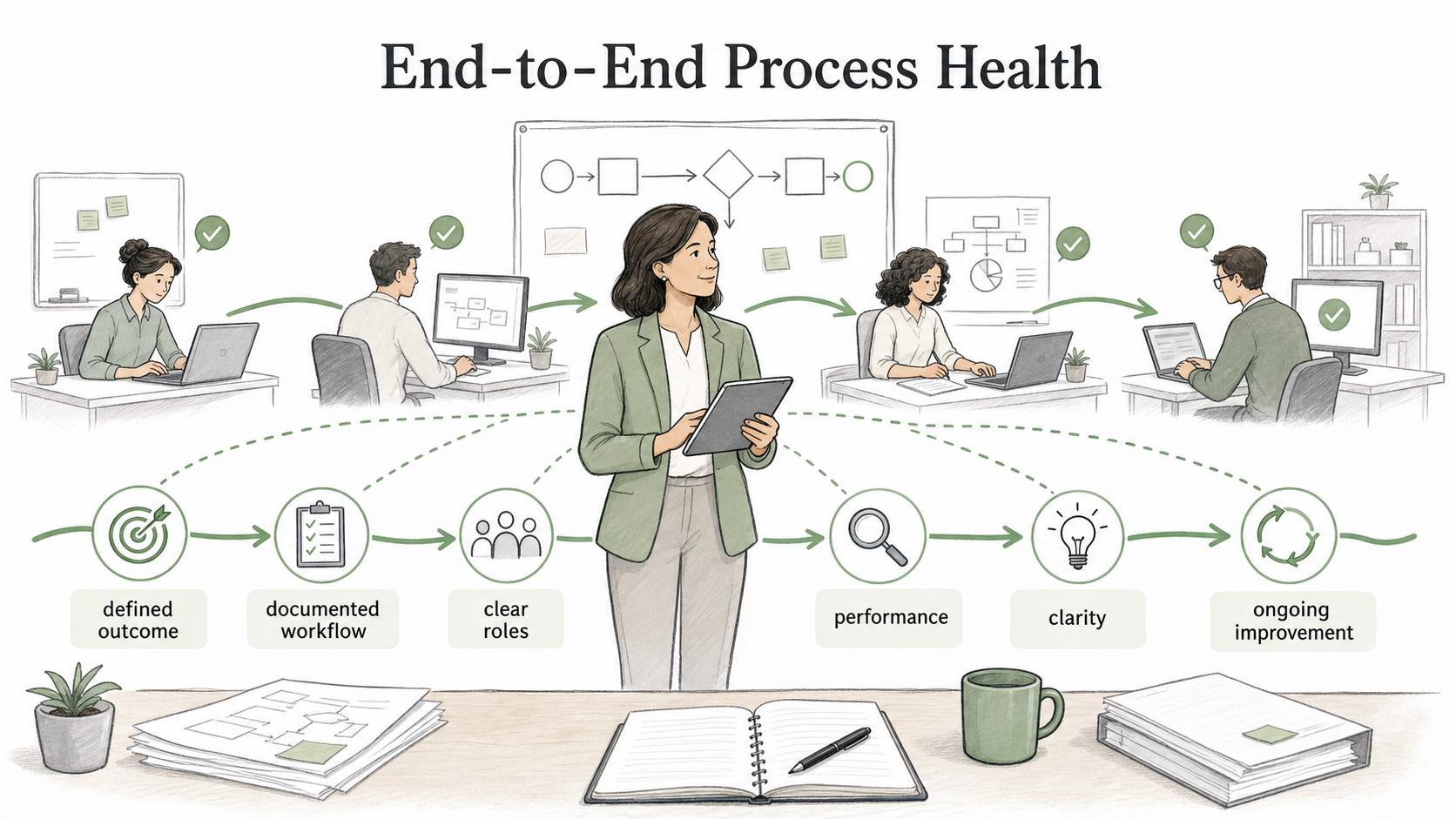
A process owner is the person accountable for the performance, clarity, and ongoing improvement of a business process.1 They make sure the process has a defined outcome, documented workflow, clear roles, useful metrics, and a way to change when the process stops working.
A process owner does not have to perform every step. Their job is to keep the end-to-end process healthy, especially when the work crosses teams. Without an owner, processes often become shared in theory and neglected in practice.
What a process owner is responsible for
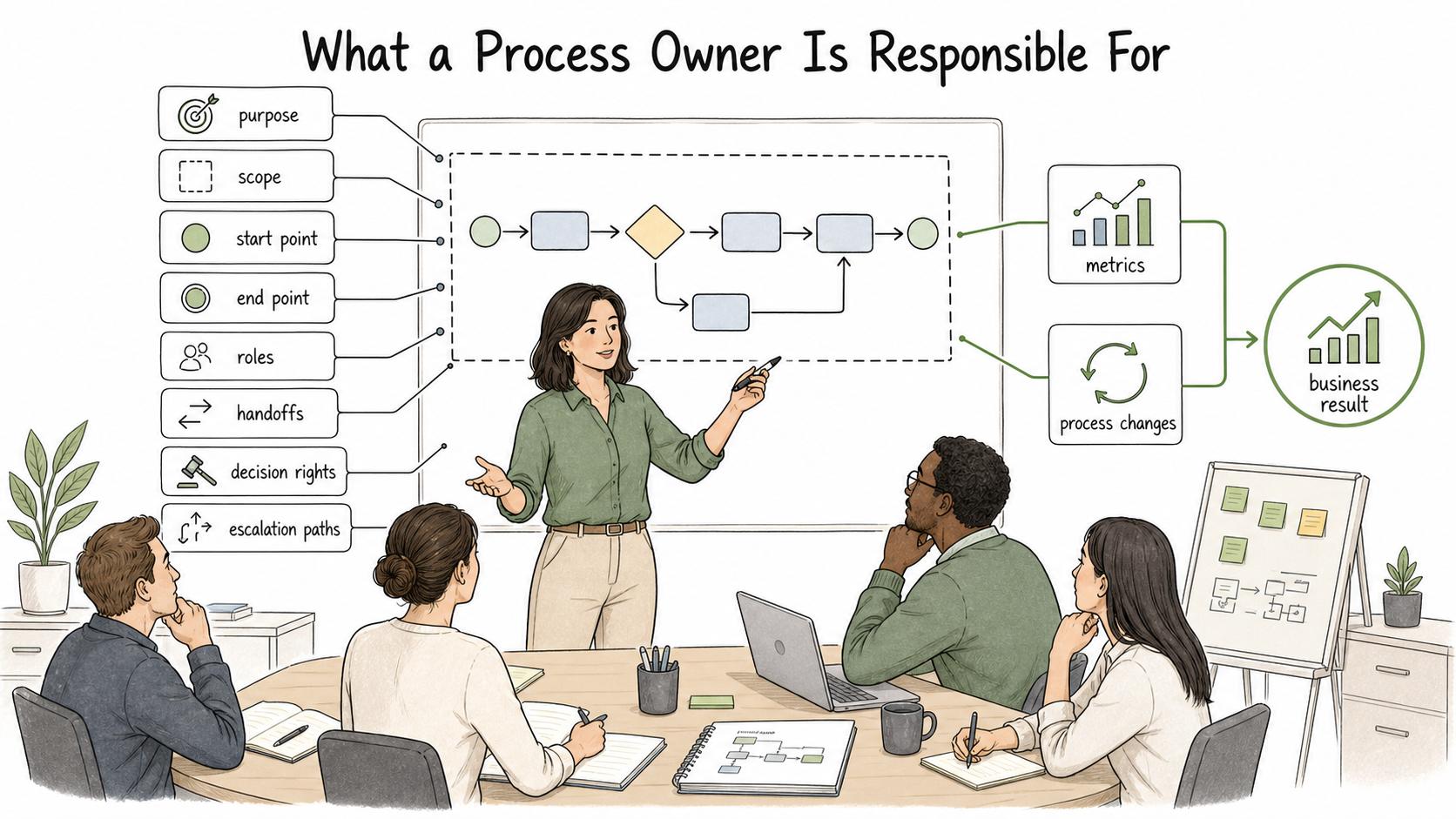
The process owner connects the workflow to a business result. They should be able to answer: what is this process supposed to produce, who depends on it, how do we know it is working, and what changes when it is not?
Typical responsibilities include:
- Defining the process purpose, scope, start point, and end point
- Clarifying roles, handoffs, decision rights, and escalation paths
- Maintaining or assigning ownership for SOPs, guides, and work instructions2
- Choosing process metrics and reviewing performance
- Approving meaningful process changes before rollout
- Coordinating stakeholders across teams or functions
- Identifying risks, controls, exceptions, and failure modes
- Keeping process training aligned with the current workflow
- Prioritizing improvements when the process creates delays, rework, or confusion
The role is partly operational and partly editorial. A good process owner keeps the work itself healthy and keeps the story of the work accurate enough for other people to follow.
Process owner vs. process manager vs. task owner
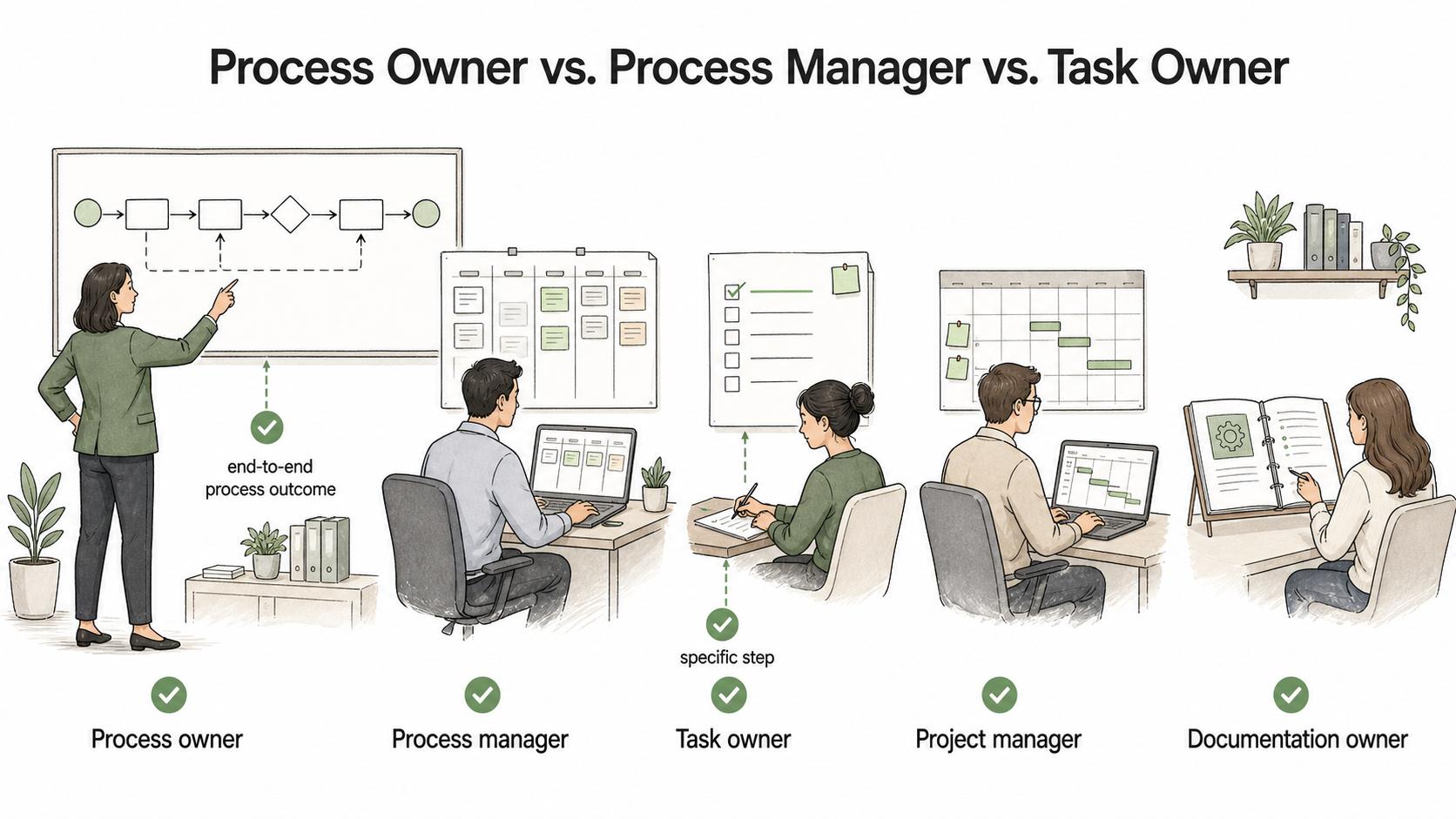
These roles often overlap in smaller teams, but the distinction matters when work scales.
| Role | Main accountability | Common question they answer |
|---|---|---|
| Process owner | End-to-end process outcome and long-term health | Is this process producing the result we need? |
| Process manager | Day-to-day coordination of the process | Are current cases, queues, or handoffs moving correctly? |
| Task owner | Completion of a specific step or deliverable | Did this assigned piece get done? |
| Project manager | Delivery of a temporary change initiative | Is the redesign or rollout project on track? |
| Documentation owner | Accuracy of a specific document or guide | Is this SOP or guide current and usable? |
One person may hold more than one role, but the responsibilities should still be explicit.3 If everyone assumes someone else owns the full process, no one does.
What makes process ownership real
Many teams assign process owners in a spreadsheet and stop there. That creates a named owner, not actual ownership. Real process ownership requires authority, visibility, and a review habit.
Authority to change the process. A process owner needs a way to approve changes, convene stakeholders, and escalate conflicts. If they can only observe problems, they are more of a reporter than an owner.
Visibility into process performance. The owner needs signals: cycle time, error rates, rework, customer escalations, SLA misses, backlog, quality defects, or whatever best reflects the process outcome.4 Without signals, ownership becomes opinion management.
Clear documentation. The owner needs a documented process map, SOP, role matrix, decision rules, and exception path. The documentation does not have to be fancy; it has to be accurate enough that people can work from it.
A regular review cadence. Processes drift as tools, roles, policies, and customer expectations change. A process owner should review the process before it quietly becomes outdated.
Process owner checklist
Use this checklist to test whether a process has real ownership:
- Is one person accountable for the end-to-end outcome?
- Are the process purpose, start point, and end point clear?
- Are roles, handoffs, decision rights, and escalation paths documented?
- Are current SOPs or guides accurate enough to use during real work?
- Are metrics reviewed on a useful cadence?
- Are exceptions documented instead of handled informally every time?
- Can the owner approve or sponsor process changes?
- Is training updated when the process changes?
- Is there a change log or review history?
If several answers are no, the process may have participants, but it probably does not have enough ownership.
Example of a process owner
Consider a customer onboarding process that involves sales, finance, implementation, support, and customer success. Each team may own its own tasks, but the process owner is accountable for the end-to-end onboarding outcome.
That owner might track how long onboarding takes, where handoffs stall, which setup steps get missed, whether customers repeat information, and whether new employees understand the workflow. They might sponsor changes to intake forms, approve a new handoff rule, assign an SOP update, or ask for automation once the redesigned flow is stable.
The process owner is not responsible for doing every onboarding task. They are responsible for making sure the process works as a whole.
Common mistakes
One mistake is naming an owner without giving them enough authority. If the person cannot influence tools, handoffs, documentation, or stakeholder behavior, they will struggle to improve the process.
Another mistake is confusing department ownership with process ownership. A department head may manage one team in the workflow, but an end-to-end process often crosses multiple departments.
A third mistake is measuring only task completion. A process can have all tasks marked complete and still fail the customer, employee, or business outcome. Process owners need outcome-oriented signals, not just activity reports.
How Trails helps
Trails helps process owners capture workflows as they are performed and turn them into step-by-step guides. That gives owners a practical way to document the current process, train teams, update SOPs, and share changes when the workflow evolves.
For cross-functional processes, Trails helps turn scattered process knowledge into a source of truth people can actually use.
The SOP software comparison can help an owner choose tools for creating and maintaining the procedure library; ownership and review responsibilities still need to be assigned by the team.
Frequently asked questions
Does a process owner need to be a manager?
Not always. A process owner needs enough authority and stakeholder trust to influence the process. In some teams that person is a manager; in others, they are an operations lead, program owner, subject matter expert, or cross-functional owner.
Can a process have more than one owner?
It can have many contributors, but shared ownership should be used carefully. For end-to-end accountability, one accountable owner is usually clearer than a group of people who all partially own the outcome.
What should a process owner review?
They should review process performance, documentation accuracy, role clarity, exceptions, training gaps, customer or employee pain points, and proposed changes to tools or automation.
Sources
- 1
SAP Signavio. Business Process Owner. www.signavio.com/wiki/bpm/business-process-owner/.
- 2
APQC. Process Management FAQ: Roles and Skillsets. www.apqc.org/blog/process-management-faq-roles-and-skillsets.
- 3
Cornell University. RACI and RASCI Definitions. it.cornell.edu/it-service-management/raci-and-rasci-definitions.
- 4
APQC. Business Process Owners. www.apqc.org/resources/blog/business-process-owners.