
Glossary
Operations Manager
 ChatGPT
 Perplexity
 Gemini
 Claude
What is an operations manager?
An operations manager is responsible for making day-to-day work run reliably. The role connects people, processes, tools, capacity, quality, metrics, and issue resolution so a team, site, department, or business function can execute consistently. O*NET describes general and operations managers as people who plan, direct, or coordinate organizational operations across departments or locations.1
A practical way to understand the role: an operations manager owns the conditions for repeatable work. They may not perform every task themselves, but they make sure the work has clear standards, enough capacity, visible performance, and a practical path for improvement.
What an operations manager does
The exact responsibilities vary by industry and company size. A warehouse operations manager, support operations manager, clinic operations manager, and SaaS revenue operations manager work in different systems, but all are judged by reliable execution. BLS describes management occupations as roles that establish plans and policies, direct business activities, and oversee people, products, and services.2
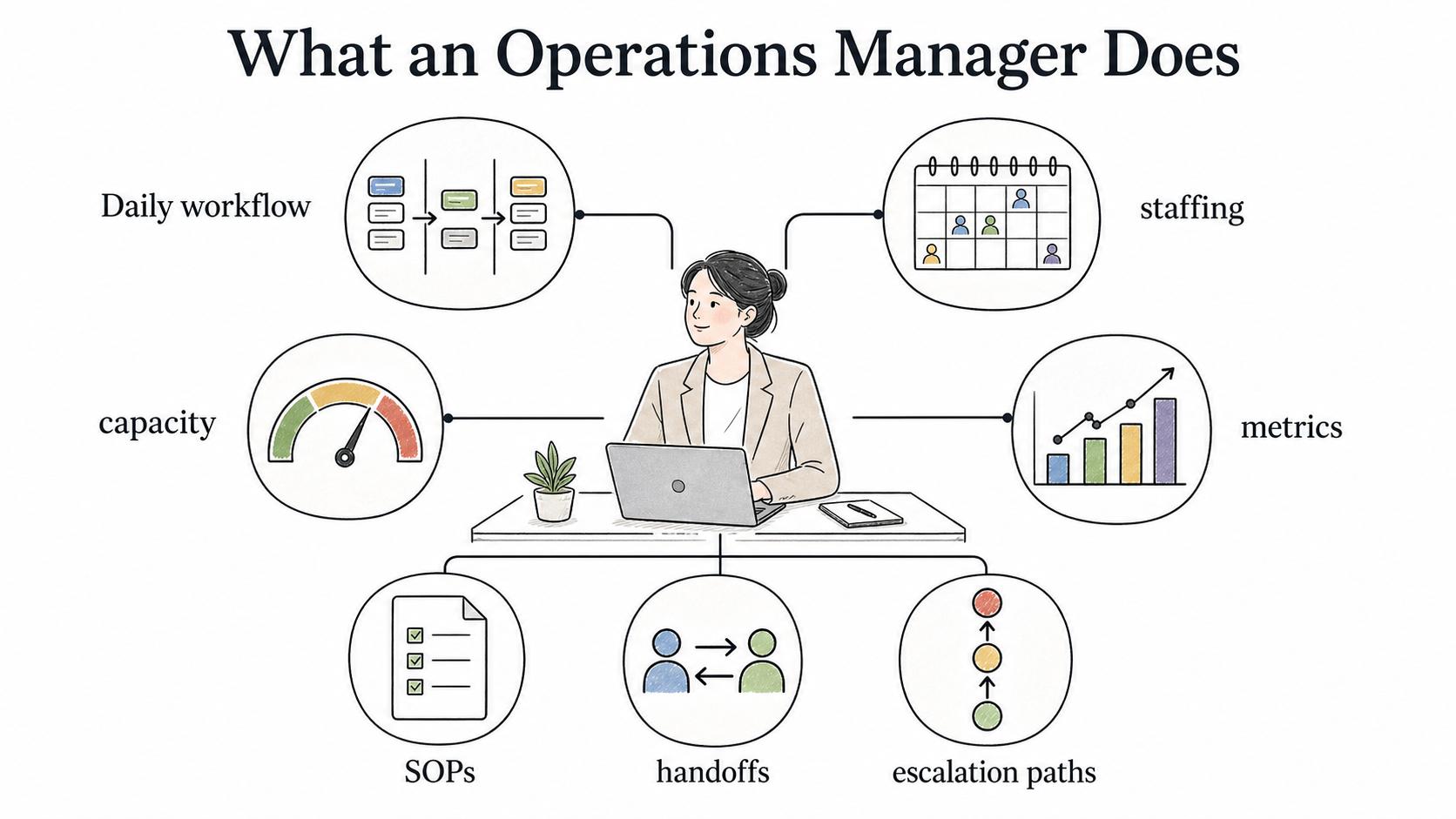
Typical responsibilities cluster around a few operating levers:
- Daily workflow, staffing, schedules, and capacity
- Operational metrics, service levels, bottlenecks, and recurring issues
- SOPs, checklists, work standards, and process-change training
- Tools, vendors, systems, and handoffs between teams
- Escalation paths when normal workflows break
- Communication between leadership priorities and frontline execution
Good operations managers spend less time being the only person with answers and more time building a system where answers are easy to find.
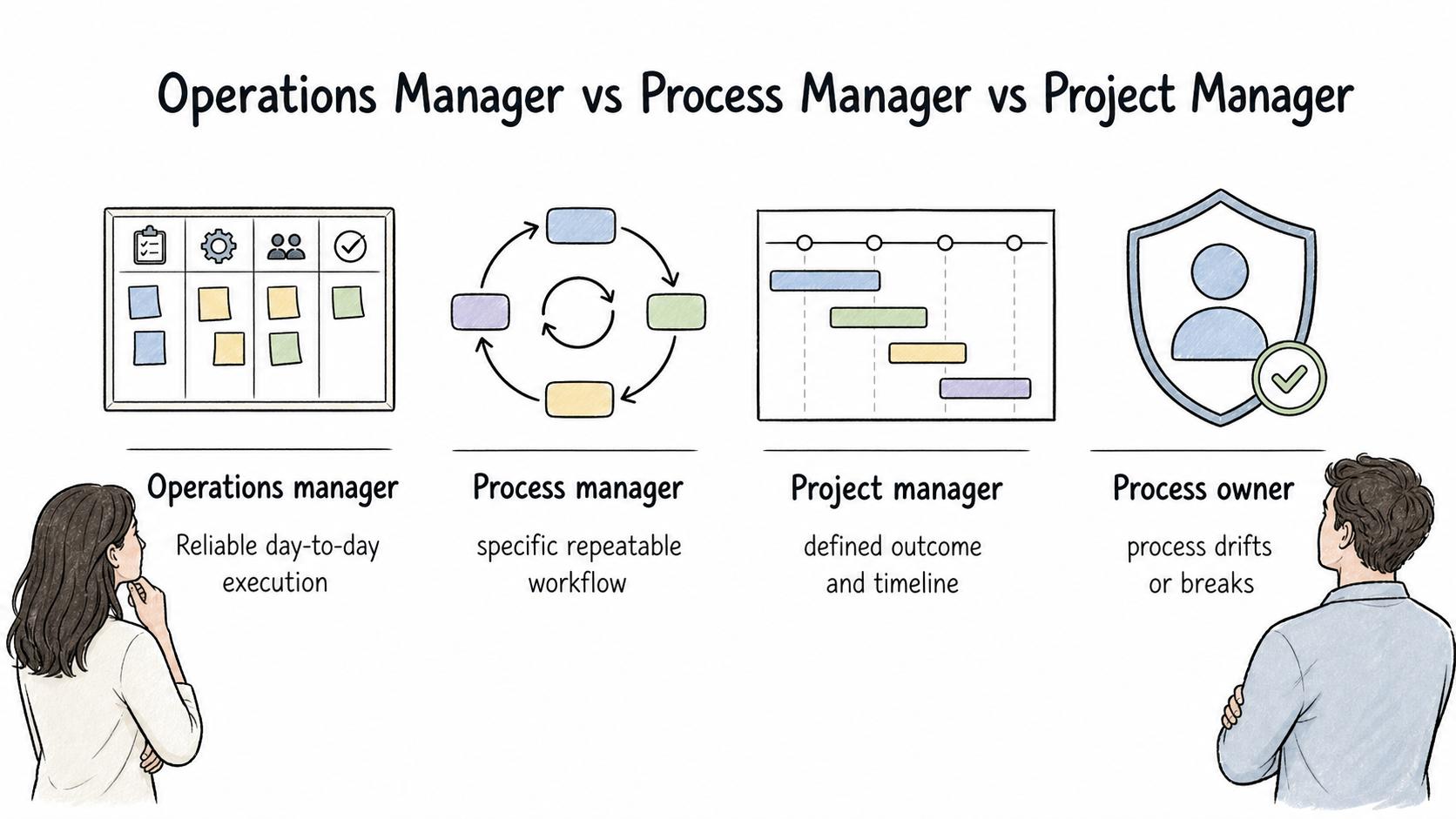
Operations manager vs process manager vs project manager
The titles can overlap, especially in smaller companies, but they emphasize different kinds of ownership.
| Role | Primary focus | Common question |
|---|---|---|
| Operations manager | Reliable day-to-day execution across a team or function | Can the operation run well today and keep improving? |
| Process manager | Health and improvement of a specific repeatable workflow | Is this process clear, measured, owned, and improving? |
| Project manager | Temporary work with a defined outcome and timeline | Are we delivering this change on scope, schedule, and budget? |
| Process owner | Accountability for how one process performs over time | Who is responsible when this process drifts or breaks? |
An operations manager may manage processes and projects, but the role is broader than either one. The job is the operating environment itself: staffing, standards, handoffs, constraints, performance, and the habits that keep work moving.
What effective operations managers pay attention to
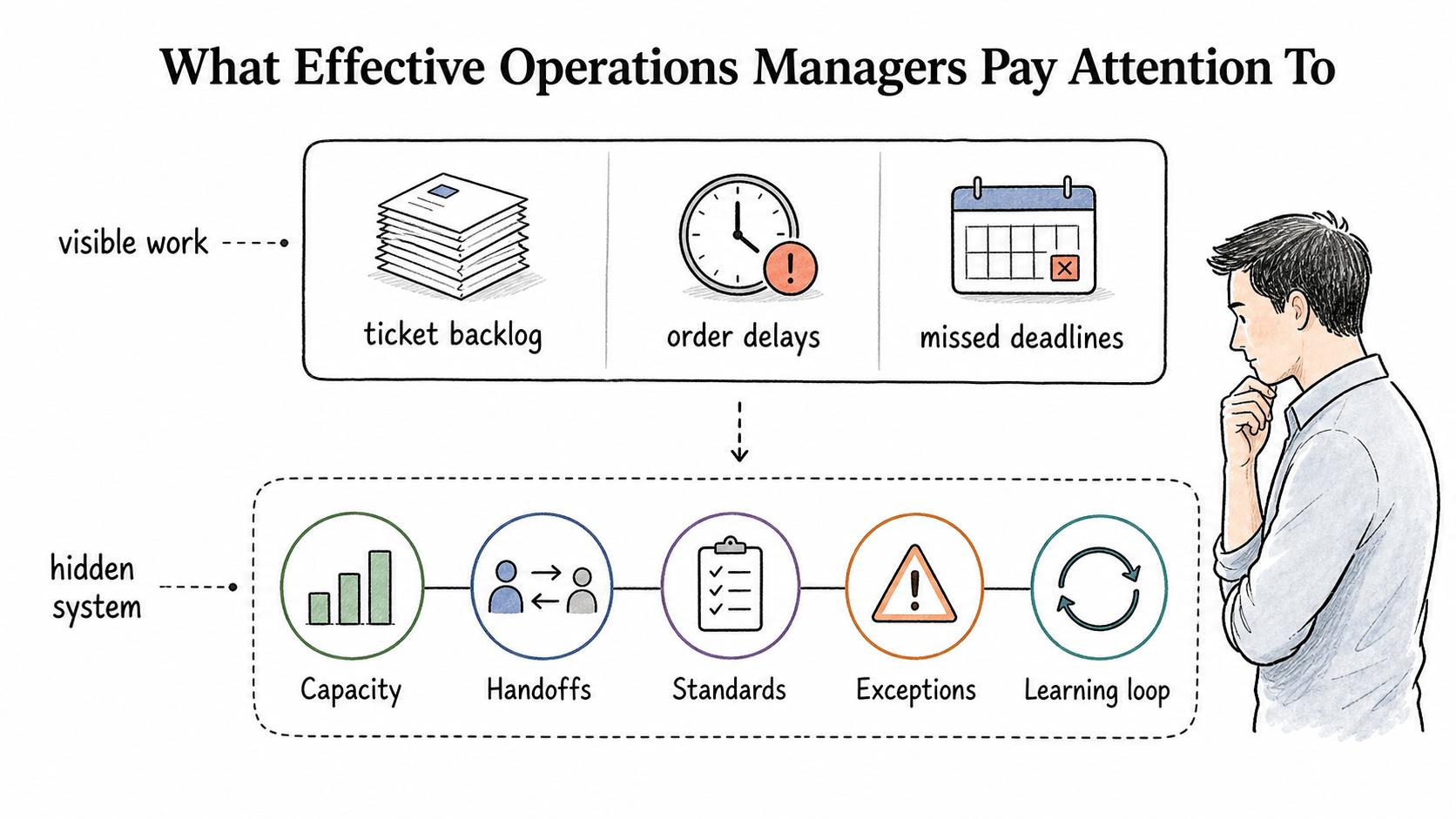
Operations managers need to see both the visible work and the hidden system behind it. A dashboard may show ticket backlog, order delays, or missed deadlines, but the manager still has to understand why the workflow is producing those results.
That usually means watching a few practical signals:
Capacity: Does the team have enough people, time, and tooling to meet demand without relying on constant overtime or shortcuts?
Handoffs: Does work move cleanly between people, shifts, systems, or departments, or does it stall because ownership is unclear?
Standards: Do people know the expected way to do recurring work, and are the SOPs current enough to trust?
Exceptions: Are edge cases handled deliberately, or does every exception become a one-off manager decision?
Learning loop: When the team finds a better way to work, does it update the process, train people, and retire the old method?
The last point is where many operations teams lose leverage. Solving one incident is useful. Changing the system so the same incident happens less often is operations management.
Documentation an operations manager needs
Documentation gives operations managers scale. Without it, the manager becomes the routing layer for every question, escalation, and process memory. Microsoft research found that 62% of surveyed workers struggle with too much time spent searching for information, which makes clear operating documentation a practical management lever.3
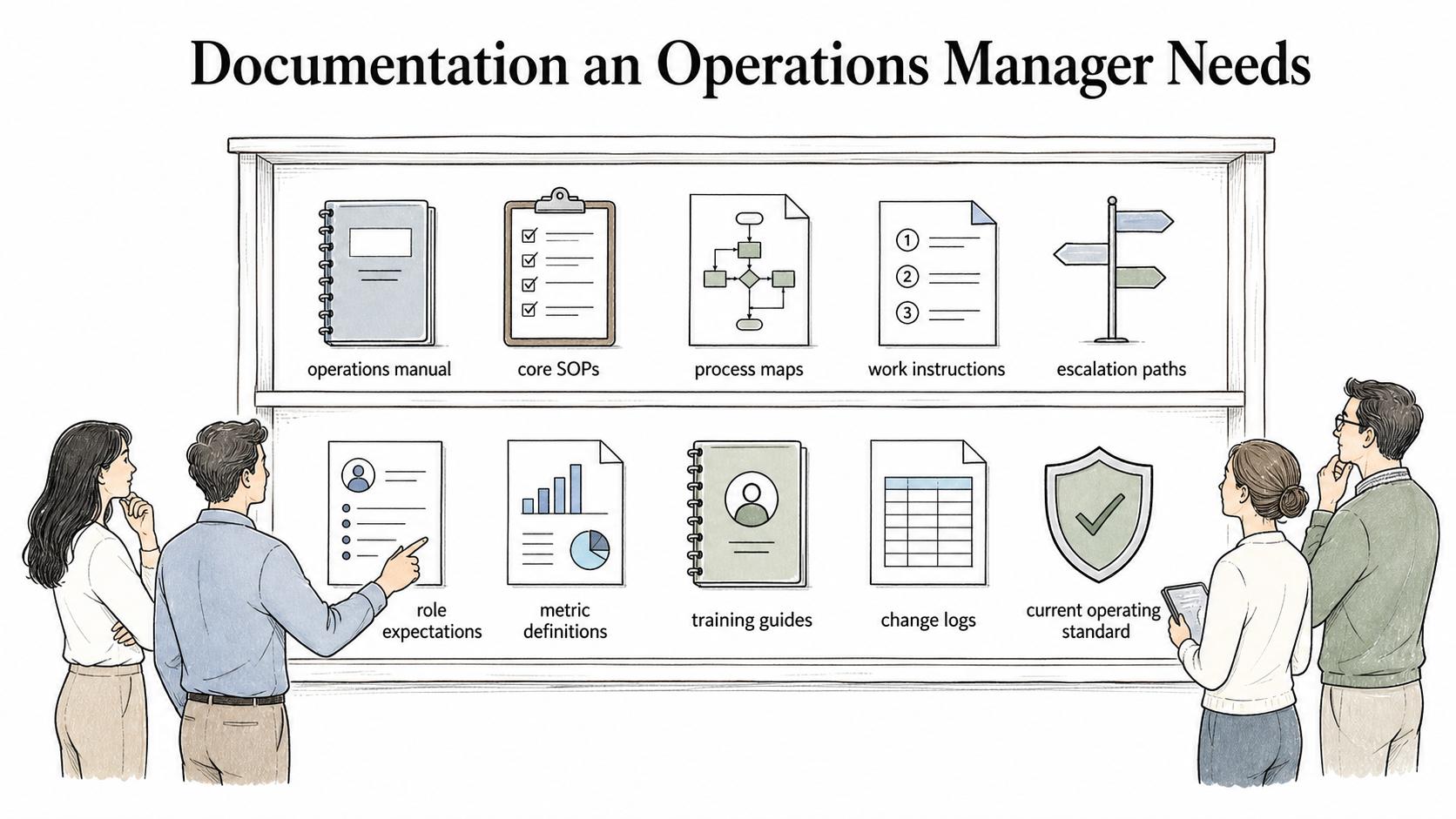
The most useful documentation usually includes an operations manual, core SOPs, process maps, work instructions, escalation paths, role expectations, meeting cadence, metric definitions, training guides, and change logs. A perfect library is less useful than a current operating standard the team can follow without constant interpretation.
A strong operations manager also treats documentation as a feedback system. If employees keep asking the same question, the standard is missing, hard to find, or too vague. If people ignore an SOP, the SOP may be outdated, unrealistic, or disconnected from the tool where work happens.
Operations manager diagnostic prompt
Use this prompt to review an operating area:
## Operations manager diagnostic prompt

**Glossary term:** Operations Manager
**Source:** Trails Glossary — trails.so/glossary/operations-manager

---

### 01. Analyze an operating system

"Analyze the operating system for [team or function]. Identify the core workflows, process owners, capacity constraints, handoffs, recurring exceptions, key metrics, SOPs or guides, training gaps, and decisions that depend too much on one person. Recommend the three documentation updates that would most improve daily execution."
This prompt works because it avoids a generic role checklist. It focuses on where the current system makes work harder than it needs to be.
Common mistakes
One mistake is managing only through urgency. If every day is spent reacting to the loudest issue, the underlying process problems stay intact.
Another mistake is treating documentation as administrative cleanup. For an operations manager, documentation is part of the operating system. It affects training speed, handoff quality, audit readiness, consistency, and how quickly improvements spread.
A third mistake is optimizing one metric without watching the tradeoff. Faster throughput can create more rework. Lower staffing cost can create longer queues. Shorter training can increase escalations. Operations management requires looking at the whole system, not one number in isolation. The ISO 9001 quality-management framing is useful here because it connects consistency, efficiency, and customer expectations rather than treating one metric as the whole system.4
Documentation takeaway
Operations managers need documentation that helps people run the work, not just describe it. SOPs, operations manuals, process maps, metric definitions, and training guides should make the operating standard visible and easier to improve.
When the documentation is current, the manager can spend less time answering repeat questions and more time improving the system.
How Trails helps
Trails helps operations managers capture real workflows and turn them into polished step-by-step guides. Those guides can support onboarding, process changes, shift handoffs, and daily reference. Trails can also create AI-narrated video versions when a process needs to be shared or trained more broadly.
Sources
- 1
O*NET OnLine. General and Operations Managers. www.onetonline.org/link/summary/11-1021.00.
- 2
U.S. Bureau of Labor Statistics. Management Occupations. www.bls.gov/ooh/management/.
- 3
Microsoft. 2023 Work Trend Index Annual Report. assets.ctfassets.net/y8fb0rhks3b3/5eyZc6gDu1bzftdY6w3ZVV/beeb0f2e437044fc99a0408867a263d8/WTI_Annual_2023_Will_AI_Fix_Work_.pdf.
- 4
ISO. ISO 9001 Explained. www.iso.org/home/insights-news/resources/iso-9001-explained.html.