
Glossary
Process Flow
 ChatGPT
 Perplexity
 Gemini
 Claude
What is process flow?
Process flow is the way work moves from the start of a process to a finished outcome. It includes the order of steps, the people or systems involved, the decisions that change the path, and the handoffs that move work from one owner to another. 1
Many process problems hide between steps. A team may know how to complete each task and still lose time because the handoff is vague, the next step is missing information, or the decision rule lives in one person's head.
What process flow includes
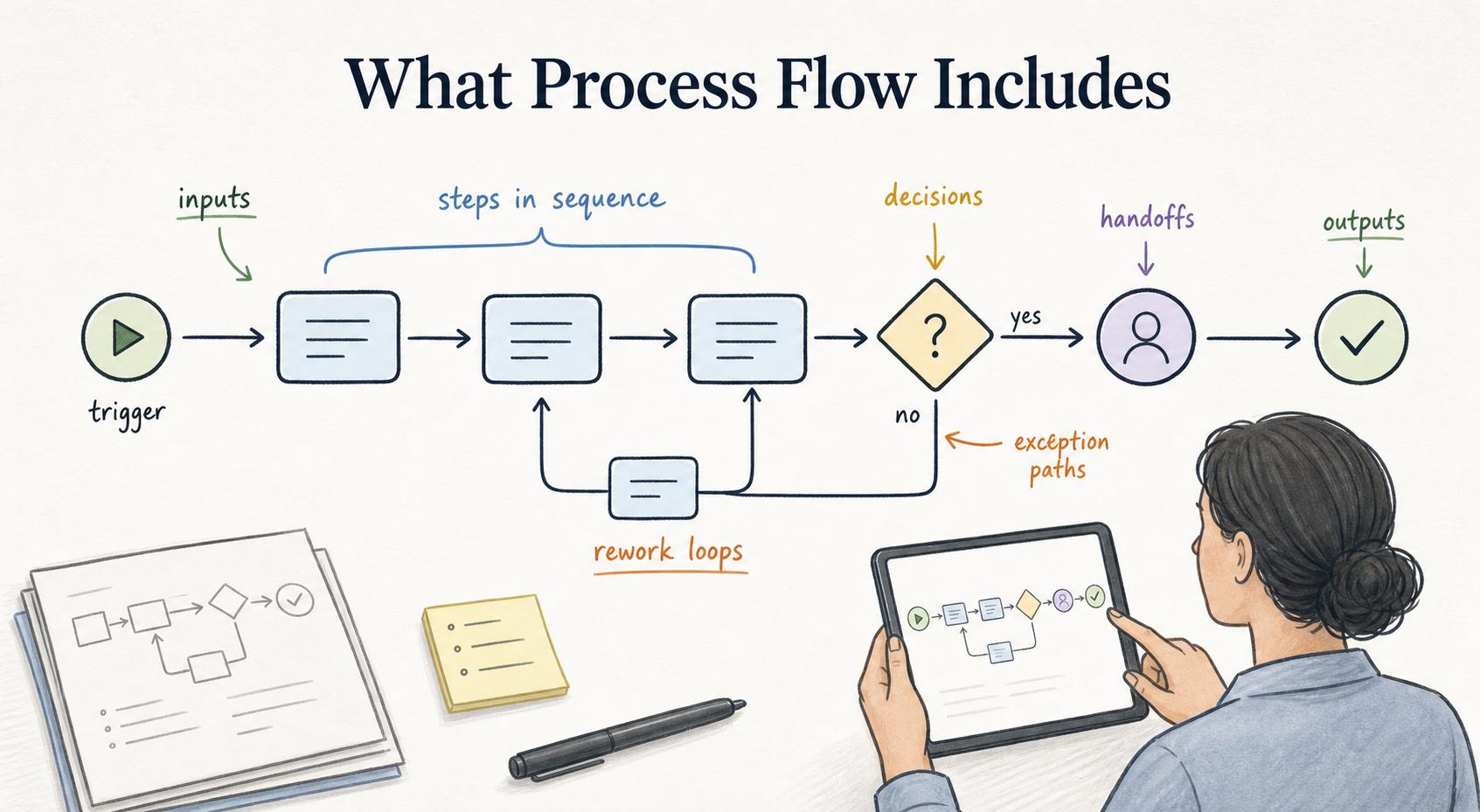
A process flow usually starts with a trigger. A customer submits a request, a deal closes, an invoice arrives, a bug is reported, or an employee starts onboarding. From there, work moves through steps until it reaches a defined end state.
A complete process flow should make the movement of work visible, including the triggers, decisions, inputs, outputs, and rework loops that shape what actually happens. 2 Pay closest attention to:
- the event that starts the process and the result that ends it
- the main steps in sequence, with the role or system responsible for each one
- the inputs required before work can continue
- the decisions that change the route
- the handoffs and exception paths that create waiting, rework, or side-channel conversations
Those details matter because a process can look simple at the task level and still fail at the flow level.
Process flow vs. process flow diagram
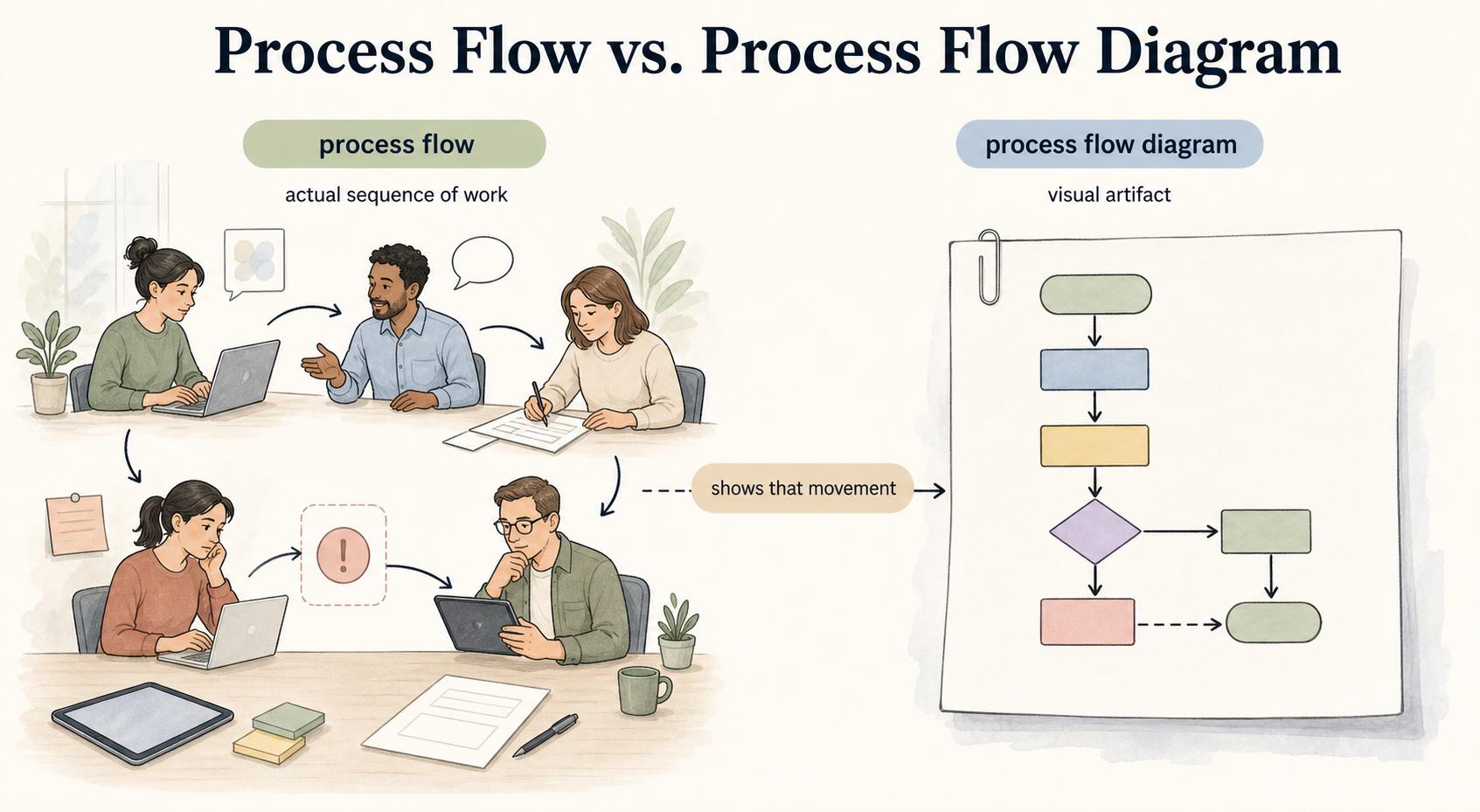
Process flow is the actual sequence of work. A process flow diagram is one way to represent that sequence visually.
The distinction keeps the work separate from the artifact. The real process is what people do in systems, conversations, forms, approvals, and exception handling. The diagram is a map. It helps people inspect and explain the process, but the process only improves when behavior, ownership, tools, or documentation change.
Use process flow when you're talking about how work moves. Use process flow diagram when you're talking about the visual artifact that shows that movement.
Why process flow matters
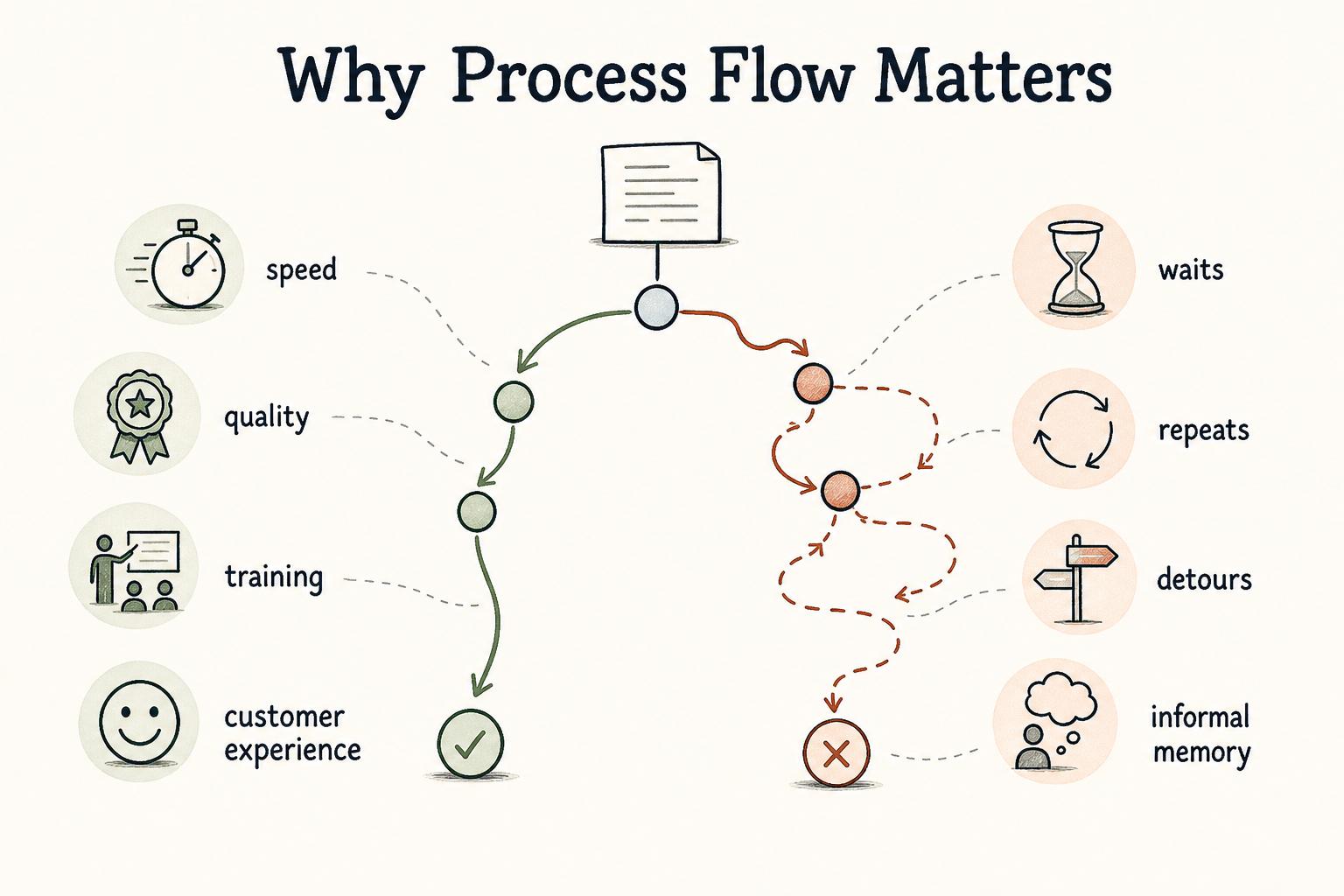
Process flow affects speed, quality, training, and customer experience. When the flow is clear, people know what happens next and what information the next person needs. When it's unclear, work waits, repeats, detours, or depends on informal memory. 3
The expensive problems often look small. A missing intake field creates three follow-up messages. A vague approval rule creates a queue. A handoff without context makes the next team redo discovery. A process with no exception path turns every unusual case into a meeting.
Good process flow doesn't remove all complexity. It makes the important complexity visible enough to manage.
Example of process flow
Consider customer onboarding. The process might begin when a contract is signed, move through internal handoff, account setup, kickoff scheduling, training, configuration, launch readiness, and finally go-live.
If that flow is healthy, each step produces what the next step needs. Sales passes over the customer's goals and commitments. Implementation has a launch checklist. Customer success knows when ownership transfers. The customer sees one coherent experience instead of a series of disconnected requests.
If the flow is weak, the same process gets noisy. Implementation asks sales for missing context. The customer repeats information. Training happens before configuration is ready. Go-live slips because no one defined readiness criteria.
The work isn't failing because people are careless. The flow is failing because the connections between steps are underdesigned.
How to inspect a process flow
When reviewing a process flow, don't start by asking whether every step is documented. Start by asking where the work changes state.
Useful diagnostic questions include:
- What event starts the process, and is that trigger unambiguous?
- What does each step need from the previous step?
- Where does work wait for approval, missing information, or capacity?
- Which handoffs create the most clarification messages?
- Which exceptions happen often enough to deserve a defined path?
- Where do people use side channels because the official process is unclear?
- What proves the process is complete?
These questions keep the review grounded in movement rather than paperwork. Documentation matters, but the goal is to understand how work travels through the organization.
How to improve process flow
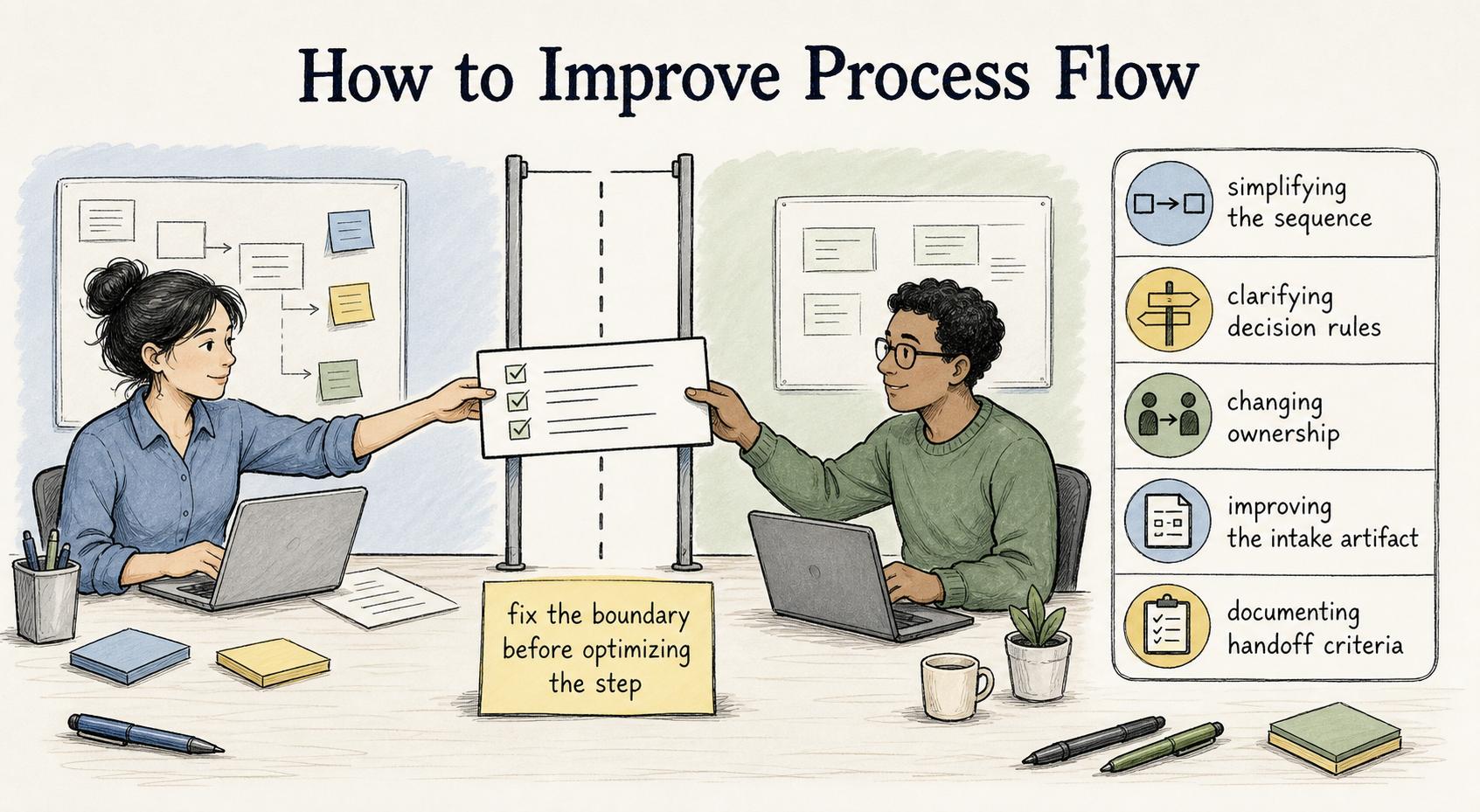
Improving process flow usually means removing friction between steps. That may involve simplifying the sequence, clarifying decision rules, changing ownership, improving the intake artifact, or documenting handoff criteria.
A useful rule: fix the boundary before optimizing the step. If work breaks when it moves from one person or system to another, making an individual task faster won't solve the larger flow problem.
For example, a support escalation process may not need faster triage. It may need a clearer definition of what information engineering needs before accepting the escalation. Once that boundary is explicit, both teams can move faster with less rework.
Documentation takeaway
Process flow documentation should explain how work moves, not just list tasks. It should make sequence, handoffs, decisions, and exception paths visible. 4
A strong documentation set often includes a process flow diagram for orientation and a step-by-step guide or SOP for execution. The diagram helps people understand the route. The guide helps them complete the work correctly.
How Trails helps
Trails helps teams capture workflows as people perform them and turn those workflows into polished step-by-step guides. That is useful when a process flow needs supporting documentation that reflects the real work, not just the idealized version.
Teams can use Trails to document the detailed steps behind the flow and create an AI-narrated video version for onboarding, training, or change rollout.
Sources
- 1
BPMN.org. Business Process Model and Notation. www.bpmn.org/.
- 2
APQC. How Do You Conduct a Process Map?. www.apqc.org/blog/how-do-you-conduct-process-map.
- 3
AHRQ PSNet. The Empty Handoff. psnet.ahrq.gov/web-mm/empty-handoff.
- 4
UC Berkeley. Process Documentation. bpm.berkeley.edu/process-documentation.