
Glossary
Process Discovery
 ChatGPT
 Perplexity
 Gemini
 Claude
What is process discovery?
Process discovery is the work of uncovering how a process actually happens today. It combines conversations, observation, existing documentation, system records, and frontline judgment so a team can see the real workflow before it documents, improves, automates, or redesigns it.
The useful word is actually. Many teams have three versions of a process: the version leaders believe exists, the version written in an old SOP, and the version people use under pressure. Process discovery closes the gap between them.
Why process discovery matters
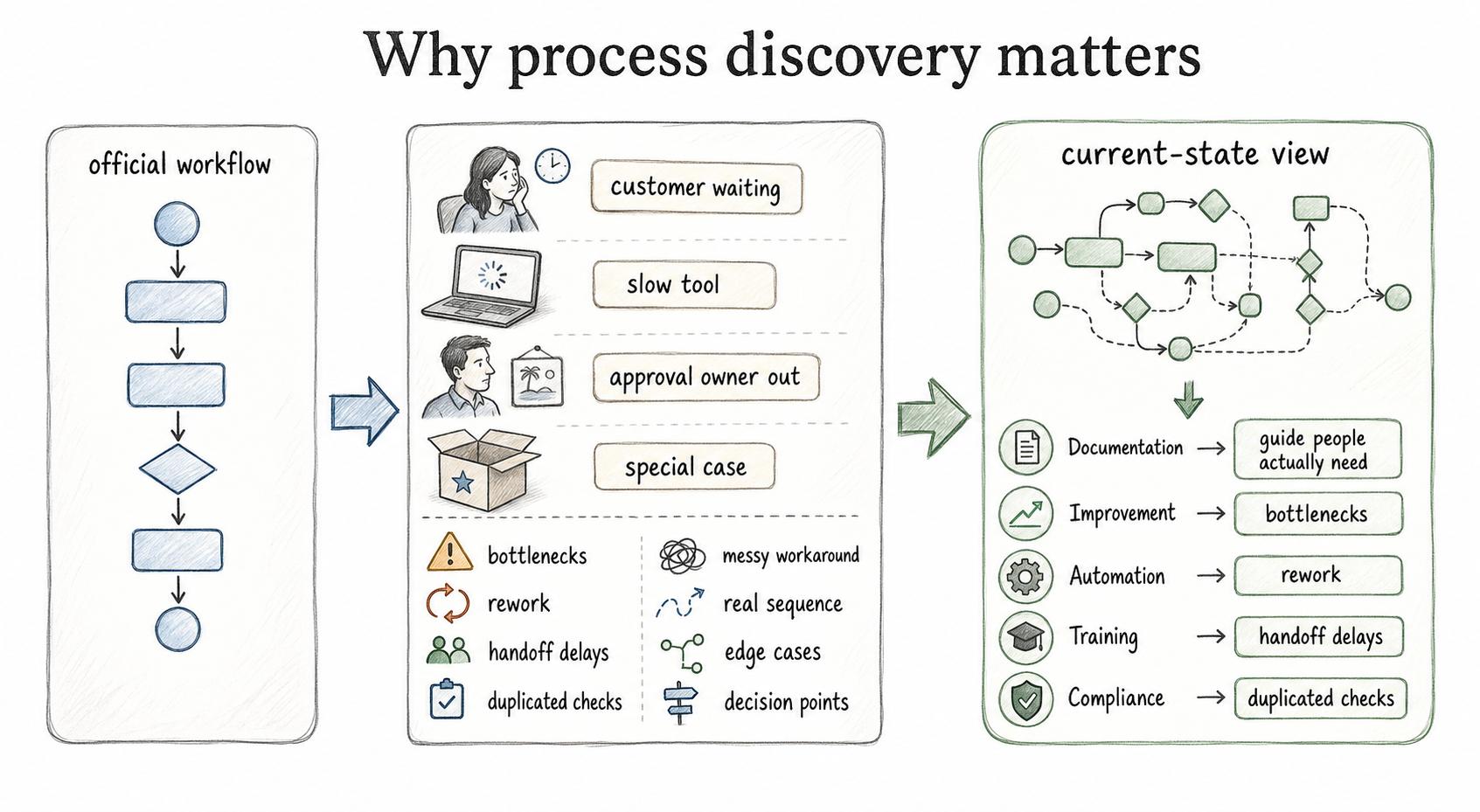
Process discovery matters because most process problems are invisible from the official workflow alone. A manager may know the expected path. A ticketing system may show timestamps. An SOP may list the approved steps. None of those sources, by itself, explains how work moves when a customer is waiting, a tool is slow, an approval owner is out, or a special case breaks the normal route.
Good discovery gives teams a current-state view they can trust. That matters before:
- Documentation: Teams can write the guide people actually need, not a polished version of the process nobody uses.
- Improvement: Bottlenecks, rework, handoff delays, and duplicated checks become easier to see.
- Automation: The team can avoid automating a messy workaround that should have been simplified first.
- Training: New hires learn the real sequence, edge cases, and decision points faster.
- Compliance: Owners can spot where the stated control and the real behavior have drifted apart.
Discovery can feel slower than jumping straight to a new SOP or tool. It usually saves time because it keeps the team from solving the wrong version of the problem.
How process discovery works
A strong discovery pass starts with a narrow process and a clear question. "How does customer onboarding work?" is often too broad. "How does a new customer move from signed contract to first live training session?" gives the team something observable.
From there, discovery compares several kinds of evidence:
| Evidence source | What it reveals | What it can miss |
|---|---|---|
| Existing SOPs and guides | The intended process and official language | Informal workarounds and outdated steps |
| Interviews | Context, judgment, and pain points | Details people forget because they are routine |
| Observation or screen recording | The real sequence of work | Rare exceptions that do not happen during observation |
| Tickets, forms, and system logs | Timing, volume, handoffs, and variants | Why people made certain decisions |
| Workshops | Agreement across teams | Quiet disagreement from people who do not speak up |
The best discovery work does not treat any one source as the truth. It looks for the pattern that appears when those sources are compared.
A practical process discovery workflow
For a support escalation process, discovery might start with the support leader's goal: reduce incomplete bug escalations to engineering. The team would gather the current escalation SOP, review recent tickets, interview support reps and engineers, and watch a few escalations happen in the ticketing system.
The output should be a current-state summary, not a giant transcript. It should name the steps, roles, tools, decision points, exceptions, and pain points that shape the work.
A useful discovery workflow is:
- 1. Define the process boundary and the decision the discovery work should support.
- 2. Identify people who perform, approve, manage, or receive the work.
- 3. Collect existing SOPs, templates, forms, checklists, tickets, and tool records.
- 4. Observe the process or capture someone performing it when possible.
- 5. Compare the intended workflow with what actually happened.
- 6. Validate the findings with the people closest to the work.
- 7. Turn the findings into a process map, updated SOP, improvement backlog, or automation requirements.
The validation step is easy to skip and expensive to miss. Discovery often exposes sensitive issues: missing ownership, hidden rework, inconsistent training, or tools people quietly work around. Letting the team correct the current-state picture builds trust and prevents a flawed process map from becoming the new source of truth.
Common process discovery mistakes
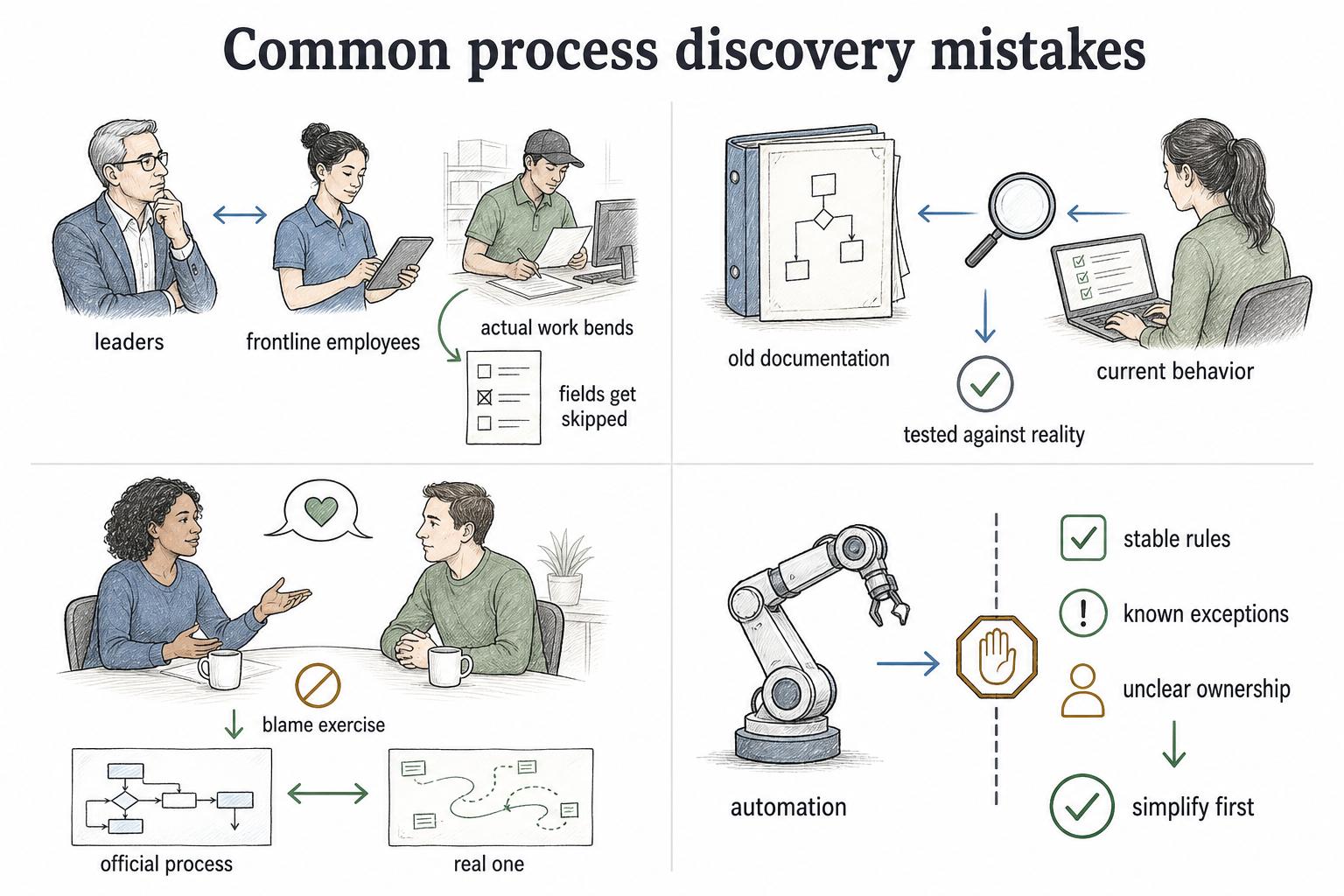
The first mistake is interviewing only leaders. Leaders can explain why the process exists, but they may not know where the actual work bends. Frontline employees usually know which fields get skipped, which approvals are rubber-stamped, and which steps only happen when someone remembers.
The second mistake is treating old documentation as current behavior. Existing documentation shows the intended standard. It should be tested against reality.
The third mistake is turning discovery into a blame exercise. If people think the goal is to catch mistakes, they will describe the official process instead of the real one. Frame discovery around making work easier to repeat, teach, measure, and improve.
The fourth mistake is jumping straight to automation. Automation works best when the process has stable rules and known exceptions. If discovery reveals unclear ownership or inconsistent decisions, simplify those first.
Process discovery output template
Use this AI-ready prompt to turn raw discovery notes into a useful current-state summary:
## Process Discovery Output Template

**Glossary term:** Process Discovery
**Source:** Trails Glossary — trails.so/glossary/process-discovery

---

### 01. Create a current-state process summary

"You are helping document a current-state process for [team].
Process name: [process]
Goal of discovery: [decision or improvement question]
Raw notes: [paste interview notes, observed steps, ticket examples, or tool records]

Create a current-state process summary with:
- Trigger and end point
- Main actors and owners
- Step-by-step workflow as it actually happens
- Decision points and common exceptions
- Tools, forms, documents, and systems used
- Handoffs, waiting points, rework, and bottlenecks
- Gaps between documented process and observed process
- Questions to validate with the team before updating documentation

Keep the summary factual. Separate observed behavior from assumptions."
Documentation takeaway
Process discovery is the raw material for useful process documentation. It gives the team enough evidence to write an SOP that reflects real work, a process map that shows meaningful handoffs, and training material that prepares people for common exceptions.
Strong documentation does not hide variation. It explains the standard path, names the allowed exceptions, and gives people a decision rule for when the process should branch.
How Trails helps
Trails helps teams capture workflows as someone performs them, then turn that workflow into a polished step-by-step guide. That makes process discovery more concrete: instead of relying only on memory or interviews, a team can start from the real sequence of work and refine it into documentation for training, handoffs, and improvement.
Trails can also create an AI-narrated video version of the guide, which helps teams share a discovered process with people who need to learn it quickly.