
Glossary
Process Optimization
 ChatGPT
 Perplexity
 Gemini
 Claude
What is process optimization?
Process optimization is the practice of improving an existing process so it performs better against a specific goal. It usually aims to reduce waste, shorten cycle time, improve quality, lower cost, simplify handoffs, increase consistency, or make work easier to complete correctly.1
Optimization assumes the process is worth keeping in some form. The team is not starting from a blank page; it is studying the current workflow, finding friction, making targeted changes, and measuring whether the process actually got better.
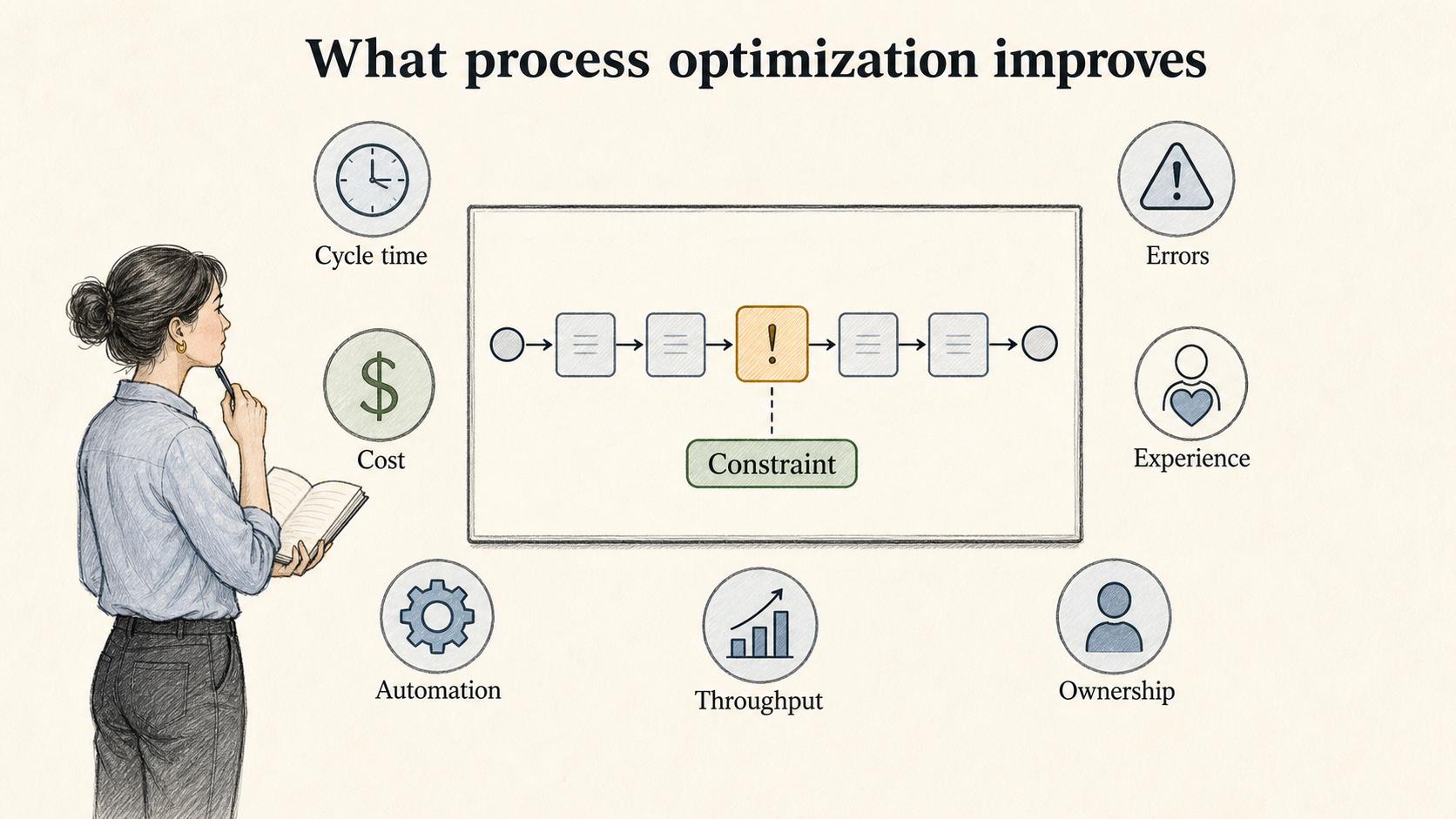
What process optimization improves
A process can be optimized for many things, but not all at once. That tradeoff matters. A workflow optimized only for speed may create more mistakes. A workflow optimized only for control may become too slow for routine work.
Common optimization goals include:
- Shorter cycle time or wait time between handoffs
- Fewer errors, defects, duplicate approvals, or rework loops
- Lower cost per transaction or case
- Better customer or employee experience
- Less manual data entry and better use of automation
- Clearer ownership, escalation, and quality checks
- Higher throughput without reducing quality
The best optimization work starts by naming the constraint.2 For example, "reduce onboarding handoff delays without removing security review" is clearer than "make onboarding better."
Process optimization vs. process improvement
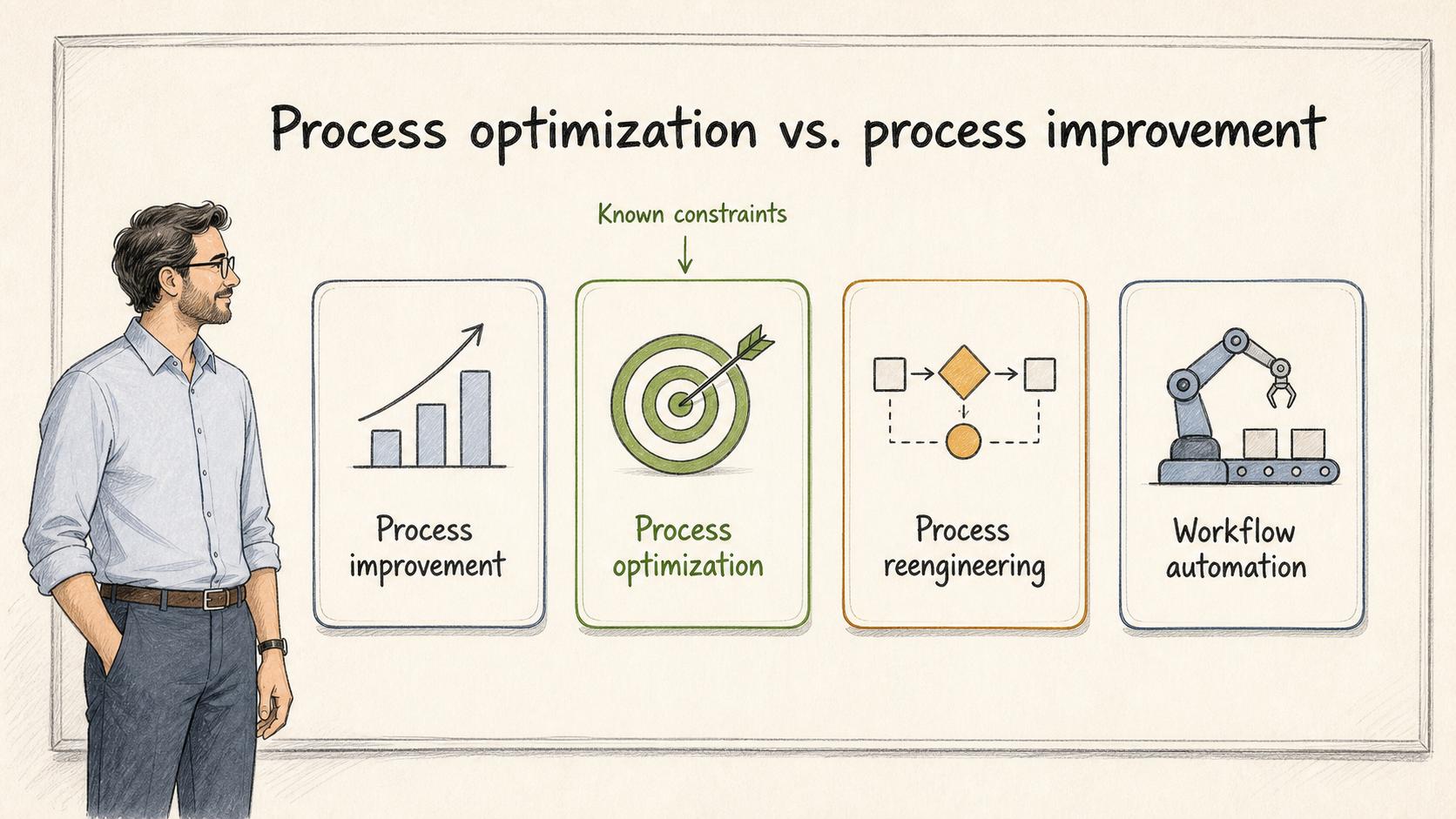
Process optimization, improvement, reengineering, and automation often get used together, but they imply different levels of change.
| Approach | Best fit | Example |
|---|---|---|
| Process improvement | A broad effort to make a process better | Clarify a confusing intake form or remove a redundant review |
| Process optimization | Targeted changes to improve performance within known constraints | Reduce renewal prep time by standardizing data, routing, and reminders |
| Process reengineering | A major redesign when the current process model no longer works | Replace department-by-department onboarding with one cross-functional workflow |
| Workflow automation | Software handles repeatable rules, reminders, routing, or updates | Auto-assign requests based on type, priority, or customer segment |
Optimization may include automation, but software should come after the team understands the process. Otherwise, automation can make the wrong steps happen faster.
How process optimization works
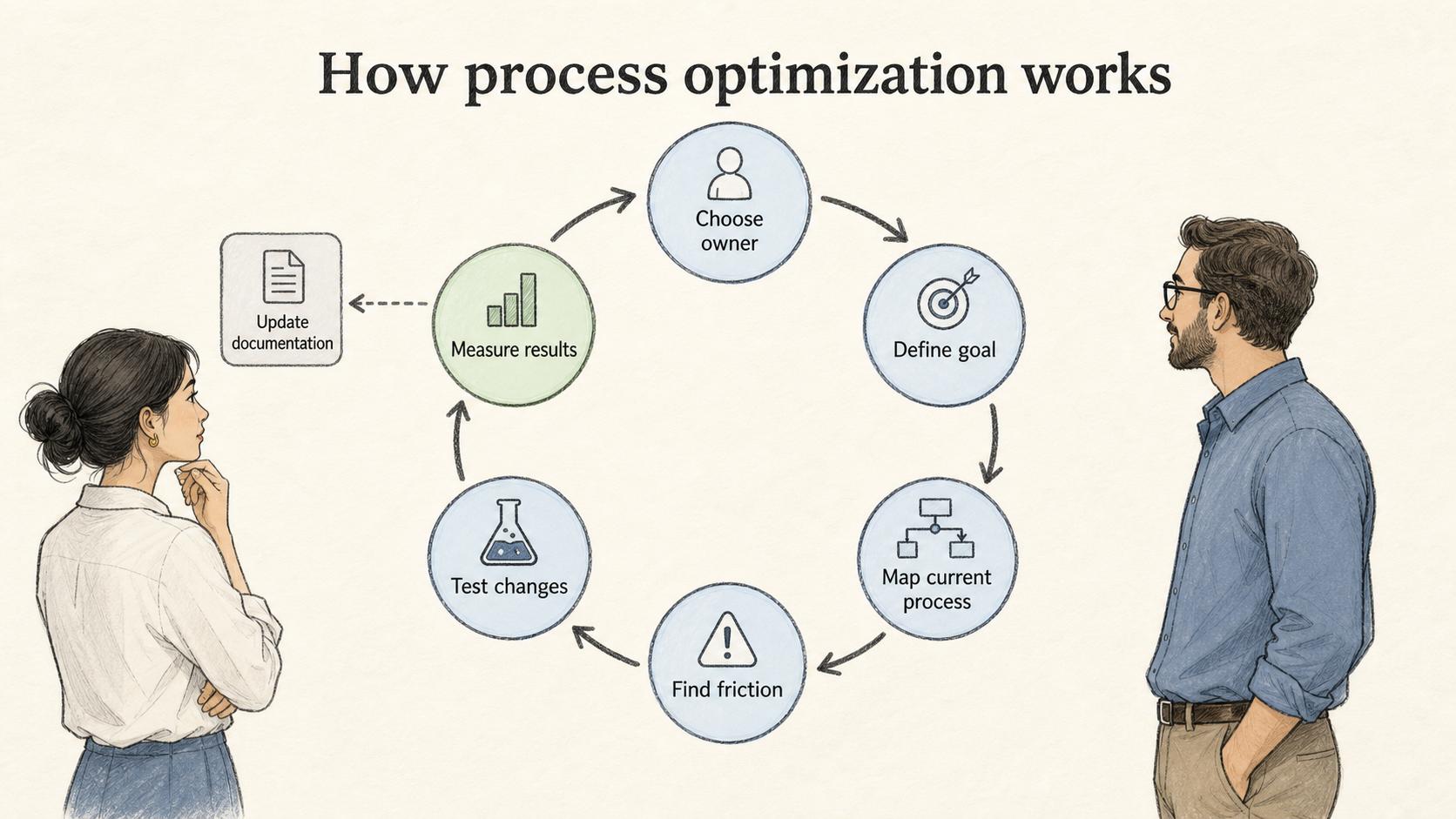
A practical optimization effort follows a loop:
- Choose the process and owner.
- Define the goal and the metric that will prove progress.
- Map the current process as it actually happens.
- Identify bottlenecks, delays, rework, defects, and handoff gaps.
- Talk to the people who perform the work and receive the output.
- Test a small set of changes on real cases.
- Update SOPs, guides, training, and controls.
- Measure before-and-after performance and decide whether to standardize, adjust, or keep iterating.3
The order matters.4 Teams often jump from complaint to fix: "This approval takes too long, so remove it." Sometimes that is right. Sometimes the approval is catching costly errors. Better optimization asks what the approval protects, whether that risk still exists, and whether a lighter control would work.
Process optimization diagnostic
Use this prompt to pressure-test a workflow before changing it.
## Process Optimization Diagnostic

**Glossary term:** Process Optimization
**Source:** Trails Glossary — trails.so/glossary/process-optimization

---

### 01. Analyze a process for optimization opportunities

"Analyze [process] for optimization opportunities.

Context:
- Process owner: [owner]
- Business outcome: [outcome]
- Current pain point: [delay, error, cost, rework, customer issue]
- Main constraint: [speed, quality, compliance, cost, customer experience]
- Current tools: [systems, documents, spreadsheets, approvals]
- Known risks: [risk areas]

Identify:
1. The strongest optimization goal and metric
2. The current bottlenecks, handoff gaps, duplicate work, and rework loops
3. Which steps protect quality, compliance, or customer experience
4. Which steps appear unnecessary, late, duplicated, or poorly owned
5. Three practical changes to test
6. What documentation, training, or controls must be updated if the changes work
7. What could get worse if the team optimizes for the wrong thing

Do not recommend automation until the process problem is clear."
What to document during optimization
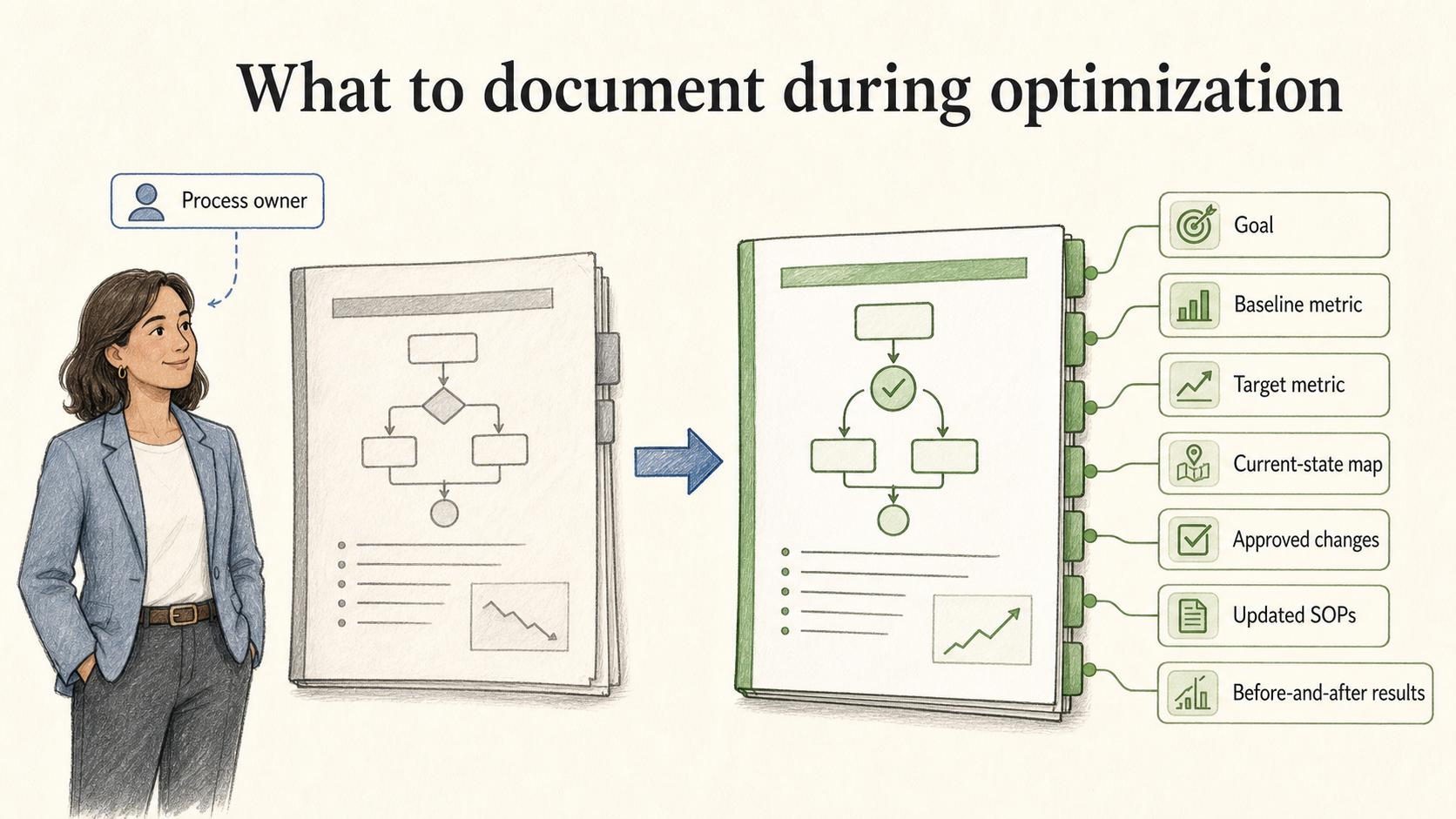
Optimization changes how work happens, so the documentation needs to move with the process. Otherwise, people keep following the old workflow while leadership thinks the new one has launched.
Document:
- The process owner, optimization goal, baseline metric, and target metric
- The current-state map, bottlenecks, waste, rework, and change hypothesis
- Approved process changes, including roles, handoffs, decision rules, and tool changes
- Updated SOPs, work instructions, quality controls, exception paths, and training
- Before-and-after results, review cadence, and next decision
A small documentation update can be the difference between a real optimization and a temporary workaround.
Example of process optimization
A customer success team may want to optimize its renewal process. The current workflow requires account managers to gather usage notes, customer health data, contract dates, renewal risks, and stakeholder updates from several tools.
The team could optimize the process by creating one renewal preparation checklist, pulling data into a shared view, removing duplicate manager review for low-risk renewals, automating reminder tasks, standardizing customer handoff notes, and creating an escalation path for at-risk accounts. The team would then measure renewal preparation cycle time before and after the change.
This is optimization because the renewal process still exists. The team is improving flow, visibility, and consistency rather than replacing the whole operating model.
Common mistakes
One mistake is optimizing locally and hurting the end-to-end process. A team may make its own step faster by sending less information downstream, only to create more rework later.
Another mistake is optimizing for speed without protecting quality. A shorter process is not better if customers, employees, or auditors have to clean up the result.
A third mistake is failing to update documentation. If the SOP, guide, or training still describes the old workflow, the optimized process becomes a rumor instead of a standard.
How Trails helps
Trails helps teams capture the current workflow, document the optimized version, and turn the new process into step-by-step guides or AI-narrated training videos. That gives process owners a practical way to make improvements visible and repeatable.
Optimization works best when the new way of working is easy to find, easy to follow, and easy to maintain. Trails helps with that handoff from process change to daily execution.
FAQ
Is process optimization the same as process improvement?
Process optimization is a type of process improvement, but it is usually more specific. It focuses on improving performance against a defined metric or constraint, such as time, quality, cost, or throughput.
Should a process be optimized before it is automated?
Usually yes. Automation works best when the process is understood, stable, and repeatable. If the process is unclear, automation can make the wrong steps happen faster.
Who owns process optimization?
The process owner should be accountable for the optimization decision. Analysts, managers, operators, and automation teams may help, but the process owner should connect the change to the business outcome and updated documentation.
Sources
- 1
Lean Production. The Essence of Lean: Eliminating Waste. Lean Production. www.leanproduction.com/essence-of-lean/.
- 2
Theory of Constraints Institute. Theory of Constraints. Theory of Constraints Institute. www.tocinstitute.org/theory-of-constraints.html.
- 3
IBM. Business Process Management. IBM. www.ibm.com/think/topics/business-process-management.
- 4
Source. DMAIC methodology overview. PubMed Central. pmc.ncbi.nlm.nih.gov/articles/PMC10229001/.