
Glossary
Business Process Management
 ChatGPT
 Perplexity
 Gemini
 Claude
What is business process management?
Business process management, often shortened to BPM, is the discipline of designing, improving, documenting, and monitoring repeatable work inside an organization. It looks at how work moves across people, systems, decisions, and handoffs, then helps teams make that work more consistent and effective.
BPM starts by clarifying how work should run. A tool can support the work, but the core practice is to understand the process, decide what good performance looks like, improve weak points, and keep the process healthy as the business changes. ISO's process-approach guidance describes processes as an integrated system that uses inputs to deliver intended results, which supports treating BPM as a way of managing work across the organization.1
Why business process management matters
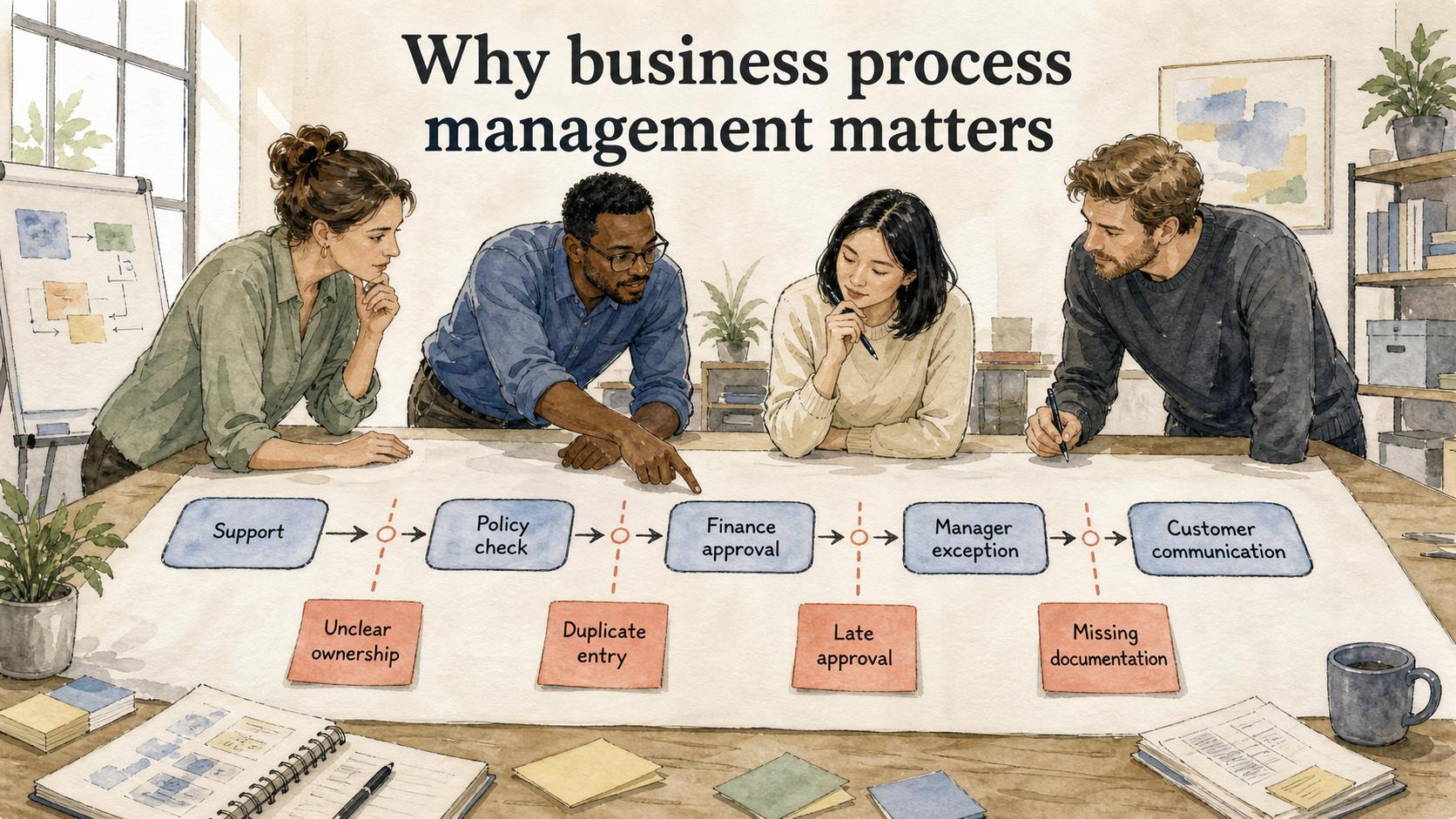
Most operational problems don't come from one bad step. They come from the space between steps: unclear ownership, duplicated data entry, undocumented exceptions, late approvals, or teams optimizing their own task while the customer experience suffers.
Business process management gives leaders a way to see those problems as system issues. A support refund process, for example, might involve a customer service rep, finance approval, policy checks, manager exceptions, and customer communication. If BPM only looks at the support team's task list, it misses the process. If it maps the whole flow, the team can see where work stalls, where quality drops, and where documentation is missing.
The practical value of BPM is structure without needless rigidity. Important work gets enough visibility that teams can improve it intentionally.
How business process management works
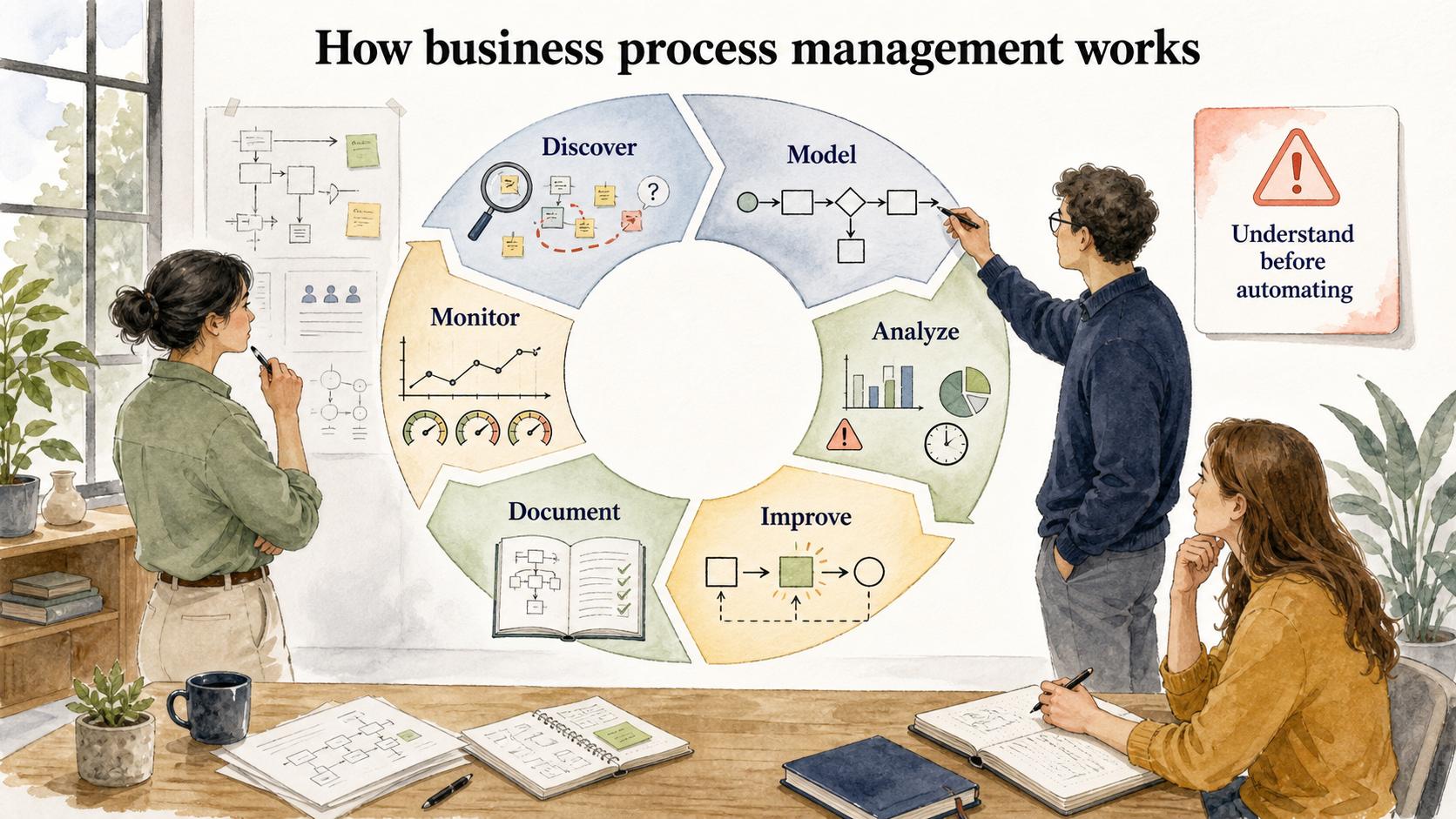
A BPM effort usually moves through a cycle: discover, model, analyze, improve, document, and monitor. SAP Signavio describes the BPM lifecycle as a structured, repeatable approach through discovery, analysis, design, implementation, and optimization, which closely matches the practical sequence used here.2
First, the team discovers how work happens today, including the workarounds that never made it into the official policy. Next, it models the process so people can see handoffs and decisions. OMG's BPMN specification is designed to provide a standard notation that business stakeholders can understand while still representing process semantics precisely.3
Analysis comes before improvement. The team looks for delays, errors, rework, missing data, unclear ownership, and unnecessary steps. Then it redesigns steps, removes friction, clarifies decision rules, or introduces automation. Documentation turns the improved process into something repeatable. Monitoring keeps it from drifting back into old habits.
The common failure mode is starting with automation. Automating a confused process usually makes confusion happen faster. BPM should make the process understandable before it makes the process faster.
BPM vs. related process terms
| Term | Main focus | Useful when |
|---|---|---|
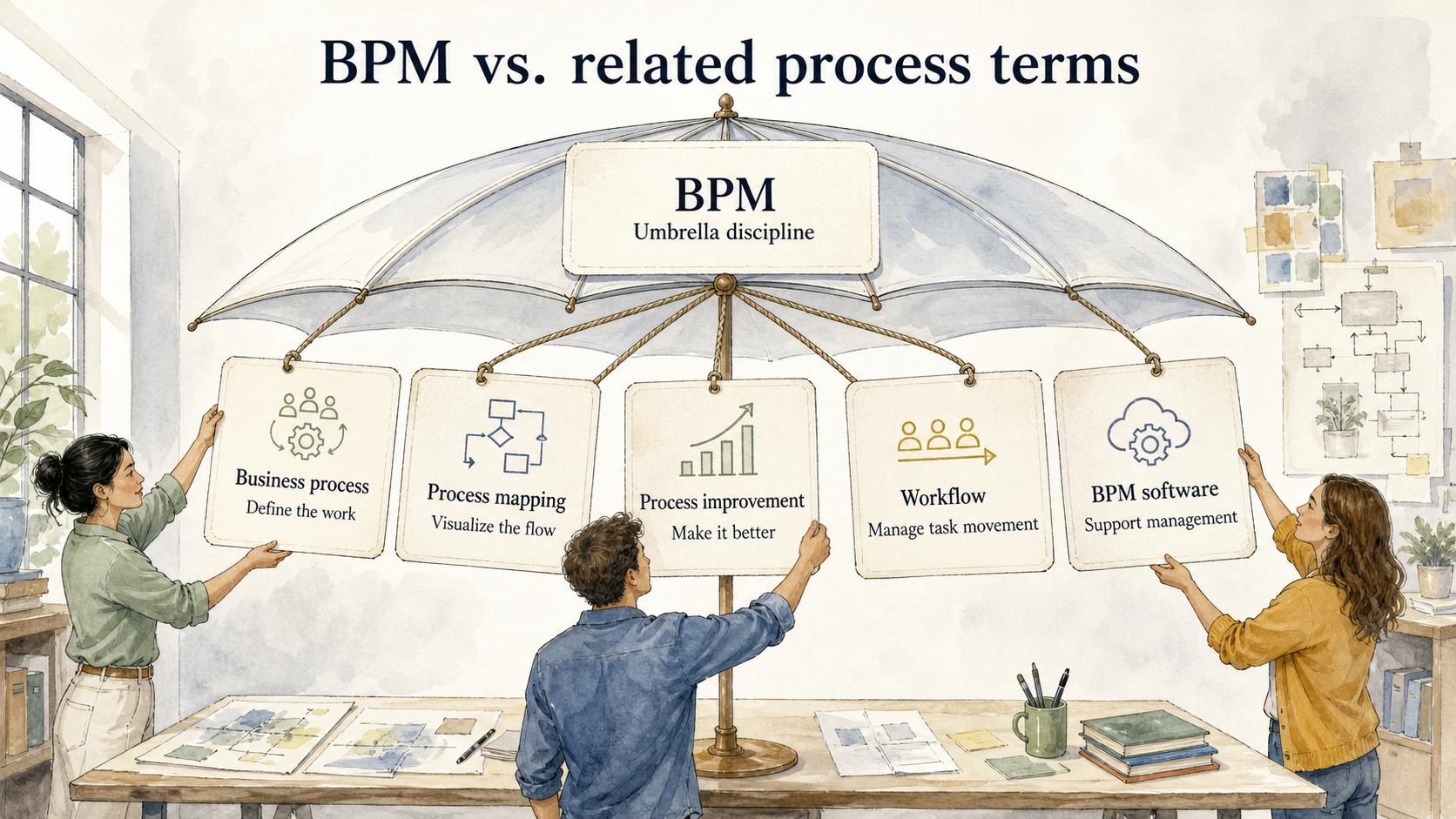
| Business process | A repeatable set of work that creates an outcome | You need to define what work is being managed |
| Process mapping | Visualizing the steps, decisions, and handoffs | You need shared understanding of the current flow |
| Process improvement | Making a process better | You already know what needs to change or measure |
| Workflow | The movement of tasks through people and systems | You need to manage execution at the task level |
| BPM software | Tools that model, automate, or monitor processes | You need system support for repeatable process management |
The terms overlap. BPM is the umbrella discipline. Process mapping, improvement, workflow design, documentation, and software are methods or tools inside that discipline.
What good BPM pays attention to
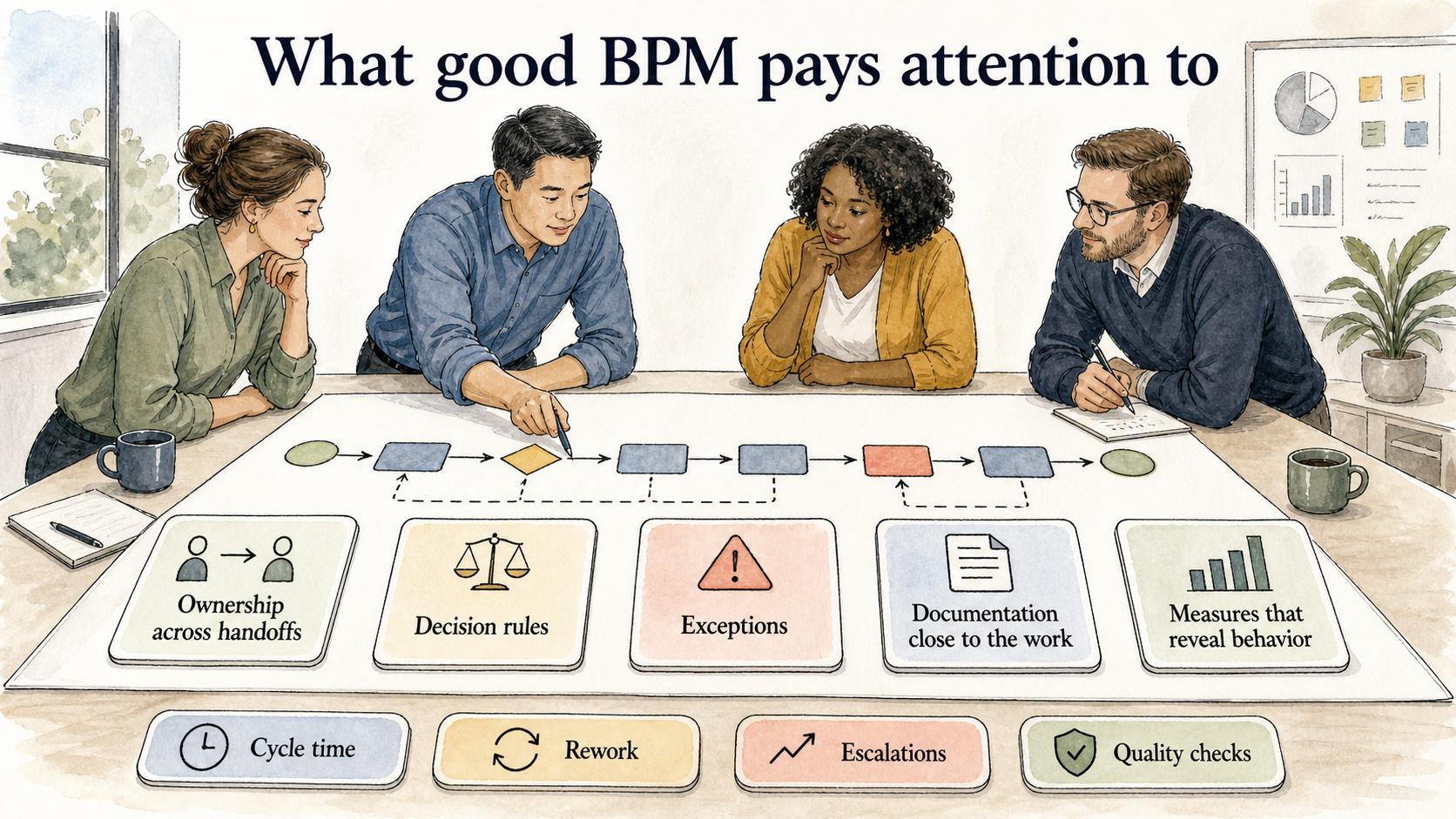
Ownership across handoffs. Many processes have owners for individual tasks but no owner for the end-to-end outcome. APQC describes process frameworks as hierarchical views of key organizational processes that help teams define and benchmark business processes, which is useful when ownership spans functions.4 BPM should name who is accountable for the whole process and who owns each critical handoff.
Decision rules behind review steps. A process map that says "manager reviews request" is incomplete if it doesn't explain what the manager is deciding. Decision rules are where consistency often breaks.
Exceptions. Real processes need flexibility. The useful move is to decide which exceptions are legitimate, how they should be recorded, and when they signal that the process itself needs redesign.
Documentation close to the work. BPM loses value when the model lives in a diagram employees never use. The improved process needs practical SOPs, job aids, checklists, or walkthroughs that help people perform the work correctly.
Measures that reveal behavior. A process metric should show whether the process is working, including what happens after a task is completed. Cycle time, rework, escalation volume, quality checks, and exception patterns reveal different kinds of process health.
Business process management example
Imagine a company wants to improve customer onboarding. A BPM approach would map the full process from signed contract to first successful customer outcome instead of telling the onboarding team to work faster. That map might reveal that sales promises aren't captured in a consistent handoff, customer data is entered twice, kickoff materials vary by manager, and customers wait too long for training resources.
The improved process might include a standard handoff form, clearer onboarding stages, a documented kickoff procedure, templates for recurring communications, and a dashboard for stalled accounts. The useful output is a more reliable way for teams to deliver the outcome.
How Trails helps
Business process management depends on turning improved workflows into documentation people can actually follow. Trails captures a workflow as someone performs it, turns that workflow into a polished step-by-step guide, and can create an AI-narrated video version for training or sharing. That helps BPM work survive the gap between process design and daily execution.
FAQ
What is business process management in simple terms?
Business process management is the practice of understanding, improving, documenting, and monitoring the repeatable work that helps an organization produce an outcome.
Is BPM only for large enterprises?
No. Smaller teams also have repeatable processes. They may not need heavy BPM programs, but they still benefit from clear ownership, better handoffs, practical documentation, and process measures.
What is the difference between BPM and workflow automation?
Workflow automation uses software to move tasks or data through a defined path. BPM is broader: it decides what the process should be, how it should be improved, and whether automation is the right answer.
When should a team start using BPM?
BPM is useful when a process is important, repeated often, crosses teams, creates errors or delays, or is hard to improve because no one can see the full flow.
Sources
- 1
ISO. The process approach in ISO 9001:2015. www.iso.org/iso/iso9001_2015_process_approach.pdf.
- 2
SAP Signavio. Business Process Management Lifecycle. www.signavio.com/wiki/bpm/business-process-management-lifecycle/.
- 3
Object Management Group. BPMN 2.0. www.omg.org/spec/BPMN/2.0/.
- 4
APQC. Process Frameworks. www.apqc.org/process-frameworks.