
Glossary
Operations Manual
 ChatGPT
 Perplexity
 Gemini
 Claude
What is an operations manual?
An operations manual is the central reference for how a business, department, location, or function runs. It connects roles, workflows, policies, tools, standards, schedules, and escalation paths so people can perform recurring work consistently. ISO guidance on documented information for ISO 9001 emphasizes the same process view: teams should identify the processes they need, how those processes interact, who is responsible, what criteria apply, which resources are required, and where improvement is needed.1
A useful operations manual does not hold every detail. It works as the map above the SOPs: what exists, who owns it, how work fits together, and where the deeper checklists, policies, and guides live.
What an operations manual includes
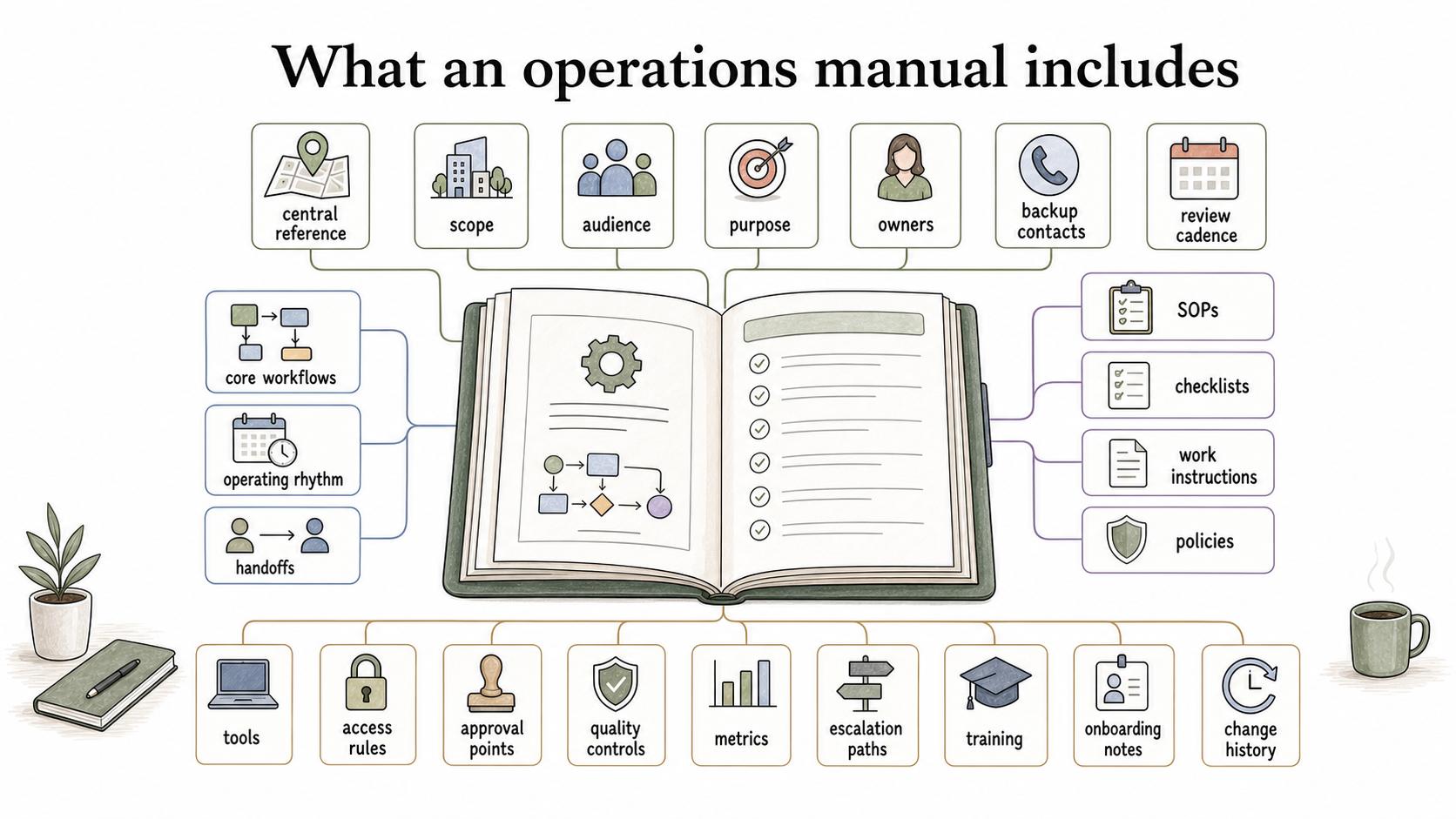
An operations manual covers the system around the work, not just the steps inside one task. For a support team, that might mean coverage hours, queue ownership, escalation rules, service-level definitions, tooling, reporting cadence, and links to SOPs for refunds, bug reports, account changes, and customer handoffs.
The most useful sections are the ones people reach for while running the operation:
- Scope, audience, and purpose of the manual
- Named owners, backup contacts, and review cadence
- Core workflows, operating rhythm, and handoffs
- Links to SOPs, checklists, work instructions, and policies
- Tool responsibilities, access rules, and approval points
- Quality controls, metrics, and escalation paths
- Training resources, onboarding notes, and change history
The manual should answer practical operating questions: who owns this, where is the current process, what standard applies, what happens when the normal path breaks, and how do we know whether the work is healthy? NIST contingency-planning guidance uses the same logic for high-risk work: formal operating documents should address purpose, scope, roles, responsibilities, coordination, and procedures.2
Operations manual vs SOP vs policy manual
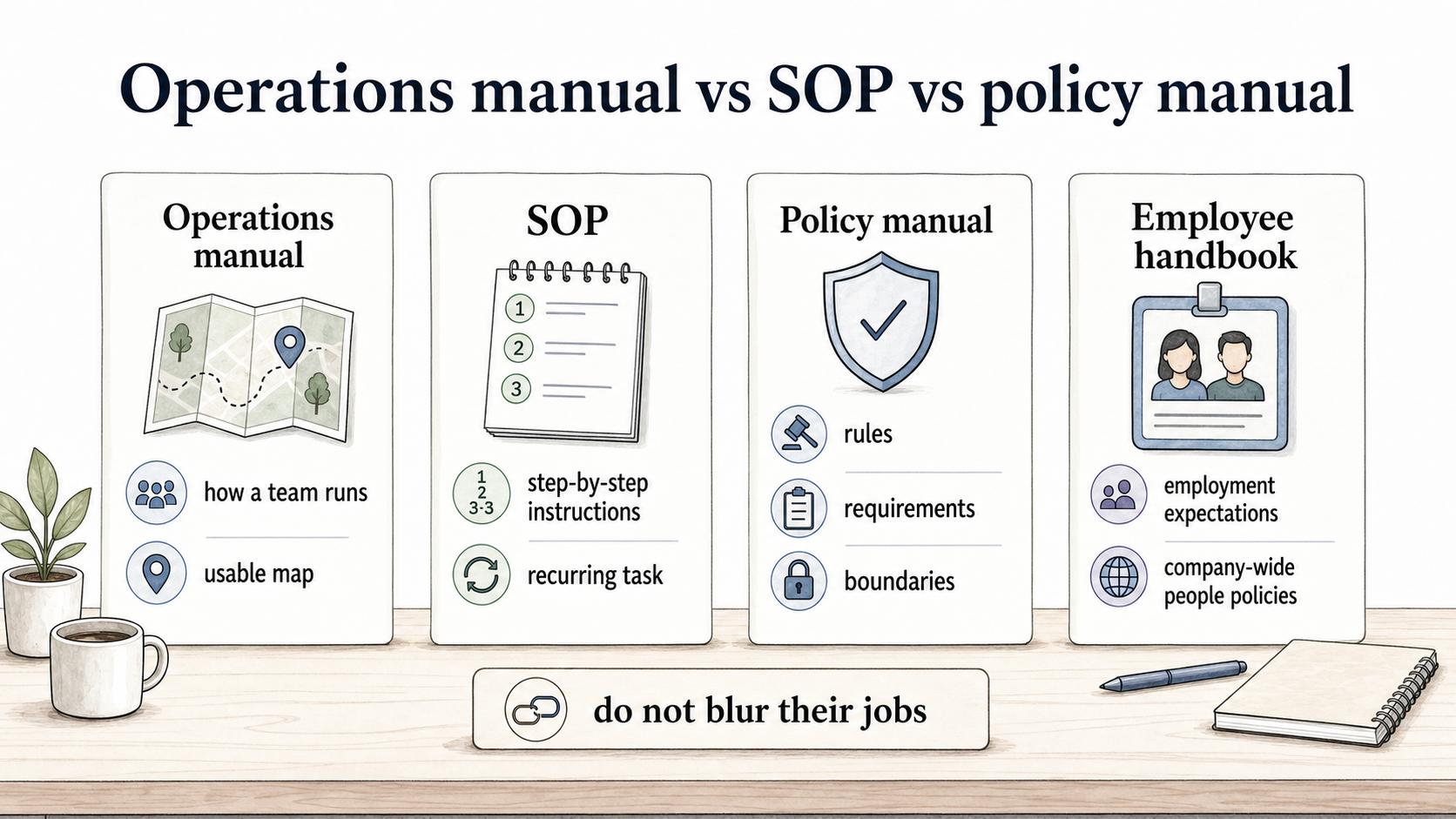
These documents overlap, but they are not interchangeable.
| Document type | Main job | Common failure mode |
|---|---|---|
| Operations manual | Explains how a team, function, or location runs | Becomes a dumping ground instead of a usable map |
| SOP | Gives step-by-step instructions for a recurring task | Gets separated from the workflow where people need it |
| Policy manual | States rules, requirements, and boundaries | Describes what must happen without showing how work gets done |
| Employee handbook | Explains employment expectations and company-wide people policies | Gets mistaken for role-specific operating guidance |
A strong operations manual can link to all of these, but it should not blur their jobs. If readers cannot tell whether they are looking at a rule, a task instruction, or background context, the manual will be harder to trust.
When an operations manual is worth creating
Create an operations manual when repeatable work has become too important to live in memory. That usually happens when the team is growing, splitting across locations, hiring new roles, changing tools, or relying on a few experienced people to answer the same operational questions every week.
The signal is operational drag, not document volume. If onboarding stalls because nobody knows where the current process lives, managers keep clarifying basic handoffs, or two teams run the same workflow differently without meaning to, the operation needs a clearer home.
The manual is also useful during change. A new tool, manager, location, or service model can quietly change how work happens. The operations manual gives the team one place to update the operating picture instead of letting the change scatter across chat messages, meetings, and individual memory.
How to build an operations manual that people use
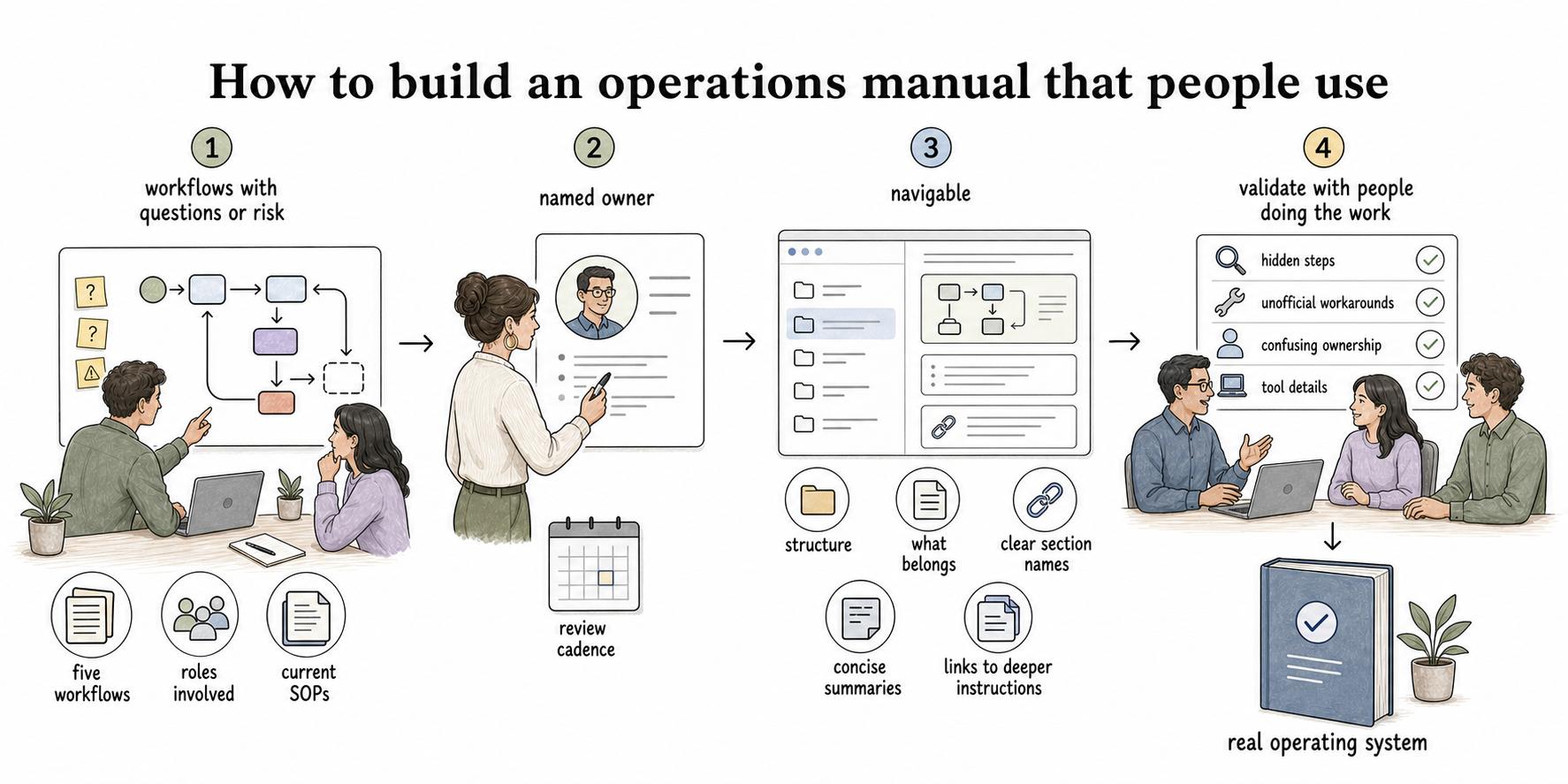
Start with the workflows that create the most questions or risk. A useful first version might cover the five workflows people ask about most often, the roles involved, and links to the current SOPs.
Give the manual a named owner. The owner does not need to write every section, but they should manage the review cadence, structure, and decisions about what belongs in the manual versus a linked SOP or policy. Without ownership, the manual becomes a record of how the operation used to run.
Keep the manual navigable. Long prose is rarely the main problem; unlabeled reference material is. Use clear section names, concise summaries, and links to deeper instructions so a reader can tell within a few seconds whether they are looking at an overview, a rule, a step-by-step process, or a pointer to another source.
Validate the manual with the people doing the work. They will catch hidden steps, unofficial workarounds, confusing ownership, and tool details leaders may miss. The manual should describe the real operating system, then make it easier to improve.
Operations manual template
Use this AI-ready prompt to create a practical first draft:
## Operations manual template

**Glossary term:** Operations Manual
**Source:** Trails Glossary — trails.so/glossary/operations-manual

---

### 01. Create an operations manual outline

"Create an operations manual outline for [team, function, or location]. Include purpose, scope, audience, owners, core workflows, role responsibilities, operating cadence, tools and systems, policies and standards, escalation paths, metrics, training resources, linked SOPs, exception handling, and review cadence. For each section, note what information must be owned by a named person and what should be linked out to a separate SOP or policy."
That last instruction prevents two common failures: a manual that buries every procedure inline, and a manual that only links out without explaining how the operation works.
Common mistakes
The first mistake is building the manual for leaders instead of users. Executive-friendly categories may look tidy, but employees need to find answers in the order work actually happens.
The second mistake is mixing permanent structure with temporary notes. A rollout reminder may belong in a launch plan; the enduring workflow change belongs in the operations manual or a linked SOP.
The third mistake is failing to retire stale content. Old links and outdated tool instructions are worse than missing documentation because they teach people not to trust the source of truth. ISO document-control guidance reinforces that documented information has to stay available and suitable for use while being protected from unintended changes or obsolete use.3
Documentation takeaway
An operations manual gives recurring work a navigable home. It should connect process documentation, SOPs, policies, roles, tools, metrics, and training without flattening them into one giant document.
The practical standard is simple: when someone needs to run the operation without interrupting a manager, the manual should help them find the current answer.
How Trails helps
Trails helps teams create the step-by-step guides that make an operations manual useful. Teams can capture a workflow as someone performs it, turn it into a polished guide, create an AI-narrated video version, and link that guide from the relevant section of the manual.
Compare SOP software for the task-level procedures inside the manual, and explore Trails knowledge bases for organizing the resulting workflow guides.
Sources
- 1
ISO. Guidance on the Requirements for Documented Information of ISO 9001:2015. www.iso.org/iso/documented_information.pdf.
- 2
National Institute of Standards and Technology. NIST Special Publication 800-34 Revision 1. NIST. nvlpubs.nist.gov/nistpubs/legacy/sp/nistspecialpublication800-34r1.pdf.
- 3
Smithers. ISO 9001 Document Control Requirements. www.smithers.com/resources/2023/july/iso-9001-document-control-requirements.