
Glossary
Procedure Manual
 ChatGPT
 Perplexity
 Gemini
 Claude
What is a procedure manual?
A procedure manual is a structured collection of instructions for repeatable work. It explains how people should complete tasks, use systems, follow rules, handle exceptions, and document the right evidence.
A useful procedure manual works as an operating reference. It gives employees a dependable path through work that would otherwise live in memory, chat threads, old screenshots, or one experienced person's head.
What a procedure manual is for
A procedure manual turns repeated work into a shared way of working. It matters most when a team needs consistency across people, shifts, locations, departments, or customer situations.
For example, a customer support procedure manual might cover ticket triage, refund requests, escalation rules, account updates, bug reporting, and case closure. Each procedure should give the reader enough instruction to complete the task correctly without hunting for tribal knowledge.
The hidden value is confidence. When the manual is current and easy to search, people stop improvising the basics and spend more attention on exceptions, customer judgment, and improvement.
What belongs in a procedure manual
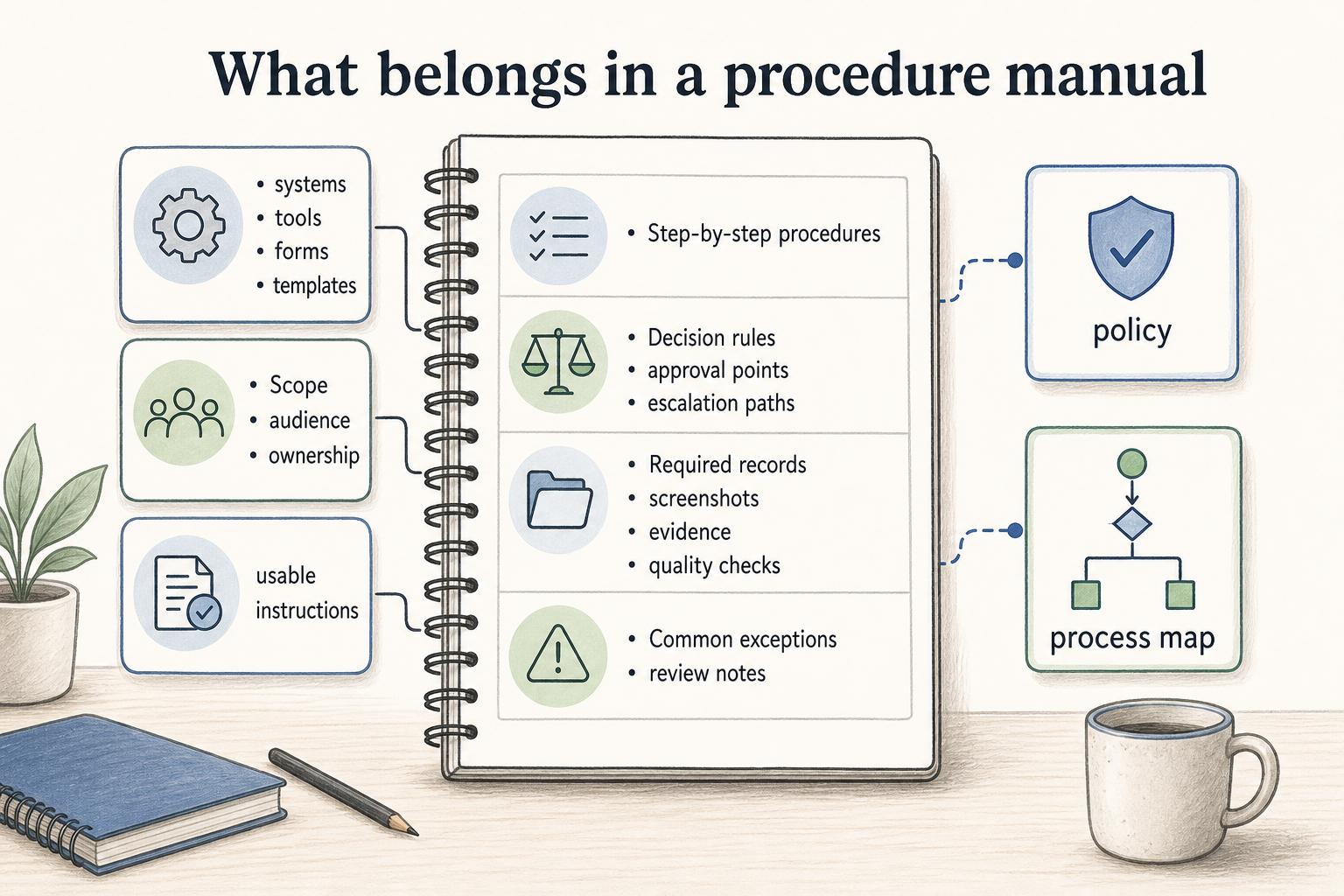
A procedure manual should include what someone needs to execute the work and trust the documentation. Most manuals need:
- Scope, audience, and ownership
- The systems, tools, forms, and templates used in the work
- Step-by-step procedures for recurring tasks
- Decision rules, approval points, and escalation paths
- Required records, screenshots, evidence, or quality checks
- Common exceptions and review notes
The boundaries matter as much as the contents. If a policy defines what is allowed, link to it. If a process map explains the larger workflow, link to that too. Keep the manual focused on usable instructions.
How to organize a procedure manual
Organize the manual around how people look for help. A department-based structure may work for managers, but frontline employees often search by task, trigger, system, or customer situation.
A practical structure might look like this:
## Procedure Manual Template

**Glossary term:** Procedure Manual
**Source:** Trails Glossary — trails.so/glossary/procedure-manual

---

### 01. Organize a procedure manual

"Procedure manual: [team or process area]
Owner: [person or team]
Audience: [roles who use it]
Scope: [included work and excluded work]
Review cadence: [monthly, quarterly, or after major changes]

1. Start here
- What this manual covers
- Key systems and access requirements
- Where to ask for help

2. Core workflows
- [Workflow or process area]
  - Procedure: [task name]
  - Procedure: [task name]

3. Exception handling
- When to pause the standard procedure
- Approval or escalation rules
- How to document exceptions

4. Quality checks
- Required evidence
- Common errors
- Review or audit steps

5. Change history
- Date
- Change
- Owner"
That structure is intentionally plain. The manual that works is the one people can navigate under pressure.
What makes a procedure manual usable
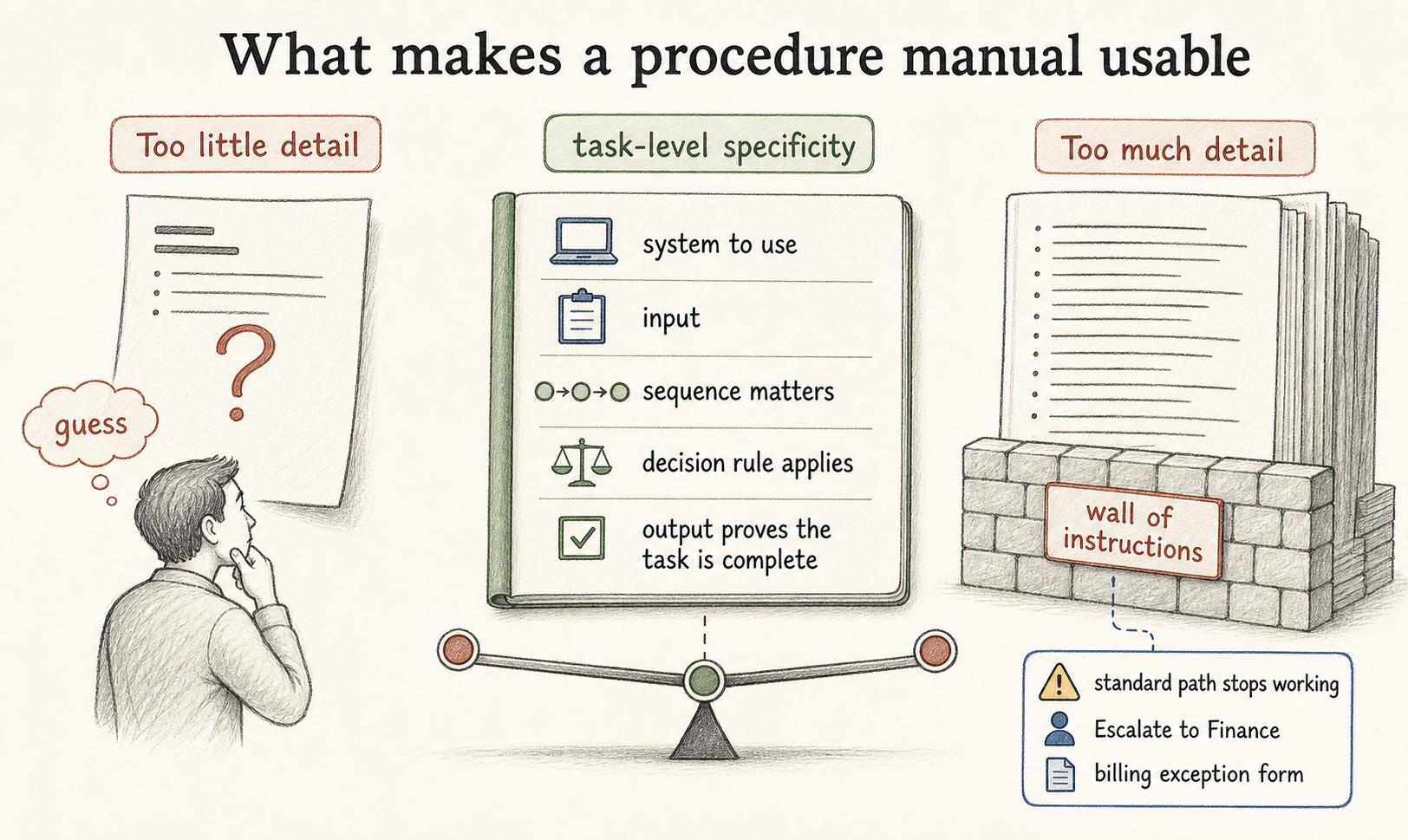
Usability depends on the level of detail. Too little detail forces people to guess. Too much detail turns the manual into a wall of instructions nobody wants to open.
The useful middle is task-level specificity. Tell the reader what system to use, what input they need, what sequence matters, what decision rule applies, and what output proves the task is complete. Skip background context unless it changes how the person should act.
A strong procedure also names the moment when the standard path stops working. For example: “If the customer's account has an unresolved billing dispute, don't issue the refund directly. Escalate to Finance using the billing exception form.” That sentence is more useful than another reminder to “follow company policy.”
Common mistakes
The first mistake is treating the manual as a dumping ground. A folder full of PDFs, outdated screenshots, and duplicated instructions is a search problem, not a manual.
The second mistake is writing only for auditors. Auditability matters in some environments, but the manual still has to help a real person complete real work. Evidence requirements should be clear because they support execution.
The third mistake is leaving ownership vague. Procedures decay whenever tools, teams, rules, or customer expectations change. If nobody owns the manual, employees eventually learn to distrust it.
How Trails helps
Trails helps teams create the individual step-by-step guides that belong inside a procedure manual. A person can perform the workflow once, capture it, and turn it into a polished guide with screenshots and clear instructions. Trails can also create an AI-narrated video version for training or sharing.
That makes the manual easier to build and maintain because procedures come from the actual work, not from memory after the fact.
FAQ
Is a procedure manual the same as an SOP manual?
They are closely related. Many teams use procedure manual and SOP manual to mean a collection of standard operating procedures, though a procedure manual may also include supporting instructions, templates, and review notes.
Who should own a procedure manual?
The owner should be close enough to the work to know when procedures change. In practice, that is often an operations lead, department manager, enablement owner, compliance owner, or process owner.
How often should a procedure manual be reviewed?
Review it after major process, tool, policy, or staffing changes. For stable work, a quarterly or semiannual review is often enough, but high-risk procedures may need a tighter cadence.