
Glossary
Knowledge Base
 ChatGPT
 Perplexity
 Gemini
 Claude
What is a knowledge base?
A knowledge base is a centralized collection of information that helps people find answers, follow processes, solve problems, and make consistent decisions. It can serve employees, customers, partners, or any audience that needs reliable self-service guidance. 1
A useful knowledge base is more than a folder of documents. It has structure, ownership, searchability, and maintenance habits. Its job is to make trusted knowledge easier to find than asking the same person again.
What a knowledge base includes
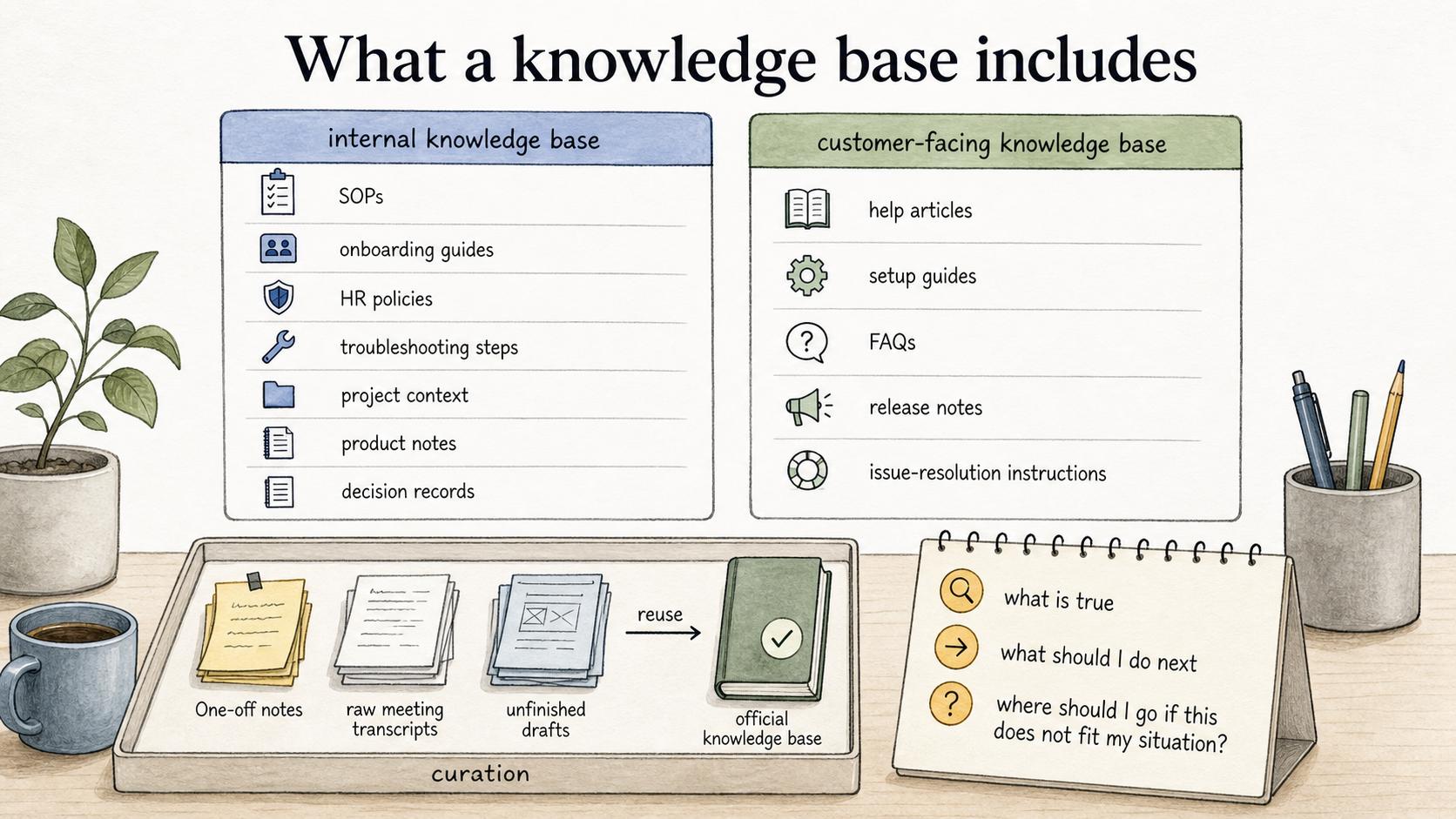
An internal knowledge base might include SOPs, onboarding guides, HR policies, troubleshooting steps, project context, product notes, and decision records. A customer-facing knowledge base might include help articles, setup guides, FAQs, release notes, and issue-resolution instructions.
A strong knowledge base answers three questions: what is true, what should I do next, and where should I go if this does not fit my situation?
Why knowledge bases matter
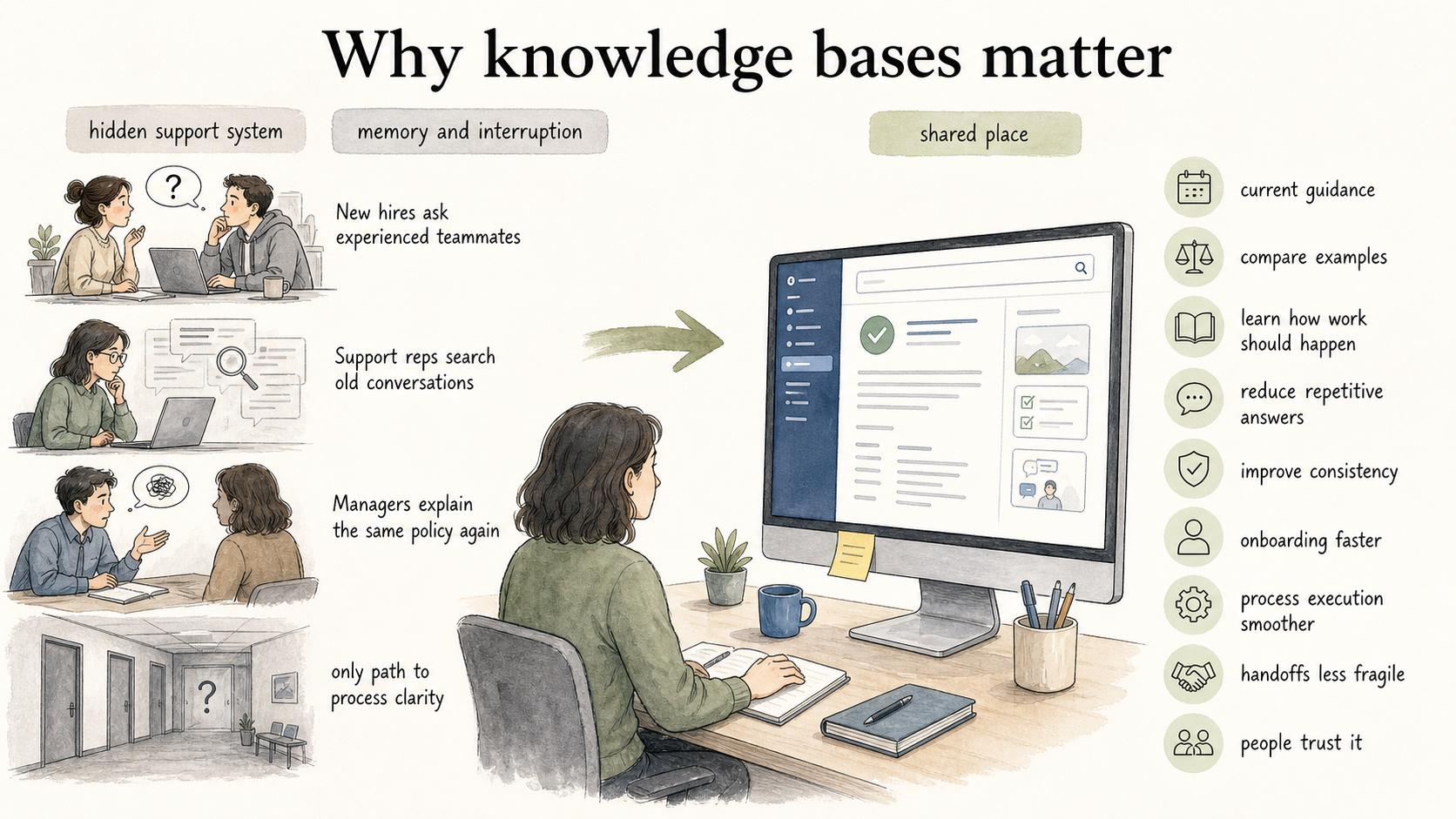
Without a knowledge base, teams build a hidden support system around memory and interruption: new hires ask experienced teammates, support reps search old conversations, and managers explain the same policy again. 2
A knowledge base gives people a shared place to find current guidance, compare examples, and learn how work should happen. The value is not that information exists. The value is that people trust it enough to use it before interrupting someone else.
Knowledge base vs. wiki vs. help center
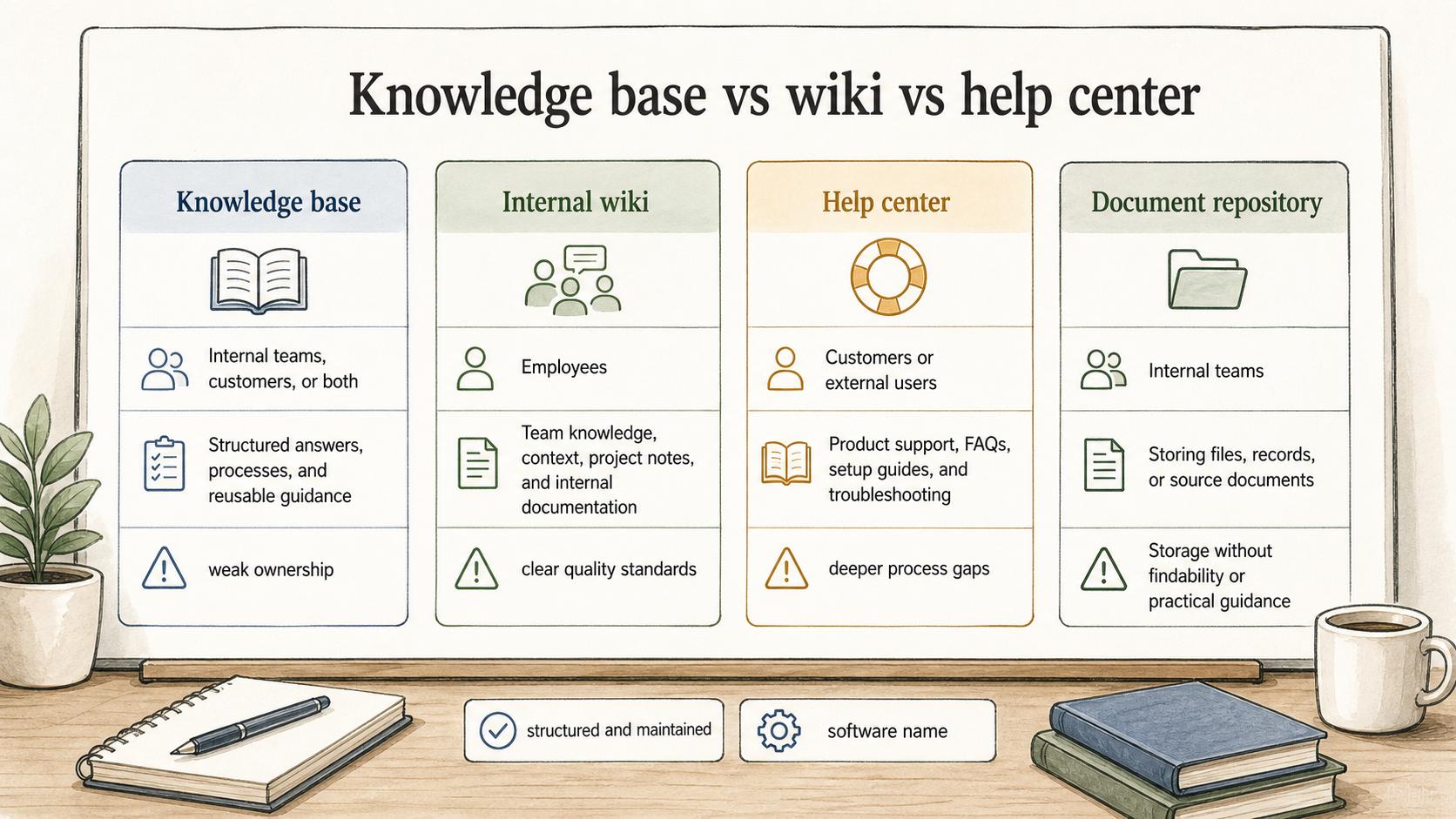
| Term | Typical audience | Best for | Watch out for |
|---|---|---|---|
| Knowledge base | Internal teams, customers, or both | Structured answers, processes, and reusable guidance | Weak ownership |
| Internal wiki | Employees | Team knowledge and internal documentation | Unclear quality standards |
| Help center | Customers or external users | Product support, FAQs, setup, troubleshooting | Hiding deeper process gaps |
| Document repository | Internal teams | Storing files and records | Storage without findability |
These formats overlap. A wiki can function as a knowledge base, and a help center can be a customer-facing knowledge base. The difference is less about the software name and more about how intentionally the information is structured and maintained.
How to structure a knowledge base
Start with the reader's task, not the organization chart. Structure should follow the questions and workflows people actually use. Use stable categories such as onboarding, support workflows, product setup, policies, billing, customer handoffs, troubleshooting, or team operations.
Search helps, but it should not be the only navigation strategy. Cross-link related processes, add synonyms where needed, and give important pages descriptive titles. Every high-value section should have someone responsible for accuracy, review, and retirement. ISO frames effective knowledge management as something organizations establish, maintain, review, and improve over time. 3
What makes a knowledge base useful
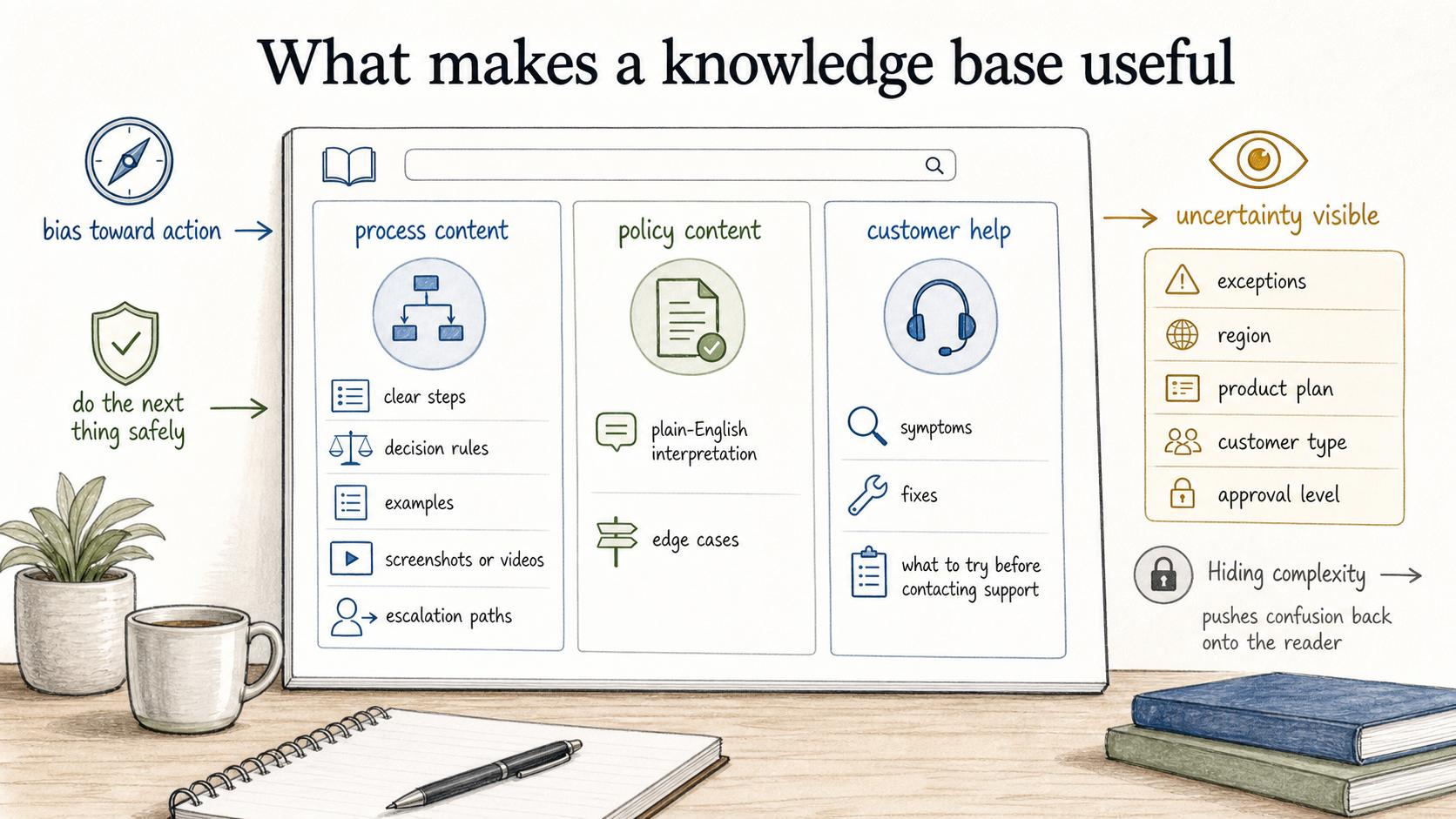
A useful knowledge base has a bias toward action. For process content, that means clear steps, decision rules, examples, screenshots or videos when useful, and escalation paths. For policy content, it means plain-English interpretation and edge cases.
Make uncertainty visible. If an answer depends on region, product plan, customer type, or approval level, say so. Hiding complexity makes a page feel cleaner, but pushes confusion back onto the reader.
Common knowledge base mistakes
Do not treat the knowledge base as a warehouse. Uncurated information makes useful answers harder to find. Do not launch once and stop: processes evolve, owners leave, and customer questions shift.
Maintenance needs to be part of the operating rhythm; support knowledge systems often pair ownership, approvals, review cycles, and version history to keep guidance current and consistent. 4
Measure trust rather than volume. Better signals include reduced repeated questions, faster onboarding, fewer avoidable mistakes, and more links to official guidance in everyday work.
Sources
- 1
Atlassian. Best practices for self-service knowledge bases. www.atlassian.com/itsm/knowledge-management/self-service-success.
- 2
APQC. Understanding Content Management. www.apqc.org/resource-library/resource/understanding-content-management-0.
- 3
ISO. ISO 30401:2018 Knowledge management systems. www.iso.org/standard/68683.html.
- 4
NiCE. Knowledge Management for Customer Service Teams. www.nice.com/products/knowledge-management.