
Glossary
Operational Process
 ChatGPT
 Perplexity
 Gemini
 Claude
What is an operational process?
An operational process is repeatable work that keeps a business, team, or function running. It turns inputs into outputs through defined steps, roles, decisions, tools, handoffs, and standards. ISO 9001 describes quality management around consistent products and services, efficiency, and customer expectations, which is the practical reason operational processes need clear definition.1
Operational processes are the routines behind daily execution: onboarding a customer, approving an invoice, closing a support ticket, shipping an order, granting software access, scheduling staff, or publishing a recurring report. The work does not have to be simple. It only has to happen often enough that improvising creates risk.
What makes a process operational
A process becomes operational when it supports recurring work rather than a one-time effort. It usually has a trigger, a desired outcome, a known path, an owner, and some way to tell whether the work is healthy.
For example, a customer refund flow is operational. It starts with a refund request, moves through review and approval, creates a financial action, and ends with a customer update. A project to redesign the refund policy is different: temporary work may change the operational process, but it is not the process itself.
The distinction matters because operational processes need maintenance. People change, tools change, exceptions accumulate, and the documented version can drift away from the real workflow. An ownerless process will still run, but it will run through habit, memory, and workarounds. Microsoft research found that 62% of surveyed workers struggle with too much time spent searching for information, which is exactly the kind of friction process documentation should reduce.2
Operational process vs workflow vs procedure
These terms are often used together, but each points to a different level of detail.
| Term | What it usually describes | Example |
|---|---|---|
| Operational process | The repeatable business activity and its outcome | Customer onboarding |
| Workflow | The path work follows across steps, tools, or people | Sales handoff to kickoff to setup |
| Procedure | The exact instructions for completing one task | How to schedule the kickoff call |
| Project | Temporary work that changes or creates something | Implementing a new onboarding tool |
A single operational process may contain several workflows and many procedures. If documentation jumps straight to procedures, people may know how to perform individual tasks without understanding how the whole process fits together.
Examples of operational processes
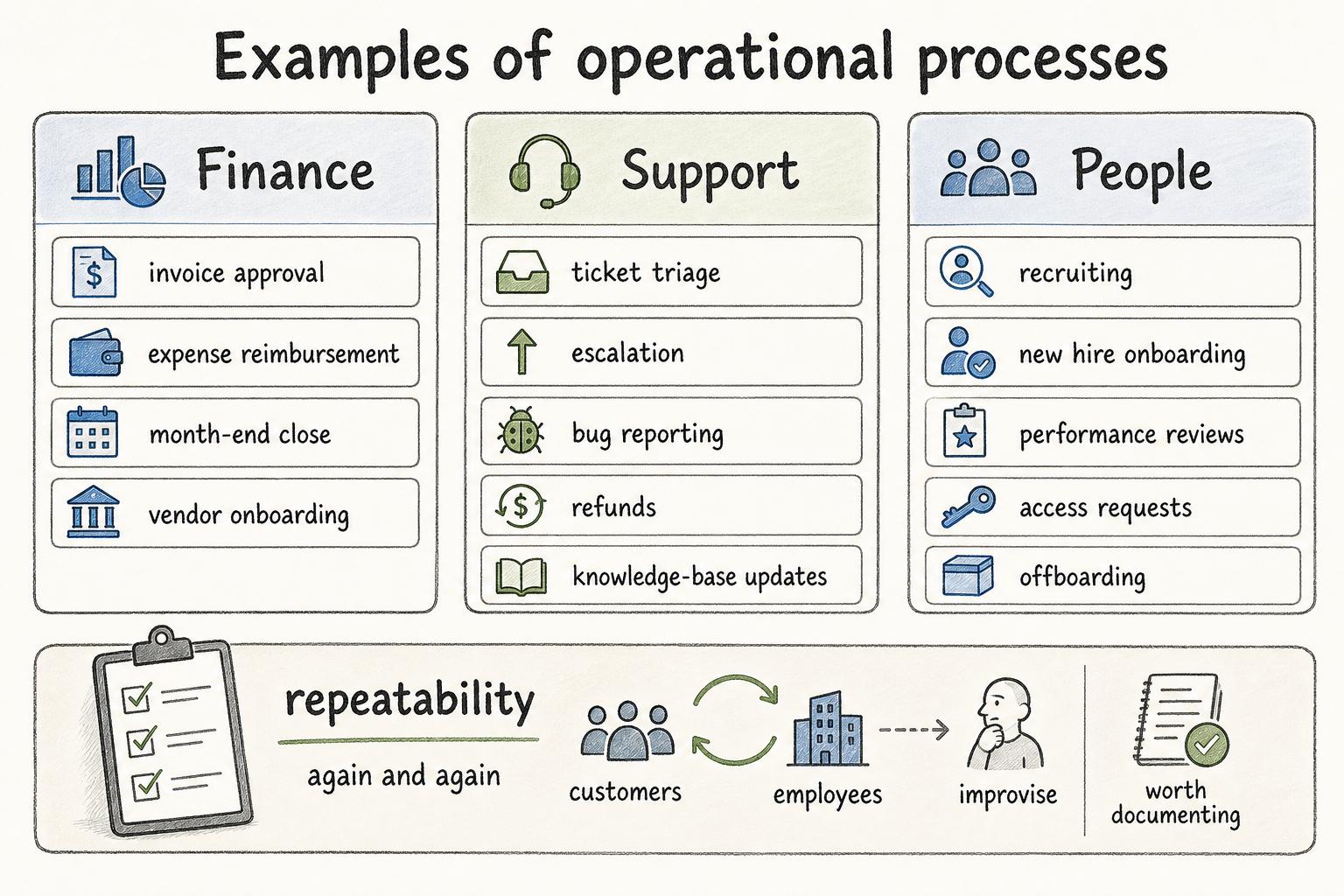
Operational processes appear in every function. Finance teams use them for invoice approval, expense reimbursement, month-end close, and vendor onboarding. Support teams use them for ticket triage, escalation, bug reporting, refunds, and knowledge-base updates. People teams use them for recruiting, new hire onboarding, performance reviews, access requests, and offboarding.
The best test is repeatability. If the same kind of work happens again and again, affects customers or employees, and gets worse when people improvise, it is probably an operational process worth documenting.
How to document an operational process
Start with the main path before chasing every exception. Teams often overcomplicate process documentation because they try to capture every edge case in the first draft. That creates a document nobody wants to use.
A practical first pass should capture the operating standard, not every possible variation:
- Trigger and expected outcome: what starts the process, and what done looks like
- Owner and participants: who is accountable, who contributes, and who approves
- Main path: the normal sequence of steps before exceptions enter the picture
- Handoffs and required inputs: what each role needs before work can move forward
- Tools and systems: where work happens and which records must stay current
- Exceptions and decisions: the few branches common enough to document upfront
- Metrics and linked SOPs: how the team knows the process is healthy, and where task-level instructions live
The non-obvious part is ownership. Documentation without an owner becomes a snapshot. A named process owner turns it into an operating asset that can be reviewed, corrected, and improved. NIST guidance on configuration management treats documented policy and procedures as part of implementation planning, a useful parallel for keeping operational standards controlled instead of informal.3
How operational processes break
Operational processes usually break in ordinary places. The trigger is unclear, so work starts late. A handoff has no owner, so the next person waits. A tool field is optional, so downstream teams receive incomplete information. A manager changes the workflow verbally, but the SOP and training guide stay old.
These failures are easy to dismiss as human error. Often they are design errors: the process does not make the right action easy enough, visible enough, or owned enough.
Good process documentation exposes that system. Once the steps, owners, handoffs, and standards are visible, the team can see where the work depends too much on memory or heroics.
Operational process documentation prompt
Use this prompt to create a useful first draft:
## Operational process documentation prompt

**Glossary term:** Operational Process
**Source:** Trails Glossary — trails.so/glossary/operational-process

---

### 01. Document an operational process

"Document the operational process for [workflow]. Include the trigger, expected outcome, process owner, participating roles, main steps, handoffs, tools, required inputs, decision points, common exceptions, quality checks, metrics, and related SOPs or work instructions. Separate the main path from edge cases, and flag any step where ownership is unclear."
The instruction to separate the main path from edge cases is important. If every possible variation gets equal weight, the process becomes harder to follow.
Documentation takeaway
An operational process is repeatable work that needs a reliable operating standard. The documentation should show how the process runs, who owns it, where it can break, and which deeper guides support the work.
Good documentation makes the real workflow visible enough that people can run it consistently and improve it deliberately.
How Trails helps
Trails helps teams capture operational processes as people perform them and turn those workflows into polished step-by-step guides. Those guides can support SOPs, onboarding, training, and process improvement, especially when teams need the documented process to match the actual work.
Sources
- 1
ISO. ISO 9001 Explained. www.iso.org/home/insights-news/resources/iso-9001-explained.html.
- 2
Microsoft. 2023 Work Trend Index Annual Report. assets.ctfassets.net/y8fb0rhks3b3/5eyZc6gDu1bzftdY6w3ZVV/beeb0f2e437044fc99a0408867a263d8/WTI_Annual_2023_Will_AI_Fix_Work_.pdf.
- 3
National Institute of Standards and Technology. NIST Special Publication 800-128. NIST. nvlpubs.nist.gov/nistpubs/SpecialPublications/NIST.SP.800-128.pdf.