
Glossary
Policy Manual
 ChatGPT
 Perplexity
 Gemini
 Claude
What is a policy manual?
A policy manual is a centralized collection of policies that define an organization's rules, standards, expectations, and responsibilities. It helps employees and managers understand what is required, who owns the rule, and where to find the related procedure when action is needed.
A useful policy manual works as a decision reference. It keeps standards clear while leaving task-level instructions to procedures, SOPs, and training materials.
What a policy manual is for
A policy manual gives people a consistent place to find the rules that govern work. It can cover employee conduct, security, privacy, expenses, travel, procurement, safety, records, customer commitments, approvals, and other standards that need consistent interpretation.
The manual matters most when decisions need to be fair, repeatable, and explainable. If every manager interprets remote work, customer refunds, expense approvals, or data access differently, the documentation gap has become an operating risk.
The manual reduces that risk by making the standard visible before someone has to guess during a busy or sensitive situation.
What belongs in a policy manual
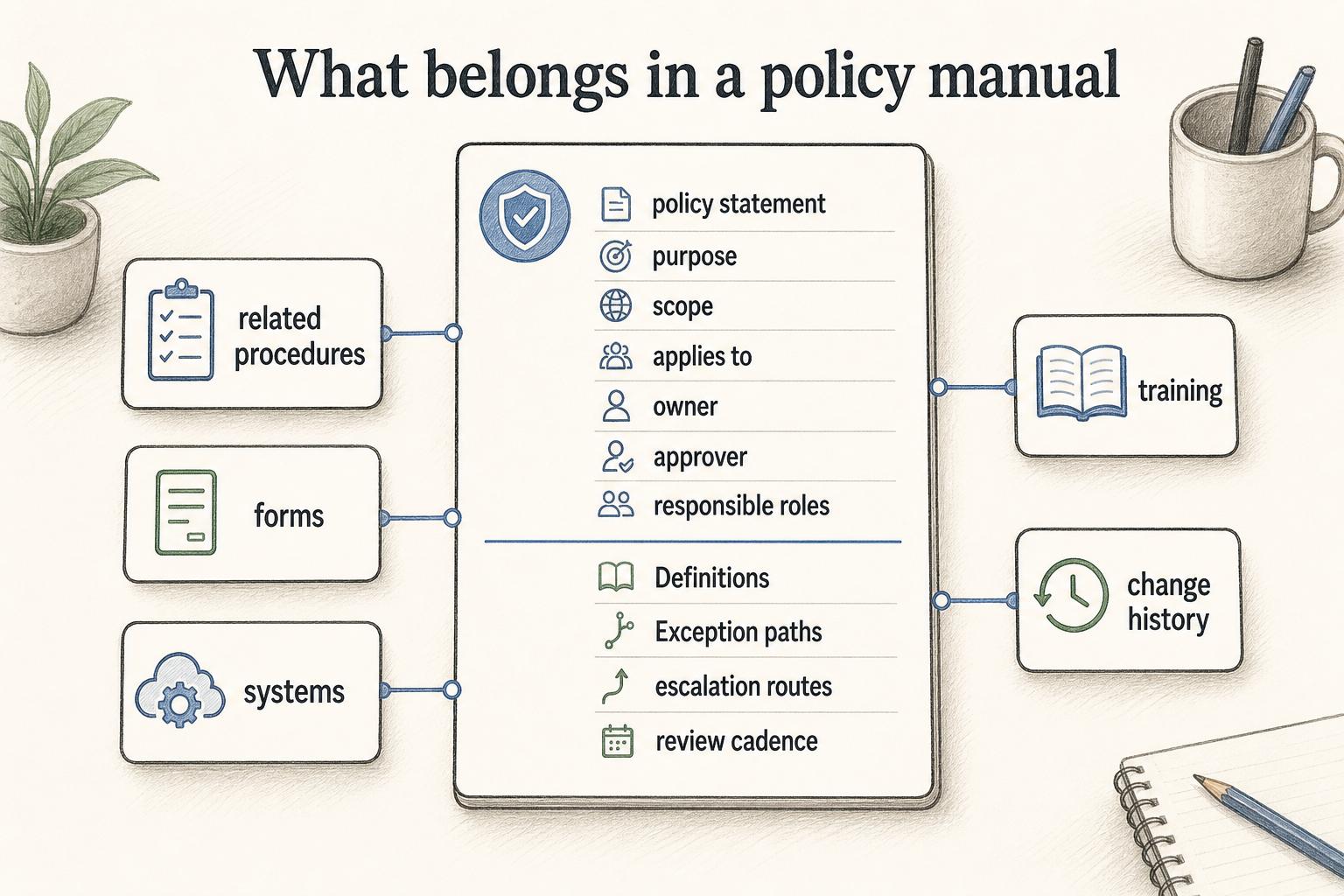
A useful policy manual includes enough context for someone to understand the rule and know what to do next. Most entries need:
- The policy statement, purpose, and scope
- Who the policy applies to
- The owner, approver, and responsible roles
- Definitions for terms that affect interpretation
- Exception paths, escalation routes, and review cadence
- Links to related procedures, forms, systems, training, and change history
The links matter. A policy manual should take employees directly to the procedure that makes the policy real. If a policy says expenses need receipts, link to the expense submission procedure. If a policy sets a data retention rule, link to the records management SOP.
Policy manual vs procedure manual
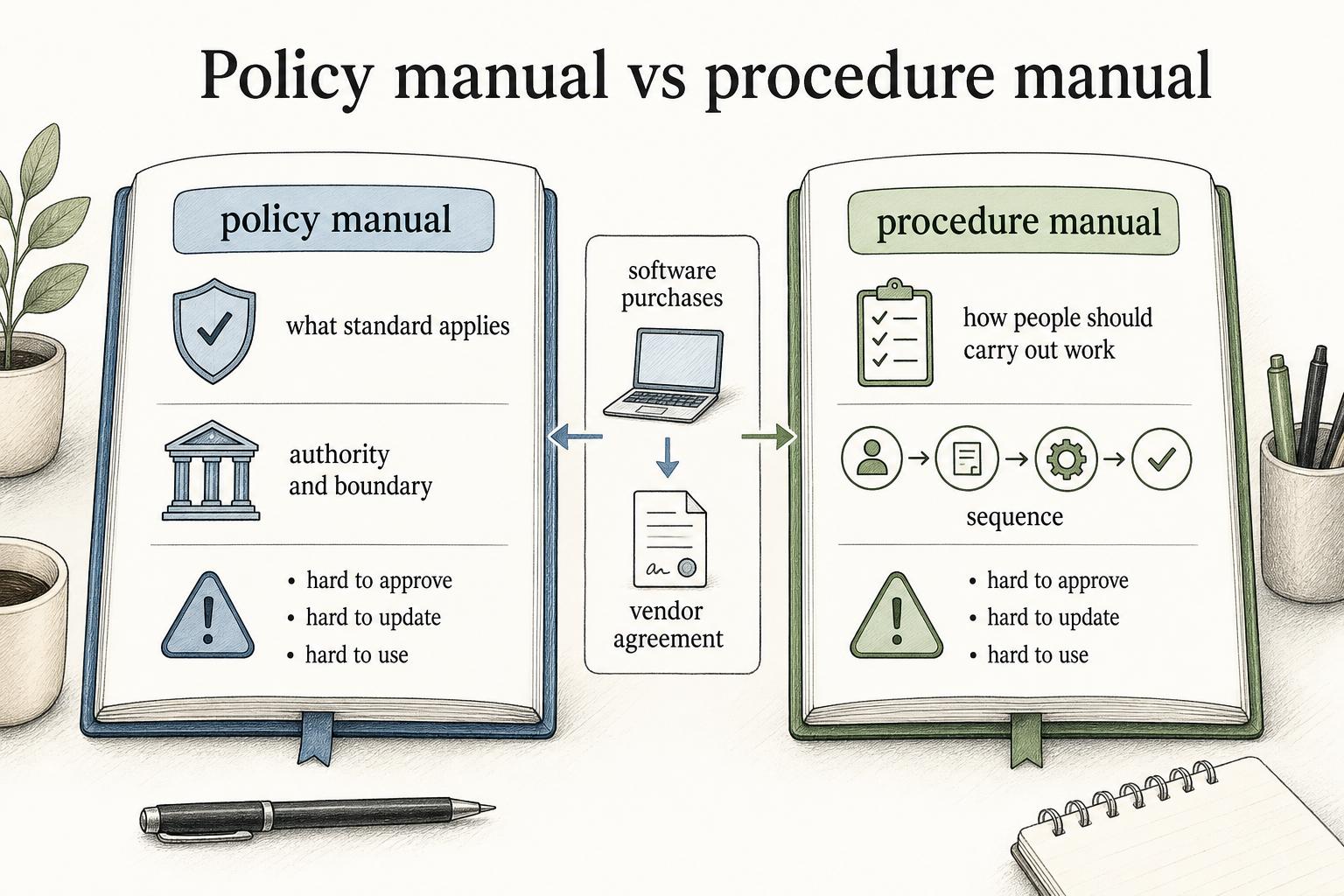
A policy manual explains what standard applies. A procedure manual explains how people should carry out work connected to that standard.
For example, a policy manual might say managers must approve software purchases before a team signs a vendor agreement. The procedure manual would explain how to submit the request, which information to include, who reviews security questions, where approval is recorded, and what happens after approval.
The policy gives the authority and boundary. The procedure gives the sequence. When teams merge them into one document, they often create a manual that is hard to approve, hard to update, and hard to use.
How to organize a policy manual
Organize the manual by the way employees and owners need to find decisions. Common categories include HR, finance, security, privacy, procurement, operations, customer commitments, safety, compliance, and records management.
Within each category, keep the entry structure consistent. A reader should not have to relearn the format on every page. A compact policy entry might look like this:
## Policy Manual Entry Template

**Glossary term:** Policy Manual
**Source:** Trails Glossary — trails.so/glossary/policy-manual

---

### 01. Document a policy entry

"Policy title: [name]
Owner: [person or team]
Approver: [role or group]
Effective date: [date]
Review cadence: [monthly, quarterly, annually, or event-based]
Applies to: [roles, teams, locations, or systems]
Purpose: [why the policy exists]
Policy statement: [the rule or standard]
Responsibilities: [who must do what]
Exceptions: [allowed exceptions and approval path]
Related procedures: [links to SOPs or guides]
Related forms, systems, or training: [links]
Change history: [major updates]"
The template is a guardrail against missing ownership, scope, exceptions, and downstream procedures. It does not mean every policy has to be long.
What makes a policy manual usable
The hardest part of a policy manual is making it trustworthy enough that people use it before they ask around.
Trust comes from practical signals: clear owners, visible review dates, linked procedures, archived old versions, and language direct enough that employees can understand the expectation without translation.
A policy manual also needs boundaries. Not every preference deserves a policy. If a rule changes often, applies to one small task, or exists only because of a temporary project, it may belong in an SOP, workflow note, or team guide instead. Too many low-value policies make the manual harder to govern.
Common mistakes
One mistake is writing policies for approval committees instead of readers. A policy can be formal without being foggy. If the language is so broad that every decision still requires interpretation, the manual has not done its job.
Another mistake is hiding procedures inside policy pages. That makes updates harder. The policy may need legal, executive, compliance, or leadership approval, while the procedure may need to change whenever a tool or workflow changes. Separating them keeps governance practical.
A third mistake is treating publication as completion. A policy manual begins to decay the moment work changes. New tools, new risks, new teams, and new customer promises can all make a policy unclear or incomplete.
How to maintain a policy manual
Assign an owner for the manual and an owner for each policy. The manual owner manages structure, publishing, and review rhythm. Policy owners keep their own policies accurate.
Maintenance should include checking whether policies still match current work, whether related procedures still reflect the policy, whether links and forms still work, and whether changes were communicated to affected teams. The manual should also preserve enough change history that people can understand what changed and when.
Use a simple maintenance rule: review policy when the standard changes, review procedure when the workflow changes, and review both when a change affects how employees act.
How Trails helps
Trails supports the procedure side of a policy manual. When a policy requires a repeatable action, Trails can capture the workflow as someone performs it and turn it into a polished step-by-step guide. Trails can also create an AI-narrated video version for training or sharing.
That helps teams connect policy standards to practical execution without stuffing step-by-step instructions into the policy manual itself.
FAQ
Is a policy manual legally required?
Requirements vary by organization, industry, location, and policy area. Many teams maintain policy manuals because they need consistent expectations and governance, but legal requirements should be reviewed with qualified counsel for the specific situation.
Who should own a policy manual?
Ownership often sits with HR, operations, compliance, legal, security, or an executive function, depending on the manual's scope. Individual policies should also have named owners who understand the subject area.
How is a policy manual different from an employee handbook?
An employee handbook is usually a broad employee-facing guide to workplace expectations and benefits. A policy manual may be broader, more detailed, or more governance-focused, and it may include policies used by managers, compliance teams, or process owners.