
Glossary
Skills Training
 ChatGPT
 Perplexity
 Gemini
 Claude
What is skills training?
Skills training is structured learning that helps someone build, practice, and apply a specific capability. In the workplace, it helps employees perform tasks, use tools, make decisions, communicate clearly, or improve in a defined role.
The useful test is application. A strong program gives people practice, feedback, and a way to show they can use the skill in real work. CDC training-evaluation guidance defines training effectiveness in terms of competence, capacity, performance, and workplace transfer.1
What skills training includes
Skills training can cover technical skills, process skills, role-specific skills, communication skills, leadership skills, customer-facing skills, or operational judgment.
Examples include teaching a support agent to diagnose billing issues, training a warehouse employee to inspect incoming inventory, helping a manager run effective one-on-ones, showing a marketer how to schedule campaigns, or coaching an operations analyst to map a process.
The best skills training starts with the work someone must do, not the course title. If the training cannot answer "what should the learner be able to do afterward?" it is probably too vague. CDC's Quality Training Standards emphasize learning objectives, engagement, assessment, and follow-up support.2
Skills training vs. knowledge training
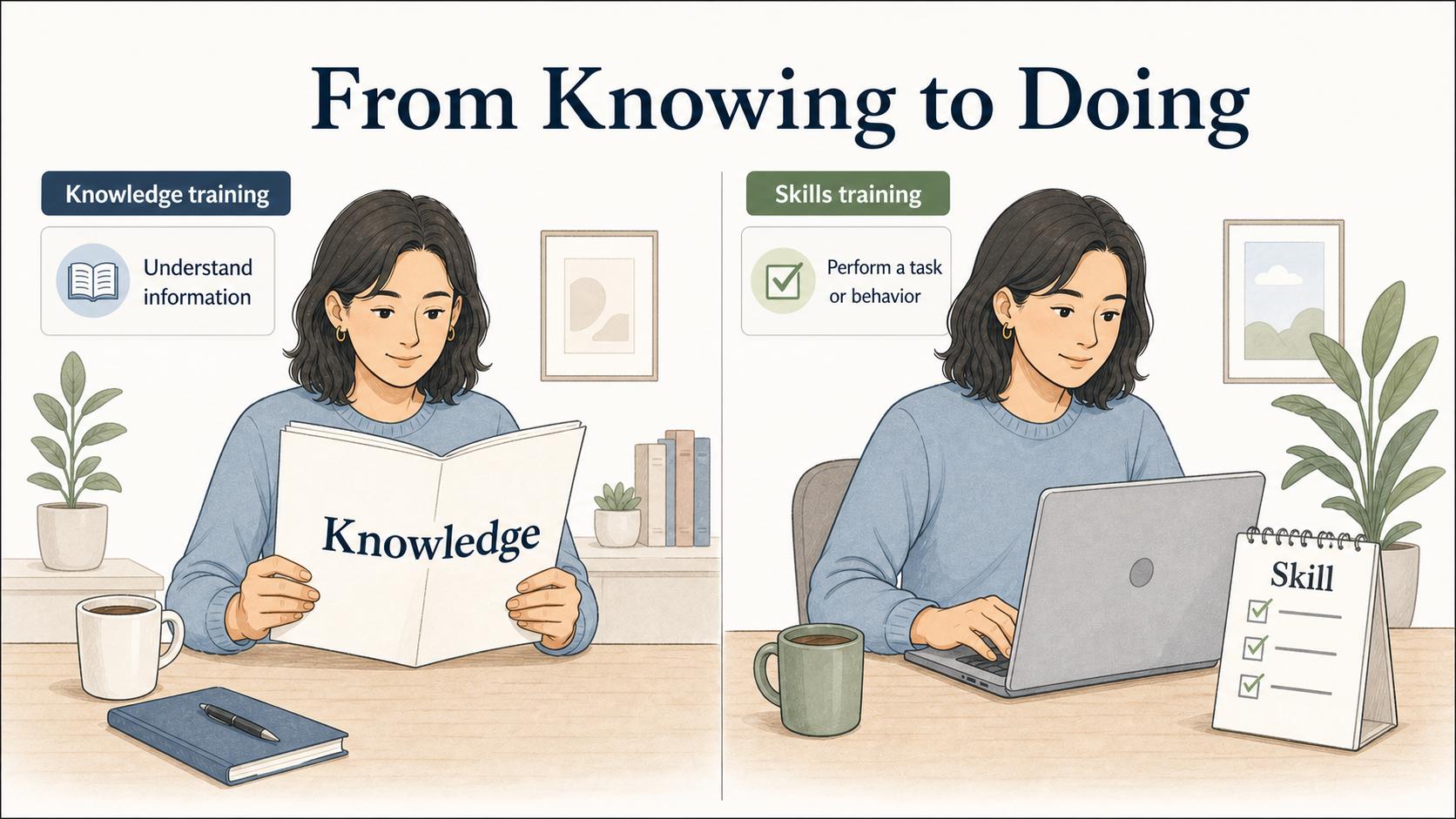
Knowledge matters, but it is not the same as skill. Knowing a refund policy is different from handling a frustrated customer. Knowing a CRM exists is different from updating the right fields under time pressure.
| Training type | Main goal | Example |
|---|---|---|
| Knowledge training | Help someone understand information | Explain the refund policy |
| Skills training | Help someone perform a task or behavior | Practice handling a refund request in the CRM |
| Compliance training | Confirm awareness of required rules | Complete annual data privacy training |
| Performance support | Help someone at the moment of work | Use a job aid while processing a refund |
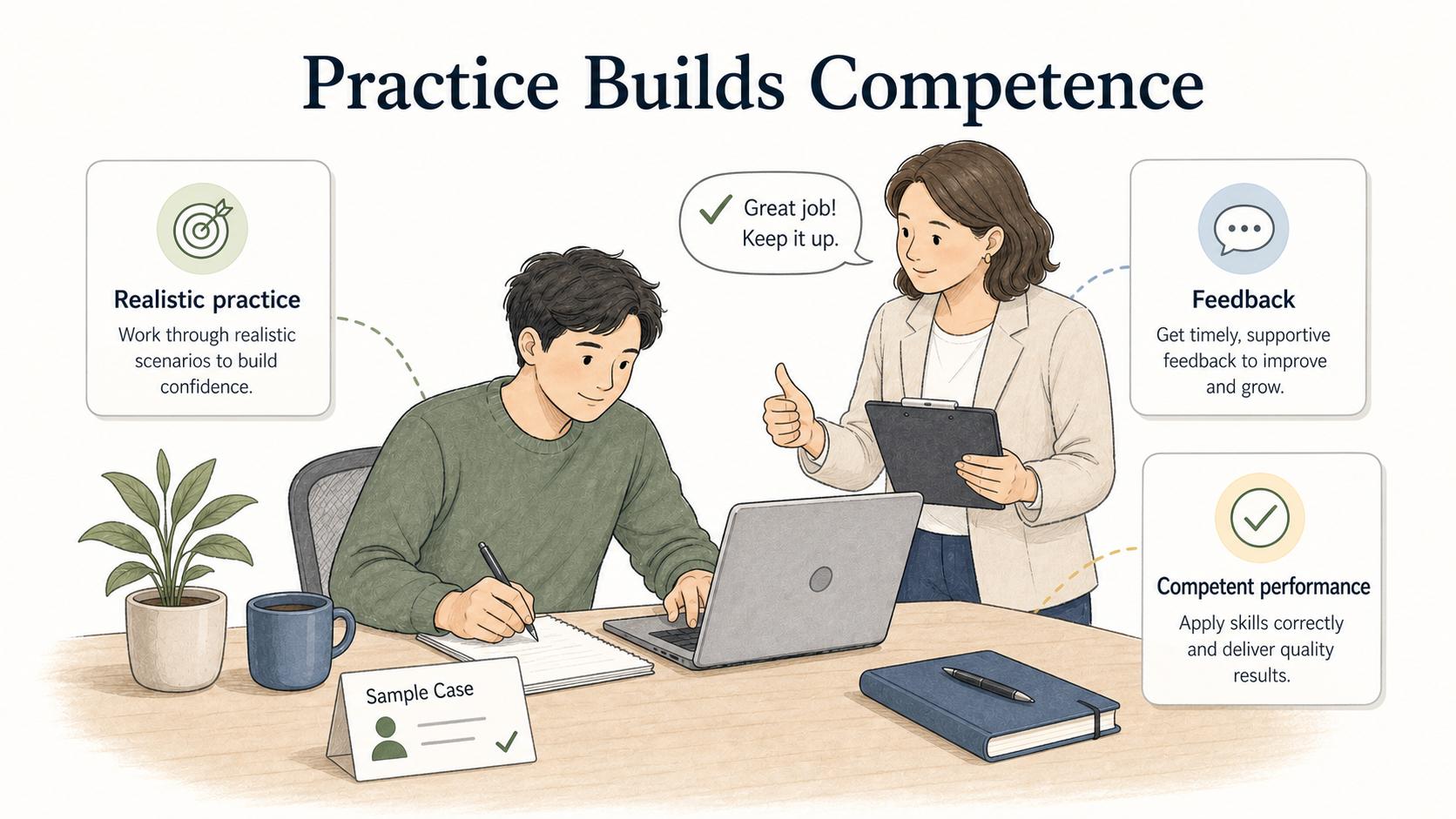
Most workplace training needs a mix: background knowledge, a clear process, realistic practice, feedback, and a reference learners can use later.
How to design effective skills training
Start by defining the skill in observable terms. Improve customer service is too broad. Resolve a standard refund request without manager help is much clearer.
A practical skills training plan should answer six questions:
- What specific task, behavior, or decision should the learner be able to perform?
- Who is the training for, and what do they already know?
- What approved process, standard, or quality bar should the training follow?
- What realistic scenario will let the learner practice the skill?
- Who gives feedback, and what counts as competent performance?
- What job aid, SOP, checklist, guide, or follow-up support will help the skill stick?
The success criteria are especially important. Without them, training completion becomes a weak substitute for competence. NIST's Training Within Industry job-instruction model includes preparing the worker, demonstrating the job, letting the trainee try the task, and following up until the worker can perform independently.3 A person can attend a session and still be unable to perform the skill reliably.
Example: skills training for a support workflow
Imagine a support team wants to train new agents on refund requests. A weak plan says, "Read the refund policy and shadow a senior agent." A stronger plan breaks the skill into work the learner can practice:
- Identify the customer's request type.
- Check eligibility in the account record.
- Apply the refund decision rule.
- Ask for manager approval when required.
- Process the refund in the payment system.
- Update the ticket and CRM.
- Send the customer the approved response.
The learner practices with sample cases, gets feedback, and uses a checklist during live work. That is skills training because it connects knowledge, practice, documentation, and performance.
AI prompt for a skills training plan
Use this prompt to create a practical skills training plan:
## Skills Training Plan Prompt

**Glossary term:** Skills Training
**Source:** Trails Glossary — trails.so/glossary/skills-training

---

### 01. Create a skills training plan

"Create a skills training plan for [role/team].

Target skill: [specific task or behavior]
Learner level: [new hire, experienced employee, manager, cross-trained teammate]
Work context: [tools, systems, customers, constraints]
Business risk if done poorly: [quality, cost, safety, compliance, customer experience]

Include:
- Observable training objective
- Prerequisites
- Short teaching sequence
- Realistic practice scenario
- Feedback method
- Competence checklist
- Reference materials needed
- Follow-up or refresher plan"
Review the plan with the person who owns the work. AI can structure the training, but the team still needs to verify the real steps, examples, and quality standard.
Common mistakes
The most common mistake is treating skills training like content delivery. Watching a video or reading a guide may help, but it does not prove the learner can perform the skill. Build in practice and feedback.
Another mistake is training too broadly. A skill should be specific enough to observe. "Use the CRM" is broad. "Create a new account, assign the correct owner, and add required onboarding fields" is teachable.
A third mistake is hiding the reference material. People forget details after training. Skills training should connect to job aids, SOPs, checklists, or step-by-step guides that support performance after the session ends. CDC's Quality Training Developer Checklist explicitly calls for follow-up evaluation after learners have had time to apply what they learned.4
How Trails helps
Trails helps teams capture real workflows, turn them into step-by-step guides, and create AI-narrated video versions for training. That makes it easier to build skills training around the actual work employees need to perform, not a generic course outline.
- Process training
- Training assessment
- New hire training
- Competency based training
- SOP training
- Learning path
- Training transfer
Sources
- 1
Centers for Disease Control and Prevention. Evaluate Training: Measuring Effectiveness. CDC. www.cdc.gov/training-development/php/about/evaluate-training-measuring-effectiveness.html. Accessed July 7, 2026.
- 2
Centers for Disease Control and Prevention. Quality Training Standards. CDC. www.cdc.gov/training-development/php/qts/index.html. Accessed July 7, 2026.
- 3
National Institute of Standards and Technology. Training Within Industry. NIST MEP. www.nist.gov/mep/training-within-industry-twi. Accessed July 7, 2026.
- 4
Centers for Disease Control and Prevention. CDC Quality Training Developer Checklist. CDC. www.cdc.gov/training-development/media/pdfs/2025/06/330094-F_FS_QTSChecklistUPDATE-508_pass.pdf. Accessed July 7, 2026.