
Glossary
Sales SOP
 ChatGPT
 Perplexity
 Gemini
 Claude
What is a sales SOP?
A sales SOP is a standard operating procedure for a repeatable sales workflow. It explains how a sales task should be performed, who owns each step, which tools or templates to use, what information must be captured, and what outcome should exist before the work moves forward.
Sales SOPs are useful for lead routing, qualification, discovery preparation, CRM updates, proposal creation, discount approvals, contract handoffs, renewals, and sales-to-customer-success transitions. A good sales SOP does not script every human conversation. It standardizes the parts of selling that need consistency so reps, managers, and downstream teams are not relying on memory.
Why sales SOPs matter
Sales work often looks flexible from the outside, but many parts of it are operational. Leads need to be assigned. CRM fields need to be complete. Follow-ups need timing. Discount requests need approval. Closed-won deals need clean handoffs.
When those tasks are undocumented, every rep builds a private version of the process. That can create uneven customer experiences, messy pipeline data, missed handoffs, and avoidable manager follow-up. The cited Gartner analysis points to CRM adoption, discipline, and data governance as factors in forecast quality, which is why operating standards around CRM updates matter.1
The tradeoff is real: too little structure creates inconsistency, but too much structure flattens good sales judgment. The best sales SOPs standardize the workflow, not the rep's personality.
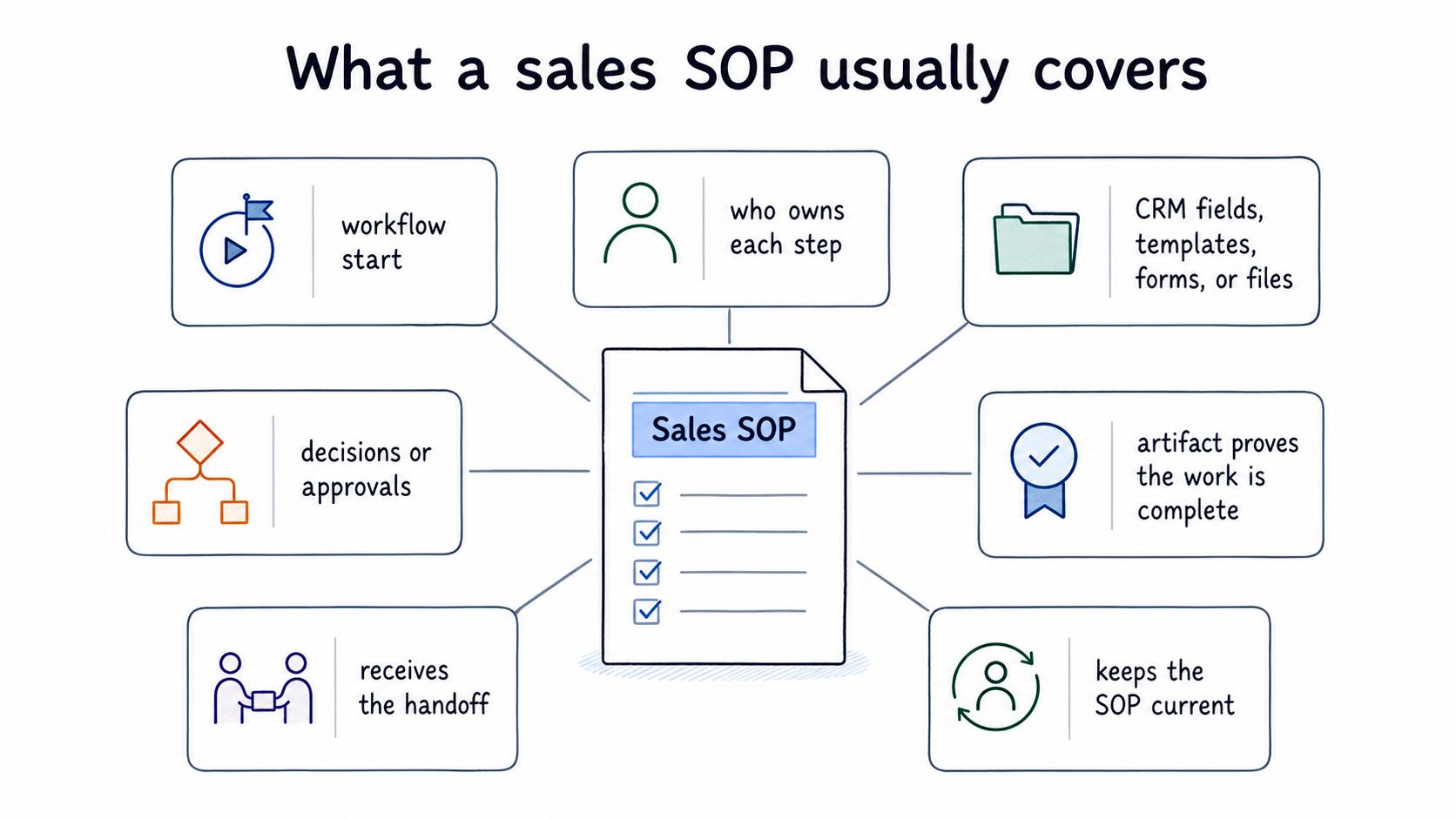
What a sales SOP usually covers
A useful sales SOP is specific enough that a new team member can complete the workflow without guessing, but focused enough that an experienced rep will still use it.
At minimum, it should answer:
- When does this workflow start?
- Who owns each step?
- Which CRM fields, templates, forms, or files are required?
- What decisions or approvals change the path?
- What artifact proves the work is complete?
- Who receives the handoff, and what do they need?
- Who keeps the SOP current?
For example, a lead routing SOP might define how inbound demo requests are assigned, what makes a lead sales qualified, which CRM fields must be complete, how quickly a rep should respond, and what to do when the lead is outside the ideal customer profile.
Sales SOP examples
Sales SOPs work best for workflows that repeat often, affect revenue, or create downstream confusion when handled inconsistently.
Useful examples include:
- Inbound lead routing SOP
- Outbound prospecting setup SOP
- Discovery call preparation SOP
- CRM stage update SOP
- Proposal creation SOP
- Discount approval SOP
- Contract review handoff SOP
- Closed-won handoff SOP
- Renewal preparation SOP
- Lost deal review SOP
Not every sales task needs a formal SOP. A one-off strategic account plan, a unique enterprise negotiation, or a coaching conversation may need a playbook or manager guidance instead. A workflow usually deserves an SOP when multiple people perform it, the steps are repeatable, and mistakes create rework. CSO Insights research has linked more formal sales process maturity with stronger sales performance, which supports documenting repeatable revenue workflows instead of leaving them informal.2
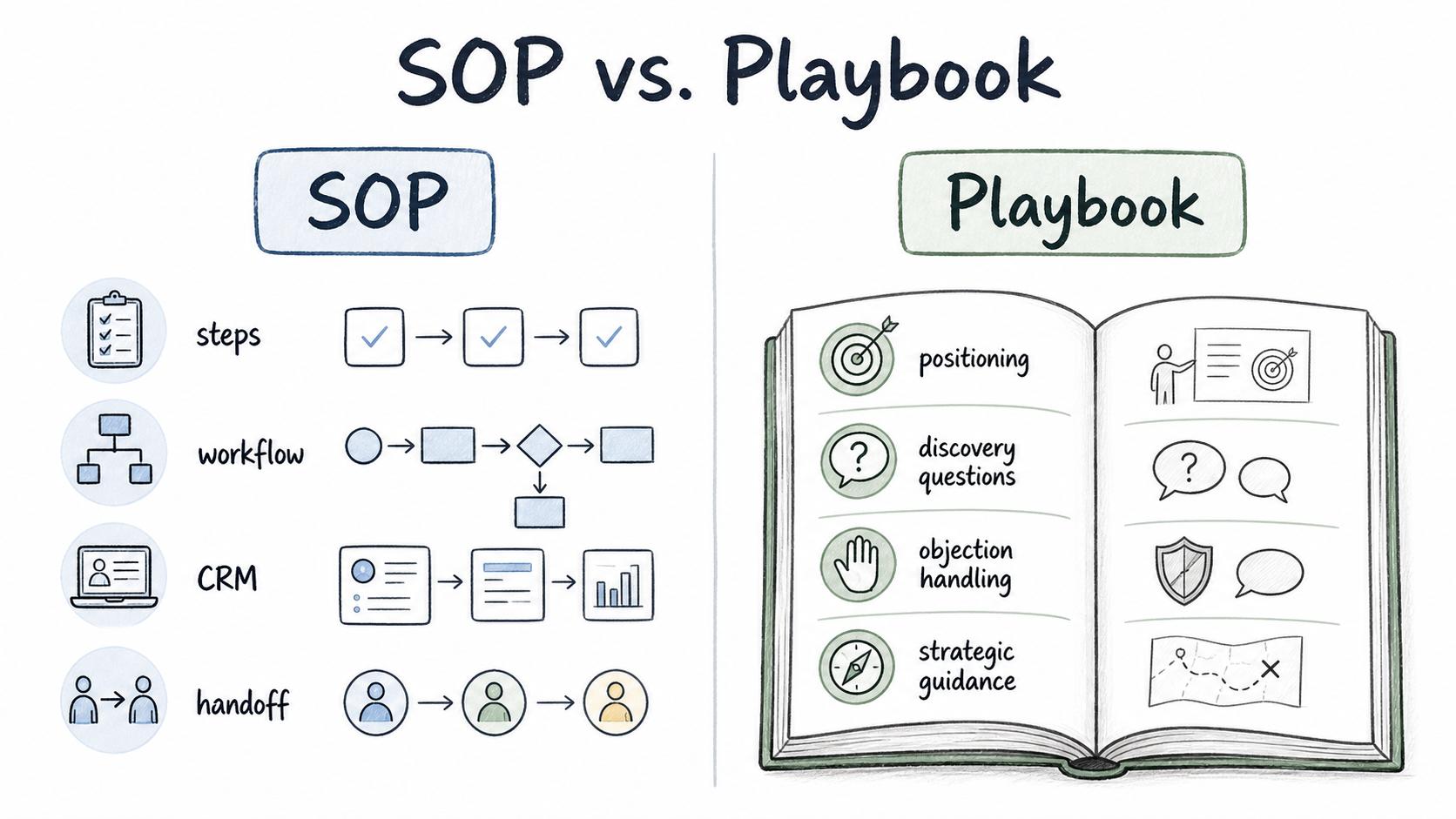
Sales SOP vs. sales playbook
A sales SOP and a sales playbook are related, but they solve different problems.
A sales SOP tells the team how to complete a repeatable operational workflow. It should be procedural and specific. Example: how to move an opportunity from verbal commit to contract review.
A sales playbook helps the team make better selling decisions. It can include positioning, discovery questions, objection handling, persona guidance, competitive notes, and examples. It is more strategic and judgment-heavy.
A simple rule: if the document tells someone which steps to take in a workflow, it is probably an SOP. If it helps someone decide what to say or how to think in a selling moment, it is probably a playbook.
How to write a useful sales SOP
Start with one workflow. Do not try to document the entire sales process in one pass. Pick a workflow where inconsistency is already causing pain: messy CRM updates, late follow-up, unclear handoffs, or approval bottlenecks.
Watch how the work actually happens. Talk to reps, the sales operations lead, the manager, and the team that receives the output. The best SOP is rarely a policy imagined from a blank page. It is the real workflow cleaned up enough that it can be repeated.
## Sales SOP Template

**Glossary term:** Sales SOP
**Source:** Trails Glossary — trails.so/glossary/sales-sop

---

### 01. Document one sales workflow

"Create a sales SOP for the workflow below.

Workflow: [name]
Purpose: [why this process exists]
Applies when: [trigger or condition]
Does not apply when: [important exceptions]
Owner: [role accountable for keeping the SOP current]
Participants: [roles involved]
Tools: [CRM, forms, templates, calendars, call tools]
Inputs: [information needed before starting]
Steps: [ordered procedure]
Required fields or artifacts: [what must be captured]
Exceptions: [what to do when the standard path breaks]
Final check: [how to know the workflow is complete]
Review cadence: [when this SOP should be reviewed]"
The strongest sales SOPs name the exact artifact that proves the work happened: a completed CRM field, a linked proposal, a signed approval, a recorded handoff note, or a scheduled next step. Salesforce's 2026 State of Sales report highlights data accuracy and sales planning efficiency as benefits sales teams expect from better sales systems, which makes field-level standards a practical SOP concern.3
Common mistakes
One common mistake is writing a sales SOP that states a value but not an action. "Follow up quickly" is a principle. "Send the first follow-up within two business hours and log the next step in the CRM before moving the opportunity stage" is an operating standard.
Another mistake is over-scripting the parts of sales that need judgment. Discovery, negotiation, and relationship-building need guidance, examples, and coaching. They usually should not be reduced to a rigid procedure unless there is a compliance reason.
A third mistake is forgetting the handoff. Sales SOPs often fail at the boundary between sales and customer success, finance, legal, or implementation. If another team depends on the output, the SOP should define what that team needs before the work is considered done.
How Trails helps
Trails helps teams capture workflows as they happen and turn them into polished step-by-step guides. For a sales SOP, that can mean documenting the exact CRM path, screenshots, fields, templates, and handoff expectations that make a sales workflow repeatable without asking every rep to reconstruct the process from memory.
Explore sales enablement with Trails for turning CRM procedures and rep handoffs into guides the team can reuse.
Sources
- 1
Gartner. 3 Common Data Quality Challenges Undermine Sales Forecast Accuracy. Sales & Marketing Management. salesandmarketing.com/3-common-data-quality-challenges-undermine-sales-forecast-accuracy/. Accessed July 9, 2026.
- 2
CSO Insights. 2019 Sales Enablement Report. Highspot Community. community.highspot.com/assets/2019/10/CSO-Insights-5th-Annual-Sales-Enablement-Study.pdf. Accessed July 9, 2026.
- 3
Salesforce. State of Sales, 7th Edition. Salesforce, 2026. www.salesforce.com/en-us/wp-content/uploads/sites/4/documents/reports/sales/salesforce-state-of-sales-report-2026.pdf. Accessed July 9, 2026.