
Glossary
Manufacturing SOP
 ChatGPT
 Perplexity
 Gemini
 Claude
What is a manufacturing SOP?
A manufacturing SOP is a standard operating procedure that explains how a repeatable manufacturing process should be performed. It documents approved steps, roles, equipment, materials, safety precautions, quality checks, records, and escalation rules for production work.1
The job is consistency under real floor conditions. A manufacturing SOP gives operators, supervisors, quality teams, trainers, and backup staff a shared standard so the process doesn't depend on memory, informal habits, or whoever happens to be on shift.
Why manufacturing SOPs matter
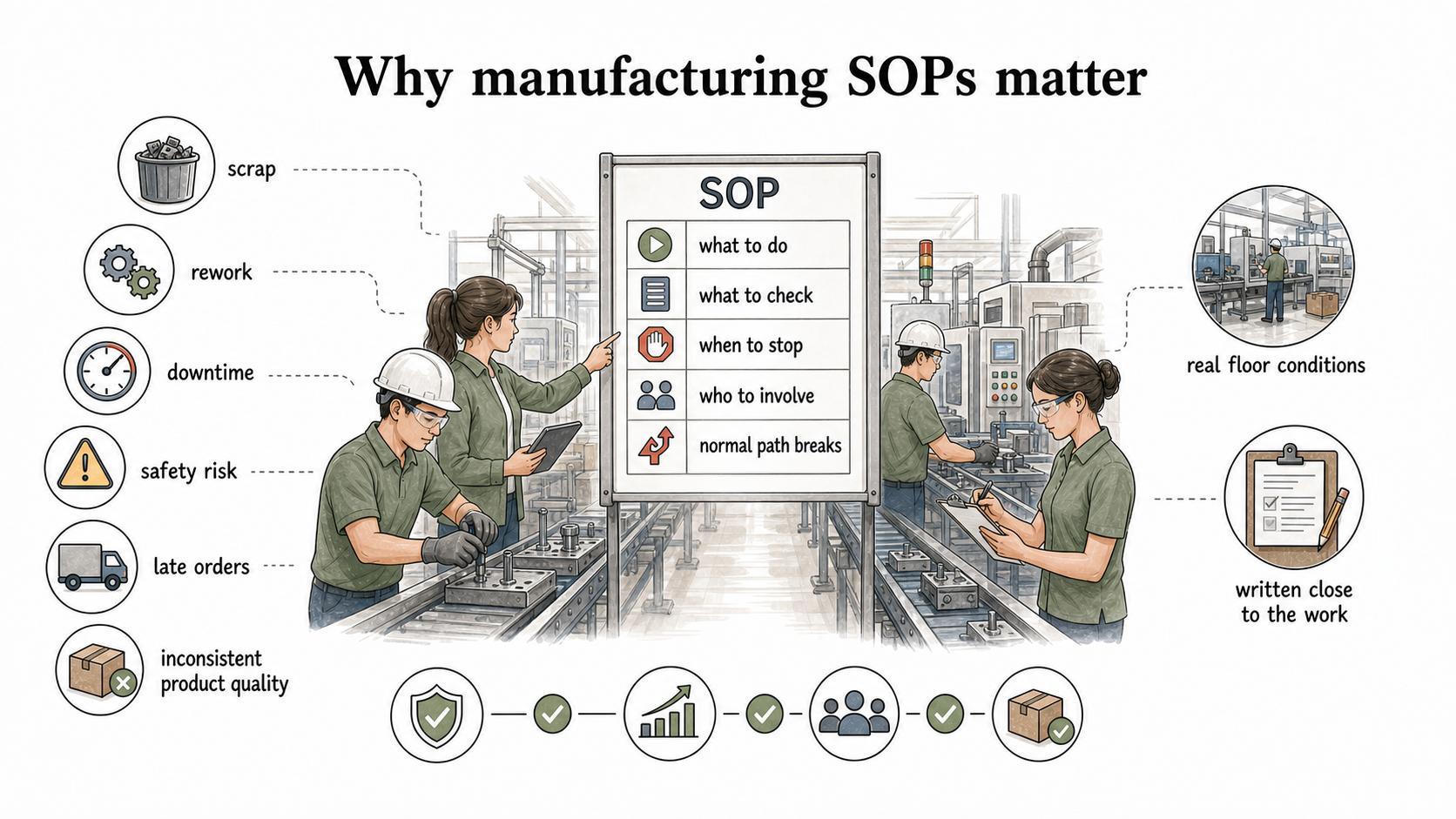
Manufacturing work has little patience for vague documentation. If a step is skipped, a measurement is unclear, or an inspection point is missing, the result can show up as scrap, rework, downtime, safety risk, late orders, or inconsistent product quality.
A manufacturing SOP makes the current standard visible. It tells the team what to do, what to check, when to stop, and who to involve when the normal path breaks.
The strongest SOPs are written close to the work. They reflect the actual process on the floor, not an idealized version created for a binder.
What a manufacturing SOP should include
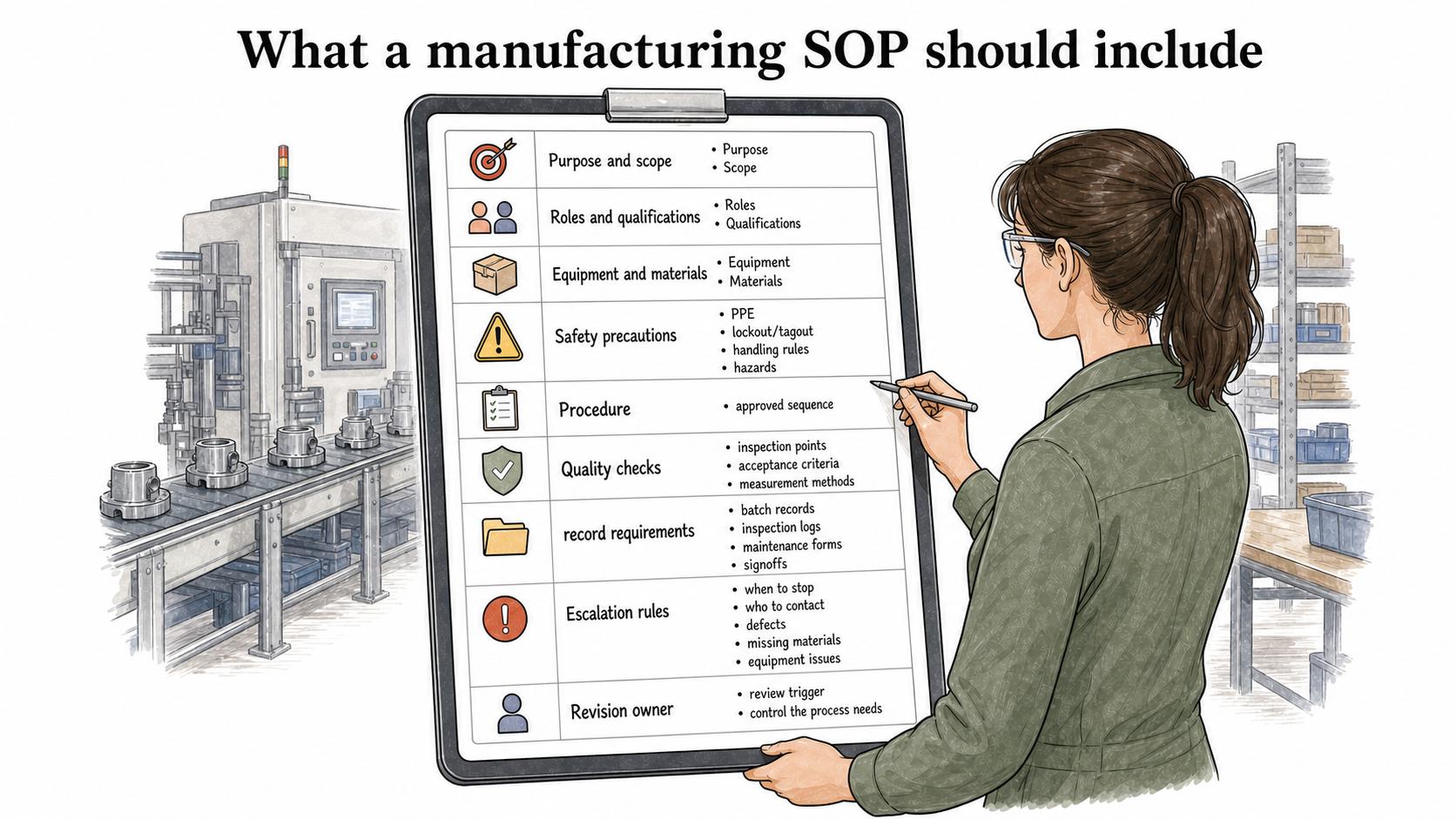
A practical manufacturing SOP usually includes:
- Purpose and scope: What process the SOP covers and when it applies.
- Roles and qualifications: Who can perform the work and who approves exceptions.
- Equipment and materials: Machines, tools, parts, supplies, software, and forms needed.
- Safety precautions: Required PPE, lockout/tagout references, handling rules, and hazards to watch when machinery or hazardous energy is involved.2
- Procedure: The approved sequence of work, written in the order operators perform it.
- Quality checks: Inspection points, acceptance criteria, measurement methods, and record requirements.
- Escalation rules: When to stop, who to contact, and how to handle defects, missing materials, or equipment issues.
- Records: Batch records, inspection logs, maintenance forms, signoffs, or digital entries.
- Revision owner: Who maintains the SOP and what events trigger review.
The detail should match how much control the process needs.3 A safety-critical or quality-critical procedure needs more precision than a low-risk internal handoff.
Manufacturing SOP vs work instruction vs standard work
These documents are related, but they guide different levels of work.
| Document | Best use | Practical difference |
|---|---|---|
| Manufacturing SOP | Defines the standard process for a manufacturing workflow | Explains the approved procedure, responsibilities, checks, and records |
| Work instruction | Explains a specific task at the point of use | Often more visual, detailed, and station-specific |
| Standard work | Captures the best-known method for consistent execution and improvement | Often used in lean environments to stabilize and improve work |
A manufacturing SOP may link to several work instructions. A line changeover SOP might define the overall changeover process, while separate work instructions show how to clean a component, verify a setting, or inspect the first unit.
Examples of manufacturing SOPs
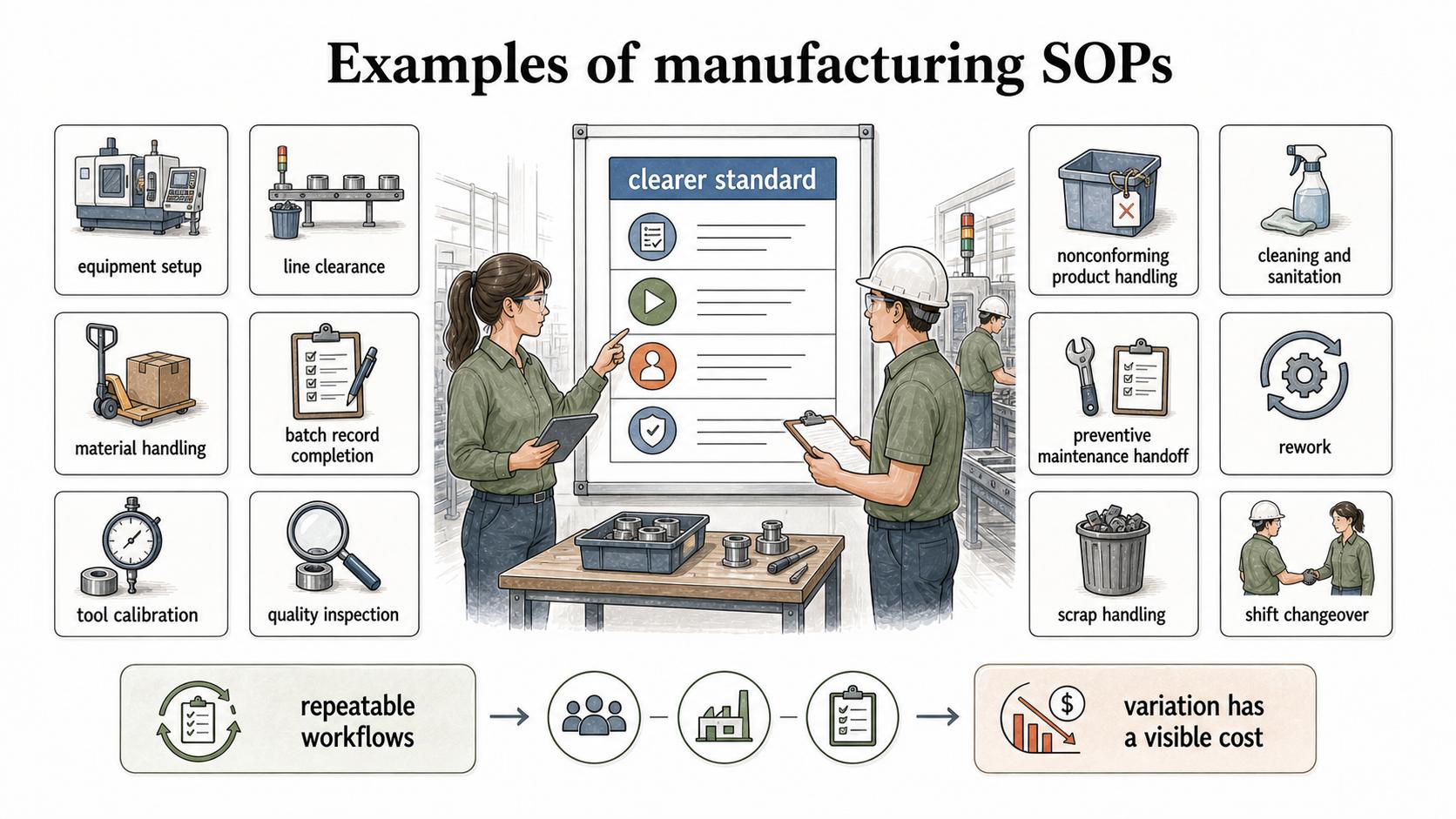
Common manufacturing SOPs cover repeatable workflows such as equipment setup, line clearance, material handling, batch record completion, tool calibration, quality inspection, nonconforming product handling, cleaning and sanitation, preventive maintenance handoff, rework, scrap handling, and shift changeover.4
The best candidates are workflows where variation has a visible cost. If different operators perform the same work in different ways and the outcome changes, the process probably needs a clearer standard.
Common mistakes
The first mistake is writing for auditors instead of operators. A document can look complete and still be useless at the point of work. Operators need sequence, clarity, examples, and decision rules they can apply in real conditions.
The second mistake is hiding judgment. If the operator must decide whether a measurement is acceptable, whether a part should be rejected, or whether a supervisor needs to be called, the SOP should make that decision rule explicit.
The third mistake is letting the SOP drift after a process improvement. Manufacturing teams often improve the work before they update the documentation. That creates a quiet training problem: new people learn from the document, experienced people learn from habit, and the standard splits in two.
How to keep a manufacturing SOP current
A manufacturing SOP should be reviewed when the work changes, not only on a calendar. Good review triggers include a defect, near miss, equipment change, material change, audit finding, new inspection point, repeated operator question, updated quality requirement, or process improvement event.
The practical rule is direct: if the approved way of working changes, the SOP should change with it. Otherwise, the document becomes a record of what the process used to be.
How Trails helps
Trails helps teams capture real workflows as someone performs them and turn those workflows into polished step-by-step guides. Those guides can include screenshots and can be converted into AI-narrated videos for training or sharing.
For manufacturing teams, that is useful when knowledge lives with experienced operators or supervisors. Capturing the actual process makes it easier to train across shifts, document handoffs, and keep procedures aligned with the way work is really done.
Sources
- 1
eCFR. 21 CFR Part 211. U.S. Government Publishing Office. www.ecfr.gov/current/title-21/chapter-I/subchapter-C/part-211. Accessed July 24, 2026.
- 2
Occupational Safety and Health Administration. Control of Hazardous Energy (Lockout/Tagout). U.S. Department of Labor. www.osha.gov/control-hazardous-energy. Accessed July 24, 2026.
- 3
International Organization for Standardization. Guidance on the requirements for documented information of ISO 9001:2015. International Organization for Standardization. www.iso.org/iso/documented_information.pdf. Accessed July 24, 2026.
- 4
National Institute of Standards and Technology. Standard Operating Procedures. National Institute of Standards and Technology. www.nist.gov/pml/owm/laboratory-metrology/documentary-standards-and-resources/sops. Accessed July 24, 2026.